Showing posts with label United States. Show all posts

27 February, 2020

We’re All on This Sick Planet Together

Tuesday, the Centers for Disease Control warned that the United States should brace itself for a widespread outbreak of the novel coronavirus, known as COVID-19. “It’s not so much of a question of if this will happen anymore but rather more of a question of exactly when this will happen,” National Center for Immunization and Respiratory Diseases Director Dr. Nancy Messonnier told reporters yesterday. “We are asking the American public to prepare for the expectation that this might be bad.” Wall Street was responsive, and the Dow Jones Industrial Average had tumbled nearly 900 points by the end of the day.
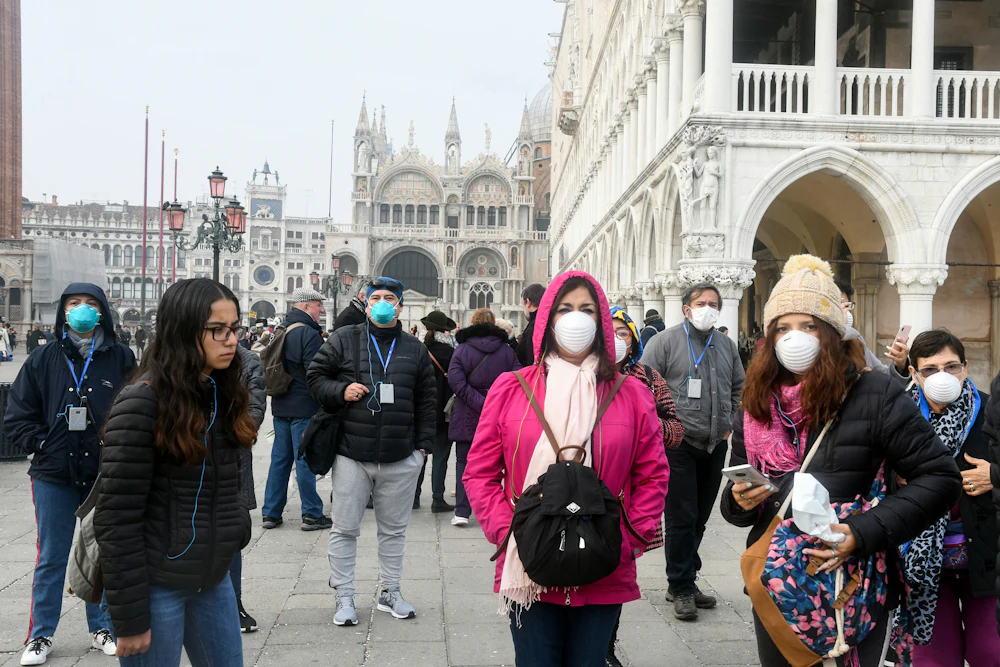
Tourists in the sinking city of Venice wear masks against the coronavirus. 
Exploiting crisis is a common move in politics, especially on the right. And in reactions to the current coronavirus outbreak worldwide, there’s already a pattern emerging. French National Rally party head Marine Le Pen and the League Party’s Matteo Salvini, of Italy—right-wing opposition leaders polling well against their countries’ centrist governments—have begun using the coronavirus’s spread as a platform to advocate long-held closed-border policies they hope will endear them to panicked voters. In Italy, where there are now well over 200 confirmed cases, Salvini called to “make our borders armor-plated” and criticized the government for allowing an NGO rescue ship with 276 African migrants aboard to dock; of the two confirmed cases in Africa, one came from an Italian who flew to Algeria. There are now two confirmed cases in France, where Le Pen urges suspending Europe’s Schengen Zone, which allows free passage within the customs union. 


Read the story from The New Republic by Kate Aronoff - “We’re All on This Sick Planet Together.”

04 February, 2020

It is time to change the definition of refugee

Despite recent and increasing efforts by the United States and other governments to narrow their interpretations of the refugee definition and to shirk their protection responsibilities, the need to expand the grounds for asylum is becoming increasingly urgent as the consequences of climate change become more pronounced. 
With surrounding sea levels rising, it is estimated the island nation of Kiribati will likely become uninhabitable in 10-15 years [File: Reuters/David Gray]
With surrounding sea levels rising, it is estimated the island
nation of Kiribati will likely become uninhabitable in 10-15 years.
A desperate appeal for asylum by a family from a Pacific island may have far-reaching implications for protecting people forcibly displaced by the effects of climate change. It could cause countries around the world to reconsider their laws and policies concerning refugees.
The case involves the Teitiota family, who fled the island of Tarawa in the Republic of Kiribati in 2007 and sought asylum in New Zealand in 2013. Ms Teitiota told the New Zealand court that she feared for her children's health and wellbeing, that crops and coconut trees on the island were dying.

Read the story from Al Jazeera by Bill Frelick - “It is time to change the definition of refugee.”

16 December, 2019

U.N. Climate Talks End With Few Commitments and a ‘Lost’ Opportunity

In what was widely denounced as one of the worst outcomes in a quarter-century of climate negotiations, United Nations talks ended early Sunday morning with the United States and other big polluters blocking even a nonbinding measure that would have encouraged countries to adopt more ambitious targets for reducing greenhouse gas emissions next year. 
Because the United States is withdrawing from the Paris climate agreement, it was the last chance, at least for some time, for American delegates to sit at the negotiating table at the annual talks — and perhaps a turning point in global climate negotiations, given the influence that Washington has long wielded, for better or worse, in the discussions.
The Trump administration used the meeting to push back on a range of proposals, including a mechanism to compensate developing countries for losses that were the result of more intense storms, droughts, rising seas and other effects of global warming.

Read the story from The New York Times by Somini Sengupta - “U.N. Climate Talks End With Few Commitments and a ‘Lost’ Opportunity.”

05 November, 2019

Trump Serves Notice to Quit Paris Climate Agreement

WASHINGTON — The Trump administration formally notified the United Nations on Monday that it would withdraw the United States from the Paris Agreement on climate change, leaving global climate diplomats to plot a way forward without the cooperation of the world’s largest economy.
The action, which came on the first day possible under the accord’s complex rules on withdrawal, begins a yearlong countdown to the United States exit and a concerted effort to preserve the Paris Agreement, under which nearly 200 nations have pledged to cut greenhouse emissions and to help poor countries cope with the worst effects of an already warming planet.
Secretary of State Mike Pompeo announced the notification on Twitter and issued a statement saying the accord would impose intolerable burdens on the American economy. 

Read the story from The New York Times by Lisa Friedman - “Trump Serves Notice to Quit Paris Climate Agreement.”

12 October, 2019

It’s Time for a Climate Trade War

In the fall of 2016, and the global climate community was in turmoil. The world’s largest historical emitter of greenhouse gas emissions, the United States, would soon have a climate denying President who had made promises to dramatically cut back on the climate actions of his predecessor, Barack Obama. A year after the world had agreed to a historic climate agreement, it was looking like the country most important for its success might, soon, depart, and could, potentially, doom the planet to climate catastrophe.
It's time for global climate trade war.
Unless, of course, the world did something about it. In the weeks after Donald Trump was elected, there were statements from world leaders that if the incoming President were to follow through on his climate commitments, the world could react by implementing retaliatory measures, such as a border tax. In fact, these stories got much attention in global media from November 2016 through the inauguration.

Read the story from Medium by Nithin Coca - “It’s Time for a Climate Trade War.”

23 June, 2019

Study: U.S. Fossil Fuel Subsidies Exceed Pentagon Spending

The United States has spent more subsidizing fossil fuels in recent years than it has on defense spending, according to a new report from the International Monetary Fund. 
The dome of the U.S. Capitol is seen behind the smoke
 stacks of the Capitol Power Plant, the only coal-burning
power plant in Washington, D.C.
The IMF found that direct and indirect subsidies for coal, oil and gas in the U.S. reached $649 billion in 2015. Pentagon spending that same year was $599 billion.
The study defines “subsidy” very broadly, as many economists do. It accounts for the “differences between actual consumer fuel prices and how much consumers would pay if prices fully reflected supply costs plus the taxes needed to reflect environmental costs” and other damage, including premature deaths from air pollution.

Read the story from Rolling Stone by Tom Dickinson - “Study: U.S. Fossil Fuel Subsidies Exceed Pentagon Spending.”

29 May, 2019

Trump’s New Climate Plan Involves a Guy Who Compared Pollution to ‘Jews Under Hitler’

Withdrawing the United States from the Paris Agreement was only the beginning. According to a new report from the New York Times, the Trump administration is poised to enter a dangerous, politically motivated new front of its war on climate science. “It reminds me of the Soviet Union,” Philip Duffey, an expert who served on the National Academy of Sciences, told the paper.
Vehicles move along the the New Jersey Turnpike in 2017
while a factory emits smoke. The United States is still c
ontributing to the global greenhouse gas emissions as
the Trump administration has dismantled the U.S.
foreign policy to reduce carbon pollution.
In the coming months, the White House is expected to officially vanquish what’s left of Obama-era regulations to curb emissions from tailpipes and power plants. Though the scientific community agrees that to pumping carbon dioxide into the environment will be catastrophic for future generations, the administration isn’t very concerned with the state of the planet beyond the president’s potential lifespan. According to the Times, U.S. Geological Survey Director James Reilly — a former petroleum geologist appointed by Trump — has ordered his office to only study the effects of climate change up to 2040. Doing so would paint a relatively rosy picture of the effects of climate change, as the rate of warming isn’t expected to increase precipitously until the middle of the century.


11 April, 2019

U.S. Climate Report Warns of Damaged Environment and Shrinking Economy

WASHINGTON — A major scientific report issued by 13 federal agencies on Friday presents the starkest warnings to date of the consequences of climate change for the United States, predicting that if significant steps are not taken to rein in global warming, the damage will knock as much as 10 percent off the size of the American economy by century’s end.
Fighting the Camp Fire this month in Magalia, Calif.CreditCredit
The report, which was mandated by Congress and made public by the White House, is notable not only for the precision of its calculations and bluntness of its conclusions, but also because its findings are directly at odds with President Trump’s agenda of environmental deregulation, which he asserts will spur economic growth.

Mr. Trump has taken aggressive steps to allow more planet-warming pollution from vehicle tailpipes and power plant smokestacks, and has vowed to pull the United States out of the Paris Agreement, under which nearly every country in the world pledged to cut carbon emissions. Just this week, he mocked the science of climate change because of a cold snap in the Northeast, tweeting, “Whatever happened to Global Warming?” 


Read the story from The New York Times by Coral Davenport and Kendra Pierre-Louis - “U.S. Climate Report Warns of Damaged Environment and Shrinking Economy.”

11 March, 2019

Alexandria Ocasio-Cortez can teach Bill Shorten a thing or two about climate change policy

It is high school students who have helped reinvigorate the climate change debate in Australia and they are preparing to march again this week. The effect they have had is similar to the reaction created by the Green New Deal in the United States in the last month.
Alexandria Ocasio-Cortez.
Last month newly elected congressional representative Alexandria Ocasio-Cortez brought a new proposal to the Congress: a 14-page vision for a Green New Deal.

More statement than legislative proposal (it was a non-binding resolution), the Green New Deal outlined the total economic transformation required to respond to escalating climate change, then combined that action plan with a values proposition – that the economic and social transition must be just (indeed the resolution began by outlining the combined challenges of climate change and inequality).

The Green New Deal released a rocket into the US climate change debate. Until very recently climate change was not seen as a vote winner. Rather most Democrats saw it as a kind of fringe, green issue that only moved small-liberal middle-class people living in gentrified inner-city pockets of a few “blue” cities. While climate campaigners would shout about how this was wrong, especially after the IPCC’s 2018 dire predictions of rapidly rising temperatures, they struggled to change the conversation.


Read the opinion piece by Amanda Tattersall from The Guardian - “Alexandria Ocasio-Cortez can teach Bill Shorten a thing or two about climate change policy.”

31 January, 2019

Arctic Weather Plunges into North America

Desperately cold weather is now gripping the Midwest and Northern Plains of the United States, as well as interior Canada. The culprit is a familiar one: the polar vortex.


A large area of low pressure and extremely cold air usually swirls over the Arctic, with strong counter-clockwise winds that trap the cold around the Pole. But disturbances in the jet stream and the intrusion of warmer mid-latitude air masses can disturb this polar vortex and make it unstable, sending Arctic air south into middle latitudes.

That has been the case in late January 2019. Forecasters are predicting that air temperatures in parts of the continental United States will drop to their lowest levels since at least 1994, with the potential to break all-time record lows for January 30 and 31. With clear skies, steady winds, and snow cover on the ground, as many as 90 million Americans could experience temperatures at or below 0 degrees Fahrenheit (-18° Celsius), according to the National Weather Service (NWS).


Read the story earth observatory story from NASA - “Arctic Weather Plunges into North America.”

27 January, 2019

Americans Increasingly Say Climate Change Is Happening Now.

Nearly half of Americans say people in the United States are being harmed by global warming "right now"—the highest point ever in a decade-long national survey called Climate Change in the American Mind.
"It's when they get the fact that it's not just a polar bear
problem, that's when they come to deeply care," said
George Mason University Professor Edward Maibach.
The climate communications researchers who conducted the survey believe the results released Tuesday mark a shift in perceptions on the urgency of the climate crisis, with far-reaching implications for the politics of what should be done to address the issue.

"For the longest time, we have been saying that while most Americans understand that the climate is changing, most systematically misunderstand it and misperceive it as being a distant threat," said Edward Maibach, a professor at George Mason University. He is one of the principal investigators of the survey, conducted by the Yale Program on Climate Change Communication and the George Mason University Center for Climate Change Communication.


Read the Inside Climate News story by Marianne Lavelle - “Americans Increasingly Say Climate Change Is Happening Now.

26 December, 2018

We the People Pledge to Fight Climate Change

President Trump’s declaration on June 1, 2017, that he was withdrawing the United States from the 2015 Paris agreement on climate change, which I helped to design, was framed as a call to nationalism, saying he was “elected to represent the citizens of Pittsburgh, not Paris.”
Illustration by Jon Han.
But 75 percent of Pittsburghers voted for Hillary Clinton, who was in favor of the agreement, and since then the mayors of Pittsburgh and Paris have together endorsed the Paris agreement, in the joint goal of building a cleaner, safer world.

As local governments see how climate change is linked to citizens’ well-being, they are taking concrete actions such as setting milestones for air quality, banning diesel cars or combustion engines, and implementing renewable energy systems.


Read the story from The New York Times by Laurence Tubuana - “We the People Pledge to Fight Climate Change.”

11 December, 2018

Australia only nation to join US at pro-coal event at COP24 climate talks

Australia has reaffirmed its commitment to coal – and its unwavering support for the United States – by appearing at a US government-run event promoting the use of fossil fuels at the United Nations climate talks in Poland.
Patrick Suckling (sitting on panel right), Australia’s
ambassador for the environment, waits as protesters
 disrupt an event at the COP24 climate change
summit in Katowice, Poland. 
Australia was the only country apart from the host represented at the event, entitled “US innovative technologies spur economic dynamism”, designed to “showcase ways to use fossil fuels as cleanly and efficiently as possible, as well as the use of emission-free nuclear energy”.

Its panel discussion was disrupted for several minutes by dozens of protesters who stood up suddenly during speeches, unfurling a banner reading “Keep it in the ground” while singing and chanting “Shame on you”.


Read the story from The Guardian by Ben Doherty - “Australia only nation to join US at pro-coal event at COP24 climate talks.”

10 December, 2018

Trump administration resists global climate efforts at home and overseas

Arguments erupted Saturday night before a United Nations working group focused on science and technology, where the United States teamed with Russia, Saudi Arabia and Kuwait to challenge language that would have welcomed the findings of the landmark report, which said that the world has barely 10 years to cut carbon emissions by nearly half to avoid catastrophic warming.
In November, President Trump tours the area in California
 that was devastated by the Camp Fire. With him are
Gov.-elect Gavin Newsom, left, and Gov. Jerry Brown.
The United States joined a controversial proposal by Saudi Arabia and Russia this weekend to weaken a reference to a key report on the severity of global warming, sharpening battle lines at the global climate summit in Poland aimed at gaining consensus over how to combat rising temperatures.


Read the story from The Washington Post by David Nakamura and David Fears  - “Trump administration resists global climate efforts at home and overseas."

27 November, 2018

The Depravity of Climate-Change Denial

The Trump administration is, it goes without saying, deeply anti-science. In fact, it’s anti-objective reality. But its control of the government remains limited; it didn’t extend far enough to prevent the release of the latest National Climate Assessment, which details current and expected future impacts of global warming on the United States.
A trailer park destroyed by the fire that swept
 through Paradise, California, this month - ri
sking
civilization for profit, ideology and ego.
True, the report was released on Black Friday, clearly in the hope that it would get lost in the shuffle. The good news is that the ploy didn’t work.

The assessment basically confirms, with a great deal of additional detail, what anyone following climate science already knew: Climate change poses a major threat to the nation, and some of its adverse effects are already being felt. For example, the report, written before the latest California disaster, highlights the growing risks of wildfire in the Southwest; global warming, not failure to rake the leaves, is why the fires are getting ever bigger and more dangerous.


Read the opinion piece in The New York Times by Richard Krugman  - “The Depravity of Climate-Change Denial."

31 July, 2018

Droughts, Heat Waves and Floods: How to Tell When Climate Change Is to Blame

The Northern Hemisphere is sweating through another unusually hot summer. Japan has declared its record temperatures a natural disaster. Europe is baking under prolonged heat, with destructive wildfires in Greece and, unusually, the Arctic. And drought-fuelled wildfires are spreading in the western United States.
The dried up bed of Yarrow Reservoir near Bolton, England,
 on July 23, 2018, during a weeks-long heatwave across the U.K.
For Friederike Otto, a climate modeller at the University of Oxford, UK, the past week has been a frenzy, as journalists clamoured for her views on climate change’s role in the summer heat. “It’s been mad,” she says. The usual scientific response is that severe heatwaves will become more frequent because of global warming. But Otto and her colleagues wanted to answer a more particular question: how had climate change influenced this specific heatwave? After three days’ work with computer models, they announced on 27 July that their preliminary analysis for northern Europe suggests that climate change made the heatwave more than twice as likely to occur in many places.


Read the Scientific American story by Quirin Schiermeier -  “Droughts, Heat Waves and Floods: How to Tell When Climate Change Is to Blame.”

30 July, 2018

These six species are about to be sacrificed for the oil and gas industry

Republicans in the western United States have been trying to whittle away the Endangered Species Act (ESA) since Donald Trump took office. Under new proposals, wildlife managers would limit protections for species designated as “threatened” (a level below endangered), consider the economic costs prior to defending a species, and de-emphasize long-term threats such as climate change.
Gray wolves are threatened by budget riders that would remove protections.
The proposals follow Republican bills and budget riders that would remove protections for gray wolves in the lower 48 states, exempt the greater sage-grouse from an ESA listing for 10 years, and increase state involvement in conservation decisions.


Read the story from The Guardian by Rex Bullinger - “These six species are about to be sacrificed for the oil and gas industry.”

08 April, 2018

As e-biking grows, U.S. cities consider easing rules on where the machines may be used

A surge in the use of electric bicycles throughout the United States is prompting cities to revise regulations that restrict their use, including bans against riding them on sidewalks and trails.
JUMP, one of five dockless bike operators in the
District, brought its e-bikes to the city last fall,
and it has become one of the most popular
services, officials said.
The nation’s capital and other Washington-area jurisdictions are among those taking steps to modernize and streamline policies advocates say are outdated, set unrealistic restrictions and confuse riders of bikes that can be run on electric power as well as by pedalling.
“The number of bicyclists in the U.S. is growing, in part because of the rise of e-bikes, but it is difficult for people to know where they are allowed to ride them,” said Morgan Lommele, with the cycling advocacy group PeopleForBikes. “The laws are all over the place for electric bicycles.”


08 March, 2018

New U.S. Record-Level Oil Production! Peak Oil Theory Disproven! Not

Well, I’m amazed and impressed. Tight oil production has pushed total United States petroleum output to more than 10 million barrels a day, a rate last seen almost a half-century ago. It’s a new U.S. record. Fifteen years ago I was traveling the world with a Powerpoint presentation featuring a graph of U.S. oil production history. That graph showed a clear peak in 1970 and a long bumpy decline thereafter.
My message: as went the U.S., so would go the world at some point in the fairly near future. Peak oil—the inevitable moment when global oil supplies started drying up—would be a watershed for industrial societies, leading to economic contraction, geopolitical crisis, and social upheaval.

So is it time for a retraction? The optics are certainly unfavorable for peak oil theorists like me. Our forecasts obviously failed, in that none of us expected the current surge in U.S. output. But permit me to offer some context.


Read the Resilience story by Richard Heinberg - “New U.S. Record-Level Oil Production! Peak Oil Theory Disproven! Not.”

02 March, 2018

UMass Amherst Political Economy Research Institute’s Toxic 100 Names the Top U.S. Climate, Air and Water Polluters

The University of Massachusetts Amherst Political Economy Research Institute (PERI) today published new editions of its lists of the top corporate air and water polluters and top greenhouse gas emitters in the United States using the most recent data available from the U.S. Environmental Protection Agency.
Top U.S. polluters identified.
PERI unveiled its 2018 Greenhouse 100 index, ranking U.S. companies by their emissions responsible for global climate change according to the U.S. EPA Greenhouse Gas Reporting Program, and the Toxic 100 Air and Toxic 100 Water indexes, ranking U.S. industrial polluters using the U.S. EPA Toxics Release Inventory. The PERI indexes also include environmental justice indicators to assess impacts on low-income people and minorities.