Showing posts with label Green New Deal. Show all posts

22 February, 2020

What U.S. Farming Can Do to Stop Climate Change

The Green New Deal is the only U.S. policy initiative that promises policy reform on a scale that matches the scale of the climate emergency. However, for the Green New Deal to accomplish its climate goals, it must spur two large-scale transitions: the transition away from fossil fuel use toward renewable energy, and the transition away from industrial agriculture, a huge polluter and greenhouse gas emitter in its own right, toward organic regenerative practices that draw down and sequester carbon.
The latter transition would have the added benefit of reducing emissions associated with industrial agriculture, which among other things, include the enormous nitrous oxide and methane emissions from factory farms and synthetic fertilizer production and use.
The potential for regenerative agriculture to reverse global warming is huge—but only if these practices are adopted, rapidly, on a large scale. We can’t address global warming, one small farm or hobby farm at a time.

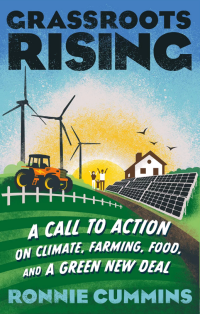
Read the Yes! magazine story by Ronnie Cummins - “What U.S. Farming Can Do to Stop Climate Change.”

16 December, 2019

The Climate Crisis Is Our Third World War. It Needs a Bold Response

Advocates of the Green New Deal say there is great urgency in dealing with climate change and highlight the scale and scope of what is required to combat it. They are right. They use the term “New Deal” to evoke the massive response by Franklin Delano Roosevelt and the United States government to the Great Depression. An even better analogy would be the country’s mobilization to fight World War II.
We need World War Two-like mobilization to confront climate change. 
Critics ask, “Can we afford it?” and complain that Green New Deal proponents confound the fight to preserve the planet, to which all right-minded individuals should agree, with a more controversial agenda for societal transformation. On both accounts the critics are wrong.
Yes, we can afford it, with the right fiscal policies and collective will. But more importantly, we must afford it. The climate emergency is our third world war. Our lives and civilization as we know it are at stake, just as they were in the second world war.

Read the story from The Guardian by Joseph Stiglitz - “The Climate Crisis Is Our Third World War. It Needs a Bold Response.”

07 December, 2019

A Blueprint for Europe’s Just Transition.

On December 3, the Green New Deal for Europe launched its new landmark report, A Blueprint for Europe’s Just Transition.

The publication coincides with the arrival of the new European Commission, which has promised to deliver a “green deal” within its first 100 days (read the leaked contents of that “green deal” here) — an all-together uninspiring vision that we believe is doomed to fail.
The report sets out an alternative vision for a Green New Deal — one that gets Europe to carbon neutrality by 2030 while delivering environmental justice across the continent and around the world. The report also includes a new chapter, Pathways to the Green New Deal for Europe, on the politics to bring this vision to reality.
To accompany the report, we are publishing an open letter to President Ursula von der Leyen — co-signed by Yanis Varoufakis, Bill McKibben, Daniela Gabor Jason Hickel, Ann Pettifor and many many others — taking her to task for the deficits of the so-called “green deal.”

Read the story from Roar Magazine - “A Blueprint for Europe’s Just Transition."

03 October, 2019

The climate crisis is our third world war. It needs a bold response

Advocates of the Green New Deal say there is great urgency in dealing with the climate crisis and highlight the scale and scope of what is required to combat it. They are right. They use the term “New Deal” to evoke the massive response by Franklin Delano Roosevelt and the United States government to the Great Depression. An even better analogy would be the country’s mobilization to fight World War II.

‘The war on the climate emergency, if correctly waged, would actually be good for the economy’
 ‘The war on the climate emergency, if correctly
waged, would actually be good for the economy’
Critics ask, “Can we afford it?” and complain that Green New Deal proponents confound the fight to preserve the planet, to which all right-minded individuals should agree, with a more controversial agenda for societal transformation. On both accounts the critics are wrong.

Yes, we can afford it, with the right fiscal policies and collective will. But more importantly, we must afford it. The climate emergency is our third world war. Our lives and civilization as we know it are at stake, just as they were in the second world war.


Read the story from The Guardian by Joseph Stiglitz - “The climate crisis is our third world war. It needs a bold response.”

23 June, 2019

The climate crisis is our third world war. It needs a bold response

Advocates of the Green New Deal say there is great urgency in dealing with the climate crisis and highlight the scale and scope of what is required to combat it. They are right. They use the term “New Deal” to evoke the massive response by Franklin Delano Roosevelt and the United States government to the Great Depression. An even better analogy would be the country’s mobilization to fight World War II.
‘The war on the climate emergency, if correctly waged, would actually be good for the economy’
‘The war on the climate emergency, if correctly
waged, would actually be good for the economy’
Critics ask, “Can we afford it?” and complain that Green New Deal proponents confound the fight to preserve the planet, to which all right-minded individuals should agree, with a more controversial agenda for societal transformation. On both accounts the critics are wrong.
Yes, we can afford it, with the right fiscal policies and collective will. But more importantly, we must afford it. The climate emergency is our third world war. Our lives and civilization as we know it are at stake, just as they were in the second world war.

Read the option piece from The Guardian by Joseph Stiglitz - “The climate crisis is our third world war. It needs a bold response.”

27 March, 2019

Where’s Your Climate Plan, Mr. McConnell?

For those wondering if it was still possible for the Senate Republican leader, Mitch McConnell, to raise his cynicism game, Tuesday’s show vote on the Green New Deal supplied a resounding “yes.”

CreditCredit
Lewis Scott
Of all the pressing business Mr. McConnell could be tackling, he devoted precious floor time to the resolution introduced last month by the Democrats Ed Markey, the junior senator from Massachusetts, and Alexandria Ocasio-Cortez, a House freshman from New York. A grand reimagining of America’s environmental and economic landscape, the Green New Deal is not a policy proposal. It is a statement of values — a nonbinding resolution that even its champions do not expect to become law. Ms. Ocasio-Cortez has called it “a vision document.”

Which is precisely why Mr. McConnell couldn’t resist it.

The Senate majority leader, like so much of his party, has zero interest in climate change — or rather, he has no interest in pursuing policies to address what many regard as the defining crisis of our time. Mr. McConnell is, however, passionate about making life politically awkward for the opposition. With their base voters fired up about climate change, dozens of Democratic lawmakers have embraced the Green New Deal, including at least half a dozen 2020 presidential contenders. Even so, the resolution’s sweeping ambitions — built around a huge infrastructure investment and a shift to carbon-free energy — strike more than a few Democrats, especially moderates, as unrealistic and politically perilous.


Read the opinion piece from The New York Times by Michelle Cottle - “Where’s Your Climate Plan, Mr. McConnell?”

11 March, 2019

Alexandria Ocasio-Cortez can teach Bill Shorten a thing or two about climate change policy

It is high school students who have helped reinvigorate the climate change debate in Australia and they are preparing to march again this week. The effect they have had is similar to the reaction created by the Green New Deal in the United States in the last month.
Alexandria Ocasio-Cortez.
Last month newly elected congressional representative Alexandria Ocasio-Cortez brought a new proposal to the Congress: a 14-page vision for a Green New Deal.

More statement than legislative proposal (it was a non-binding resolution), the Green New Deal outlined the total economic transformation required to respond to escalating climate change, then combined that action plan with a values proposition – that the economic and social transition must be just (indeed the resolution began by outlining the combined challenges of climate change and inequality).

The Green New Deal released a rocket into the US climate change debate. Until very recently climate change was not seen as a vote winner. Rather most Democrats saw it as a kind of fringe, green issue that only moved small-liberal middle-class people living in gentrified inner-city pockets of a few “blue” cities. While climate campaigners would shout about how this was wrong, especially after the IPCC’s 2018 dire predictions of rapidly rising temperatures, they struggled to change the conversation.


Read the opinion piece by Amanda Tattersall from The Guardian - “Alexandria Ocasio-Cortez can teach Bill Shorten a thing or two about climate change policy.”

17 February, 2019

Ocasio-Cortez says we need World War II-scale action on climate. Here’s what that looks like

The Green New Deal resolution introduced last week by Rep. Alexandria Ocasio-Cortez (D-NY) and Sen. Ed Markey (D-MA) states that fighting climate change requires “a new national, social, industrial, and economic mobilization on a scale not seen since World War II.”

Rep.Alexandria Ocasio-Cortez (D-NY) and Senator Ed
Markey (right D-MA) announce the Green new deal
legislation outside the U.S. Capitol early in February.

The world’s leading climate scientists agree. In 2015, for instance, they called for a sweeping mobilization — “a radical transition (deep decarbonization now and going forward),” as they described it — to avoid catastrophic impacts of climate change. And last October, the world’s nations unanimously agreed with our top scientists that preserving a livable climate requires “system changes” across the economy that “are unprecedented in terms of scale.”


05 January, 2019

Beto O'Rourke Is 'Supportive Of The Concept' Of A Green New Deal

Beto O’Rourke is the latest potential 2020 presidential candidate to get behind a Green New Deal.
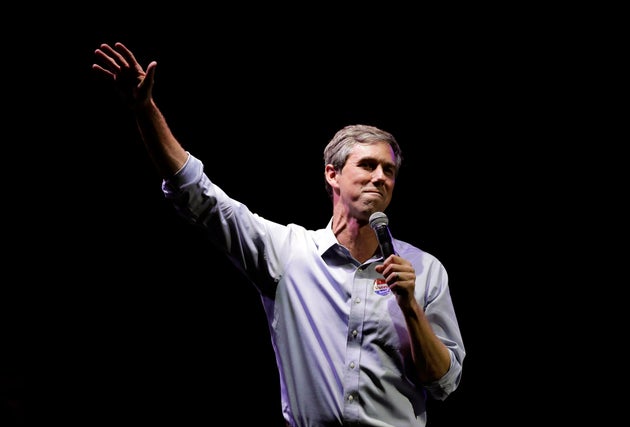
Former Rep. Beto O’Rourke (D-Texas) delivering his
concession speech after narrowly losing his race against
 Sen. Ted Cruz (R-Texas) in November. A spokesperson
 for O’Rourke said he is “supportive of the concept” of
a Green New Deal and “how it invests in green jobs.”
In a statement to HuffPost, a spokesman for O’Rourke, whose high-profile bid to unseat Sen. Ted Cruz (R-Texas) propelled the former House Democrat from Texas onto the national stage last year, said he is “supportive of the concept” of a Green New Deal and “how it invests in green jobs.”

“[He] is looking forward to engaging more on the issue as it continues to develop,” Chris Evans, a spokesman for O’Rourke, said by email Friday. “As he mentioned while traveling to every county across Texas during his senate campaign, he’s proud to come from a renewable energy producing state that is number one in wind power production, number one in wind power jobs and number one in solar energy potential.”
Three days ago, Sen. Elizabeth Warren (D-Mass.), who on Monday announced the launch of an exploratory committee for a presidential bid, told Axios she supports the “idea” of a Green New Deal.


Read the Huffington Post story by Alexander C. Kaufman  - “Beto O'Rourke Is 'Supportive Of The Concept' Of A Green New Deal.”