Showing posts with label Climate change debate. Show all posts

05 October, 2019

Inadequate drought preparation may prove to be political disaster too

Panicky. That’s a word to describe the Morrison government’s response to a national drought emergency. Lack of rain, arid conditions, scorching winds and higher temperatures are contributing to an evolving disaster against the background of a contentious climate change debate. This is a challenge that will become increasingly difficult for the governments, federal and state, to ignore as water supplies run down in New South Wales towns such as Dubbo and Queensland towns such as Stanthorpe. Risks of bushfire will be further elevated.
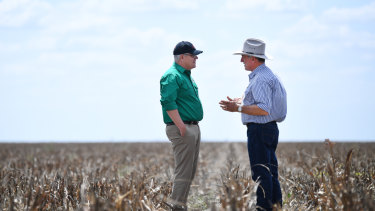
Prime Minister Scott Morrison with farmer David Gooding on his drought-affected property near Dalby, Queensland.
Prime Minister Scott Morrison with farmer David Gooding
 on his drought-affected property near Dalby, Queensland.
Judging by Bureau of Meteorology forecasts, drought over much of eastern Australia is set to surpass all others in living memory going back to the beginning of record keeping. In other words, things may get a lot worse before they get better. What is left unspoken by government officials and farm representatives is this aridity will prove to be the new normal.

Let’s repeat these words in capitals: NATIONAL DROUGHT EMERGENCY. It might also be observed that no less than a drought emergency, this is a POLITICAL EMERGENCY for the Morrison government. Governmental responses, both federal and state, to a catastrophic dry across central and northern New South Wales and southern Queensland have been unfocused, according to farm representatives. Tony Mahar, chief executive of the National Farmers’ Federation, the peak body for Australian farmers, awards federal and state governments a "fail" when it comes to developing a national drought strategy to deal with emergencies. "No government, red or blue, has successfully nailed drought policy," Mahar tells me.


Read the opinion piece from The Age by Tony Walker - “Inadequate drought preparation may prove to be political disaster too.”

11 March, 2019

Alexandria Ocasio-Cortez can teach Bill Shorten a thing or two about climate change policy

It is high school students who have helped reinvigorate the climate change debate in Australia and they are preparing to march again this week. The effect they have had is similar to the reaction created by the Green New Deal in the United States in the last month.
Alexandria Ocasio-Cortez.
Last month newly elected congressional representative Alexandria Ocasio-Cortez brought a new proposal to the Congress: a 14-page vision for a Green New Deal.

More statement than legislative proposal (it was a non-binding resolution), the Green New Deal outlined the total economic transformation required to respond to escalating climate change, then combined that action plan with a values proposition – that the economic and social transition must be just (indeed the resolution began by outlining the combined challenges of climate change and inequality).

The Green New Deal released a rocket into the US climate change debate. Until very recently climate change was not seen as a vote winner. Rather most Democrats saw it as a kind of fringe, green issue that only moved small-liberal middle-class people living in gentrified inner-city pockets of a few “blue” cities. While climate campaigners would shout about how this was wrong, especially after the IPCC’s 2018 dire predictions of rapidly rising temperatures, they struggled to change the conversation.


Read the opinion piece by Amanda Tattersall from The Guardian - “Alexandria Ocasio-Cortez can teach Bill Shorten a thing or two about climate change policy.”

31 December, 2018

Polling: Consensus emerges in climate change debate: Consensus emerges in climate change debate

WASHINGTON — The climate change debate has been a part of politics in Washington for decades now, but polling from 2018 shows that there may be a consensus emerging from the American public. A range of surveys show more people believe it is happening and more people believe humans are responsible.

If you expect those changing views to lead to action in Washington, however, think again. In the places where it counts, where laws and regulations are made, the feelings concerning what should be done about climate change are much more divided.

On the most basic level, there is big agreement that climate change is a real thing and is happening before our eyes, according to a massive survey from the Yale Program on Climate Change Communication and the George Mason Center for Climate Change Communication.


Read the story from Dante Chinni and Sally Bronston  - “Polling: Consensus emerges in climate change debate: Consensus emerges in climate change debate.”

03 September, 2017

Rick Perry says climate change debate is "secondary" amid Harvey destruction

Energy Secretary Rick Perry, a former Texas governor, is still taken aback by Hurricane Harvey's devastation, but said conversations about climate change can wait.

U.S. Energy Secretary Rick Perry -
he has argued that 
the climate change
debate is very secondary at this
particular time.
"No one has ever seen flooding like this," he told CBSN in an interview Friday, noting that parts of Texas had seen 50 inches of rain. 

In spite of the record-breaking rainfall and scientists charging that warming seas have caused hurricanes of greater intensity, Perry declined to weigh in right now on whether the White House would make any changes to its stance on climate change.

"We can line up scientists on both sides of this," he told CBSN's Stephanie Sy, but "this is not the time to be having this conversation." At this moment, he said, it's time to focus on helping victims recover from the damage wrought by Harvey.

"Everyone wants to run to the climate change debate, but that is very secondary at this particular time," he said.


(Most people have a perverse avoidance of discussing the cause of an event while it is actually happening or whichever community affected is knee deep in the recovery process - that is wrong, for the evidence is frequently its richest, and clearest, when at its peak, or when the difficulty as at its worst. Rick Perry’s suggestion that climate change debate - that’s the first mistake for there is no ‘debate’ - is "secondary" amid Harvey destruction is political delaying tactic during which people can avoid the hard questions and, equally, the hard answers - as Al Gore has said the “inconvenient truth” - Robert McLean

24 June, 2017

Climate forces consolidate as coal backers rush for government help

Forces on the green-energy side are positioning for a renewed climate change debate in coming months, as the Turnbull government struggles to convince internal dissenters of the need for tougher carbon reduction measures.

Ben Oquist, executive director of the Australia Institute. 
The nation's preeminent advocate of strong laws against carbon emissions, the Climate Institute, will close its doors on June 30 after a dozen years in operation, and transfer its assets and intellectual property to high-profile progressive think tank the Australia Institute.

The financial terms of the new arrangement have been kept confidential.

As the recipient body, the economically-oriented Australia Institute will in turn establish a dedicated "Climate and Energy Program" with the aim of stepping up the public pressure on lawmakers to meet Australia's obligations under the Paris Accord. 


Read Mark Kenny’s story in today’s Melbourne Age - “Climate forces consolidate as coal backers rush for government help.”

02 December, 2015

Fewer march although the problem is even more pressing


O
n a steamy afternoon in Sydney last Sunday, about 45,000 people turned up to walk the short distance from the Domain to the Opera House. I was one of them. We – together with hundreds of thousands of others across the globe – hoped to make some impression on the policy-makers gathering in Paris to discuss, yet again, the vexed issue of climate change.

Jonathan Holmes - it's about
choosing sides.
I am not a frequent participant in protest marches. In my opinion, they don't have a great record of success.  Over the weekend of February 15-16, 2003, some 10 million people worldwide marched to protest against the coming war in Iraq – including about 200,000 in Sydney, 150,000 in Melbourne, and as many as a million in London. The US president George W. Bush launched the war anyway, with the enthusiastic endorsement of the Australian and British governments.

Compared to that global demonstration, Sunday's efforts in Sydney and Friday's in Melbourne were modest – considering what's at stake, disappointingly so.

Read Jonathan Holmes piece in today’s Melbourne Age - “Climate change debate comes down to choosing sides.”