Showing posts with label higher temperatures. Show all posts

05 October, 2019

Inadequate drought preparation may prove to be political disaster too

Panicky. That’s a word to describe the Morrison government’s response to a national drought emergency. Lack of rain, arid conditions, scorching winds and higher temperatures are contributing to an evolving disaster against the background of a contentious climate change debate. This is a challenge that will become increasingly difficult for the governments, federal and state, to ignore as water supplies run down in New South Wales towns such as Dubbo and Queensland towns such as Stanthorpe. Risks of bushfire will be further elevated.
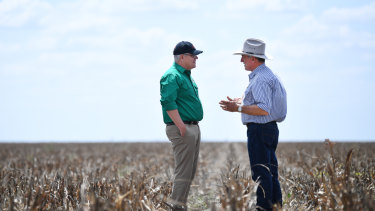
Prime Minister Scott Morrison with farmer David Gooding on his drought-affected property near Dalby, Queensland.
Prime Minister Scott Morrison with farmer David Gooding
 on his drought-affected property near Dalby, Queensland.
Judging by Bureau of Meteorology forecasts, drought over much of eastern Australia is set to surpass all others in living memory going back to the beginning of record keeping. In other words, things may get a lot worse before they get better. What is left unspoken by government officials and farm representatives is this aridity will prove to be the new normal.

Let’s repeat these words in capitals: NATIONAL DROUGHT EMERGENCY. It might also be observed that no less than a drought emergency, this is a POLITICAL EMERGENCY for the Morrison government. Governmental responses, both federal and state, to a catastrophic dry across central and northern New South Wales and southern Queensland have been unfocused, according to farm representatives. Tony Mahar, chief executive of the National Farmers’ Federation, the peak body for Australian farmers, awards federal and state governments a "fail" when it comes to developing a national drought strategy to deal with emergencies. "No government, red or blue, has successfully nailed drought policy," Mahar tells me.


Read the opinion piece from The Age by Tony Walker - “Inadequate drought preparation may prove to be political disaster too.”

02 August, 2019

‘Quite scary': Rising temperatures threaten Melbourne, Sydney's water security

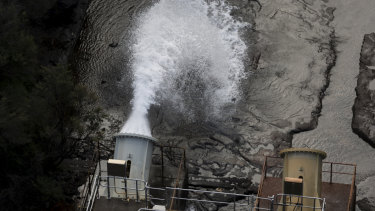
Sydney and Melbourne face rising threats to their water supplies from climate change as higher temperatures diminish inflows while pushing up demand, according to new research.
Water security for major Australian cities including Melbourne and Sydney is likely to become more of a challenge under climate change, scientists say.
Water security for major Australian cities including Melbourne
and Sydney is likely to become more of a challenge under
climate change, scientists say.
A paper published by Environment Research Letters shows a "substantially" amplified risk for Melbourne's water availability if global temperatures rise 2 degrees above pre-industrial levels rather than the 1.5-degree target set by the Paris climate agreement.

Read the story from The Sydney Morning Herald by Peter Hannam - “‘Quite scary': Rising temperatures threaten Melbourne, Sydney's water security.”

12 October, 2018

Farmers’ climate denial begins to wane as reality bites

Australia has been described as the “front line of the battle for climate change adaptation”, and our farmers are the ones who have to lead the charge. Farmers will have to cope, among other pressures, with longer droughts, more erratic rainfall, higher temperatures, and changes to the timing of seasons.
Doing it tough.
Yet, puzzlingly enough to many commentators, climate denial has been widespread among farmers and in the ranks of the National Party, which purports to represent their interests.


21 June, 2017

Ethiopia’s Coffee Farmers Are 'On The Front Lines Of Climate Change’

Ethiopia gave the world Coffea arabica, the species that produces most of the coffee we drink these days. Today, the country is the largest African producer of Arabica coffee. The crop is the backbone of the country's economy – some 15 million Ethiopians depend on it for a living.
Growing coffee provides income for about 15 percent
 of Ethiopia's population and is the country's top export.
Climate change is likely to shrink the land suitable for
 coffee, thereby also hurting the livelihoods of many people.
But the effects of climate change – higher temperatures and less rainfall – could take a toll on the country's ability to farm this treasured crop. In parts of Ethiopia, spring and summer rains have already declined by 15–20 percent since the 1970s. Climate data shows that rainfall in Ethiopia has declined by almost 40 inches since the 1950s. And the frequency of droughts has increased in recent years, affecting coffee growing regions as well.

Ethiopia could lose from 39 to 59 percent of its current coffee-growing areas to climate change by the end of the century, according to a new study published in Nature Plants.


Read the story by Courtney Columbus on The Salt - “Ethiopia’s Coffee Farmers Are 'On The Front Lines Of Climate Change’.”

23 January, 2016

We will feel the higher temperatures 'where we live'

Regions around the Arctic may have passed a 2°C temperature rise as far back as 2000 and, if emissions rates don't change, areas around the Mediterranean, central Brazil and the contiguous United States could see 2°C of warming by 2030.

This is despite the fact that under a business as usual scenario the world is not expected to see global average temperatures rise by 2°C compared to preindustrial times until the 2040s.

New research published in Nature led by Prof Sonia Seneviratne from ETH Zurich with researchers from Australia's ARC Centre ofExcellence for Climate System Science (ARCCSS) has quantified the change in regional extremes in a world where global average temperatures have risen by 2°C.

07 December, 2015

Heatwaves and drought claims thousands of trees


A study has found more than 25 per cent of trees across 7000 hectares of jarrah forest in the Perth Hills, Western Australia have died after the drought and heatwaves experienced in 2010-11.

Similar numbers of trees died in arid areas of Queensland in response to the 2003-07 drought, and there are similar reports from around the world

The high death rate of trees is attributed to lower rainfalls, higher temperatures and extreme weather events.