Showing posts with label new research. Show all posts

10 April, 2020

Nearly half of global coal plants will be unprofitable this year, study show

Nearly half of all global coal plants will run at a loss this year, new research suggests.
This comes despite proposals in China to build more plants to stimulate its economy in the wake of the coronavirus pandemic, according to Carbon Tracker, a London-based environmental think tank.
The organisation analysed the profitability of 95 per cent of coal plants in operation or planned around the world.
Looking at 6,696 existing plants and 1,046 in the pipeline, it found that 46 per cent will be unprofitable this year, up from 41 per cent in 2019.

This is based on estimated revenues from wholesale power markets, ancillary and balancing services and capital markets, as well as running costs, carbon pricing and pollution policies.
Read the story from the Independent by Samuel Lovett - “Nearly half of global coal plants will be unprofitable this year, study show.”

20 February, 2020

Oil and Gas May Be a Far Bigger Climate Threat Than We Knew

Oil and gas production may be responsible for a far larger share of the soaring levels of methane, a powerful greenhouse gas, in the earth’s atmosphere than previously thought, new research has found.
The findings, published in the journal Nature, add urgency to efforts to rein in methane emissions from the fossil fuel industry, which routinely leaks or intentionally releases the gas into air.
“We’ve identified a gigantic discrepancy that shows the industry needs to, at the very least, improve their monitoring,” said Benjamin Hmiel, a researcher at the University of Rochester and the study’s lead author. “If these emissions are truly coming from oil, gas extraction, production use, the industry isn’t even reporting or seeing that right now.”

Read the story from The New York Times by Horoko Tabuchi - “Oil and Gas May Be a Far Bigger Climate Threat Than We Knew.”

13 February, 2020

Indian Ocean Dipole linked to global warming in new research by Australian scientists

One of the big drivers of drought in Australia, the Indian Ocean Dipole, is trending towards a more drought-causing positive state due to climate change, according to new research.
Cracked earth in drought conditions.
Extreme positive Indian Ocean Dipole events have
 been strongly linked to drought in Australia.
Professor Nerilie Abram from the ANU Research School of Earth Sciences said the changes were occurring in the Indian Ocean Dipole's (IOD) behaviour. 
"That is going to increase the risk that we will have these very dry and hot years and those are the years where we precondition our landscape to burn," she said.
The 2019 drought occurred at a time where the Indian Ocean Dipole was at a record positive level. 
Extreme positive IOD events have been strongly linked to drought in Australia.

16 December, 2019

Dire predictions for future Kimberley heatwaves, but climate scientists warn against 'crying wolf’

Climate scientists have cautioned against "crying wolf" on the unfolding impacts of climate change, as new research suggests a dramatic upswing in heatwaves across northern Australia.
The sun sets over bushland in the Kimberley.
Research suggests WA's north could have
 60 days a year above 40 degrees Celsius.
Released by think tank The Australia Institute this week, the Kimberley HeatWatch report pointed to an unprecedented rise in hot weather across the West Australia's Kimberley by the end of the century.
The paper, commissioned by local conservation group Environs Kimberley, suggested that without adequate policies to reduce global temperatures, the number of "extreme heat days" where temperatures reach 35 degrees Celsius and over would increase dramatically each year.

07 November, 2019

Scientists looked at sea levels 125,000 years in the past. The results are terrifying

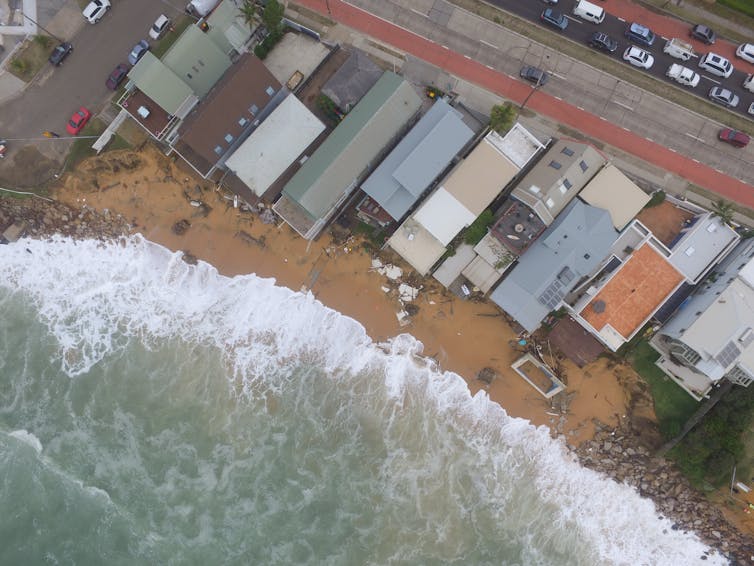
Sea levels rose 10 metres above present levels during Earth’s last warm period 125,000 years ago, according to new research that offers a glimpse of what may happen under our current climate change trajectory.
Aerial footage showing devastation caused by severe storms at
Collaroy on Sydney’s northern beaches in June 2016.
Our paper, published today in Nature Communications, shows that melting ice from Antarctica was the main driver of sea level rise in the last interglacial period, which lasted about 10,000 years.
Rising sea levels are one of the biggest challenges to humanity posed by climate change, and sound predictions are crucial if we are to adapt.
This research shows that Antarctica, long thought to be the “sleeping giant” of sea level rise, is actually a key player. Its ice sheets can change quickly, and in ways that could have huge implications for coastal communities and infrastructure in future. 

30 October, 2019

Rising Seas Will Erase More Cities by 2050, New Research Shows

Rising seas could affect three times more people by 2050 than previously thought, according to new research, threatening to all but erase some of the world’s great coastal cities. 
The authors of a paper published Tuesday developed a more accurate way of calculating land elevation based on satellite readings, a standard way of estimating the effects of sea level rise over large areas, and found that the previous numbers were far too optimistic. The new research shows that some 150 million people are now living on land that will be below the high-tide line by midcentury. 
Southern Vietnam could all but disappear. 
The first map shows earlier expectations of submerged land by 2050. But the new outlook, the second map, indicates that the bottom part of the country will be underwater at high tide. 
More than 20 million people in Vietnam, almost one-quarter of the population, live on land that will be inundated. 

Read the story from The New York Times by Denise Lu and Christopher Flavelle - “Rising Seas Will Erase More Cities by 2050, New Research Shows.”

02 August, 2019

‘Quite scary': Rising temperatures threaten Melbourne, Sydney's water security

Sydney and Melbourne face rising threats to their water supplies from climate change as higher temperatures diminish inflows while pushing up demand, according to new research.
Water security for major Australian cities including Melbourne and Sydney is likely to become more of a challenge under climate change, scientists say.
Water security for major Australian cities including Melbourne
and Sydney is likely to become more of a challenge under
climate change, scientists say.
A paper published by Environment Research Letters shows a "substantially" amplified risk for Melbourne's water availability if global temperatures rise 2 degrees above pre-industrial levels rather than the 1.5-degree target set by the Paris climate agreement.

Read the story from The Sydney Morning Herald by Peter Hannam - “‘Quite scary': Rising temperatures threaten Melbourne, Sydney's water security.”

26 July, 2019

Human-caused global heating breaks clear from nature, studies find

Global heating in recent decades is of a pace and magnitude that's unique in at least the past two millennia, with human-caused climate change now "overwhelming" natural variability, new research has found.
German police find a new use for their water cannons
 amid record-breaking heat in that country on Wednesday.
Those heat records, though, may last just one day.
According to three papers published in Nature and Nature Geoscience on Thursday, international teams of scientists used seven different statistical techniques to reconstruct global temperature during the so-called Common Era starting 2000 years ago.

Read the story from The Age by Peter Hannam - “Human-caused global heating breaks clear from nature, studies find.”

18 May, 2019

Scientists want to build trust in science and technology. The alternative is too risky to contemplate

New research shows that despite differences in their funding commitments, major political parties in Australia – the Coalition, Labor and the Greens – see science and technology as important aspects of our economy and future prosperity.
Not everyone trusts that science will bring benefits to society.
But that’s not enough.

It’s also crucial that the Australian public is able to have a say on priorities for scientific research and its applications. The social license of science depends on being able to engage with the public. Without this, scientists and other experts risk losing public trust.

This could have real implications for achieving the public good when it comes to emerging disruptive technologies (like robotics and AI), the environment (including climate change) and more.


09 March, 2019

Climate change to expose half of world's population to disease-spreading mosquitoes by 2050, study finds

Over the next 30 years, mosquito-borne diseases such as dengue, yellow fever and the Zika virus are on course to spread – posing a risk to half the world’s population, new research has revealed.
Climate change and modern travel are facilitating
 the spread of diseases around the world.
Two of the main disease-spreading mosquitoes – Aedes aegypti and Aedes albopictus – are forecast to significantly expand their range due to warming temperatures.

The models predict that by 2050, 49 per cent of the world’s population will live in places where these species are established if greenhouse gas emissions continue at current rates, and if they are not curbed, even greater areas will be at risk.


08 March, 2019

IEEFA report: every two weeks a bank insurer or lender announces new coal restrictions

New research from the Institute for Energy Economics and Financial Analysis (IEEFA) today reveals over 100 major global financial institutions have introduced policies restricting coal funding.

The report, “Over 100 Global Financial Institutions Are Exiting Coal, With More to Come,” finds global capital is fleeing the coal sector at an electrifying rate.

Since 2013, coal exit announcements have occurred at a rate of over one per month from globally significant banks and insurers holding more than US$10bn worth of assets under management.


08 February, 2019

Hurricanes are strengthening faster in the Atlantic, and climate change is a big reason why, scientists say

A group of top hurricane experts, including several federal researchers at the National Oceanic and Atmospheric Administration, published striking new research Thursday suggesting that hurricanes in the Atlantic Ocean have grown considerably worse, and climate change is part of the reason why.
Television reporters watch as Category 4 Hurricane
Michael makes landfall along the Florida panhandle
on Oct. 10, 2018, in Panama City Beach, Fla.
The study focused on rapid intensification, in which hurricanes may grow from a weak tropical storm or Category 1 status to Category 4 or 5 in a brief period. They found that the trend has been seen repeatedly in the Atlantic in recent years. It happened before Hurricane Harvey struck Texas and before Hurricane Michael pummeled the Gulf Coast with little warning last fall. Hurricane Michael, for example, transformed from a Category 1 into a raging Category 4 in the span of 24 hours.

The study, published in Nature Communications, describes its conclusion in blunt language, finding that the Atlantic already has seen “highly unusual” changes in rapid hurricane intensification, compared to what models would predict from natural swings in the climate. That led researchers to conclude that climate change played a significant role.


Read the story from The Washington Post by Chris Mooney and Brady Dennis - “Hurricanes are strengthening faster in the Atlantic, and climate change is a big reason why, scientists say."

08 January, 2019

U.S. greenhouse gas emissions spiked in 2018 — and it couldn’t happen at a worse time

U.S. carbon dioxide emissions rose an estimated 3.4 percent in 2018, according to new research — a jarring increase that comes as scientists say the world needs to be aggressively cutting its emissions to avoid the most devastating effects of climate change.


The findings, published Tuesday by the independent economic research firm Rhodium Group, mean that the United States now has a diminishing chance of meeting its pledge under the 2015 Paris climate agreement to dramatically reduce its emissions by 2025.

The findings also underscore how the world’s second-largest emitter, once a global leader in pushing for climate action, has all but abandoned efforts to mitigate the effects of a warming world. President Trump has said he plans to officially withdraw the nation from the Paris climate agreement in 2020 and in the meantime has rolled back Obama-era regulations aimed at reducing the country’s carbon emissions.


Read the story from The Washington Post by Chris Mooney and Brady Dennis - “U.S. greenhouse gas emissions spiked in 2018 — and it couldn’t happen at a worse time.”

03 January, 2019

Climate change could turn green turtles female

London: Up to 93 per cent of green turtle hatchlings could be female by 2100 as climate change causes "feminisation" of the species, new research suggests.
A green sea turtle at Lizard Island in Australia.
The sex of turtle hatchlings is determined by temperature, and at present about 52 per cent of hatching green turtles – one of seven species of sea turtle – are female.

But a study by the University of Exeter and the Marine and Environmental Sciences Centre in Portugal shows that in warmer temperatures predicted by Intergovernmental Panel on Climate Change scenarios, 76 to 93 per cent of hatchlings would be female.

The figures are specific to the study site in Guinea-Bissau, West Africa but researchers say they expect a similar picture globally.


Read the story from The Age - “Climate change could turn green turtles female.”

10 December, 2018

Climate change likely to make us more stupid, study finds

Rising carbon dioxide emissions could cause a decline in the brainpower of workers around the world, according to new research.
Rising levels of carbon dioxide could affect concentration
 and decision-making of global workforce.
A new study by academics at University College London (UCL) found that higher amounts of greenhouse gas in the atmosphere could affect our memory, concentration and decision-making abilities.

Raised CO2 in workplaces lacking proper ventilation is known to make employees more sluggish and less able to successfully complete tasks.


Read by Adam Forrest from the Independent - “Climate change likely to make us more stupid, study finds.”

12 September, 2018

More Australians fear climate change as Morrison government dumps emissions legislation

Voter concern about climate change has surged and about half of Australians want new coal mines banned, according to new research that suggests the Morrison government’s relegation of emissions reduction is at odds with public sentiment.
A polar bear on melting ice off the coast of Svalbard,
Norway. The vast majority of Australians say they are
concerned about climate
change.
As federal cabinet agreed on Monday night to dump climate targets associated with its energy plan, official figures also show crop production in Australia has dropped due to the harsh drought – conditions exacerbated by climate change - and the United Nations chief warned of “a direct existential threat” unless Earth changes course on deadly greenhouse gas emissions by 2020.

Research by progressive think tank The Australia Institute to be released on Wednesday found that 73 per cent of Australians were concerned about climate change, up from 66 per cent last year.


13 June, 2018

Why methane should be treated differently compared to long-lived greenhouse gases

New research provides a way out of a longstanding quandary in climate policy: how best to account for the warming effects of greenhouse gases that have different atmospheric lifetimes.
Livestock is a significant source of methane,
a potent but short-lived greenhouse gas
.
Carbon dioxide is a long-lived greenhouse gas, whereas methane is comparatively short-lived. Long-lived “stock pollutants” remain in the atmosphere for centuries, increasing in concentration as long as their emissions continue and causing more and more warming. Short-lived “flow pollutants” disappear much more rapidly. As long as their emissions remain constant, their concentration and warming effect remain roughly constant as well.

Our research demonstrates a better way to reflect how different greenhouse gases affect global temperatures over time.


30 April, 2018

The hills are alive with the signs of plastic: even Swiss mountains are polluted

Microplastic pollution contaminates soil across Switzerland, even in remote mountains, new research reveals. The scientists said the problem could be worse in other nations with poorer waste management and that research was urgently needed to see if microplastics get into food.
Microplastic soil contamination was found even in remote areas,
 leading scientists to conclude it must be windborne.
In the first major study of microplastics in soil, the researchers analysed soil samples from 29 river flood plains in nature reserves across Switzerland. They found microplastics, fragments under 5mm in size, in 90% of the soils. The scientists believe the particles are carried across the country by the wind.

Research on microplastic pollution to date has largely concentrated on the oceans, in which it is found across the globe, including the Arctic. The particles have been shown to harm marine life and can absorb toxins from the water.


Read Damian Carrington’s story from The Guardian - “The hills are alive with the signs of plastic: even Swiss mountains are polluted.”

14 November, 2017

Australia’s lush street trees face grave threat if emissions keep rising, research finds

Much-loved leafy streets and shady parks in Sydney and Melbourne are in jeopardy, according to new research that found climate change severely threatens the health of more than one-third of tree species in Australia's cities.

Australia's much-loved street trees could fall victim to rising emissions. 
The federally funded study of 1.5 million trees in 29 council areas across Australia found that higher temperatures and urban heat means new tree species may be introduced, existing trees must be given special care and some trees may disappear in certain locations.

More than four in 10 houses in Australia's capital cities have a street tree.

Trees can greatly affect people's experience of a city - providing shade, places for recreation and a sense of place and heritage. They also cool the city, capture rain, slow stormwater and provide habitat for birds and other animals.


Read the story by Nicole Hasham in the Melbourne Age - “Australia’s lush street trees face grave threat if emissions keep rising, research finds.”

04 October, 2017

‘Really awful': 50-degree days possible for Sydney, Melbourne, as warming worsens

Sydney and Melbourne can expect summer days when the mercury climbs to 50 degrees within a couple of decades if greenhouse gas emissions continue to rise, new research has found.

A bushfire near Healesville, on the outskirts of
Melbourne on Black Saturday in February 2009. 
The study, led by Sophie Lewis at the Australian National University, analysed new models being prepared for the Intergovernmental Panel on Climate Change (IPCC) to examine the difference between a 1.5- and 2-degree warming limit compared with pre-industrial times.

At the upper end of the range – which would amount to a 1.1-degree rise from current global warming levels – NSW's record extremes would increase 3.8 degrees compared with existing records. Those in Victoria would rise by 2.3 degrees, the simulations showed.

For Sydney and Melbourne, populations could swelter in 50-degree weather even if the 2-degree global warming limit agreed in the 2015 Paris accord were achieved, according to the research co-authored by Andrew King from Melbourne University and published Wednesday in Geophysical Research Letters.

Read Peter Hannam”s story in today’s Melbourne Age - “‘Really awful': 50-degree days possible for Sydney, Melbourne, as warming worsens.”