Showing posts with label devastating effects. Show all posts

04 January, 2020

Act over climate change

Are we now experiencing the devastating effects of human-assisted climate change through the fires that are devastating communities across Australia?
If so, what should we do? Before proceeding, I should state my credentials. I am not a climate change guru but just a normal, retired working man. However, since 1991 I have listened to the overwhelming scientific research and through Doctor Google noted the development of historical changes to the Earth’s climate.
These moved at a glacial pace compared to the speed of the past 100 years.
So, what can we do?

I do not have the answers but I can make suggestions and hopefully stir people to get involved.
Leadership at the federal level is critical, as we must join with other leading countries in setting and producing feasible targets. Will this happen? On the home front, a body of people could be established to advise the government.
This grouping could include scientists, economists, grassroots activists and, importantly, young people.
I must stress that by the time a 16-year-old reaches 40, it will be 2044 — almost at the tipping point for the climate.
This is not a concern for me as I am in my late 80s but for my great-grandchildren it is something I cannot imagine.
As for climate deniers being involved, no way, as the science is in and the public are restless.
I must emphasise that advice to government must be enacted.
In dealing with fires we could increase our air capability and our mobility on the ground.
Maybe we could halve the money being spent on submarines for use against an unidentified enemy and which may still be in production as we near the tipping point.
Or, how about a fire strike force on standby all year?
Not cheap, but out-of control fires are not cheap to deal with either.
Water? How much water has been used so far since the first fire last spring? How do we prepare ourselves for the future use of water when fighting fires?
More importantly, where does this water come from? A network of pipelines carrying only sea water stored for firefighting only may not sound feasible but this is possible. Fresh water is fast becoming a scarce commodity so should not be used for firefighting.
What about you, me and our fellow citizens? What can we do? Plenty.
We should ask ourselves the following questions: Are we ready to give up our reliance on petrol/diesel-powered vehicles? Are we ready to use cheap and reliable public transport that means giving up the convenience provided by the car?
Watch people driving to work — one person in one car seems to be the norm. Probably the most inefficient method of transport invented by mankind.
The use of horses, bicycles, scooters, public transport and Shanks’ pony (walking) are more cost effective than the car. The downside is that we have to move more slowly — a real difficulty for many people, as the need for speed (not the drug) seems to be part of our DNA.
Electric cars may be the answer to part of this problem and our congratulations should go to the Greater Shepparton City Council on the purchase of two electric cars.
This will probably lead to our whole fleet being electric.
I would like people to respond with their thoughts, and if there is a good response maybe the News will provide space for a weekly column on our climate and our future.
A lot of questions, and the answers are not easy but need to be urgently addressed.

Letter in The Shepparton News from Bill Brown - “Act over climate change.”

07 March, 2019

Why Is This Happening? Fighting for climate action with 'The Uninhabitable Earth' author David Wallace-Wells: podcast and transcript

Is it too late for us? Scientists have spent decades sounding the alarm on the devastating effects of climate change. And for decades, society decided to do pretty much nothing about it. In fact, over the past 30 years, we’ve done more damage to the climate than in all of human history!


Now, there’s a real chance we may have waited too long to avoid widespread tragedy and suffering.

In his book “The Uninhabitable Earth”, David Wallace-Wells depicts a catastrophic future far worse than we ever imagined... and far sooner than we thought. It is undoubtedly a brutal truth to face, as you will hear in this episode, but if there’s any hope to avert the worst case scenarios, we have to start now.


09 January, 2019

How to Make Climate Change Doubters Pay a Political Price

More than any past report, the U.S. government’s National Climate Assessment in November made clear the devastating effects of climate change on global public health. As it and other analyses have described, these aftershocks will be generational and wide-reaching but particularly crushing for vulnerable health systems in developing countries. In response, multinational organizations and elected officials must reprioritize how they delegate scarce health resources to ensure that recent progress in combating both communicable and noncommunicable diseases is not reversed. And even the status quo is too little; current efforts are insufficient and poorly funded.
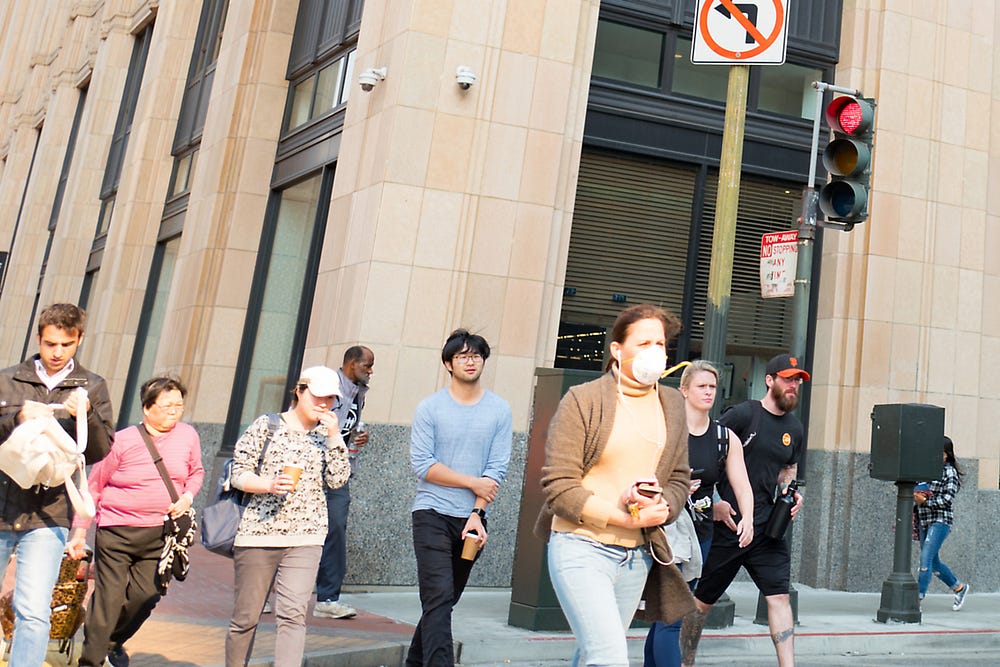
A woman wears an air-filtration mask while crossing
a street in San Francisco, California, October 13, 2017. 
In purely economic terms, health consequences dwarf the other effects of climate change in sheer cost to the United States, estimated at $141 billion due to heat-related deaths alone by 2100, vastly outpacing infrastructure damage to coastal cities from sea-level rise (estimated at $118 billion).

Read the Medium story by Vin Gupta and Juliette Kayyem - “How to Make Climate Change Doubters Pay a Political Price.”

08 January, 2019

U.S. greenhouse gas emissions spiked in 2018 — and it couldn’t happen at a worse time

U.S. carbon dioxide emissions rose an estimated 3.4 percent in 2018, according to new research — a jarring increase that comes as scientists say the world needs to be aggressively cutting its emissions to avoid the most devastating effects of climate change.


The findings, published Tuesday by the independent economic research firm Rhodium Group, mean that the United States now has a diminishing chance of meeting its pledge under the 2015 Paris climate agreement to dramatically reduce its emissions by 2025.

The findings also underscore how the world’s second-largest emitter, once a global leader in pushing for climate action, has all but abandoned efforts to mitigate the effects of a warming world. President Trump has said he plans to officially withdraw the nation from the Paris climate agreement in 2020 and in the meantime has rolled back Obama-era regulations aimed at reducing the country’s carbon emissions.


Read the story from The Washington Post by Chris Mooney and Brady Dennis - “U.S. greenhouse gas emissions spiked in 2018 — and it couldn’t happen at a worse time.”

09 April, 2016

Globalization and capitalism defy the ulitmate needs of humanity, serving only profit

Globalization is as old as capitalism itself, although the trend has intensified significantly in the last 40 or so years, promoting what is known as a "monoculture" economy with devastating effects for the well-being of many communities in the global South and the environment alike.

Localization, in this regard, is seen by an increasing number of people as the counterweight to globalization.

A leading voice against "monoculture" and a passionate advocate of localization in the struggle for a just social and economic order and a sustainable ecology is the activist, author, and producer Helena Norberg-Hodge.

In this first installment of a two-part interview with Truthout, Norberg-Hodge speaks about globalization, localization, and her work to promote a just and sustainable future social order.