Showing posts with label November. Show all posts

15 September, 2019

‘Critical': parts of regional NSW set to run out of water by November

Parts of regional New South Wales could run out of water as early as November with data showing the worst-case scenario for the state if there’s no rain or government intervention.
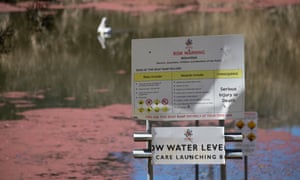
A huge mat of red duckweed floats on the surface of the Macquarie River due to the decreased flow of water.
A huge mat of red duckweed floats on the surface of
 the Macquarie River in Dubbo due to the decreased
flow of water. WaterNSW say Dubbo is set to be one of
the first NSW towns to lose water if it does not rain.
The projections from NSW’s river operator and bulk water supplier WaterNSW show without significant rain the first towns to lose water supply will be Dubbo, Cobar, Nyngan and Narromine with the Macquarie River forecast to run dry by November.

The Macquarie River experiences an average inflow of 1,448GL annually but in the past two years has seen just 97GL enter the river system, the data shows.

Read the story from The Guardian by Paul Karp and Australia Associated Press - “‘Critical': parts of regional NSW set to run out of water by November.”


(It’s events such as these that will focus peoples’ thinking about the climate crisis - Robert McLean)

09 January, 2019

How to Make Climate Change Doubters Pay a Political Price

More than any past report, the U.S. government’s National Climate Assessment in November made clear the devastating effects of climate change on global public health. As it and other analyses have described, these aftershocks will be generational and wide-reaching but particularly crushing for vulnerable health systems in developing countries. In response, multinational organizations and elected officials must reprioritize how they delegate scarce health resources to ensure that recent progress in combating both communicable and noncommunicable diseases is not reversed. And even the status quo is too little; current efforts are insufficient and poorly funded.
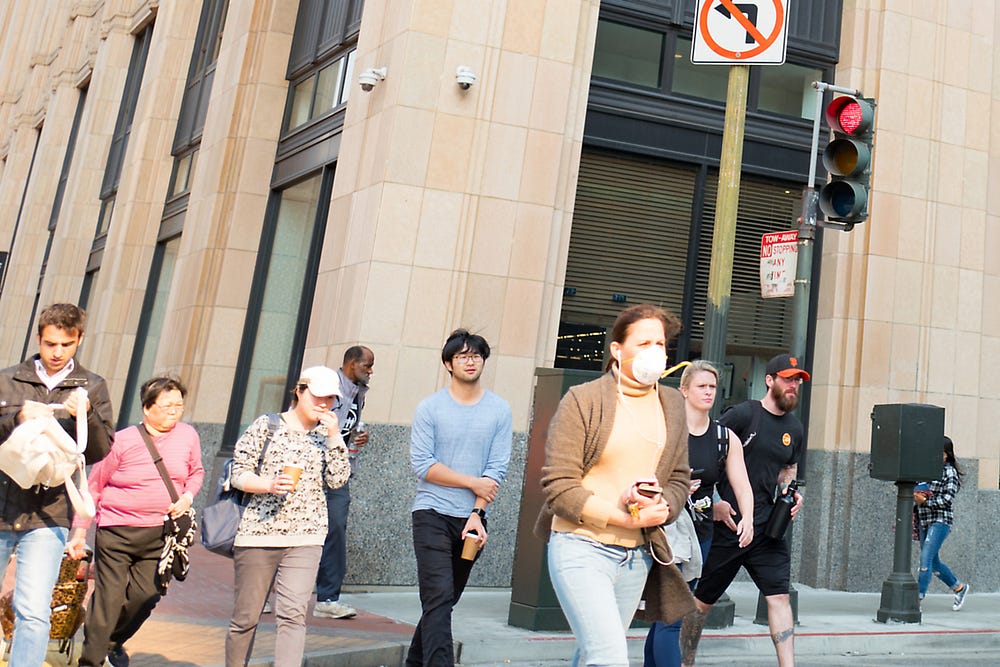
A woman wears an air-filtration mask while crossing
a street in San Francisco, California, October 13, 2017. 
In purely economic terms, health consequences dwarf the other effects of climate change in sheer cost to the United States, estimated at $141 billion due to heat-related deaths alone by 2100, vastly outpacing infrastructure damage to coastal cities from sea-level rise (estimated at $118 billion).

Read the Medium story by Vin Gupta and Juliette Kayyem - “How to Make Climate Change Doubters Pay a Political Price.”

31 December, 2018

Weatherwatch: how do we store surplus renewable energy until we need it?

A milestone was reached for renewable energy in November when more than 100% of Scotland’s electricity demand was met by wind turbines for the first time – enough for nearly six million homes. Scottish weather is powering a revolution. With ever-larger wind turbines being built at sea, and wave and tidal power being developed, the problem will soon be how to use this surplus energy. 

Some is already exported to England via interconnector cables and in 2020 there will be another running from the Aberdeen area to Norway. But this will not be enough and the race is on to find ways to store cheap energy to sell back to the grid when demand is high.
Turbines being assembled in Norway before being moved to
 the world’s first floating wind farm off north-east  Scotland.
Large batteries are helping, but another proven method is pump storage. This uses virtually free surplus electricity at night to pump water into upland reservoirs to be used to power turbines during peak periods. Scotland has had these schemes since the 1960s but there is potential for many more and two new ones are proposed to pump water uphill from Loch Ness to reservoirs in the hills.


Read the story from The Guardian by Paul Brown - “Weatherwatch: how do we store surplus renewable energy until we need it?”

19 December, 2018

Is the Pacific island nation of Tuvalu growing, and not sinking, as Craig Kelly says?

Liberal MP and climate sceptic Craig Kelly made headlines in November when he was caught on tape mocking "lefties" for exaggerating the effects of climate change.
Coalition backbencher, Craig Kelly, says Pacific
island nations are growing rather than shrinking,
Speaking at a local party event, audio of which was leaked to the Guardian, Mr Kelly set out to debunk several justifications for climate change action, including the argument that Tuvalu, the Pacific island nation, was slipping beneath the sea.


04 November, 2018

‘Getting close': El Nino event seen as not far off as Sydney sizzles

The hot start to November may be a taste of the summer to come with meteorologists watching a Pacific Ocean that is being primed for an El Nino event.
Early season heat in Sydney - and the growing prospect of an El Nino.
Sydney backed up Friday's scorcher with another day in the mid-30s across the basin before a weak cool change arrived on Saturday afternoon.

According to Weatherzone, NSW averaged 34 degrees on Friday, the hottest this early in the warming season in at least two decades.

"In the past 20 years, the previous earliest in the season the state had got this hot was the 12th November, in 2009," Brett Dutschke, senior meteorologist with Weatherzone, said.


Read the story from The Age by Peter Hannam - “‘Getting close': El Nino event seen as not far off as Sydney sizzles.”

17 January, 2018

Climate action in 2018: expect same, but different

As I predicted a year ago, 2017 was another vicious and bloody-minded year in Australian climate politics. Yet the political bickering belied the fact that it was actually a great year for green energy.
Illustration by Andrew Dyson.
Nowhere was that more in evidence than in South Australia, which got its big battery inside a 100-day deadline, with the world’s biggest solar thermal plant set to begin construction this year. Elsewhere, Prime Minister Malcolm Turnbull talked up the prospects of the Snowy 2.0 hydro storage project.

Yet the politics remain as rancorous as ever. The federal government unveiled its National Energy Guarantee (NEG) in November, after Chief Scientist Alan Finkel’s Clean Energy Target proved too rich for some in the Coalition. Just before Christmas, the long-awaited climate policy review was released, and was immediately branded as weak.

Both issues are unresolved, and are set to loom large on the landscape this year. But what else is on the horizon?


Read Marc Hudson’s comment in today’s Melbourne Age - “Climate action in 2018: expect same, but different.”

21 November, 2017

Melbourne to swelter through longest November heatwave in 150 years

Melbourne's spring weather has sent records tumbling, with forecasters predicting the longest November heatwave in more than 150 years.

People enjoy hot weather at St Kilda beach in November this year. 
The city has sweltered through its first taste of summer early this year, and if temperatures stay as high as predicted, it will be Melbourne's first seven-day spell of temperatures higher than 28 degrees in November since official records began in 1862.

Melbourne is halfway though its hot streak, and unless you plan on being poolside for the rest of the week, there's not much relief in sight.

The mercury hit 34 degrees on Tuesday and Melburnians are expected to toss and turn through another sticky night with the temperature not expected to drop below 22 degrees. 


Read Melissa Cunningham’s story in the  Melbourne Age - “Melbourne to swelter through longest November heatwave in 150 years.”

08 September, 2017

Harvey and Irma, Married 75 Years, Marvel at the Storms Bearing Their Names

Harvey and Irma Schluter have been married for 75 years. He turned 104 in July; she will be 93 in November.
Irma and Harvey Schluter celebrated their 75th
wedding anniversary in Spokane, Wash., in March.
They vividly remember many of the major events of the 20th century, from her first time spotting an airplane, during the Great Depression, to his wonder at watching Neil Armstrong walk on the moon. In a recent phone interview, Mrs. Schluter even recalled the weather near her home in Spokane, Wash., on the day that President John F. Kennedy was assassinated. (Cool and cloudy.)

But never before have they seen two major hurricanes bearing their names threaten the United States.

“I don’t know how they’ve done that, to have a Harvey and Irma,” Mrs. Schluter said Wednesday. “I don’t know how that worked out.”


Read Jonan Engel Bromwich’s story in The New York Times - “Harvey and Irma, Married 75 Years, Marvel at the Storms Bearing Their Names."

07 October, 2016

Briefings to consider Andrew's Labor Government progress

November will be the half way point for Premier Andrew's Labor Government.

And so it is important we check out its election promise of making Victoria a leader on climate change and our environment. So how are they tracking?

To mark this event, Environment Victoria, Victorian National Parks Association, Friends of the Earth and the Wilderness Society are jointly hosting a series of community briefings.

The government’s achievements in those areas, including, announcing a permanent ban on unconventional gas, setting strong renewable energy targets and banning cattle grazing in the Alpine National Park, will be discussed.

Also, the briefings will consider what important actions remain. What will happen with Hazelwood? Will the Great Forest National Park finally be created? Will the government set ambitious targets to cut climate pollution immediately?

The organizers say this will also be an opportunity to consider how Victorians can continue holding the government to account on climate and the environment. 

Venues for the briefings, sadly with none in country Victoria, can be found on the published brochure.

02 October, 2015

'Road to Paris' clogs as traffic builds


T

he “road” to Paris has become a freeway and that also is quickly becoming clogged as traffic builds.

Let’s avoid the car metaphors and just talk about the avalanche of news surrounding the build-up to the COP21 talks that start in Paris late in November this year.

Business Green, in association with PwC, has set up what is calling “Road to Paris Hub”.

It says “Road to Paris Hub” will bring you all the latest news, analysis, and opinion on the crucial UN climate talks and their implications for the global economy.

The inference is that if we manage the economy we can address climate change, and while that is true the zero emissions needed are so dramatically different from what exists, that any tinkering will not do, we need major structural and systemic changes; changes that are so dramatic and different that only a whole new way of living will do.

-      Robert McLean.

22 November, 2014

Summer is not here yet, and already the records tumble


Summer has not yet even arrived and already Australian towns are setting heat-based records.

The Melbourne Age has reported that the outback Queensland town of Longreach has set a record, with the temperature topping 40 degrees on 10 consecutive November days for the first time in the region.

It discusses this record-breaking rush of hot days in a story headed: “Longreach tops 40 for 10 days in a row - and there's more to come”.