Showing posts with label the state. Show all posts

15 September, 2019

‘Critical': parts of regional NSW set to run out of water by November

Parts of regional New South Wales could run out of water as early as November with data showing the worst-case scenario for the state if there’s no rain or government intervention.
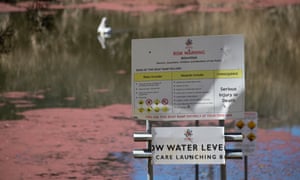
A huge mat of red duckweed floats on the surface of the Macquarie River due to the decreased flow of water.
A huge mat of red duckweed floats on the surface of
 the Macquarie River in Dubbo due to the decreased
flow of water. WaterNSW say Dubbo is set to be one of
the first NSW towns to lose water if it does not rain.
The projections from NSW’s river operator and bulk water supplier WaterNSW show without significant rain the first towns to lose water supply will be Dubbo, Cobar, Nyngan and Narromine with the Macquarie River forecast to run dry by November.

The Macquarie River experiences an average inflow of 1,448GL annually but in the past two years has seen just 97GL enter the river system, the data shows.

Read the story from The Guardian by Paul Karp and Australia Associated Press - “‘Critical': parts of regional NSW set to run out of water by November.”


(It’s events such as these that will focus peoples’ thinking about the climate crisis - Robert McLean)

19 June, 2019

New York to Approve One of the World’s Most Ambitious Climate Plans

New York lawmakers have agreed to pass a sweeping climate plan that calls for the state to all but eliminate its greenhouse gas emissions by 2050, envisioning an era when gas-guzzling cars, oil-burning heaters and furnaces would be phased out, and all of the state’s electricity would come from carbon-free sources. 
Under an agreement reached this week between legislative leaders and Gov. Andrew M. Cuomo, the Climate Leadership and Community Protection Act would require the state to slash its planet-warming pollution 85 percent below 1990 levels by 2050, and offset the remaining 15 percent, possibly through measures to remove carbon dioxide from the atmosphere.
If the state manages to hit those targets, it would effectively create a so-called net-zero economy, the ultimate goal of environmentalists and others seeking to slow the pace of global warming.

Read the story from The New York Times by Jesse McKinley and Brad Plumer - “New York to Approve One of the World’s Most Ambitious Climate Plans.”

25 December, 2018

Labour would 'radically transform economy' to focus on climate change

A future Labour government would oversee an economic revolution to tackle the climate crisis, using the full power of the state to decarbonise the economy and create hundreds of thousands of green jobs in struggling towns and cities.
 Experts brought together by Labour have suggested the party
should increase the UK’s installed offshore wind capacity sevenfold
if it gets into government.
Rebecca Long-Bailey, the shadow business secretary who is driving the party’s climate agenda, said the UK’s “entire society and entire economy” needed to be refocused to meet the looming challenge of ecological breakdown.

“It could not be made clearer to us and people are starting to realise how incredibly dangerous this situation is,” said Long-Bailey, a close ally of the Labour leader Jeremy Corbyn and the shadow chancellor John McDonnell. “There is no option but to radically transform our economy.”

But, in an interview with the Guardian, she said the crisis was also an opportunity to bring well-paid, highly skilled jobs and economic regeneration to some of the most marginalised communities in the country.


Read the story from The Guardian by Matthew Taylor - “Labour would 'radically transform economy' to focus on climate change.”

16 September, 2018

Bikes aren't just transportation, they are climate action

California Governor Jerry Brown kicked off the Global Climate Action Summit with a big announcement, so big that according to David Roberts of Vox, it "was so out of left field and yet so profound in its implications that few in the media, or even in California, seem to have fully absorbed it yet." He has declared that by 2045, the state will be totally carbon neutral -- the entire state economy. As Roberts notes, this is a very big deal.
Bikes - they may be the single best
way to decarbonize transportation.
SB 100, the bill Brown signed on Monday, commits the state to clean electricity by 2045, but electricity only accounts for about 16 percent of California’s greenhouse gas emissions. Brown’s executive order would commit the state to doing something about the other 84 percent — transportation, building heating and cooling, industry, all the many and varied energy services that rely on direct fossil fuel combustion rather than electricity.

That's a tall order. How are we going to decarbonize transportation? We can't all drive Teslas. Over at Greenbiz, Andrea Learned suggests a new emphasis on bikes and e-bikes. 


Read the Treehugger story by Lloyd Alter - “Bikes aren't just transportation, they are climate action.”

06 June, 2018

Massive wind farm approved in central Queensland

A billion-dollar wind farm planned for central Queensland is set to be the biggest in the state and one of the largest in Australia.
An artist's impression of the project, which
 is expected to begin next year.
The 195-turbine Lacour Energy project at Clarke Creek, north-west of Rockhampton, has been granted State Government approval, with construction expected to begin next year.
Company director Mark Rayner said the turbines would be positioned across eight cattle grazing properties, stretching 50 kilometres along the Broadsound Range and covering 76,000 hectares
"We have the full support of the landowners on which the project will be built on," he said.
Read the ABC News story by Megan Hendry and Jacquie Mackay - “Massive wind farm approved in central Queensland.”

03 June, 2018

An Indian state banned pesticides. Tourism and wildlife flourished. Will others follow?

SORENG, India — Fifteen years ago, the tiny Indian state of Sikkim launched a radical experiment: Its leaders decided to phase out pesticides on every farm in the state, a move without precedent in India — and probably the world.
Organic farms are perched on hillsides on the outskirts
 of Gangtok, in the Indian state of Sikkim. 
The change was especially significant for India, a country whose progress in agriculture was defined by the introduction of fertilizers and pesticides that rapidly boosted food production across the country, staving off famine and reducing the country’s reliance on foreign aid.

But with the indiscriminate use of pesticides came a spike in cancer rates in industrial farming areas. Rivers became polluted and soil infertile. Sikkim’s leaders say they were driven to go all-organic by those concerns and because pesticide residue — including from some chemicals banned in other countries — was tainting fish, vegetables and rice.


15 May, 2018

Biggest solar farm connects to the grid

The 100MW Clare solar farm – the biggest to date in Queensland – has begun exporting to the grid, as some 1400MW of large scale solar projects in the state get ready to begin production this year.

Clare, located  some 35 km southwest of Ayr, in north Queensland is the twice the size of the current biggest operating solar farm in the state, the recently connected 50MW Kinston project, although it will soon be overtaken.

The Clare solar farm is owned by Lighthouse Solar, whose have another project in north Queensland, the 20MW Hughenden solar farm, that is also now registered with AEMO and appears poised to begin production.

Clare has been injecting up to 20MW in each of the last few days. The two new solar farms join a string of new solar projects connected in Queensland, NSW and South Australia in the last few weeks, including Australia’s biggest that has just begun production


Read the story by Giles Parkinson from RenewEconomy - “Biggest solar farm connects to the grid.”