Showing posts with label 2050. Show all posts

29 November, 2019

‘Our house is on fire': EU parliament declares climate emergency

The European parliament has declared a global “climate and environmental emergency” as it urged all EU countries to commit to net zero greenhouse gas emissions by 2050.
Climate protesters outside the EU parliament in Brussels demand it declares a climate emergency.
Climate protesters outside the EU parliament in
Brussels demand it declares a climate emergency.
The vote came as scientists warned that the world may have already crossed a series of climate tipping points, resulting in “a state of planetary emergency”.
Intended to demonstrate Europe’s green credentials days before a crucial UN climate conference in Madrid, the vote also ratchets up pressure on Ursula von der Leyen, the incoming president of the European commission, who declared this week that the EU would lead the fight against “the existential threat” of the climate crisis.

Read the story from The Guardian by Jennifer Rankin - “‘Our house is on fire': EU parliament declares climate emergency.”

25 August, 2019

The Real Obstacle to Climate Action

WASHINGTON, DC – Climate change is probably the biggest threat facing humanity today. According to the United Nations Intergovernmental Panel on Climate Change, the world must cut its carbon dioxide emissions to net zero by 2050 in order to prevent global warming of 1.5°C, or likely more, above pre-industrial levels in this century. The challenge calls for drastic immediate action, because the infrastructure investments the world makes today will determine the carbon intensity of its growth path for decades.
Image result for The Real Obstacle to Climate Action

Yet despite widespread recognition of the size and urgency of the climate challenge, emissions continue to increase, land is “under growing human pressure,” and the Amazon has never been more threatened.Much of the early climate debate revolved around whether the world should take drastic immediate action to mitigate global warming, or adopt a more gradual approach. The gradualists argued with some success that drastic immediate measures would impose heavy short-term economic costs.But three recent developments have altered the course of the debate. First, the various feedback loops triggered by global warming now threaten to cause greater and more imminent damage than previously thought. 


Read the story from Project Syndicate - “The Real Obstacle to Climate Action.”

19 June, 2019

New York to Approve One of the World’s Most Ambitious Climate Plans

New York lawmakers have agreed to pass a sweeping climate plan that calls for the state to all but eliminate its greenhouse gas emissions by 2050, envisioning an era when gas-guzzling cars, oil-burning heaters and furnaces would be phased out, and all of the state’s electricity would come from carbon-free sources. 
Under an agreement reached this week between legislative leaders and Gov. Andrew M. Cuomo, the Climate Leadership and Community Protection Act would require the state to slash its planet-warming pollution 85 percent below 1990 levels by 2050, and offset the remaining 15 percent, possibly through measures to remove carbon dioxide from the atmosphere.
If the state manages to hit those targets, it would effectively create a so-called net-zero economy, the ultimate goal of environmentalists and others seeking to slow the pace of global warming.

Read the story from The New York Times by Jesse McKinley and Brad Plumer - “New York to Approve One of the World’s Most Ambitious Climate Plans.”

13 June, 2019

Zero emissions: UK aims to be first of G7 with 'ambitious' target

London: The UK will become the first major nation to pass a law mandating “net zero” greenhouse gas emissions by 2050, the government has announced.
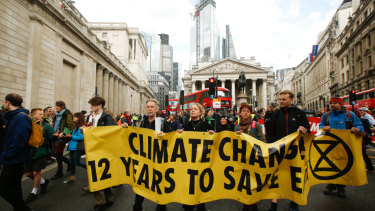
Climate activists from the Extinction Rebellion group demonstrate in London in April.
Climate activists from the Extinction Rebellion
group demonstrate in London in April.
And Downing Street has said it expects other countries to “follow suit”.
They have not specified how they will reach this goal – but it is likely to be though a combination of clean energy generation, tree planting, a change to domestic central heating technology and habits, and incentives to switch to an electric car and truck fleet.

Read the story from The Age by Nick Miller - “Zero emissions: UK aims to be first of G7 with 'ambitious' target.”

13 October, 2018

Climate Crisis Spurs UN Call for $2.4 Trillion Fossil Fuel Shift

The world must invest $2.4 trillion in clean energy every year through 2035 and cut the use of coal-fired power to almost nothing by 2050 to avoid catastrophic damage from climate change, according to scientists convened by the United Nations.


Their report published Monday adds pressure on policymakers and businesses to step up their response to global warming, which is boosting sea levels, making storms more violent and exacerbating poverty. The atmosphere is already almost 1 degree Celsius (1.8 Fahrenheit) hotter than it was at the start of the industrial revolution and on track to rise 3 degrees by 2100, according to the report. That’s double the pace targeted under the 2015 Paris climate agreements endorsed by almost 200 nations.


04 June, 2018

New Zealand’s productivity commission charts course to low-emission future

New Zealand has set itself a target of becoming carbon-neutral by 2050.
According to a recent report, New Zealand will need to increase
renewable electricity generation, plant more trees and continue
switching to electric transport more rapidly to achieve
 its zero carbon goal by 2050.
A recent report issued by the New Zealand Productivity Commission has found that this is an achievable goal, even under modest forecasts of technological progress and increases in carbon price.

New Zealand already had a goal of reducing greenhouse gas emissions to 50% below 1990 levels by 2050. That target had been in place since 2002, but emissions continued to rise through the 2000s.


Read the story on The Conversation by a Professor in Applied Mathematics from Massey University, Robert McLachlan - “New Zealand’s productivity commission charts course to low-emission future.”

22 March, 2018

Heat on over climate change

More than 140 million people in Africa, Latin America and South Asia could move to another part of their country by 2050 to escape the worsening impacts of climate change, unless urgent action is taken to curb global warming and help people adapt, the World Bank says.

Moving: Venezuelans cross the International Simon
Bolivar bridge into Cucuta, Colombia, as rising numbers
 of Venezuelans flee in a burgeoning refugee crisis.
Globally, the numbers of people forced to leave home because of water shortages, crop failures, sea-level rise, storm surges and other climate threats was likely to be much higher, researchers said.

But if global warming is effectively kept to limits set in the Paris Agreement on climate change, and people are helped to adapt, then the numbers migrating in the three regions will drop to about 40 million people, the study predicted.

‘‘We have a small window now, before the effects of climate change deepen, to prepare the ground for this new reality,’’ World Bank head Kristalina Georgieva said.

That preparation needs to include making economies less vulnerable to climate change, helping farmers adapt their growing techniques, and making city infrastructure more resilient to storms, rising sea levels, f loods or drought, the study noted. Cities also need to create enough jobs, and boost health and education services, to meet the needs of the growing number of people migrating to urban areas.

Without that preparation, cities could face serious repercussions, said Kanta Kumari Rigaud, who led the creation of the World Bank report.

‘‘We could see increased tensions and conflict . . . but that doesn’t have to be the future,’’ the environmental specialist said. ‘‘It won’t be a crisis if we plan for it now.’’

In the worst-case scenario, more than 85 million people could leave home by 2050 in sub-Saharan Africa, 40 million in South Asia, and 17 million in Latin America, the report noted.

And the number of climate migrants could accelerate after 2050, unless there is urgent action to hold global warming to below 2 °C above pre-industrial levels, the report noted.

The most vulnerable people, however, will be unable to move and will remain trapped in increasingly unviable areas, it predicted.

Many more people are migrating within their own countries than across borders, doing so for economic, social, political and environmental reasons, the World Bank report said.

In 2016, storms, floods and other weather-related disasters — not all of them driven by climate change — forced 23 million people to move within their countries, according to the Internal Displacement Monitoring Centre.

‘‘Although cross-border movement is much more attention-grabbing and can appear more dramatic, right now the internal movement of people forms the bulk of what’s going on,’’ United Kingdom-based Climate and Migration Coalition coordinator Alex Randall said.

Migration was not necessarily a bad thing, he said, and could be a good way to adapt to climate change and improve people’s lives.

‘‘It can be a positive, empowering experience. But it comes with risks as well. The emphasis should be on how we make migration safe,’’ he told the Thomson Reuters Foundation.

Although much migration is likely to take place from the countryside to urban areas, cities themselves will grapple with climate impacts as well.

For example, Dhaka in Bangladesh and Dar es Salaam in Tanzania are particularly vulnerable to rising sea levels and storm surges. Addis Ababa in Ethiopia, by comparison, could see slower population growth as it relies on increasingly unpredictable rainfall, the World Bank study noted.

Regions and cities that are likely to attract large numbers of climate migrants include Nairobi, the southern Indian highlands between Bangalore and Chennai, and the central plateau areas around Mexico City and Guatemala City.

But lack of clear data about how a particular area will be impacted by climate change, and when, makes it difficult for cities, governments and communities to plan.
Nonetheless, ‘‘(it’s) important to help people make good decisions about whether to stay where they are, or move to new locations where they are less vulnerable,’’ Ms Georgieva said.


Story in today’s Shepparton News by Alex Whiting (Reuters) - “Heat on over climate change.”

17 March, 2018

Big Australia's rubbish future does not have to go to waste.

Would the concept of waste become obsolete if our garbage had value?
Veena Sahajwalla, who spoke at a Slap Tomorrow forum
 in Shepparton in 2013, says being able to create your own
 materials is "the ultimate empowerment".
Imagine if you could get paid for the things you put in your rubbish, and countries competed to import waste.

Waste is an environmental issue as well as a resource issue, and as Australia approaches 2050 and a population of 40 million, resources will be more valuable than ever.

Will we look back on single-use products as 21st century madness?

That depends on the policy decisions we put in place today, and whether we can transition to a circular economy.


Read the ABC News story by Nick Kilvert - “Big Australia's rubbish future does not have to go to waste.

22 February, 2018

Of 21 Winter Olympic Cities, Many May Soon Be Too Warm to Host the Games

Distill the upcoming Winter Olympics in Pyeongchang, South Korea, to their essence and you get 15 sports that involve gliding on snow or ice. Because of climate change, though, by 2050 many prior Winter Games locations may be too warm to ever host the Games again.
Cross-country skiers at the 2014 Winter Olympics in Sochi, Russia. 
A team of researchers, led by Daniel Scott, a geography professor at the University of Waterloo in Ontario, came to that conclusion by taking climate data from previous Winter Games locations and applying climate-change models to predict future winter weather conditions.

The research, originally published in 2014, was updated this month to include the Pyeongchang Olympics, which begin Feb. 9, and the 2022 Winter Games in Beijing.


11 February, 2018

No Drop in U.S. Carbon Footprint Expected Through 2050, Energy Department Says

The carbon footprint of the United States will barely go down at all for the foreseeable future and will be slightly higher in 2050 than it is now, according to a new projection by the Energy Department's data office.
President Trump, speaking here at a refinery in North
Dakota, has pushed for policies that promote fossil fuels
 and for the removal of greenhouse gas regulations. 
If that projection came true, it would spell the end of an era in which the U.S. led the world in reducing the tonnage of carbon dioxide it pumped each year into the atmosphere.

The new plateau would reflect Donald Trump's determination to walk away from the Paris climate agreement, to abandon any thought of more ambitious climate change policies, and to overturn the main federal climate protections recently put in place, like President Barack Obama's rules to curtail emissions from electric power plants.


Read the Inside Climate News story by John H. Cushman Jr. - “No Drop in U.S. Carbon Footprint Expected Through 2050, Energy Department Says.”

25 September, 2017

Switzerland, where are your two extra planets?


The Swiss aim to live within their means.
If everybody on this planet lived like people in Switzerland today, it would take more than three planet Earths to provide all they demand.

Could Switzerland have moved to a one-Earth economy by 2050, as proposed by the ballot measure? Would it have been too fast? Would it be a loss or a gain?

The ballot’s goal was consistent with what the Paris Climate Agreement requires: to restrain global warming on average to less than 2 degrees Celsius depends on moving out of fossil fuel use way before 2050. Given the large fossil fuel dependence of Switzerland, making up 72% of the Swiss Ecological Footprint, and given the technical possibilities to decarbonize energy substantively, living up to the Paris goal would be consistent with achieving a one-Earth economy by 2050. That’s a goal the Swiss government already signed up for one year prior to the popular ballot.


Read the Global Footprint Network story - “Switzerland, where are your two extra planets?"