Showing posts with label the world. Show all posts

19 November, 2019

Huge Tesla battery in South Australia primed for big upgrade

The largest lithium-ion battery in the world – Tesla's big battery in South Australia – will undergo a 50 per cent expansion in a move its owners hope will increase the stability of the grid and reduce power bills.
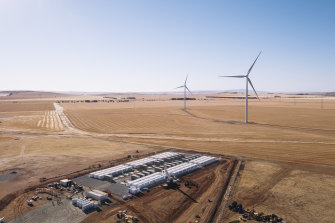
French energy giant Neoen has announced plans to expand the capacity of the huge Tesla battery installed at the Hornsdale Power Reserve in South Australia by 50 per cent.
French energy giant Neoen has announced plans to expand the capacity
 of the huge Tesla battery installed at the Hornsdale Power Reserve in
South Australia by 50 per cent.
Tech billionaire Elon Musk's Tesla built the huge battery in a remote area of South Australia in 2017. The battery system has the capacity of 100 megawatts and can store 129 megawatt-hours of energy from wind turbines nearby – enough to supply 30,000 homes for eight hours.
The battery system's capacity will now be increased to 150 megawatts under an expansion plan put forward by French energy giant Neoen, the owner of the site, with the support of Tesla and the state and federal governments.
Paired with the adjacent Hornsdale wind farm, Tesla's grid-scale battery, known as the Hornsdale Power Reserve, has helped reduce intermittency and manage increased demand during summer when the grid is under the most strain. In its first year of operation, it saved consumers more than $50 million, according to Neoen.

Read the story from The Sydney Morning Herald by Nick Toscano - “Huge Tesla battery in South Australia primed for big upgrade.”

26 October, 2019

Stopping Global Warming Will Cost $50 Trillion: Morgan Stanley Report

Topline: While estimates vary on the cost of halting global warming and reducing net carbon emissions to zero, a new report from Morgan Stanley analysts finds that to do so by 2050 the world will need to spend $50 trillion in five key areas of zero-carbon technology.

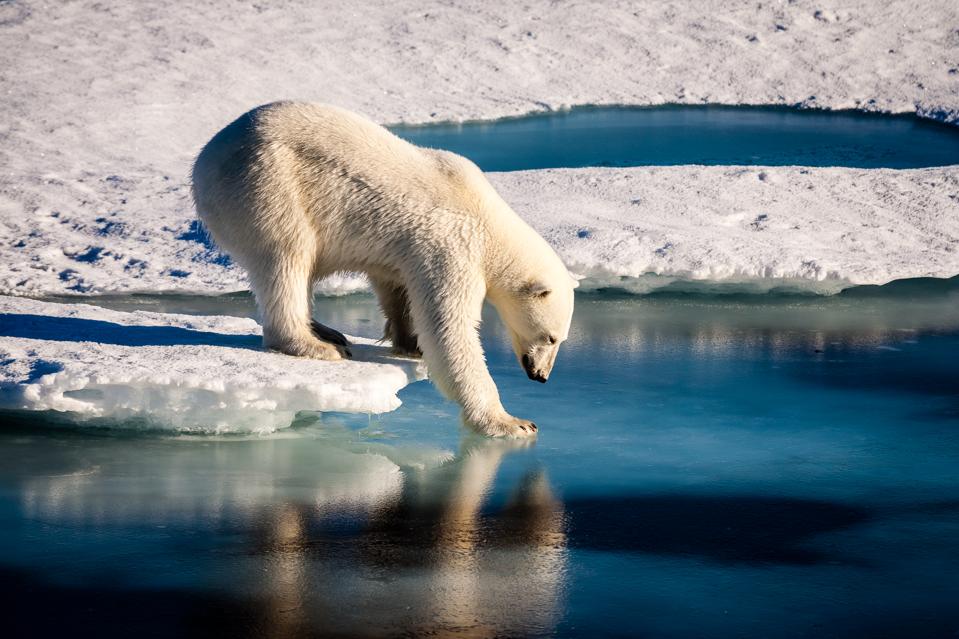
Majestic polar bear touching sea surface
A new report estimates that $50 trillion of
investment is needed in the next three decades.
  • Renewables will require $14 trillion of investment, and could deliver around 80% of global power by 2050—up from 37% today. As solar energy becomes more affordable, it will become the fastest-growing renewable technology.
  • Electric vehicles will become more important than ever in the bid to reduce greenhouse gas emissions from automobiles; $11 trillion will be needed to build more factories and develop the batteries and infrastructure needed for a widespread switch to electric vehicles—the total number of which could grow to nearly 950 million by 2050.
  • Carbon capture and storage, which Morgan Stanley says is the only viable option for reducing emissions from coal-fired plants, is another key area and would need almost $2.5 trillion of investment.
  • Hydrogen can help provide clean fuel for power, cars and other industries—it will require almost $20 trillion of cumulative investments to help make the gas, increase capacity to power plants and manage its storage.
  • Biofuels, like ethanol, will be key for future global transportation and eventually spread to aircraft and other forms of other travel—requiring $2.7 trillion by 2050.
Read the story from Forbes by Sergei Klebnikov - “Stopping Global Warming Will Cost $50 Trillion: Morgan Stanley Report.”

17 June, 2019

Civilisation will be under threat by 2050 if we don’t tackle climate change, report warns

The world is “on a path to the end of human civilisation and modern society as we have known it,” warns the Breakthrough National Centre for Climate Restoration.
Once international trade collapses, law and order
 will soon follow warns an Australian think-tank. 
“Even for 2C of warming, more than a billion people may need to be relocated and in high-end scenarios, the scale of destruction is beyond our capacity to model with a high likelihood of human civilisation coming to an end,” the report, written by David Spratt and former Royal Dutch Shell senior executive and Australian Coal Association chair Ian Dunlop, reads.
Among its members are former Australian defence department head and Royal Australian Navy Admeral Chris Barrie.
It’s all because of the loss of arable farm land. The collapse of international trade and communications. Nations warring to secure first-dibs on what remains. A massive migration of refugees.


(Listen to an interview with David Spratt on Climate Conversations)

25 May, 2019

It’s not entirely up to school students to save the world

In the past several months, people around the world have watched in awe as school students, led by the Swedish teen-ager Greta Thunberg, have taken their concerns about the climate crisis to a new level, with a series of one-day strikes. The latest took place on Friday, and drew what is estimated as more than a million participants in a hundred and twenty-five countries. The strikes have been the biggest boost yet for the global climate movement, galvanizing public attention by reminding people just who will have to deal with the mess that older generations have created. Thunberg has spoken to the Pope and to the British and European parliaments—and this week she and her fellow student leaders are speaking to everyone else who’s older than them. On Thursday, they issued an appeal to adults to take up the same tactic, and on Friday a number of them responded, with a letter pledging to organize the first of a series of all-ages, one-day climate strikes, on Friday, September 20th. (I was among them and helped draft the letter.) The initial list of signees is composed of a wide array of, well, adults, from around the world. Some have spent their lives trying to make change from within the system, such as Christiana Figueres, the United Nations diplomat who served as the lead negotiator of the Paris climate accords. Others are writers (Margaret Atwood, Barbara Kingsolver), scientists (Tim Flannery, of the University of Melbourne; Katharine Hayhoe, of Texas Tech), trade-union leaders (Sharan Burrow, the general secretary of the International Trade Union Confederation), and indigenous leaders from Australia (Anne Poelina) to America (Tom B. K. Goldtooth) and the Arctic (Jenni Laiti).
Young people have used strikes to call attention to the
climate disaster. Now they’ve challenged adults to do the same.
What all of these people have in common is a strong sense that business as usual has become the problem, and that it needs to be interrupted, if only for a day. The climate crisis is a perplexing one because, mostly, we just get up each day and do what we did the day before, as if an enormous emergency weren’t unfolding around us. That hasn’t been true of past crises: during the Second World War, oceans may have separated American civilians from the fighting, but every day they were aware of the need to change their ways of life: to conserve resources, buy bonds, black out their windows at night if they lived on the coast.


Read the story from The New Yorker by Bill McKibben - “It’s not entirely up to school students to save the world.”

27 December, 2018

Farewell, Chevy Volt: an oral history of the plug-in hybrid

THE DEATH OF the Chevrolet Volt was a quiet one. It came in early December amid news that General Motors was cutting 14,000 jobs, closing three assembly plants, and also ending production of the Chevy Cruze and Impala, the Buick LaCrosse, and the Cadillac CT6. It made sense: Sales have been slowing, Americans aren’t buying compact cars or sedans anymore, and GM is repositioning itself for a future that includes both bigger vehicles and many more electrics.
A decade ago, the plug-in hybrid Chevrolet Volt was
 the signal to the country and the world that General
 Motors might have run out of money, but it still had
ideas and engineering talent.
A decade ago, the Volt, a plug-in hybrid, was the signal to the country and the world that General Motors might have run out of money, but it still had ideas and engineering talent. But it was ultimately eclipsed by GM’s successful launch of the Bolt EV—the $37,500 all-electric car that beat Tesla’s Model 3 to market.


Read the Wired story by Alex Davies - “Farewell, Chevy Volt: an oral history of the plug-in hybrid.”

11 November, 2018

In a World of Their Own - George Monbiot

Knowingly creating a false impression of the world: this is a serious matter. It is more serious still when the BBC does it, and yet worse when the presenter is “the most trusted man in Britain”. But, as his latest interview with the Observer reveals, Sir David Attenborough sticks to his line that fully representing environmental issues is a “turn-off”.
David Attenborough - In a world of his own.
His new series, Dynasties, will mention the pressures affecting wildlife, but Attenborough makes it clear that it will play them down. To do otherwise, he suggests, would be “proselytising” and “alarmist”. 

His series will be “a great relief from the political landscape which otherwise dominates our thoughts.” In light of the astonishing rate of collapse of the animal populations he features, alongside most of the rest of the world’s living systems, and when broadcasting as a whole has disgracefully failed to represent such truths, I don’t think such escapism is appropriate or justifiable.

It is not proselytising or alarmist to tell us the raw truth about what is happening to the world, however much it might discomfit us. Nor do I believe that revealing the marvels of nature automatically translates into environmental action, as the executive producer of Dynasties claims. I’ve come to believe it can have the opposite effect.


Read the article from Guardian columnist, George Monbiot - "In a World of Their Own.”

03 November, 2018

Palau to become the first country to ban toxic sunscreen to protect its reefs

Palau is set to become the first country in the world to ban certain reef-toxic sunscreens, a move the tiny Pacific island nation hopes will help protect its coral reefs.
There is evidence certain chemicals in
sunscreens are toxic to marine life.
It comes after a similar initiative in Hawaii, which became the first US state to ban the sale of sunscreens containing two common chemicals in May.

Palau, east of the Philippines, has already banned chemical sunscreens from Jellyfish Lake, one the country's most famous tourist attractions.

21 October, 2018

US city empowers Australian councils to develop solar as lack of federal climate policy causes concern

A city in southern California has become the first city in the world to be zero net energy with solar farms powering the entire city, and now it is inspiring Australian cities to follow its lead.
Rex Parris is the Mayor of Lancaster in southern
 California, the first zero net energy city.
Being zero net energy means the city produces more solar electricity through solar farms than it can use.

Lancaster Mayor Rex Parris has attributed an increase in employment, new manufacturers moving to the city, and a reduction in crime to the approach to alternative energy.

This week, Mr Parris has been in Kiama on the NSW south coast at the Cities Power Partnership summit, speaking to local council representatives from around Australia about how they might be able to do something similar.


13 October, 2018

Why we can’t reverse climate change with ‘negative emissions’ technologies

In a much-anticipated report, the Intergovernmental Panel on Climate Change (IPCC) said the world will need to take dramatic and drastic steps to avoid the catastrophic effects of climate change.
Without rapid and dramatic changes, the world will
face a higher risk of extreme weather and other
 effects of climate change.
Featured prominently in the report is a discussion of a range of techniques for removing carbon dioxide from the air, called Carbon Dioxide Removal (CDR) technologies or negative emissions technologies (NETs). The IPCC said the world would need to rely significantly on these techniques to avoid increasing Earth’s temperatures above 1.5 degrees Celsius, or 2.7 degrees Fahrenheit, compared to pre-industrial levels.

Given that the level of greenhouse gases continues to rise and the world’s efforts at lowering emissions are falling way short of targets climate scientists recommend, what contribution we can expect from NETs is becoming a critical question. Can they actually work at a big enough scale?


Read the piece from The Conversation by a Senior Research Engineer, Massachusetts Institute of Technology, Howard J. Herzog -  “Why we can’t reverse climate change with ‘negative emissions’ technologies.”

Climate Crisis Spurs UN Call for $2.4 Trillion Fossil Fuel Shift

The world must invest $2.4 trillion in clean energy every year through 2035 and cut the use of coal-fired power to almost nothing by 2050 to avoid catastrophic damage from climate change, according to scientists convened by the United Nations.


Their report published Monday adds pressure on policymakers and businesses to step up their response to global warming, which is boosting sea levels, making storms more violent and exacerbating poverty. The atmosphere is already almost 1 degree Celsius (1.8 Fahrenheit) hotter than it was at the start of the industrial revolution and on track to rise 3 degrees by 2100, according to the report. That’s double the pace targeted under the 2015 Paris climate agreements endorsed by almost 200 nations.


07 October, 2018

Scientists champion forests as 'unsung hero' of climate action

Barcelona: Scientists from around the world called for stepped-up efforts to use forests to keep global warming to the lowest limit agreed by governments in 2015, as a key report on how to meet that goal is finalised in South Korea this week.
"Our planet's future climate is inextricably tied to the
 future of its forests," the international panel said.  
"Forests really are the unsung hero of our struggle to address climate change," said Deborah Lawrence, a University of Virginia professor and one of 40 scientists who backed a statement emphasising how the Earth's climate depends on forests.

The natural processes by which forests suck in and store carbon help reduce levels of planet-warming carbon dioxide in the atmosphere - and forests also underpin key parts of the world's economy, the scientists said.


Read the story by Megan Rowling from The Age - “Scientists champion forests as 'unsung hero' of climate action.”

18 September, 2018

Australia ranks in bottom three rich countries for environmental policies

Australia's status as one of the largest per capita greenhouse gas emitters in the world has contributed to a bottom three ranking for environmental policy among wealthy nations.
Australia's high per capita emissions reduction are
 holding it back, according to a new global development index.
But Australia has jumped four places overall in the Center for Global Development's commitment to development index thanks to effective foreign aid spending and dedication to open trading relationships.

The annual index – which analyses 27 developed countries for their impact on the world's poor across seven policy areas – found Australia would struggle to improve on its middle-of-the-pack ranking of 14th without boosting foreign aid and efforts to address environmental issues, especially climate change.


Read the story by Fergus Hunter from The Age - “Australia ranks in bottom three rich countries for environmental policies."

10 September, 2018

Dear politicians, get your heads out of the coal pit and into the real world

As a third-generation farmer from Harden in New South Wales, I’ve weathered climate extremes my whole life. It’s simply part of doing business in one of the most variable climates in the world.
‘This is not a “hard done by farmer” narrative. We’re tough
and we manage our resources carefully, making decisions based
upon the best available evidence’.
The truth is, Australian farmers are good at what they do, and we know when things are changing.

Read the opinion piece from The Guardian by Peter Holding - “Dear politicians, get your heads out of the coal pit and into the real world.”

04 August, 2018

Lost at sea: the race against time to save the Carteret Islands from climate change

They were supposed to be underwater by now.

Children help with the work on Carteret Island.

The Carteret Islands in the Pacific were the first place in the world to require population relocations due to climate change related sea level rises, with predictions they would be submerged by 2015.

However the islands are still there sitting roughly 90 kilometres from northern Bougainville, but only just — with a highest point of just 1.5 metres, the atolls are vulnerable to even slight sea level rises.


Read the ABC News story/pictures by Darren James - “Lost at sea: the race against time to save the Carteret Islands from climate change.”

19 June, 2018

Frydenberg energy plan merits support

To this day, a statement by the first chancellor of Germany, Otto von Bismarck (1815-1898), has resounded throughout the world: ‘‘Politics is the art of the possible, the attainable – the art of the next best.’’ This notion is also expressed in the more recent axioms that politics is the art of compromise, and indeed is more about art than science. Viewed through this powerful prism, Australia’s energy policy has until recent months reflected limited artistry and an insufficient regard for science.
Environment and Energy Minister Josh Frydenberg: a
 powerful man with a power plan is having trouble
getting colleagues to see the light.
In recent days, an update from the Coalition government on the National Energy Guarantee, a policy to establish a carbon emissions reduction guarantee in the electricity market alongside a reliability guarantee, has reignited internecine strife, with supporters of coal-generated power pushing, in effect, for a delay in the inevitable and economically and environmentally responsible transition to a low-carbon economy. Such ideological intransigence has generated a decade of policy failure; the biggest impediment to the transition has been the lack of certainty. The lack of a clear and consistent policy has shackled the necessary investment in renewable energy.


Read the Editorial from today’s Age - “Frydenberg energy plan merits support.”

05 May, 2018

Is Buying Renewables Anti-American?

COUNTRIES AROUND THE world are embracing renewable energy like solar and wind power and switching from coal to natural gas. But as they plan to invest billions of dollars in such infrastructure projects, they might also have to pick a side.

With the U.S. betting heavily on natural gas and China tightening its grip on the manufacturing of solar panels, choosing one technology over the other might risk alienating – or could end up currying favor with – one superpower or the other.

In short, new solar facilities – while friendly to the global environment – could one day become seen as the anti-American choice.


Read the U.S. News and World Report story - “Is Buying Renewables Anti-American?”

11 March, 2018

Renewable Energy Has More Economic Benefits Than You Know.”

Renewable energy is already cheaper than other energy options in most of the world, but it comes with other economic and societal benefits as well. 
Renewable energy - jobs, jobs, jobs!
Because of the number of countries investing in renewable energy, the complexity of their national economies and their energy infrastructure details, it isn’t possible to cover everything in one online article. 

The subject would be better addressed in a book. So, this article is intended only to be a snapshot of some key high-level points.


Read the CleanTechnica story why Jake Richardson - “Renewable Energy Has More Economic Benefits Than You Know.”