Showing posts with label South Australia. Show all posts

04 January, 2020

Kangaroo Island bushfire emergency sees tourist lodges ravaged as firefighters battle 'unstoppable' blaze’

Fire crews in South Australia have spent the night battling an emergency bushfire on Kangaroo Island, which is threatening to engulf most of Australia's third-largest island.
A bushfire smoke plume rises from the horizon near a cliff looking out onto ocean. The foreground has turned orange as a result.
Multiple scrub fires continue to burn across Kangaroo
 Island's western half, such as this one in Cape Torrens.
On Friday night, Kangaroo Island's Ravine fire was described as "virtually unstoppable" and the Country Fire Service (CFS) has issued bushfire warnings for the entire 4,400-square-kilometre island. 
At 3:00am Saturday, a watch and act warning was issued for the western end of the island, which includes areas west of Parndana such as Flinders Case, Vivonne Bay, Kelly Hill, Western River, Hanson Bay, Gosselands, Middle River and Stokes Bay. 


19 November, 2019

Huge Tesla battery in South Australia primed for big upgrade

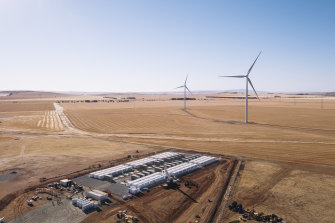
The largest lithium-ion battery in the world – Tesla's big battery in South Australia – will undergo a 50 per cent expansion in a move its owners hope will increase the stability of the grid and reduce power bills.
French energy giant Neoen has announced plans to expand the capacity of the huge Tesla battery installed at the Hornsdale Power Reserve in South Australia by 50 per cent.
French energy giant Neoen has announced plans to expand the capacity
 of the huge Tesla battery installed at the Hornsdale Power Reserve in
South Australia by 50 per cent.
Tech billionaire Elon Musk's Tesla built the huge battery in a remote area of South Australia in 2017. The battery system has the capacity of 100 megawatts and can store 129 megawatt-hours of energy from wind turbines nearby – enough to supply 30,000 homes for eight hours.
The battery system's capacity will now be increased to 150 megawatts under an expansion plan put forward by French energy giant Neoen, the owner of the site, with the support of Tesla and the state and federal governments.
Paired with the adjacent Hornsdale wind farm, Tesla's grid-scale battery, known as the Hornsdale Power Reserve, has helped reduce intermittency and manage increased demand during summer when the grid is under the most strain. In its first year of operation, it saved consumers more than $50 million, according to Neoen.

Read the story from The Sydney Morning Herald by Nick Toscano - “Huge Tesla battery in South Australia primed for big upgrade.”

21 May, 2019

Tesla big battery delivered a $22 million profit in 2018.

The Tesla big battery in South Australia has delivered a handsome profit in its first full year of operation in South Australia for owners Neoen Australia, as well as playing a key role in lowering market costs and keeping the lights on.
The profitable Tesla 'big battery' in South Australia.
The 100MW/129MWh battery – still the biggest lithium-ion battery in the world, but officially known as the Hornsdale Power Reserve – cost around $96 million to build but pulled in revenue of €18 million ($A29 million) in 2018 (as we reported in February).

It now emerges that the profit from the operation (earnings before interest, depreciation, and tax) was €14.2 million for 2018 ($A22.8 million at current exchange rates), adding on to to €0.4 million of earnings from the single month of operation in 2017.


Read the story from RenewEconomy by Giles Parkinson - “Tesla big battery delivered a $22 million profit in 2018.”

17 May, 2019

Great Australian Bight: parties soften stance as voters protest over drilling

A last-ditch effort to win votes in key seats in South Australia and Victoria has prompted both major parties to make changes to their policies on oil drilling in the Great Australian Bight.
Protests against offshore drilling in the Bight have forced
the Coalition and Labor to shift ground in the 2019 Australian election
The resources minister Matt Canavan – who has previously said offshore oil exploration should be a national priority – said on Thursday a re-elected Coalition government would commission an independent audit of the oil regulator’s consideration of exploration in the Bight.

Canavan and the environment minister Melissa Price said in a statement they recognised “the Great Australian Bight and the surrounding region are important to local communities, and the fishing and tourism industries”.


Read the story from The Guardian by Lisa Cox - “Great Australian Bight: parties soften stance as voters protest over drilling.”

15 January, 2019

Australia extreme heatwave: 'code red' issued as Port Augusta hits 48.9C

Port Augusta in South Australia has reached 48.9C on Tuesday, as a heatwave sets in across much of Australia threatening more record hot days.
 Australia is having an extreme heatwave, with daytime
 maximum temperatures forecast to extend up to the
mid-40s in parts of South Australia, Victoria and NSW.
All-time highest minimum temperatures have also been broken in three places. Meekatharra in Western Australia and Fowlers Gap and White Cliffs in New South Wales all registered an overnight minimum of 33C on Monday.

Severe to extreme heatwave conditions extending from the interior of WA across South Australia, Tasmania, Victoria, the ACT and NSW will bring maximum temperatures of 8C to 12C above average, and in some places up to 16C above average before the end of the week.


Read the story from The Guardian by Lisa Cox - “Australia extreme heatwave: 'code red' issued as Port Augusta hits 48.9C."

02 January, 2019

Warning for extreme heatwave for southern Australia after new year reprieve

Temperatures will climb above 40C in South Australia and Victoria on Thursday and Friday and an ex-tropical cyclone could re-form off the coast of Queensland.
 A man stretches during sunrise over Altona pier in Melbourne,
which is predicted to reach 42C on Friday, when an extreme
heatwave is forecast for southern Australia.
After a couple of milder days in parts of southern Australia, the Bureau of Meteorology is forecasting a resurgence of the high temperatures seen throughout the Christmas period, with possible severe to extreme fire danger over the next two days.

A broad area of the country will have temperatures 10 to 16 degrees above average for January. Adelaide is expected to reach 41C on Thursday and Melbourne 42C on Friday.

Parts of inland Victoria will have temperatures that climb into the mid 40s over the next two days: Mildura in the state’s northwest is forecast to reach 41C on Thursday and 46C on Friday.


Read the story from The Guardian by Lisa Cox - “Warning for extreme heatwave for southern Australia after new year reprieve.”

24 December, 2018

Bees 'starving' in South Australia as erratic weather takes heavy toll on hives, honey yields

Bees are suffering from starvation and hives have died following erratic weather patterns in South Australia that have been blamed for an 80 per cent drop in honey yield.
Apiarists are reporting lower-than-average bee numbers.
Hot spells followed by cold and wet periods throughout spring and early summer has resulted in some plants flowering haphazardly, or not at all, leaving many bees without enough food.

Hackham apiarist Bill Hawkes has been removing hives and bee swarms on behalf of the State Government and councils for 45 years.

In an average year he will remove 20 to 30 a week, but this year he said he had been lucky to get three jobs a week, with a lot of them for European wasps.


21 December, 2018

Heatwave to hit Australia after Christmas with 45 degrees in the south

A post-Christmas heatwave is set to hit Australia next week, stretching from Broome to Melbourne, peaking at 45C in South Australia, and bringing the heat to the Boxing Day Test.
 Inland areas of Australia are expected to experience
  temperatures of up to 45C in the days after Christmas Day. 
The Bureau of Meteorology has issued a three-day heatwave warning for inland areas across nearly the whole country from Christmas to 28 December.

Severe to low heatwaves will cover northern and central Western Australia, central South Australia, northern Victoria and southern New South Wales in the post-Christmas holiday period.

The Melbourne Cricket Ground will hit a maximum of 32C on Boxing Day, and parts of South Australia will rise to 45C the day after.


Read the story from The Guardian by Zaaman Zhou - “Heatwave to hit Australia after Christmas with 45 degrees in the south.”

31 October, 2018

Early season records set to tumble as hot air mass looms from the north

Parts of Victoria, South Australia and New South Wales are set to swelter through record-breaking temperatures this week, according to the Bureau of Meteorology.
Sydney is forecast to experience a low-intensity
 heatwave over the next few days.
The temperature in Melbourne could hit 34 degrees Celsius tomorrow — 11C over the average November maximum.

Adelaide, meanwhile, is set to reach 36C, which is 12C over the average.

On Friday, Sydneysiders could be facing a 37C day, which is 13C over the average.

Jenny Sturrock, senior forecaster with the Bureau of Meteorology, says the temperatures will set "early season records" tumbling.


Read the story from ABC News by Kate Doyle and Simon Galletta  - “Early season records set to tumble as hot air mass looms from the north.”

27 September, 2018

Tesla battery cost revealed two years after SA blackout

Two years since South Australia was plunged into darkness during a statewide blackout, new light has been shed on the cost of the Tesla battery — just one of the projects designed to prevent power failure in the state.
Tesla's lithium ion battery near Jamestown was switched online in 2017.
A 505-page report released by Neoen this month ahead of an initial public offering suggested the battery cost around $90 million, at the current exchange rate.

The giant 100-megawatt lithium ion battery near Jamestown in the state's mid-north commenced operation late last year.


Read the ABC News story boy Daniel Keane - “Tesla battery cost revealed two years after SA blackout.”

14 May, 2018

The stunning numbers behind success of Tesla big battery

The Tesla big battery in South Australia has already taken a 55 per cent share in the state’s frequency and ancillary services market, and lowered prices in that market by 90 per cent, new data has shown.
Stunning numbers.
The stunning numbers on the economics of the country’s first utility-scale battery were presented at the Australian Energy Week conference in Melbourne on Thursday by McKinsey and Co partner Godart van Gendt.

Speaking as part of a panel on the leading technologies and strategies that will help manage the transition to renewables in Australia, van Gendt said the data was more evidence that battery storage would “play a very big role.”

He said that a lot of discussion around the success of the big battery – the biggest of its kind in the world, and delivered at break-neck speed – had focused on the fact that “we did it,” and not on the economics.


Read the RenewEconomy story - “The stunning numbers behind success of Tesla big battery.”

11 May, 2018

Here’s how a complex low-pressure system sent temperatures plummeting

New South Wales, Victoria, Tasmania and South Australia are currently affected by a massive complex low pressure system, dropping temperatures and bringing rain, hail, wind and snow.
The complex low weather system currently swirling over south-eastern Australia.
While complex low pressure systems like this come along every year or so, some Australians may be feeling whiplash after a particularly warm autumn.

Typically, as Victoria and Tasmania head into winter we see cold fronts that move from west to east, generating rain and thunderstorms. This weather system started off like that, but developed into a complex low that will stay with us for the rest of the week.


Read the piece on The Conversation by a Senior Meteorologist, Australian Bureau of Meteorology, Adam Morgan - “Here’s how a complex low-pressure system sent temperatures plummeting.”

08 March, 2018

South Australia’s Iron Duchess mine could be given new life as 90MW pumped hydro plant

The Australian Renewable Energy Agency (ARENA) has today announced its support of a feasibility study to assess the potential to turn a mothballed mine in South Australia into a 90MW pumped hydro energy storage (PHES) plant.
Mothballed mine to become pumped hydro energy storage plant.
On behalf of the Australian Government, ARENA is committing $500,000 to GFG Alliance to begin the first phase of establishing the technical and commercial feasibility of bringing a disused mine site in the South Middleback Ranges, near Whyalla, back to life as a potential PHES power plant.

The $1.7 million project will investigate if the existing mine pit of “Iron Duchess North” could be utilised as a lower reservoir for a PHES plant creating an estimated capacity of 90 MW and 390 MWh of storage.

Pumped hydro works by pumping water uphill between two connected reservoirs when electricity is cheap and abundant, and running water downhill to power turbines when electricity is needed.

12 February, 2018

SA to host Australia’s first green hydrogen power plant

The South Australia government has announced funding for what will be Australia’s first renewable-hydrogen electrolyser plant – a 15MW facility to be built near the end of the grid at Port Lincoln on the Eyre Peninsula.

T
he “green hydrogen” plant – to be built by Hydrogen Utility (H2U), working with Germany’s thyssenkrupp – will include a 10MW hydrogen-fired gas turbine, fuelled by local wind and solar power, and a 5MW hydrogen fuel cell.

Both will supply power to the grid, will support two new solar farms and a local micro-grid, and will also include “distributed ammonia” that can be used as an industrial fertiliser for farmers and aquaculture operators.

The $117.5 million project, which will receive a $4.7 million grant and a $7.5 million loan from South Australia’s Renewable Technology Fund, is being described as a “globally-significant demonstrator project” for the emerging hydrogen energy sector.


Read the RenewEconomy story by Giles Parkinson - “SA to host Australia’s first green hydrogen power plant.”

01 December, 2017

Tesla’s big battery a shining light for SA but storms leave neighbours in the dark

The world's biggest lithium ion battery has been launched in South Australia, with Premier Jay Weatherill declaring it an example of SA "leading the world”.
Tesla's lithium-ion battery will store power from the Hornsdale windfarm.
Mr Weatherill travelled to the site of the battery near Jamestown in the state's north with Romain Desrousseaux, the deputy chief executive officer of French renewable energy company Neoen, which will operate the 100-megawatt Tesla battery attached to its Hornsdale windfarm.

Tesla boss Elon Musk — who travelled to South Australia twice this year to mark significant milestones for the battery — did not visit for this event.

Mr Weatherill made light of the billionaire's non-attendance, pointing out Mr Musk had delivered on his promise to deliver the battery within a 100-day deadline or deliver it free.


23 November, 2017

Elon Musk's giant battery is set for testing in South Australia

Billionaire Elon Musk's giant battery being built in South Australia will be energised in coming days and begin testing, indicating Tesla is on track to meet a 100-day self-imposed deadline to install the system.
The world’s biggest lithium iron battery farm takes
 shape near Jamestown, 200 kilometres north of Adelaide.
Tesla power packs have now been fully installed on a site near a wind farm north of Adelaide and will be tested to ensure the battery meets standards laid down by the energy market operator, the South Australia state government said in a statement on Thursday.

South Australia's Premier Jay Weatherill said in the statement he will join representatives from Tesla and others next week to officially launch the battery, which "has put South Australia and Jamestown on the map as a world leader in renewable energy with battery storage.”

"The world's largest lithium-ion battery will be an important part of our energy mix, and it sends the clearest message that South Australia will be a leader renewable energy with battery storage", he said.


Read the Sydney Morning Herald story by Perry Williams - “Elon Musk's giant battery is set for testing in South Australia.”

25 October, 2017

Back to square one in energy policy: we now have a plan to produce a plan

A year and a day — that’s how long it took Frydenberg to kill off “Finkel”.
Prime minister Malcolm Turnbull (left) and federal environment
and energy minister John Frydenberg during a press conference
at parliament house in Canberra on 17 October 2017.
On 7 October 2016, just nine days after a series of tornados took out at least 22 transmission pylons in South Australia and set off a cascading series of events resulting in a state-wide blackout, federal environment and energy minister John Frydenberg commissioned chief scientist professor Alan Finkel to review the stability of our energy system. Finkel’s expert team met with regulators around the world, considered 390 submissions, held 120 meetings and commissioned modelling from multiple experts.

On 8 October this year, word trickled out that the clean energy target (CET), Finkel’s centrepiece, was dead.

A week later, Frydenberg announced the national energy guarantee (Neg). In just three weeks, with no public process, no modelling, no consultation with the Coag energy council, whose approval it requires, the newly formed Energy Security Board (ESB) had knocked together an alternative “conceptual framework”, described in an eight-page letter and a media release, that proposes to push responsibility for reliability and emissions reduction to electricity retailers.


Read the story by Simon Holmes à Court on The Guardian - “Back to square one in energy policy: we now have a plan to produce a plan.”

23 September, 2017

Tony Abbott's gut v Elon Musk's brain and billions: which would you follow?

South Australia has one of the highest concentrations of renewable energy in the world. And its government was recently the first to announce a state-based bank tax. But while Australians have been told these "reckless" policies will destroy jobs and discourage investment, some of the world's most-successful entrepreneurs recently chose to invest big in the state. How could this be?

Over time, Tony Abbott, who now champions
 coal, has both supported and opposed
 carbon taxes, emissions-trading schemes
 and renewable-energy targets. 
Tech entrepreneur Elon Musk, who gave the world PayPal, Tesla and SpaceX, recently secured the bid to build the world's largest battery-storage plant in South Australia. English billionaire Sanjeev Gupta, whose family fortune was made in good old-fashioned steel, recently bought the Whyalla steelworks. Either these businessmen didn't do their due diligence or what conservative politicians tell us about South Australia is utter nonsense. I know which way I'd lean.


Read the column in The Canberra Times by Richard Denniss - “Tony Abbott's gut v Elon Musk's brain and billions: which would you follow?”

24 August, 2017

Port Augusta solar thermal plant cautiously welcomed by locals

South Australia has the highest unemployment rate in the country. It also has had some well-documented problems with energy reliability, following the closure of the main coal-fired power station at Port Augusta. 
Lateline host, Emma Alberici.
The state government has announced a $650 million solar thermal plant will be built there, creating hundreds of construction jobs.

 Reporter Leah MacLennan travelled to Port Augusta to find out what the locals think of the plan.


Watch Leah MacLellan’s report on the ABC’s Lateline - "Port Augusta solar thermal plant cautiously welcomed by locals."

14 August, 2017

Port Augusta solar thermal plant to power South Australian government

A proposed solar thermal power plant in South Australia’s mid-north has been contracted to supply all the state government’s power needs.

Solar Reserve’s Crescent Dune plant in Nevada will
 be a blueprint for its 150 megawatt solar thermal
plant in Port Augusta. 
Work on the $650m SolarReserve facility will start in 2018, creating 650 construction jobs and 50 ongoing positions.

The state government said the 150 megawatt plant, to be ready in 2020, would dispatch energy to the grid even when the sun was not shining.


Read The Guardian story - “A proposed solar thermal power plant in South Australia’s mid-north has been contracted to supply all the state government’s power needs.

Work on the $650m SolarReserve facility will start in 2018, creating 650 construction jobs and 50 ongoing positions.

The state government said the 150 megawatt plant, to be ready in 2020, would dispatch energy to the grid even when the sun was not shining.