Showing posts with label wind. Show all posts

23 March, 2020

North Queensland needs a new link to unlock massive wind and solar resource

Queensland needs around 15 gigawatts (GW) of wind and about 8GW of utility solar plus rooftop solar to go 100% renewable and be self-sufficient.
Image result for North Queensland needs a new link to unlock massive wind and solar resource

Queensland has around 39GW of wind resource and about 45GW of  solar resources. Both the quality and the quantity resource are in the north of the State with “North Queensland Renewable Hub” having enough resource by itself to run the State. The resource in the South of the State is not enough to provide a high level of renewable power to Queensland.
Before the last election, the Queensland Government had a  “Powering North Queensland” plan, but nothing much has come of it.
The Australian Energy Market Operator, in developing the Integrated System Plan, did not see the need for the North Queensland resource despite the fact that not only is it generally of higher quality but also the wind is negatively correlated with wind in other  States.

Read the story from RenewEconomy by David Leitch - “North Queensland needs a new link to unlock massive wind and solar resource."

18 November, 2019

Sanders’s Climate Ambitions Thrill Supporters. Experts Aren’t Impressed

WASHINGTON — Senator Bernie Sanders’s $16 trillion vision for arresting global warming would put the government in charge of the power sector and promise that, by 2030, the country’s electricity and transportation systems would run entirely on wind, solar, hydropower or geothermal energy, with the fossil fuel industry footing much of the bill much as Mexico was to pay for the border wall.
Climate scientists and energy economists say the plan is technically impractical, politically unfeasible, and possibly ineffective.
Yet the criticism does not appear to bother many of the young voters who will have an important role in selecting a Democratic presidential candidate, and who overwhelmingly place climate change at the top of their priority lists, according to polls.
“He has some really great ideas that may not be passed, but it’s definitely stuff that needs to be brought up,” said Chandler Condon, a 25-year-old supporter who traveled from Denver to Des Moines last week for a climate rally with Mr. Sanders.

Read the story from The New York Times by Lisa Friedman - “Sanders’s Climate Ambitions Thrill Supporters. Experts Aren’t Impressed.”

02 April, 2019

New figures show we’re using more energy and still pumping out more emissions — so why aren’t we moving the dial?

This comes as no surprise. The analysis from the International Energy Agency is in line with other preliminary reports from other organizations. But it raises an awkward question: if renewables are growing and the prices of solar, wind, and batteries are falling, why is the world’s climate pollution still going up?
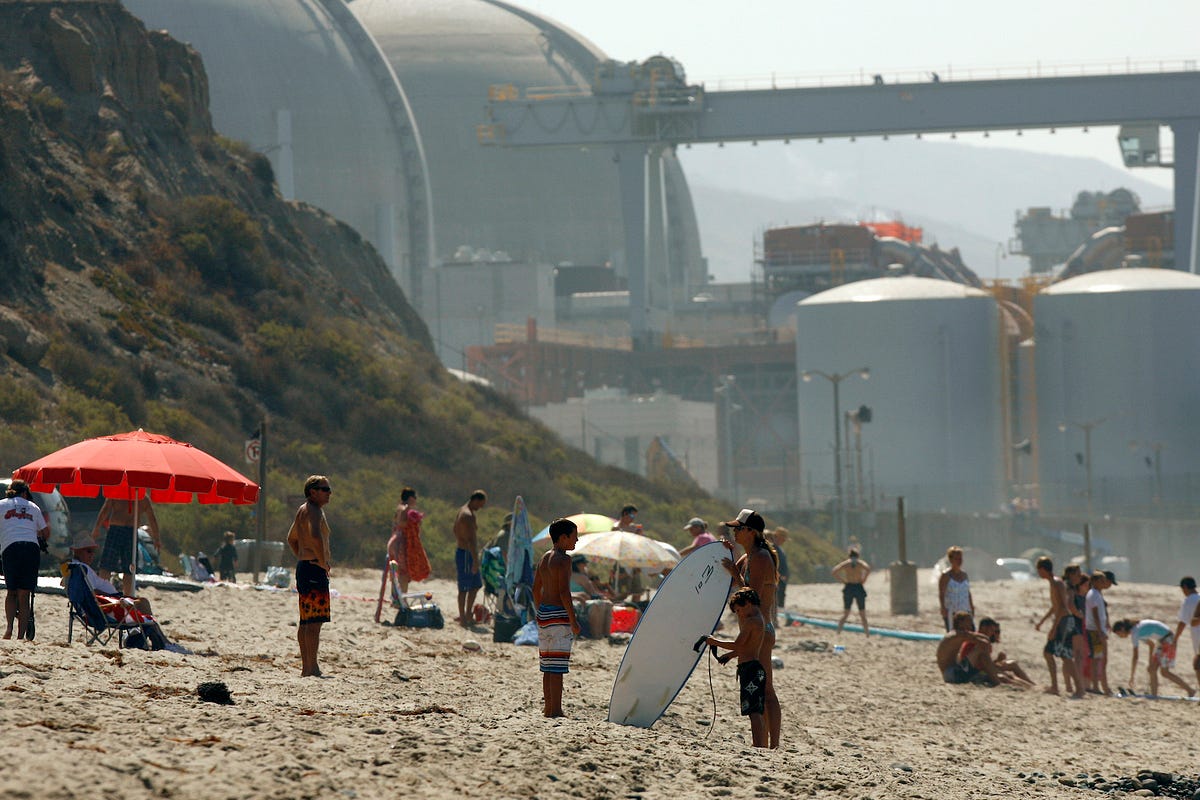
The San Onofre Nuclear Generating Station in California,
shuttered in 2013, is shown here in 2008.


Global energy demand and related carbon emissions both rose again in 2018, according to new figures out this week.

The first answer is the growing global economy, which pushed energy demand up by 2.3% last year, the IEA says. A contributing factor was that more energy was needed for extra heating and cooling in regions hit by unusually severe cold snaps and heatwaves. These were at least partly driven by our shifting climate. All of that drove increases in generation from coal and natural gas, both of which spew greenhouse gases that warm the planet.


23 September, 2018

We gotta get a better battery. But how?

“It will not be easy. It will not be immediate. But it must be done.” With that imperative, Governor Jerry Brown signed a law that required California to obtain all of its electricity from sources like solar, wind, and hydropower by 2045. It was an admirably ambitious goal, commensurate to the civilizational challenge of reducing the carbon emissions responsible for climate change. The only difficulty was that neither Brown nor any anyone else knew how to do it.

Building a better battery.
The world’s fifth-largest economy had been on track to get half its power from clean sources by 2020. But by signing the new law on September 10, the governor made a promise that existing technologies cannot keep. The problem with advanced renewable sources of energy like solar and wind is that the sun doesn’t shine at night and wind blows intermittently, and both sun and wind (especially in California) are seasonal, waxing in summer and waning in winter. Right now, technologists don’t know how to store electricity from renewable energy at scale cheaply or efficiently. The person or group who solves that problem will be the Prometheus of our age.


Read the Wired story by Jason Pontin - “We gotta get a better battery. But how?”

11 May, 2018

Here’s how a complex low-pressure system sent temperatures plummeting

New South Wales, Victoria, Tasmania and South Australia are currently affected by a massive complex low pressure system, dropping temperatures and bringing rain, hail, wind and snow.
The complex low weather system currently swirling over south-eastern Australia.
While complex low pressure systems like this come along every year or so, some Australians may be feeling whiplash after a particularly warm autumn.

Typically, as Victoria and Tasmania head into winter we see cold fronts that move from west to east, generating rain and thunderstorms. This weather system started off like that, but developed into a complex low that will stay with us for the rest of the week.


Read the piece on The Conversation by a Senior Meteorologist, Australian Bureau of Meteorology, Adam Morgan - “Here’s how a complex low-pressure system sent temperatures plummeting.”

12 April, 2018

Craig Kelly slams RenewEconomy: “Shameless propaganda arm of green rent seekers

Craig Kelly, the chairman of the Coalition’s backbench energy committee, clearly doesn’t think much of wind and solar, and it appears he thinks even less of this website.
Craig Kelly - chairman of the Coalition’s
backbench energy committee,
A reader this week sent Kelly a link to a story we published on Monday – or, more to the point, republished from The Conversation – which was co-authored by ANU researchers Andrew Blakers and Matthew Stocks, and which predicted a rapid switch from fossil fuels to renewables.


Read the story by Gile Parkinson from RenewEconomy - “Craig Kelly slams RenewEconomy: “Shameless propaganda arm of green rent seekers.”

08 March, 2018

‘World's largest' solar and wind hydrogen plant proposed for regional SA

A new solar and wind hydrogen plant, which has been dubbed the largest in the world, has been proposed for Crystal Brook in South Australia's Mid North.
Neoen's new hydrogen plant will combine wind power and solar generation.
The Labor Government has committed $25 million in grants and loans to renewable energy company, Neoen, to finalise plans and — pending development approvals — commence construction of a Hydrogen Superhub.

The French company also owns and operates the Hornsdale Wind Farm in Jamestown, SA, the site of the Tesla lithium-ion battery.

If approved for construction, the site will create up to 260 jobs during the planning and construction phase, with 40 ongoing positions once the site is operational.


18 December, 2017

AEMC admits, reluctantly, the renewables will push prices down

Australia’s principal rule maker, the Australian Energy Market Commission, has belatedly admitted that the much delayed surge in investment in wind and solar will cause wholesale electricity prices to fall in Australia, but it is clearly not happy about it.

In a report that appears to be deliberately misleading about the impacts of wind and solar, the costs of coal generation, and the impacts on wholesale prices, the AEMC says that rises in consumer bills this year, due to the jump in wholesale prices, should be reversed in the next couple of years.

The fall in wholesale prices from the influx of renewable energy has long been predicted by most analyses, but its impact has been delayed because of attempts – supported by the AEMC – to kill the renewable energy target, causing an effective three-year investment strike.


Read the RenewEconomy story by Giles Parkinson - “AEMC admits, reluctantly, the renewables will push prices down.”

12 December, 2017

Global warming will weaken wind power, study predicts

Wind farms are key to tackling climate change but warming will significantly cut the power of the wind across northern mid-latitudes, including the US, the UK and the Mediterranean, according to new research. However, some places, including eastern Australia, will see winds pick up.
 In central US, the power of the wind could fall by nearly a fifth. 
The research is the first global study to project the impact of temperature rises on wind energy and found big changes by the end of the century in many of the places hosting large numbers of turbines.

Wind farms have grown more than fivefold in the last decade and plunging costs have made them a key way of reducing carbon emissions from fossil fuel burning. But in the central US, for example, the power of the wind could fall by nearly a fifth.

“We found some substantial changes in wind energy,” said Kristopher Karnauskas at the University of Colorado Boulder, US. “But it does not mean we should not invest in wind power.” It does mean such changes need to be taken into account in planning future wind farms, he said, and also in assessing how much wind farms overall can cut global emissions.


Read The Guardian story by Damian Carrington - “Global warming will weaken wind power, study predicts.”

20 October, 2017

Small town of Glen Innes to become renewable energy hub scattered with wind turbines

Tim Moses has 14 wind turbines
being constructed on his property.
A small town in northern New South Wales has become an epicentre for renewable energy, with hundreds of millions of dollars being invested in wind and solar farms.

Perched on the Great Dividing Range, Glen Innes gets wind from all directions and as turbines fill the skies, the local economy is reaping significant gains.

For up to 30 landowners, having turbines on their land is an opportunity to "drought-proof" their income.
Tim Moses, a second-generation cattle producer is diversifying.


21 August, 2017

Energy: Windlab raises $50m IPO, backers get $25m.

Canberra-based wind farm developer Windlab has raised $50 million ahead of a listing on the ASX next week, and existing shareholders led by Innovation Capital Partners and Lend Lease Ventures will pocket half of the capital.

Windlab has a functioning wind farm at Coonooer, Victoria. 

The two anchor shareholders hold 60.8 per cent of the existing shares, which will fall to 35.8 per cent after the issue and ASX listing. Windlab's plan to list on the ASX was revealed by The Australian Financial Review's Street Talk column last month.
The company will use the remaining capital to complete the first phase of its Kennedy Energy Park, a 60 megawatt wind, solar and battery farm, which Windlab is developing in Hughenden in far north Queensland.


Read Ben Potter’s story on the Financial Review - “Energy: Windlab raises $50m IPO, backers get $25m.”

26 April, 2017

Engineer’s chemical energy machine invention could shake up renewable power

Much of the current discussion around renewable energy has centred on hydro, wind, solar and battery technology.

Behdad Mogtaderi with his
"
looping energy" system.
But work is now being done in a laboratory in Newcastle in New South Wales that may well result in a revolution in renewable power.

Behdad Mogtaderi is a chemical engineer at the University of Newcastle.

He has built a fully-functioning machine that he says can replace hot water systems and air conditioners, plus generate electricity, and store energy for when you need it.

The machine—called a Chemical Looping Energy on Demand System—was launched with little fanfare earlier this month, but it's already getting a lot of attention from international scientists and investors.


Listen to the interview on Radio National - “Engineer’s chemical energy machine invention could shake up renewable power.”

03 April, 2017

Donald Trump’s Climate Fantasies

NEW YORK – Legend holds that King Canute brought his flatterers to the sea to show them that even a king could not command the ocean waves, that the laws of nature are more powerful than the decrees of men. So pity Donald Trump, who really believes that his executive orders can hold back the tides.
Jeffrey D. Sachs.
Trump is surrounded by cronies rather than flatterers, and they and their foolish, ignorant king believe that by denying climate change they can restore the wealth and glory of coal, oil, and gas. They are wrong. Greed will not reverse human-caused climate change, and Trump’s executive orders will not stop the global process of phasing out coal, oil, and gas in favor of wind, solar, hydro, nuclear, geothermal, and other low-carbon energy sources.

In less than 100 days, we have learned that Trump is a man living in a fantasy world. He issues decrees, barks orders, sends out midnight Tweets, but to no avail. The facts – real ones, not his “alternative” variety – keep intervening. There is physics; there is law; there are courts; there are procedures; and there are voters, only 36% of whom approve of Trump’s job performance. There is also China, which wins technologically and diplomatically from every self-defeating move by the incompetent US president.


Read the piece by Jeffrey D. Sachs on Project Syndicate - “Donald Trump’s Climate Fantasies.”

22 February, 2017

Renewable Energy and our local Pollies

Dear Sir, congratulations to our local member Tim Bull and the Nationals for supporting the passage of the permanent ban on coal seam gas in parliament. 

Wind farms are beneficial to
regional Victoria in many ways.
It is a pity that the Nationals took so long to come on board instead of supporting local farmers and landholders from the outset.

Now they have a similar and much bigger problem with the coalition in Victoria joining in the Federal government’s war on renewable energy. Without a shred of doubt all aspects of renewable energy including solar, wind, battery storage and micro-grids are beneficial to regional Victoria, country towns both large and small and to farmers, businesses and ordinary citizens.


Read the Letter to the Bairnsdale Advertiser from Peter Gardner - "Renewable Energy and our local Pollies.”

04 February, 2017

'Clean coal' would push up power bills more than wind, solar or gas: analysts

Prime Minister Malcolm Turnbull and
Environment and Energy Minister Josh Frydenberg.
"Clean coal" plants that the Turnbull government has flagged could get clean energy subsidies are more expensive than solar, wind and gas-fired power and would lead to higher electricity price rises, analysts have warned.

Support for what the government calls "clean coal" stations - ultra-supercritical plants, which still emit greenhouse gas - would also be at odds with a 2015 OECD agreement under which Australia agreed not to fund any type of coal power in developing countries if cleaner options were available.

Read Adam Morton’s story in today’s Melbourne Age - “'Clean coal' would push up powerbills more than wind, solar or gas: analysts.”

08 November, 2016

The story of energy – past, present and future

In the beginning there was wind, water, fire. Canvas snatched the wind and carried us around the globe. Massive millstones turned under the force of rushing streams. A world lit by wood and wax flared brighter with the discovery of whale oil, and coastal cities grew up on that trade.

Change came, as it always does. In 1850, the whaling port New Bedford, Massachusetts, known as “the city that lit the world” was the richest town in America. Nine years later, petroleum was discovered in Pennsylvania and in an eyeblink, New Bedford dwindled into blight and poverty.

Oil, coal and gas powered a new age of industry. Sail gave way to steam and ships to planes, rail and superhighways. All this happened in the span of a single lifetime: less than a century from the Wright brothers to the Concorde, a few decades from the horse and cart to interstate highways.

Read the piece by Geraldine Brooks AO, journalist and Pulitzer Prize winning author - “The story of energy – past, present and future.”

27 April, 2015

Airborne wind power might challenge traditional base-load views


T

raditional views of power as coming from one major centralized source, such as a coal fired power station, or maybe a nuclear generator, are no longer relevant.

With the corner the world has backed itself into an ever smaller corner, extra room, and time, can be found through using renewable energy.

The use of renewable energy demands a whole new mindset – it will provide the much cherished base-load, but to get there we need to embark, now, in creating a mosaic of power sources, including solar, wind, traditional hydro, salt power storage and even pumped hydro.

Among that mix might be an airborne wind project discussed on RenewEconomy - “Ampyx Power plans to build airborne wind energy project inAustralia”.

The story says, “Ampyx Power, the Dutch-based developers of a novel airborne wind energy technology, is looking to establish some of its first commercial scale projects in Australia.”

03 April, 2015

New process makes hydrogen fuel possible


H

ydrogen has long been touted as an effective replace for conventional oil-based fuels.

It works, but its manufacture has always consumed inordinate amounts for fossil fuels and while the fuel itself was climate-friendly, its manufacture wasn’t.

However, chemists from the University of Glasgow report on a new form of hydrogen production which they claim is 30 times faster than the current state-of-the-art method.

The process, they claim, also solves common problems associated with generating electricity from renewable sources such as solar, wind or wave energy.

Read the University of Glasgow news item - “Hydrogen production breakthrough could herald cheap green energy”.

04 March, 2015

Hydro Tasmania develop innovative off-grid hybrid project on Flinders Island


ARENA CEO, Ivor Frischnecht.
The Australian Renewable Energy Agency (ARENA) today announced $5.5 million support for Hydro Tasmania to develop an innovative off-grid hybrid project on Flinders Island.

ARENA CEO Ivor Frischknecht said the project would use a combination of solar, wind, diesel, storage and enabling technologies, together with a sophisticated control system, to displace more than 60 per cent of the island’s diesel generated energy.

“The Flinders Island project will build on the success of a similar project Hydro Tasmania developed on King Island with ARENA support, which is delivering 100 per cent renewable energy to the island when conditions allow,” Mr Frischknecht said.