Showing posts with label oil. Show all posts

03 May, 2020

Airlines and oil giants are on the brink. No government should offer them a lifeline

Do Not Resuscitate. This tag should be attached to the oil, airline and car industries. Governments should provide financial support to company workers while refashioning the economy to provide new jobs in different sectors. They should prop up only those sectors that will help secure the survival of humanity and the rest of the living world.
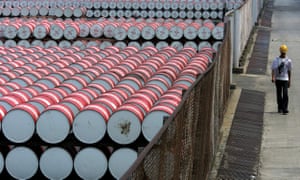
Oil drums
Governments have the oil industry over a barrel – hundreds of
millions of unsaleable barrels, to be more precise – just as
they had the banks over a barrel in 2008.’
They should either buy up the dirty industries and turn them towards clean technologies, or do what they often call for but never really want: let the market decide. In other words, allow these companies to fail.
This is our second great chance to do things differently. It could be our last. The first, in 2008, was spectacularly squandered. Vast amounts of public money were spent reassembling the filthy old economy, while ensuring that wealth remained in the hands of the rich. Today, many governments appear determined to repeat that catastrophic mistake.
Read the story from The Guardian by George Monbiot - “Airlines and oil giants are on the brink. No government should offer them a lifeline.” 

01 May, 2020

Bail Out the Planet

Do Not Resuscitate. This tag should be attached to the oil, airline and car companies. Governments should provide financial support to their workers while refashioning the economy to provide new jobs in different sectors. They should prop up only those sectors that will help secure the survival of humanity and the rest of the living world. They should either buy up the dirty industries and turn them towards clean technologies, or do what they often call for but never really want: let the market decide. In other words, allow these companies to fail.
George Monbiot.
This is our second great chance to do things differently. It could be our last. The first, in 2008, was spectacularly squandered. Vast amounts of public money were spent reassembling the filthy old economy, while ensuring that wealth remained in the hands of the rich. Today, many governments appear determined to repeat their catastrophic mistake. 
The “free market” has always been a product of government policy. If anti-trust laws are weak, a few behemoths survive, while everyone else goes down. If dirty industries are tightly regulated, clean ones flourish. If not, the corner-cutters win. But the dependency of enterprises on public policy has seldom been greater in capitalist nations. Many major industries are now entirely beholden to the state for their survival. Governments have the oil industry over a barrel – hundreds of millions of barrels of unsaleable product to be more precise – just as they had the banks over a barrel in 2008. Then they failed to use their power to eradicate the sector’s socially destructive practices and rebuild it around human needs. They are making the same mistake today.
Read the story by Guardian columnist, George Monbiot - “Bail Out the Planet.”


21 August, 2019

When it comes to coal, Australia has transitioned away from economics and common sense

Australia isn’t transitioning away from extracting fossil fuels, it is doubling down on them. That’s right – even though Australia is already the third largest fossil fuel exporter in the world, the federal government still wants to double our coal exports, drill for oil in the Great Australian Bight and open more farmland to fracking.

Night time image of Yallourn power station in the Latrobe Valley, Victoria
‘Australia isn’t just the world’s largest coal exporter.
We are the world’s largest exporter of LNG, the third
largest exporter of fossil fuels and the 14th largest
emitter of greenhouse gasses in the world.’
Australia is the world’s largest exporter of coal. In fact, our share of the world’s traded coal market is bigger than Saudi Arabia’s share of the world oil market. If Australia opened the Adani mine, and all the other mines proposed in Australia, we would indeed double our coal exports. But we would also drive down the world price of coal, drive down production in existing coalmines, and drive up global emissions. It’s not complicated. But while Australia shows no sign of transitioning away from fossil fuels, we have well and truly transitioned away from economics and common sense when it comes to coal.

And in the rush to mine more coal, Australia is transitioning away from its stated foreign policy. Since the second world war, Australia has sought to play a leadership role among the Pacific Island nations. This positioning has provided both a physical buffer to our north and a significant diplomatic platform. But that could all be coming to an end.


Read the story from The Guardian by Richard Denniss - “When it comes to coal, Australia has transitioned away from economics and common sense."

02 April, 2019

The Most Definitive Report on Climate Change in America

The burning of coal, oil, and gas is changing the global climate faster now than at any other time in modern human history, threatening our national security, our economic prosperity, and our children’s future. All this will get worse, perhaps unimaginably so, unless we shift to cleaner, smarter ways to power our future — and do so now, because we’re running out of time.
Tropical Storm Irma’s effects in Charleston, South Carolina.
That’s the conclusion of the new National Climate Assessment, the most definitive report ever compiled on climate change in America. The congressionally mandated quadrennial review pulls together experts from 13 federal agencies to connect the dots between what the science is telling us and what we’re seeing on our TVs, in our newspapers, and out our kitchen windows. “The impacts and costs of climate change are already being felt in the United States,” the report states in sum. “Future risks from climate change depend primarily on decisions made today.”

In little more than a century, the temperature has risen 1.8 degrees Fahrenheit, on average, across the continental United States. That might not sound like much, but it is remaking the map of America and altering the country in ways that touch every aspect of our lives.


Read the story from the Natural Resources Defence Council by Rhea Suh - “The Most Definitive Report on Climate Change in America.”

21 June, 2018

Learn about the important work of 350.org

350 uses online campaigns, grassroots organizing, and mass public actions to oppose new coal, oil and gas projects, take money out of the companies that are heating up the planet, and build 100% clean energy solutions that work for all. 350's network extends to 188 countries.


Learn more about the important work of 350.org here.

27 April, 2018

Energy companies will pay more under budget changes that could also secure company tax win

Oil and gas giants will be forced to pay billions more in tax under changes to the Petroleum Resources Rent Tax that could also deliver the Turnbull government a shock victory on its stalled company tax cuts.
Treasurer Scott Morrison ordered a review into the system in 2016.
It is understood next month's budget will tackle longstanding concerns about the way energy companies are taxed by curbing "uplift concessions", which determine tax deductions associated with exploration and construction. But in a concession expected to win industry support, the changes will exempt existing projects.


13 April, 2018

This environmental group is launching its own satellite to learn more about greenhouse gas leaks

When the Environmental Defense Fund told commercial space guru Tom Ingersoll that it wanted to launch a satellite to measure methane from oil and gas operations, he says his reaction was “Whoa! You guys want to do what?”
A rendering by the Environmental Defense
Fund of a methane-detecting satellite. 
Yet that’s what the EDF is doing. It is well on its way toward raising about $40 million. It has tapped into the work of Harvard University researchers to fine tune sensors. And it has reached out to Ingersoll and others in the commercial space business to create a device that will be able to measure methane emissions on a 125-mile wide swath with pixel resolution of less than  five-eighths of a mile.

EDF will also get support from TED Talks, which hopes to spur fundraising for a variety of causes through its “Audacious Project.”


Read Steven Mufson’s story from The Washington Post - “This environmental group is launching its own satellite to learn more about greenhouse gas leaks.”

29 January, 2018

The top five oil and gas trends for 2018

This year will be the year of the oil and gas revival, as prices lift performance and major projects come online.
Contracts will come under scrutiny as buyers push back.
While Australia is increasing its focus on securing domestic gas supply, it is taking a greater role globally and evolving the industry.

Wood Mackenzie Australasia oil and gas leader Saul Kavonic has outlined the five trends that will mark LNG growth in 2018.

Australia has been ramping up its LNG projects for a number of years, and 2018 will see it finally take the world’s number one spot from Qatar.


Read Cole Latimer’s story from today’s Melbourne Age - “The top five oil and gas trends for 2018.”

14 January, 2018

How Much Does Climate Change Cost? Try $1.5 Trillion (and Counting)

The Trump administration, and its allies in Congress, are fighting a losing war. They continue to press forward for the development of oil, gas, and coal when the rest of the world understands the implication of that folly. Global warming is the most pressing issue for our time. Period.
The thing is governments really have two choices when it comes to managing the impact on its people from global warming: spend money on trying to reduce the problem or spend money on cleaning up the catastrophes.
Firefighters clear debris from a mudslide in Los Angeles,
California on January 9, 2018. The deadly rain storm claimed
 the lives of 13 people in Santa Barbara County. Flash
flooding also occurred in the recently burned areas
of Ventura and Los Angeles counties.
The Trump administration is on the hook for the catastrophe. A report released Monday by The National Centers for Environmental Information pegged the total cost this year at $1.5 trillion, including estimates for Hurricanes Harvey, Irma, and Maria. (And that doesn’t even begin to count the human toll, lost lives, lost jobs, lost opportunity.)

I witnessed firsthand the impact of Hurricane Maria on the island of Dominica last month. We keep hearing stories about the power grid being down (similar to Puerto Rico) and you think, Why? It’s been months. Why aren’t the lights on? Then you see nearly every electrical pole on the island sideways. The entire grid needs to be rebuilt (or better, rethought) and that’s decades of infrastructure. So the figure of $1.5 trillion is far short of what will be needed. Nearly every electrical line, every other house, the damage was so widespread it’s impossible to overstate. And that’s just one island. Multiple the effect across the region. The planet.


Read Mark Trahant’s story on Yes! Magazine - “How Much Does Climate Change Cost? Try $1.5 Trillion (and Counting).”

21 July, 2017

This could be the next big strategy for suing over climate change

Two California coastal counties and one beach-side city touched off a possible new legal front in the climate change battle this week, suing dozens of major oil, coal, and other fossil fuel companies for the damages they say they will incur due to rising seas.

A Delta plane lands as a U.S. Airways plane
 waits to take off at San Francisco airport. 
The three cases, which target firms such as Chevron, ExxonMobil, BP and Royal Dutch Shell, assert that the fossil fuel producers are collectively responsible for about 20 percent of global carbon dioxide emissions between 1965 and 2015. They claim that industry “knew or should have known” decades ago about the threat of climate change, and want companies to pay the costs of communities forced to adapt to rising seas.
“We’re already living the impact of sea level rise,” said Marin County Supervisor Kate Sears. She said a county vulnerability study found hundreds of county businesses and other assets could be at risk in coming years.


27 June, 2017

Donald Trump to call for US dominance in global energy production

Washington: Donald Trump will tout surging US exports of oil and natural gas during a week of events aimed at highlighting the country's growing energy dominance.

Donald Trump's first major policy speech on the
campaign trail - delivered in the oil drilling hotbed of
 North Dakota in 2016 - focused on his plans
 for unleashing domestic energy production.
 
The President also plans to emphasise that after decades of relying on foreign energy supplies, the US is on the brink of becoming a net exporter of oil, gas, coal and other energy resources.

As with previous White House policy-themed weeks, such as a recent one focusing on infrastructure, the framing is designed to draw attention to Mr Trump's domestic priorities and away from more politically treacherous matters such as multiple investigations into Russian interference in the 2016 election.


Read Jennifer Dlouhy’s story in today’s Melbourne Age - “Donald Trump to call for US dominance in global energy production.”

02 May, 2017

It’s simple. If we can't change our economic system, our number's up

Let us imagine that in 3030BC the total possessions of the people of Egypt filled one cubic metre. Let us propose that these possessions grew by 4.5% a year. How big would that stash have been by the Battle of Actium in 30BC? This is the calculation performed by the investment banker Jeremy Grantham.
'The mother narrative to all this is carbon-fuelled
 expansion. Our ideologies are mere subplots.' 
Go on, take a guess. Ten times the size of the pyramids? All the sand in the Sahara? The Atlantic ocean? The volume of the planet? A little more? It's 2.5 billion billion solar systems. It does not take you long, pondering this outcome, to reach the paradoxical position that salvation lies in collapse.

To succeed is to destroy ourselves. To fail is to destroy ourselves. That is the bind we have created. Ignore if you must climate change, biodiversity collapse, the depletion of water, soil, minerals, oil; even if all these issues miraculously vanished, the mathematics of compound growth make continuity impossible.


Read George Monbiot’s observations on The Guardian - “It’s simple. If we can't change our economic system, our number's up.”

03 April, 2017

Donald Trump’s Climate Fantasies

NEW YORK – Legend holds that King Canute brought his flatterers to the sea to show them that even a king could not command the ocean waves, that the laws of nature are more powerful than the decrees of men. So pity Donald Trump, who really believes that his executive orders can hold back the tides.
Jeffrey D. Sachs.
Trump is surrounded by cronies rather than flatterers, and they and their foolish, ignorant king believe that by denying climate change they can restore the wealth and glory of coal, oil, and gas. They are wrong. Greed will not reverse human-caused climate change, and Trump’s executive orders will not stop the global process of phasing out coal, oil, and gas in favor of wind, solar, hydro, nuclear, geothermal, and other low-carbon energy sources.

In less than 100 days, we have learned that Trump is a man living in a fantasy world. He issues decrees, barks orders, sends out midnight Tweets, but to no avail. The facts – real ones, not his “alternative” variety – keep intervening. There is physics; there is law; there are courts; there are procedures; and there are voters, only 36% of whom approve of Trump’s job performance. There is also China, which wins technologically and diplomatically from every self-defeating move by the incompetent US president.


Read the piece by Jeffrey D. Sachs on Project Syndicate - “Donald Trump’s Climate Fantasies.”

26 January, 2017

Neither Trump nor Turnbull can turn back the tide on renewables

‘The US has elected a man who wants to
revive the glory days of coal, oil and gas.’
The inauguration of President Trump this Saturday (Australian time) marks a radical change in the world as we know it. It ushers in the beginning of four years where progressive issues as far reaching as race equality, women’s health, nuclear and foreign policy, and of course climate change will be under sustained attack.

Less than a year after the world agreed a historic climate pact in Paris, the US – the world’s second-largest greenhouse gas polluter – elected a man who wants to revive the glory days of coal, oil and gas.

To less fanfare here at home, the Turnbull government is pursuing a similar trajectory. Ploughing through the headwinds is our resources minister, Matt Canavan, who is seeking a $100bn investment in coal and is the biggest campaigner for a new mega-coalmine in Queensland’s Galilee basin run by the Indian company Adani.

The truth is that try as they might, neither Trump nor the Australian government can turn the tide on renewable energy, nor resuscitate an ailing coal industry with a clear expiration date. This is not a moral or political case, but a purely economical one.

Read Blaire Palese’s story in The Guardian - “Neither Trump nor Turnbull can turn back the tide on renewables.”

02 December, 2016

The Misinformation Machine - George Monbiot


‘I first encountered the machine when writing about climate change’

George Monbiot.
Yes, Donald Trump’s politics are incoherent. But those who surround him know just what they want, and his lack of clarity enhances their power. To understand what is coming, we need to understand who they are. I know all too well, because I have spent the past 15 years fighting them.

Over this time, I have watched as tobacco, coal, oil, chemicals and biotech companies have poured billions of dollars into an international misinformation machine, composed of think tanks, bloggers and fake citizens’ groups. Its purpose is to portray the interests of billionaires as the interests of the common people, to wage war against trade unions and beat down attempts to regulate business and tax the very rich. Now the people who helped run this machine are shaping the government.

I first encountered the machine when writing about climate change. The fury and loathing directed at climate scientists and campaigners seemed incomprehensible until I realised they were fake: the hatred had been paid for. The bloggers and institutes whipping up this anger were funded by oil and coal companies.

Read the piece by Guardian columnist, George Monbiot - “The Misinformation Machine.”

22 November, 2016

Environmental scepticism of China's ability to meet the Paris climate pledge

Patricia Adams - 'It's business
 as usual for China'.
A Canadian environmentalist, who has been involved in the Chinese environmental movement for decades, believes China ratifying the Paris Climate Accord is purely for show.

Patricia Adams, an economist and executive director of Probe International, argues China has made no commitment other than to cap its emissions in 2030.

"Essentially, what they are saying is it's business as usual," she said.

"At the moment, 90 per cent of China's energy, transport and some industrial processes is produced with fossil fuels; coal, oil and gas

02 August, 2016

Oil, coal, cement and mining sued as greenhouse gas emissions violate human rights

Typhoon Haiyan, known locally as Yolanda,
struck in 2013 and was one of the 
most powerful storms ever recorded.
The world’s largest oil, coal, cement and mining companies have been given 45 days to respond to a complaint that their greenhouse gas emissions have violated the human rights of millions of people living in the Philippines.

In a potential landmark legal case, the Commission on Human Rights of the Philippines (CHR), a constitutional body with the power to investigate human rights violations, has sent 47 “carbon majors” including Shell, BP, Chevron, BHP Billiton and Anglo American, a 60-page document accusing them of breaching people’s fundamental rights to “life, food, water, sanitation, adequate housing, and to self-determination”.

The move is the first step in what is expected to be an official investigation of the companies by the CHR, and the first of its kind in the world to be launched by a government body.

Read John Vidal’s story inThe Guardian - “World's largest carbon producers face landmark human rights case.”

17 June, 2015

Oil continues to 'screw over' the environment


W

hat do almonds, golf, fracking, and Kim Kardashian's lawn have in common? They've all been publicly shamed for their outsized water use during California's ongoing drought.

But you likely haven't heard as much about one of the state's major water sucks: oil refineries, which are estimated to be the second-biggest water user of non-ag businesses in the state (after golf).

The plants process more than 80 million gallons of oil per day, turning it into products like gasoline, diesel, and jet fuel. According to the Environmental Protection Agency, each gallon of oil takes between 1 and 2.5 gallons of water to refine, most of which is either dumped into the ocean after it's used and treated, or evaporated as steam. Once in the ocean, the water is unusable unless it's desalinated.

Read the Mother Jones story - “Yet Another Way That Oil Is Screwing the Environment”.

02 June, 2015

Australia's 'carbon tax' goes, oil producers seek one


T

he Abbott Government scrapped the so-called “carbon tax” claiming a mandate to do so and now Europe’s oil producers are calling for exactly that.

BloombergBusiness reports, “The heads of Europe’s largest oil and gas companies have joined together for the first time to call for governments to agree to carbon pricing at a United Nations-led summit on climate change at the end of the year.

“Climate change is a critical challenge for our world,” the chief executive officers of six energy companies wrote to the top UN official in charge of climate talks. “We need governments across the world to provide us with clear, stable, long-term ambitious policy frameworks.”

Read the BloombergBusiness story - “Europe’s Top Oil Producers Unite in Push on Climate Policy”.

17 April, 2015

Thievery of oil leads to 100,000 Mexicans without water.


A

 determined push to slow cigarette sales has increased prices and so made them even more attractive to thieves.

The price oil has also spiralled in recent years and it too is now becoming a target of thieves.

Attempts at thievery frequently go wrong, as was the case when attempts were made to illegally tap into an oil pipeline in Mexico.

Yes, things did go wrong as this story - “Oil spill leaves 100,000 Mexicans without water” – in The West Australian explains.