Showing posts with label humanity. Show all posts

03 May, 2020

Airlines and oil giants are on the brink. No government should offer them a lifeline

Do Not Resuscitate. This tag should be attached to the oil, airline and car industries. Governments should provide financial support to company workers while refashioning the economy to provide new jobs in different sectors. They should prop up only those sectors that will help secure the survival of humanity and the rest of the living world.
Oil drums
Governments have the oil industry over a barrel – hundreds of
millions of unsaleable barrels, to be more precise – just as
they had the banks over a barrel in 2008.’
They should either buy up the dirty industries and turn them towards clean technologies, or do what they often call for but never really want: let the market decide. In other words, allow these companies to fail.
This is our second great chance to do things differently. It could be our last. The first, in 2008, was spectacularly squandered. Vast amounts of public money were spent reassembling the filthy old economy, while ensuring that wealth remained in the hands of the rich. Today, many governments appear determined to repeat that catastrophic mistake.
Read the story from The Guardian by George Monbiot - “Airlines and oil giants are on the brink. No government should offer them a lifeline.” 

28 April, 2020

'Sumbiotude’: a new word in the tiny (but growing) vocabulary for our emotional connection to the environment

I am a child of the Anthropocene, born in 1953. I have lived in a period of history also known as the “Great Acceleration” as huge negative change unfolded. 
Sumbiotude': a new word in the tiny (but growing) vocabulary for ...
A child of the Anthropocene.
While contemplating these changes, I have sensed, within humanity, a profound sense of emotional isolation. To help overcome the solitude, I have created the idea of sumbiotude, thinking and working in companionship with others, to reconnect to life. 
Being alive in this particular era, I have had the privilege of living through the rapid transition from a focus on that which is “obvious to the senses” to our new ways of rendering the invisible, visible. 
Read the story from The Conversation by an Honorary Associate with the School of Geosciences from the University of Sydney, Glenn Albrecht - “‘Sumbiotude’: a new word in the tiny (but growing) vocabulary for our emotional connection to the environment.”

04 March, 2020

Facing Extinction: The Hope for Human Survival

In a recent post, William E. Rees laid out the case that humanity is on a direct path toward destruction. He sums it up neatly at the end of his post as follows:
William E. Rees writes about the hope for human survival.
Disastrous climate change and energy shortages are near certainties in this century and global societal collapse a growing possibility that puts billions at risk.
It’s an uncomfortable notion, and enticing to write him off as a zealot, but a truth that many scientists are warning we’re perilously close to passing the point of no return.
The climate crisis has arrived and is accelerating faster than most scientists expected. It is more severe than anticipated, threatening natural ecosystems and the fate of humanity. — Alliance of World Scientists
Returning to Rees, his conclusions for near-term catastrophes are predicated on three facts:

Read the Medium story by Violet Bee - “Facing Extinction: The Hope for Human Survival.”

07 December, 2019

Making Climate Real: Climate Consciousness, Culture and Music.

Image result for kings law journal logoOur world is in deep trouble. We face an existential emergency from ‘rapid climate disruption’1 and it is now clear that continuing with business as normal will not provide a safe or viable future for humanity. This disruption is not limited to humans but is also contributing to what has been called the ‘sixth extinction’.2 This rapid decline in biodiversity3 is part of a tangled web of profound challenges to planetary boundaries, what Rockström and colleagues call a ‘safe operating space’ for humanity.4 We have already exceeded the estimated safe operating space for six of the nine planetary boundaries, with two, biochemical flows and biosphere integrity, in the high risk category. In response to these challenges a number of jurisdictions are declaring climate emergencies akin to the sort of social and economic mobilisation that took place in Britain during the Second World War.5 Following the 2015 Paris Climate Agreement the Intergovernmental Panel on Climate Change (IPCC) released their 2018 report on staying under 1.5°C.6 With uncharacteristic bluntness the report stated that this would require the world’s economies to reach net zero emissions by 2050. On the current level of emissions reduction commitments the planet will warm by 3.1 to 3.7°C.7 Reducing emissions to net-zero is a challenging task, given the denial, obfuscation and resistance towards effective action to date. Some commentators argue that if the world’s carbon emissions do not begin to fall by 2020 then ‘the temperature goals set in Paris become almost unattainable’.8 If that is the case, and it seems likely, then warming of 2°C would produce, in the words of Princeton University Professor of Geosciences and International Affairs, Michael Oppenheimer, a ‘totally different worldIt would be indescribable, it would turn the world upside down in terms of its climate. There would be nothing like it in the history of civilisation.’9


Read the piece from the Kings Law Journal by Simon Kerr and Christine Parker -  “Making Climate Real: Climate Consciousness, Culture and Music.

23 November, 2019

The Collapse of Civilization May Have Already Begun

“It is now too late to stop a future collapse of our societies because of climate change.” 
These are not the words of a tinfoil hat-donning survivalist. This is from a paper delivered by a senior sustainability academic at a leading business school to the European Commission in Brussels, earlier this year. Before that, he delivered a similar message to a UN conference: “Climate change is now a planetary emergency posing an existential threat to humanity.”
In the age of climate chaos, the collapse of civilization has moved from being a fringe, taboo issue to a more mainstream concern. 
As the world reels under each new outbreak of crisis—record heatwaves across the Western hemisphere, devastating fires across the Amazon rainforest, the slow-moving Hurricane Dorian, severe ice melting at the poles—the question of how bad things might get, and how soon, has become increasingly urgent. 

Read the story from Vice by Nafeez Ahmed - “The Collapse of Civilization May Have Already Begun.”

07 July, 2019

Here Are 10 Ways AI Could Help Fight Climate Change

Some of the biggest names in AI research have laid out a road map suggesting how machine learning can help save our planet and humanity from imminent peril.

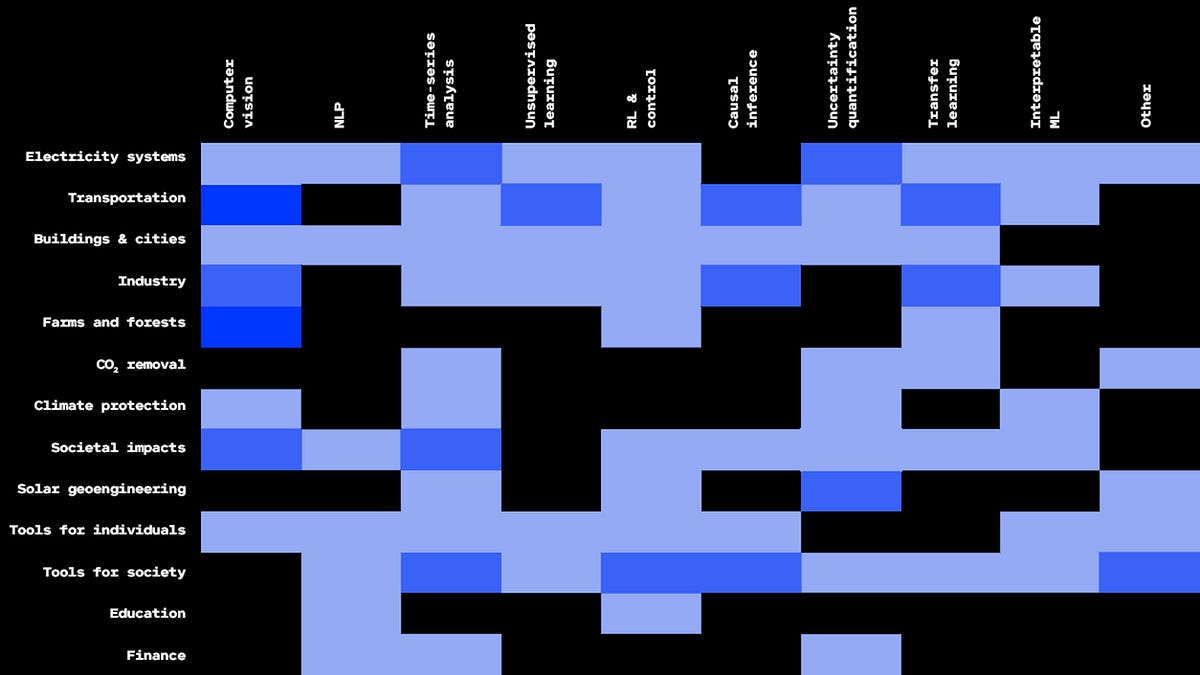
How each sub-discipline of machine learning can help fight climate change, where the darker colors represent more opportunities to pursue.
The report covers possible machine-learning interventions in 13 domains, from electricity systems to farms and forests to climate prediction. Within each domain, it breaks out the contributions for various subdisciplines within machine learning, including computer vision, natural-language processing, and reinforcement learning.

Recommendations are also divided into three categories: “high leverage” for problems well suited to machine learning where such interventions may have an especially great impact; “long-term” for solutions that won’t have payoffs until 2040; and “high risk” for pursuits that have less certain outcomes, either because the technology isn’t mature or because not enough is known to assess the consequences. Many of the recommendations also summarize existing efforts that are already happening but not yet at scale.


Read the story from Medium by Karen Has -“Here Are 10 Ways AI Could Help Fight Climate Change.”

16 May, 2019

'Net Curtains' - by George Monbiot

It is the most important news humanity has ever received: the general collapse of life on Earth. So it’s hardly surprising that it appeared on the front pages of only two of our newspapers (the Guardian and the Independent). The vast international assessment of the state of nature, whose results, released on Monday, reveal that the living planet is in a death spiral, didn’t make even the sidebar on the front of any other paper. Of all the varieties of media bias, the deepest is the bias against relevance. The more important the issue, the less it is discussed.
Industrial fishing - a key issue in the collapse of life on Earth.
There’s a reason for this. Were we to become fully aware of our predicament, we would demand systemic change. Systemic change is highly threatening to those who own the media. So they distract us with such baubles as a royal baby and a vicious dispute between neighbours about a patio. I am often told we get the media we deserve. We do not. We get the media its billionaire owners demand.

This means that the first duty of a journalist is to cover neglected issues. So I want to direct you to the 70% of the planet that was sidelined even in the sparse coverage of the new report: the seas. Here, life is collapsing even faster than on land. The main cause, the report makes clear, is not plastic. It is not pollution, not climate breakdown, not even the acidification of the ocean. It is fishing. Because commercial fishing is the most important factor, this is the one we talk about least. The BBC’s recent Blue Planet Live series, carefully avoiding any collision with powerful interests, epitomised this reticence.


Read the story by Guardian columnist George Monbiot - “Net Curtains.”

06 April, 2019

A New Language for Grappling With Climate Change

This month, a major UN report on climate change declared that humanity has just a few short years to make the drastic changes needed to stave off an environmental catastrophe. While news outlets reacted with shock and alarm, those who regularly write, research or advocate on climate change were more resigned. For them, the report which synthesized existing research merely aggravated the psychic wound formed by continually reckoning with the end of the world.
What's ahead for kids like me?
Responding to the report, climate writer Eric Holthaus encouraged readers to talk about their feelings with friends, though he said that he has “no idea whether or not this is the right advice for everyone.” Environmental reporter Zoë Schlanger expressed similar ambivalence, writing that “in 2018, life can feel in need of a dirge for the whole world, with scarcely the language to write it.”

Perhaps as the climate changes, so must our vocabulary. We need new words to grapple with these new challenges. What does it feel like when your home leaves you? When the seasons shift and rains dry up or turn to deluge? How do you capture the sense of this new abnormal? And how do you cope?


Read the story from NexusMedia by Phil Newell - “A New Language for Grappling With Climate Change.”

04 November, 2018

Stop biodiversity loss or we could face our own extinction, warns UN

The world must thrash out a new deal for nature in the next two years or humanity could be the first species to document our own extinction, warns the United Nation’s biodiversity chief.
 Deforestation in Indonesian to make way for a palm oil concession. 
Ahead of a key international conference to discuss the collapse of ecosystems, Cristiana Pașca Palmer said people in all countries need to put pressure on their governments to draw up ambitious global targets by 2020 to protect the insects, birds, plants and mammals that are vital for global food production, clean water and carbon sequestration.

“The loss of biodiversity is a silent killer,” she told the Guardian. “It’s different from climate change, where people feel the impact in everyday life. With biodiversity, it is not so clear but by the time you feel what is happening, it may be too late.”


Read the story from The Guardian by Jonathon Watts - “Stop biodiversity loss or we could face our own extinction, warns UN.”

21 August, 2018

Politicians must set aside blinkered ideologies in the climate endgame

Humanity has a big decision to make very soon about its future on a warming planet, but the federal Coalition is still in denial that human-induced climate change even exists, let alone that the climate endgame is upon us.
Prime minister Malcolm Turnbull and energy minister
 Josh Frydenberg speak during a press conference
at Parliament House in Canberra on Monday.
The national energy guarantee (Neg) is the latest manifestation of that denial. A third-rate complex, over-engineered policy that will most likely fail to contribute to meeting all three of its main objectives, namely increased reliability of electricity supply, lower energy prices and a long way third, reducing carbon emissions. A compromise upon compromise designed to placate the scientifically and economically illiterate Coalition right wing, which ignores the first priority of any government, to ensure the security of the people. For climate change is now the greatest threat to that security.


Read the story from The Guardian by David Spratt and Ian Dunlop - “Politicians must set aside blinkered ideologies in the climate endgame.”

30 May, 2018

Top Climate Scientist: Humans Will Go Extinct if We Don’t Fix Climate Change by 2023

A top climate scientist is warning that climate change will wipe out all of humanity unless we stop using fossil fuels over the next five years.
Climate scientist James Anderson says we have until 2023 to fix climate change.
In a recent speech at the University of Chicago, James Anderson — a professor of atmospheric chemistry at Harvard University — warned that climate change is drastically pushing Earth back to the Eocene Epoch from 33 million BCE, when there was no ice on either pole. Anderson says current pollution levels have already catastrophically depleted atmospheric ozone levels, which absorb 98 percent of ultraviolet rays, to levels not seen in 12 million years.


30 March, 2018

‘We’re Talking Very Big Bucks’: New Bill Could Put Oil Companies on the Hook for Climate Change Costs

Oil companies have become some of the wealthiest organizations in history by producing a product that we now know is endangering the future of humanity.
Many of these companies have known about the effects of carbon dioxide for decades, yet while they adapted their own businesses to survive climate change, they actively undermined efforts to understand it.

Should Canadians be able to sue oil companies for that?

“They are in a position to pay for this damage; they have the responsibility to pay for this damage,” Peter Tabuns, the NDP’s climate change critic in the Ontario legislature, told DeSmog Canada. “We’re talking very big bucks.”

23 February, 2018

We Can’t Close Our Eyes to Climate Change

Contrary to a common perception, ignoring climate change won't make it disappear. Global research going back to 1824 in fields ranging through physics, oceanography, biology and geology have confirmed human activity—mainly burning fossil fuels, raising livestock and destroying carbon sinks like forests and wetlands—is increasing greenhouse gas emissions and causing global temperatures to rise rapidly, putting humanity at risk. Every legitimate scientific academy and institution and every government, except the current U.S. administration, agrees.


Yet the disconnect between that reality and government action to confront the greatest crisis humanity faces is astounding. Nowhere is that disconnect more profound than in the U.S., where the attitude is "out of sight, out of mind.”


Read the EcoWatch story - “We Can’t Close Our Eyes to Climate Change.”

19 February, 2018

Climate change will accelerate extreme weather events in the coming years

Humanity is now facing an ever-increasing threat of unpredictable and extreme weather, climate scientists warn.
This Jan. 4 Geocolor image from the National
Oceanic and Atmospheric Administration
(NOAA) GOES-16 satellite captured the record
"bomb cyclone" nor’easter that battered the
 East Coast of the United States in January 2018.
While global warming is creating more powerful storms and record-breaking, drought-driven wildfires, it would be a mistake to view these events as the “new normal,” they say. The planet has not reached a new climate stability, so the years ahead could be quite a lot worse.

“‘New normal’ implies that we reach some new sort of equilibrium and that's where things stay, whereas what we're looking at is an ever-shifting baseline,” says Penn State professor and atmospheric scientist Michael Mann.


07 February, 2018

Climate action: the Foundation of Sustainable Development

The climate crisis is undoubtedly the single greatest threat to humanity. Despite the fierce debate in the United States surrounding the reality staring us square in the face, much of the rest of the world acknowledges the severity of this problem and the moral imperative to take urgent action. 


In its 2030 Agenda for Sustainable Development the United Nations included climate action as one of the 17 Sustainable Development Goals. Together, these goals outline a path by which the world can work together to strengthen universal peace and prosperity. When the UN pledged to take action on climate as part of the SDGs, it acknowledged an important – though often overlooked – fact: no issue we collectively face as humans exists separate and apart from the others. These challenges – from alleviating poverty to educating women and girls to addressing the climate crisis – intersect and are intimately connected to one another. A planet that is in a state of chaos and disruption offers a poor canvas for advancing development goals. 

Read the Impacter story by the CEO off the Climate Reality Project, Ken Berlin - “Climate action: the Foundation of Sustainable Development.”

24 January, 2018

The moral value of wilderness

Let us imagine that humanity has almost died out and only a few people remain. Out of resentment or despair, the survivors cater to their destructive urges by destroying as much of the natural world as they can. They poison rivers and lakes, drop napalm on forests, set off a few nuclear warheads. They are at ease with their conscience because no one will ever be in the position to use or appreciate the nature they are destroying.

Pause and reflect on what really makes wilderness valuable.
They are harming no one. But surely what they are doing is wrong.

The Australian environmental philosopher Richard Sylvan used this story to try to persuade us that nature has a value that is independent of our needs and desires, even our existence.


Read the piece on The Conversation by a Professor of Philosophy from La Trobe University, Janna Thompson - “The moral value of wilderness."

12 August, 2017

Humanity needs science to survive and thrive.

“Bad times have a scientific value. These are occasions a good learner would not miss.” -Ralph Waldo Emerson

Hi there, world. It’s been a long time since you’ve had a heart-to-heart with science, but there’s no better opportunity than right now. There are a whole slew of problems facing our nation and the world today, and I’m afraid you’re going to need it for all of them if you want to get through them successfully. The world is a large, complex system, with many different competing interests all vying for your attention as to which one is most important. No one is here to decide that for you, contrary to what you might’ve heard. Instead, science is here to contribute something that every perspective should agree on: the best suite of facts, laws, models, theories, conclusions and inferences that the whole of humanity has been able to collect and construct. That’s what science is. It’s what science was made to do. And it’s why humanity is the success that it is today.

Read the story by Ethan Siegel - “Humanity needs science to survive and thrive.

05 July, 2017

According to Tony Abbott coal is good for humanity, I wonder that is what Horacek means?


30 April, 2017

Yes, I am a climate alarmist. Global warming is a crime against humanity

Most of us have wondered about the human context of past crimes against humanity: why didn’t more people intervene? How could so many pretend not to know? To be sure, crimes against humanity are not always easy to identify while they unfold.
‘We are the bystanders who must choose to intervene or be defined by our failure.’ 
We need some time to reflect and to analyze, even when our reasoning suggests that large scale human suffering and death are likely imminent. The principled condemnation of large scale atrocity is, too often, a luxury of hindsight.

I’m a climate alarmist because there is no morally responsible way to downplay the dangers that negligent policies – expected to accelerate human-caused climate change – pose to humankind.
There can be no greater crime against humanity than the foreseeable, and methodical, destruction of conditions that make human life possible – hindsight isn’t necessary.


Read Laurence Torcello’s story on The Guardian - “Yes, I am a climate alarmist. Global warming is a crime against humanity.”

21 April, 2017

Floating Plastic Pollution from Europe and the US Is Accumulating in the Arctic

Plastic in its many forms is one of the obvious impacts of humanity on Earth; it’s everywhere and virtually impossible to destroy.

Polar Bears in the Arctic are often in the news and
this time it is because of plastic. While Arctic species
might well be troubled by plastic so is the huge range
 of species in Australia/'s many rivers and streams.
Frequent publicity is about the troubles arising from plastics in such exotic places as the Arctic, as discussed here, but equally this human construct is causing equally serious troubles in rivers and streams throughout Australia.

The low population of the Arctic Circle means little plastic waste is generated there. However, a new study has shown that the Greenland and Barents Seas (east of Greenland and north of Scandinavia) are accumulating large amounts of plastic debris that is carried and trapped there by ocean currents.

The new study, published today in Science Advances, found that the Greenland and Barents seas have accumulated hundreds of tons of plastic debris composed of around 300 billion pieces, mainly fragments around the size of a grain of rice. The vast majority of these fragments originate form the North Atlantic.

The team behind the study is composed of researchers from eight countries, led by Professor Andrés Cózar from the University of Cadiz in Spain, and including Dr Erik van Sebille from the Grantham Institute at Imperial College London.


Read the Science and Technology Research News story - “Floating Plastic Pollution from Europe and the US Is Accumulating in the Arctic.”