Showing posts with label natural world. Show all posts

28 April, 2020

Halt destruction of nature or suffer even worse pandemics, say world’s top scientists

The coronavirus pandemic is likely to be followed by even more deadly and destructive disease outbreaks unless their root cause – the rampant destruction of the natural world – is rapidly halted, the world’s leading biodiversity experts have warned.
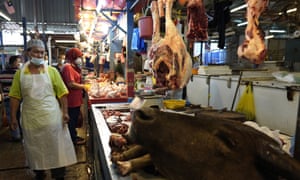
A poultry butcher at a wet market in Kuala Lumpur.
“There is a single species responsible for the Covid-19 pandemic – us,” they said. “Recent pandemics are a direct consequence of human activity, particularly our global financial and economic systems that prize economic growth at any cost. We have a small window of opportunity, in overcoming the challenges of the current crisis, to avoid sowing the seeds of future ones.”
Professors Josef Settele, Sandra Díaz and Eduardo Brondizio led the most comprehensive planetary health check ever undertaken, which was published in 2019 by the Intergovernmental Science-Policy Platform on Biodiversity and Ecosystem Services (IPBES). It concluded that human society was in jeopardy from the accelerating decline of the Earth’s natural life-support systems.
Read the story from The Guardian by Damian Carrington - “Halt destruction of nature or suffer even worse pandemics, say world’s top scientists.” 

24 April, 2020

Next UN climate science report to consider lessons from coronavirus

Scientists are studying how far human pressures on the natural world are raising risks of pandemics. They will weave lessons from the coronavirus outbreak into the next UN climate science report, even as their work is delayed by lockdowns.
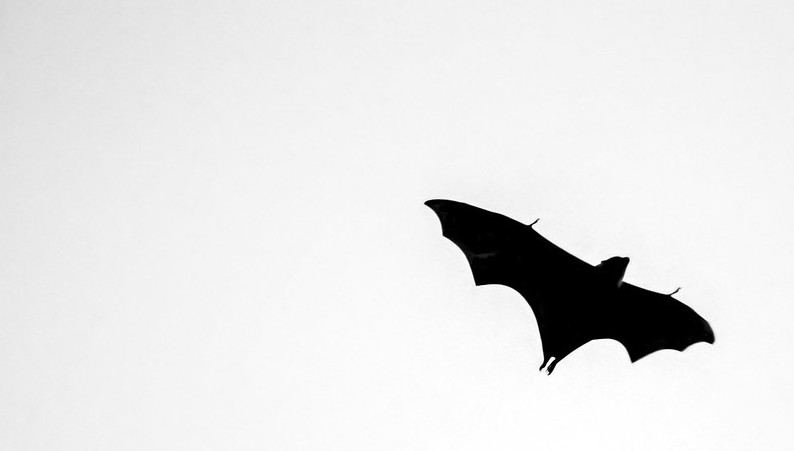
COVID-19 is understood to have been transmitted to humans by bats. 
Covid-19, which has killed more than 180,000 people worldwide, is thought to have originated in animals, perhaps bats, before infecting people in Wuhan, China.
Global warming, a rising human population, pollution and destruction of wildlife habitats are among the factors raising the risk of such zoonotic diseases, which jump from animals to humans.
Zoonotic disease was mentioned in the last round-up of scientific knowledge by the Intergovernmental Panel on Climate Change (IPCC) in 2013-14, but the pandemic potential was not a focus.
Read the Climate Home News story by Alister Doyle - “Next UN climate science report to consider lessons from coronavirus.”

30 December, 2018

David Attenborough: collapse of civilisation is on the horizon

The collapse of civilisation and the natural world is on the horizon, Sir David Attenborough has told the UN climate change summit in Poland.

The naturalist was chosen to represent the world’s people in addressing delegates of almost 200 nations who are in Katowice to negotiate how to turn pledges made in the 2015 Paris climate deal into reality.

As part of the UN’s people’s seat initiative, messages were gathered from all over the world to inform Attenborough’s address on Monday. “Right now we are facing a manmade disaster of global scale, our greatest threat in thousands of years: climate change,” he said. “If we don’t take action, the collapse of our civilisations and the extinction of much of the natural world is on the horizon.”


Read the story from The Guardian by Damian Carrington - “David Attenborough: collapse of civilisation is on the horizon.”

04 December, 2018

David Attenborough, Arnold Schwarzenegger lend green star power to open UN's COP24 climate talks

Sir David Attenborough says the "collapse of our civilisations and the extinction of much of the natural world is on the horizon" unless urgent action is taken against global warming.
UN Secretary-general, Antonio Guterres, told countries to ditch
 coal and embrace the opportunities of new energy sources.
The 92-year-old famed British naturalist and BBC presenter blamed humans for the, "man-made disaster of global scale, our greatest threat in thousands of years”.

"The world's people have spoken, their message is clear: time is running out," he said.

"They want you, the decision makers, to act now.”

The comments were made in Katowice, Poland, the city hosting the UN's COP24 climate talks — a multilateral meeting drawing together about 200 countries to set the rulebook for the 2015 Paris climate accords.


David Attenborough: collapse of civilisation is on the horizon

The collapse of civilisation and the natural world is on the horizon, Sir David Attenborough has told the UN climate change summit in Poland.
David Attenborough at Katowice in Poland -
he has made a plea on behalf of the Earth.

The naturalist was chosen to represent the world’s people in addressing delegates of almost 200 nations who are in Katowice to negotiate how to turn pledges made in the 2015 Paris climate deal into reality.

As part of the UN’s people’s seat initiative, messages were gathered from all over the world to inform Attenborough’s address on Monday. “Right now we are facing a manmade disaster of global scale, our greatest threat in thousands of years: climate change,” he said. “If we don’t take action, the collapse of our civilisations and the extinction of much of the natural world is on the horizon.”


Read the story from The Guardian by Damian Carrington - “David Attenborough: collapse of civilisation is on the horizon.”

24 January, 2018

The moral value of wilderness

Let us imagine that humanity has almost died out and only a few people remain. Out of resentment or despair, the survivors cater to their destructive urges by destroying as much of the natural world as they can. They poison rivers and lakes, drop napalm on forests, set off a few nuclear warheads. They are at ease with their conscience because no one will ever be in the position to use or appreciate the nature they are destroying.

Pause and reflect on what really makes wilderness valuable.
They are harming no one. But surely what they are doing is wrong.

The Australian environmental philosopher Richard Sylvan used this story to try to persuade us that nature has a value that is independent of our needs and desires, even our existence.


Read the piece on The Conversation by a Professor of Philosophy from La Trobe University, Janna Thompson - “The moral value of wilderness."

22 September, 2017

The Smog Chancellor by George Monbiot

Which living person has done most to destroy the natural world and the future wellbeing of humanity? Donald Trump will soon be the correct answer, when the full force of his havoc has been felt. But for now I would place another name in the frame. Angela Merkel.

George Monbiot.
What? Have I lost my mind? Angela Merkel, the “climate chancellor”? The person who, as German environment minister, brokered the first UN climate agreement, through sheer force of will? The Chancellor who persuaded the G7 leaders to promise to phase out fossil fuels by the end of this century? The architect of Germany’s Energiewende – its famous energy transition? Yes, the very same.

Unlike Donald Trump, she has no malicious intent. She did not set out to destroy the agreements she helped to create. But the Earth’s systems do not respond to mission statements or speeches or targets. 

They respond to hard fact. What counts, and should be judged, as she seeks a fourth term as German Chancellor in the elections on Sunday, is what is done, not what is said. On this metric her performance has been a planetary disaster.


Read the story by Guardian columnist, George Monbiot -“The Smog Chancellor.”

16 October, 2016

The Great Barrier Reef is ‘dead’ at the age of 25 million years - claims writer

The Great Barrier Reef Marine Park
 Authority said that during 2016
the reef died “due to the worst
mass bleaching event on record”.
THE Great Barrier Reef has been declared dead at 25 million years old by an environmentalist writer.

The incredible Coral Sea wilderness, which stretches for roughly 2250km over an area of roughly 2150km, has finally succumbed to bleaching writes Rowan Jacobsen, according to The Sun.

The icon of the natural world is bigger than the whole of the United Kingdom and is composed of more than 2900 individual reefs and 900 islands.

01 September, 2013

Make an effort, for the good of our environment, to visit film festival


Any considered and worthwhile response to climate change must begin with a caring attitude toward our natural world, commonly called the environment.

And if we give a “flick”, so to speak, about how our natural world is being treated, then we should be making an effort to see at least something at the coming Environment Film Festival Melbourne.

The festival starts on Thursday, September 5, and continues through to Friday, September 13.

The website says: “The Environmental Film Festival Melbourne entertains with groundbreaking films, traversing the relationship between humans and their environments, challenging the way people think about the natural world and inspiring them to discuss, explore and act on important environmental issues.”