Showing posts with label Even. Show all posts

28 April, 2020

Halt destruction of nature or suffer even worse pandemics, say world’s top scientists

The coronavirus pandemic is likely to be followed by even more deadly and destructive disease outbreaks unless their root cause – the rampant destruction of the natural world – is rapidly halted, the world’s leading biodiversity experts have warned.
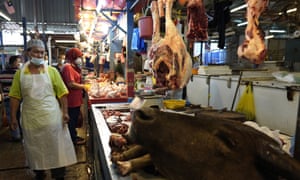
A poultry butcher at a wet market in Kuala Lumpur.
“There is a single species responsible for the Covid-19 pandemic – us,” they said. “Recent pandemics are a direct consequence of human activity, particularly our global financial and economic systems that prize economic growth at any cost. We have a small window of opportunity, in overcoming the challenges of the current crisis, to avoid sowing the seeds of future ones.”
Professors Josef Settele, Sandra Díaz and Eduardo Brondizio led the most comprehensive planetary health check ever undertaken, which was published in 2019 by the Intergovernmental Science-Policy Platform on Biodiversity and Ecosystem Services (IPBES). It concluded that human society was in jeopardy from the accelerating decline of the Earth’s natural life-support systems.
Read the story from The Guardian by Damian Carrington - “Halt destruction of nature or suffer even worse pandemics, say world’s top scientists.” 

23 July, 2018

This world is enough

Even to those who are thoroughly inured to warnings of impending catastrophe, the World Bank’s recent report on climate change, Turn Down the Heat (November, 2012), made for alarming reading. Looking at the consequences of four degrees of global warming, a likely outcome under current trajectories, the Bank concludes that the full scope of damage is almost impossible to project. Even so, it states: ‘The projected impacts on water availability, ecosystems, agriculture, and human health could lead to large-scale displacement of populations and have adverse consequences for human security and economic and trade systems.’ Among the calamities anticipated in the paper are large-scale dieback in the Amazon, the collapse of coral reef systems and the subsistence fishing communities that depend on them, and sharp declines in crop yields.
The projected Tianjin Eco City, China.
By contrast, most of us are already inured to the continuing catastrophe reported in the Bank’s annual World Development Report. Hundreds of millions of people go hungry every day. Tens of millions die every year from easily treatable or preventable diseases. Uncontrolled climate change could produce more crop failures and famines, and spread diseases and the pests that cause them even more widely.


Read the story from Aeon by a Professor of Economics from the University of Queensland, John Quiggin - “This world is enough

30 March, 2018

Consumption does not, cannot, bring meaning or even ordinary happiness

Writing about Pope Francis 2015 Encyclical entitled, "On Care For Our Common Home”, Robert Manne said, in his latest book, “On Borrowed Time”  - 


“Consumption does not, cannot, bring meaning or even ordinary happiness. In the consumer society, the ills of isolation, depression and anxiety are growing, the ties of family and community are weakening, because of what the encyclical calls ‘the silent rupture of the bonds of integration and social cohesion’.”

29 November, 2017

Climate energy appeasement does not work

The current chaos around climate and energy policy brings to mind George Santayana’s caution that: “Those who cannot remember the past are condemned to repeat it”. That is exactly what we are witnessing, albeit with far more profound implications even than the advent of the Second World War.

In November 1936, Winston Churchill, concerned at the dangers posed by the Third Reich, warned the House of Commons about the refusal of the British establishment to face up to reality:

“They go on in strange paradox, decided only to be undecided, resolved to be irresolute, adamant for drift, solid for fluidity, all-powerful to be impotent……Owing to past neglect, in the face of the plainest warnings, we have now entered upon a period of great danger …..  The era of procrastination, of half-measures, of soothing and baffling expedients, of delays, is coming to a close.  In it’s place we are entering a period of consequences….. We cannot avoid this period, we are in it now …..”

Prime Minister Neville Chamberlain was not to be diverted from the appeasement path, returning from Munich in September 1938 waving his “peace in our time” paper signed with Hitler.  The rest is history; the war started a year later.


Read the RenewEconomy story by Ian Dunlop - “Climate energy appeasement does not work.”

19 October, 2017

National energy guarantee would cut 6 per cent off power bills in best scenario

Even the best energy policy will do little to reduce costs for consumers, experts have warned, as the Turnbull government resists pressure to substantiate claims its new policy will save Australians $2 a week on power bills. 
Minister for Environment and Energy Josh Frydenberg, Deputy
 Prime Minister Barnaby Joyce and Prime Minister Malcolm
 Turnbull during Question Time at Parliament House in
 Canberra on Wednesday.
 
 In Parliament on Wednesday, Labor seized on suggestions the reduction could be closer to 50¢ a week but Energy Minister Josh Frydenberg stood by the claim of an average $115-a-year saving between 2020 and 2030.

"The national energy guarantee is a credible, workable, pro-market policy that will deliver lower power prices for Australians and involves no taxes, no subsidies and no emission trading schemes," he said. 

A report this week from the Australian Competition and Consumer Commission found a 63 per cent power price rise since 2007 had put consumers under "unacceptable pressure"
  

Read Eryk Bagshaw’s story in today’s Melbourne Age - “National energy guarantee would cut 6 per cent off power bills in best scenario.”