Showing posts with label warned. Show all posts

31 December, 2019

Experts warn extreme bushfire weather risk growing

Climate experts have warned the weather system fuelling this week's catastrophic bushfires across south-eastern Australia will be up to four times more likely to occur under forecast levels of global warming.
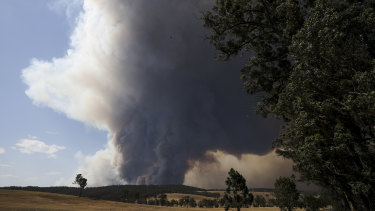
Hot, dry westerly winds created extreme bushfire conditions in south-east Australia this week.
Hot, dry westerly winds created extreme bushfire
 conditions in south-east Australia this week.
This particular weather event occurs when a low-pressure system from the Southern Ocean races north and collides with a high-pressure system on the NSW coast. The two systems then force hot, dry air from inland Australia out towards the coast, resulting in strong westerly winds for days, before an abrupt southerly change when the cold front sweeps past.

Read the story from The Age by Mike Foley - “Experts warn extreme bushfire weather risk growing.”

24 December, 2019

Home affairs warned Australian government of growing climate disaster risk after May election

The government was warned by the Department of Home Affairs after the May election that Australia faced more frequent and severe heatwaves and bushfires, and that livelihoods would be affected without effective action on climate change.
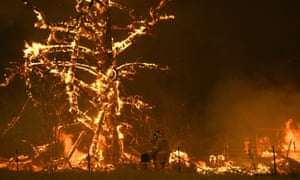
A tree burns during the New South Wales bushfires
Home affairs warned Australian government of “more
frequent and severe heatwaves, bushfires, floods, and cyclones”.
The department’s incoming government brief to the home affairs minister, Peter Dutton, warned of “disasters” exacerbated by climate change.
“The physical effects of climate change, population growth, and urbanisation mean that without effective action more Australians’ livelihoods will be impacted by disasters into the future and the cost of those disasters will continue to grow,” the brief stated.

20 December, 2019

NSW bushfires see 'catastrophic' fire danger issued for Greater Sydney, Illawarra and Southern Ranges.

The NSW Rural Fire Service (RFS) has warned it would be a "miracle" if more homes were not lost tomorrow amid a catastrophic fire danger warning across the south-eastern coast.
A police car and a police officer talk to a driver on a smoky road
Roads around Blackheath were closed to an
 emergency level fire and backburning.
It is only the second time such a warning, the highest level of bushfire danger, has been issued for the Greater Sydney area since the rating system was introduced in 2009.
Both instances have been during this year's unprecedented bushfire season in NSW, which has already seen blazes tear through 2.9 million hectares.
Tomorrow, the warning will be in place across Greater Sydney, the Illawarra/ Shoalhaven and the Southern Ranges.
Temperatures are expected to peak at the mid-40-degree mark during Saturday's heatwave, with gusty winds and dry conditions exacerbating the 100 blazes burning in the state.

16 December, 2019

Firefighters save 6000 homes in bushfire inferno but threat continues north of Perth

A bushfire raging in Perth’s north since Wednesday could remain out-of-control for several days more and the State’s top firefighter has warned the damage bill could escalate.
Bushfires in Perth’s north have burnt out more than 11,000 hectares
with residents warned to expect conditions to get worse. 
Fire and Emergency Services Commissioner Darren Klemm said more than 6000 homes had been saved so far but there were difficult times ahead.
He said gusts of 50km/h expected later on Saturday would make already tough conditions extremely difficult.
A bushfire emergency warning has been issued for Guilderton, Two Rocks, Woodridge and areas nearby.
Mr Klemm said residents in Woodridge were under particular threat because the fire was heading in that direction.
“Today we’re faced with extremely difficult conditions for fire,” he said.
“We knew we were going to have problems on Saturday and Sunday.
“The fire is moving at a rapid rate to the north-east and as you’ve seen with the wind conditions we’ve got here today it’s going to be difficult for us to pull that fire up before we get into nightfall tonight.
“Today and tomorrow are going to be particularly challenging and people need to be aware things could escalate from here in terms of the damage.”

05 September, 2019

Hurricane Dorian: 'generational devastation' in Bahamas, says PM

The official death toll from Hurricane Dorian in the Bahamas has hit 20 and is likely to rise further, the country’s prime minister has said, as he warned of “generational devastation” in the archipelago’s northern region.

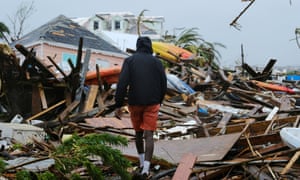
A man walks through the rubble in the aftermath of Hurricane Dorian on the Great Abaco island town of Marsh Harbour, Bahamas, 2 September 2019.
A man walks through rubble in the aftermath of Hurricane
Dorian in the Great Abaco island town of Marsh Harbour on Monday.
Aerial video of the Abaco Islands – a northern band of islands hardest hit by Dorian – showed widespread devastation, with the harbour, shops, workplaces, a hospital, and airport landing strips damaged or blown to pieces, all of which was frustrating rescue efforts.

Dorian pummelled the area as a slow moving category 5 hurricane over the weekend.

“So many families have been deeply impacted” by Dorian, which “has left generational devastation across Abaco and Grand Bahama”, Prime Minister Hubert Minnis said at a press conference late on Wednesday. “We ask you to pray for the families and loved ones of the deceased,” added the PM, who had just returned from a flyover of the Abacos.

Minnis also said he was aware of reports of looting on the Abacos.


Read the story from The Guardian by Oliver Laughland - “Hurricane Dorian: 'generational devastation' in Bahamas, says PM.”

03 September, 2019

John Kerry says we can't leave climate emergency to 'neanderthals' in power

The former US secretary of state John Kerry has warned that humanity risks marching off a cliff unless governments take immediate action to fight the climate emergency.

John Kerry at the Global Table conference
John Kerry at Australia’s Global Table conference in
Melbourne on Tuesday. He said there was a ‘dearth
of leadership’ on climate.
In a keynote address to the Global Table food and agriculture conference, Kerry made veiled swipes at the Australian government’s lack of climate and energy policy. He also weighed in on the heated debate about the massive Adani coalmine proposed for north Queensland.

“We just can’t sit on our asses and leave the political process to neanderthals who don’t want to believe in the future,” Kerry told the audience in Melbourne. “We have a dearth of leadership, but this will turn.”


Read the story from The Guardian by Lisa Martin - “John Kerry says we can't leave climate emergency to 'neanderthals' in power.” 

12 August, 2019

Is AI the Next Big Climate-Change Threat? We Haven’t a Clue

As a recent conference in San Francisco, Gary Dickerson took the stage and made a bold prediction. The chief executive of Applied Materials, which is a big supplier to the semiconductor industry, warned that in the absence of significant innovation in materials, chip manufacturing and design, data centers’ AI workloads could account for a tenth of the world’s electricity usage by 2025.
A general view in the CERN Computer/Data Centre
and server farm of the 1450 m2 main room during
 a behind the scenes tour at CERN, the world’s
 largest particle physics laboratory, on April 19, 2017
in Meyrin, Switzerland. 
Today, the millions of data centers around the world soak up a little less than 2% — and that statistic encompasses all kinds of workloads handled on their vast arrays of servers. Applied Materials estimates that servers running AI currently account for just 0.1% of global electricity consumption.
Other tech executives are sounding an alarm too. Anders Andrae of Huawei thinks data centers could end up consuming a tenth of the globe’s electricity by 2025, though his estimate covers all their uses, not just AI.

Read the story from MIT Technology Review by Martin Giles - “Is AI the Next Big Climate-Change Threat? We Haven’t a Clue.”

15 July, 2019

Defence chief sounds warning on climate refugees, conflicts

Australia’s military has warned of a rise in international conflicts and an influx of refugees as the effects of climate change start to bite.
climate change refugees
The ADF has warned that climate change could
bring an influx of refugees to Australia..
Defence chief Angus Campbell has also reportedly warned that China could take advantage of rising sea levels to occupy abandoned islands in the Pacific.
The ABC has obtained internal Australian Defence Force briefing notes from last year under Freedom of Information, which also predict that the military might have to increase patrols in Australia’s northern waters to deal with “sea-borne migration” sparked by rising sea levels in the Indo-Pacific.
One document warns that climate change could “exacerbate the potential for conflict” and contribute to “state fragility and the undermining of economic development in our immediate region”

Read the story from The New Daily - “Defence chief sounds warning on climate refugees, conflicts.”

16 June, 2019

India Heat Wave, Soaring Up to 123 Degrees, Has Killed at Least 36

NEW DELHI — One of India’s longest and most intense heat waves in decades, with temperatures reaching 123 degrees, has claimed at least 36 lives since it began in May, and the government has warned that the suffering might continue as the arrival of monsoon rains has been delayed.
Women fetching water from an opening in a
dried-up lake in Chennai, India, on Tuesday.
India’s heat waves have grown particularly intense in the past decade, as climate change has intensified around the world, killing thousands of people and affecting an increasing number of states. This year, the extreme temperatures have struck large parts of northern and central India, with Rajasthan, Madhya Pradesh, Uttar Pradesh and Maharashtra among the worst-hit states.
Anup Kumar Srivastava, an expert at India’s National Disaster Management Authority, said the number of Indian states hit by heat waves had grown to 19 in 2018 from nine in 2015, and was expected to reach 23 this year.

Read the story from The New York Times by Mujib Marshall - “India Heat Wave, Soaring Up to 123 Degrees, Has Killed at Least 36.”

21 May, 2019

Arthur Sinodinos urges Liberals to use renewables to boost environmental credentials

Arthur Sinodinos has warned that the Liberal party should not stand in the way of renewables, suggesting the government should use a changing energy market to bolster its environmental credentials.
Arthur Sinodinos says the Liberals should not make it
seem like voters have to choose between the environment
and the economy.
Anticipating a fresh internal battle over energy policy after the Liberal-National party’s success in Queensland, the Liberal senator suggested the government should recast itself as the best manager of the grid and “take advantage” of the falling cost of renewables to ensure “greater reliability, lower cost and lower greenhouse gas footprint”.

Despite the Coalition returning with a narrow majority in the 46th parliament, former prime minister Tony Abbott lost the blue-ribbon seat of Warringah and there were swings against the Liberal party in inner-city Melbourne and Sydney seats.


Read the story from The Guardian by Paul Karp - “Arthur Sinodinos urges Liberals to use renewables to boost environmental credentials.”

16 May, 2019

New York Rejects Keystone-Like Pipeline in Fierce Battle Over the State’s Energy Future

In a major victory for environmental activists, New York regulators on Wednesday rejected the construction of a heavily disputed, nearly $1 billion natural gas pipeline, even as business leaders and energy companies warned that the decision could devastate the state’s economy and bring a gas moratorium to New York City and Long Island.
Clean Water Clam, whose founding family has been
harvesting clams near the Raritan Bay for four generations,
fears that the pipeline would irreparably harm its business.
The pipeline was planned to run 37 miles, connecting natural gas fields in Pennsylvania to New Jersey and New York. Its operator, the Oklahoma-based Williams Companies, pitched it as a crucial addition to the region’s energy infrastructure, one that would deliver enough fuel to satisfy New York’s booming energy needs and stave off a looming shortage.

But environmental groups said Williams was manufacturing a crisis to justify a project that would rip apart fragile ecosystems, handcuff New York to fossil fuels and hobble the state’s march toward renewable resources.


Read the story from The New York Times by Vivian Wang and Michael Adno - “New York Rejects Keystone-Like Pipeline in Fierce Battle Over the State’s Energy Future.”

11 May, 2019

Americans have never been known to run away from a battle. Until climate change

Earlier this week Emma Howard Boyd, chair of the UK’s Environment Agency, warned that the UK needs to prepare for catastrophic flooding caused by climate change, and it is likely that entire communities will have to relocate. Because of our ongoing addiction to fossil fuels, coastal residents will be forced to move out of their homes. It is fitting that last week the UK parliament officially declared a “climate emergency”. Ireland has now followed suit (and no, not just because of Donald Trump’s golf course.)
Michael E. Mann.
It’s good to see the UK (and Ireland) confronting head-on the impacts of climate change, because they’re only growing more severe. Recent studies have shown that the Arctic is warming faster than we had previously thought. As a consequence, Arctic sea ice is disappearing more rapidly than predicted (April saw its lowest levels ever measured.) Despite what our Secretary of State Mike Pompeo recently asserted, the national security threat associated with defending a new Arctic coastline will almost certainly outweigh any hypothetical shipping route benefits.


Read the Newsweek opinion piece by Michael E. Mann - “Americans have never been known to run away from a battle. Until climate change.”

07 May, 2019

Human society under urgent threat from loss of Earth's natural life

Human society is in jeopardy from the accelerating decline of the Earth’s natural life-support systems, the world’s leading scientists have warned, as they announced the results of the most thorough planetary health check ever undertaken.
Forest clearance in Indonesia. Scientists have warned
of the impact of deforestation on animals.
From coral reefs flickering out beneath the oceans to rainforests desiccating into savannahs, nature is being destroyed at a rate tens to hundreds of times higher than the average over the past 10m years, according to the UN global assessment report.

The biomass of wild mammals has fallen by 82%, natural ecosystems have lost about half their area and a million species are at risk of extinction – all largely as a result of human actions, said the study, compiled over three years by more than 450 scientists and diplomats.


Read the story from The Guardian by global environment editor, Jonathan Watts - “Human society under urgent threat from loss of Earth's natural life.”

09 April, 2019

Fruit and vegetable prices 'could double' in a decade as power and energy costs grow

Australians are being warned that the price of fresh fruit and vegetables could double within a decade, as farmers face increasing pressure from rising labour, electricity costs and weather extremes.
Some growers have resorted to planting b-grade s
tunted and burnt runners, just to get plants in the ground.
At Luigi Coco's Elimbah strawberry farm near Caboolture in Queensland, many of the paddocks that should be filled with a million young plants are still empty.

And drought ravaged strawberry nurseries at Stanthorpe in south-east Queensland are running weeks behind schedule.


Read the story from ABC News by Jennifer Nichols and  Lydia Burton - “Fruit and vegetable prices 'could double' in a decade as power and energy costs grow.”

26 March, 2019

Don’t despair: the climate fight is only over if you think it is

In response to Monday’s release of the IPCC report on the climate crisis – which warned that “unprecedented” changes were needed if global warming increases 1.5C beyond the pre-industrial period – a standup comic I know posted this plaintive request on her Facebook: “Damn this latest report about climate change is just terrifying. People that know a lot about this stuff, is there anything to be potentially optimistic about? I think this week I feel even worse than Nov 2016 and I’m really trying to find some hope here.”
‘Climate change is an inescapable present and future
reality, but the point of the IPCC report is that there is
still a chance to seize the best-case scenario rather than
 surrender to the worst.’
A bunch of her friends posted variations on “we’re doomed” and “it’s hopeless”, which perhaps made them feel that they were in charge of one thing in this overwhelming situation, the facts. They weren’t, of course. They were letting understandable grief at the news morph into an assumption that they know just how the future is going to turn out. They don’t.


Read the story from The Guardian by Rebecca Solnit - “Don’t despair: the climate fight is only over if you think it is.”

24 March, 2019

‘Unprecedented’ US flood season will imperil 200m people, experts warn

The severe flooding in the American midwest is set to only be a prelude to “unprecedented” levels of flooding across the US in the coming months that will imperil 200 million people, federal government scientists have warned.
A team enters a flooded house to pull out several cats
 during flooding of the Missouri river near Glenwood,
Iowa, on 18 March. 
Nearly two-thirds of the lower 48 states will have a heightened risk of flooding until May, according to the National Oceanic and Atmospheric Administration (Noaa) forecast.

Communities living near the Mississippi river, which has received rain and snow levels up to 200% above normal, the lower Ohio river basin, the Tennessee river basin and the Great Lakes are at the greatest risk, Noaa said on Thursday. Vast swaths of the rest of the country may also get mild or moderate flooding, including most of eastern US and parts of California and Nevada.


Read the story from The Guardian by Oliver Milman - “‘Unprecedented’ US flood season will imperil 200m people, experts warn.”

23 March, 2019

Climate change could make insurance too expensive for most people – report

Insurers have warned that climate change could make cover for ordinary people unaffordable after the world’s largest reinsurance firm blamed global warming for $24bn (£18bn) of losses in the Californian wildfires.
An aerial view of a neighbourhood destroyed by
the 2018 wildfire in Paradise, California.
Ernst Rauch, Munich Re’s chief climatologist, told the Guardian that the costs could soon be widely felt, with premium rises already under discussion with clients holding asset concentrations in vulnerable parts of the state.

“If the risk from wildfires, flooding, storms or hail is increasing then the only sustainable option we have is to adjust our risk prices accordingly. In the long run it might become a social issue,” he said after Munich Re published a report into climate change’s impact on wildfires. 

“Affordability is so critical [because] some people on low and average incomes in some regions will no longer be able to buy insurance.”


Read the story from The Guardian by Arthur Neslen - “Climate change could make insurance too expensive for most people – report.”

20 March, 2019

Extreme weather, rising seas, feral animals: the state's environmental report card is grim

Climate change is already having a serious effect on Victoria’s environment, a landmark state government report leaked to The Age has warned, generating more extreme weather, less rainfall and snow cover, warmer sea surface temperatures, rising sea levels and the threat of greater bushfires.
Feral cats have proved difficult to control and
 have been devastating to native mammals.
Victoria's biodiversity is rapidly deteriorating in many parts of the state, with feral animals and plants on the march while native species are losing habitat and under increasing threat of extinction.

The latest State of the Environment Report for Victoria reveals that the local environment is being degraded at the hands of humans at a greater rate than it is being conserved elsewhere.

Meanwhile, "unprecedented population growth” is adding further pressure on the natural realm.


15 March, 2019

Malcolm Turnbull warns 'idiocy' of federal colleagues is damaging Gladys Berejiklian

Former prime minister Malcolm Turnbull has warned the "idiocy" of a renewed fight over coal-fired power among federal MPs is damaging the chances of NSW Premier Gladys Berejiklian as she fights the knife-edge state election.
Former prime minister Malcolm Turnbull says
Canberra is damaging the NSW government.

Several NSW ministers, including the leader and deputy leader of the Nationals, also blamed ongoing instability in Canberra for undermining the state campaign at a critical time.


Read the story from The Age by Michael Koziol and Alexandra Smith - “Malcolm Turnbull warns 'idiocy' of federal colleagues is damaging Gladys Berejiklian.”

13 March, 2019

Climate change costs will have knock-on effect on interest rates, Reserve Bank warns

The Reserve Bank has warned it will have to take the impact of climate change into account when setting interest rates.
Reserve Bank Deputy Governor Guy Debelle delivering
his speech to the Centre for Policy Development.
"The economy is changing all the time in response to a large number of forces," Guy Debelle said in a keynote address to the Centre for Policy Development.

"Monetary policy is always having to analyse and assess these forces and their impact on the economy.