Showing posts with label extreme weather. Show all posts

16 January, 2020

Climate crisis fills top five places of World Economic Forum’s risks report

A year of extreme weather events and mounting evidence of global heating have catapulted the climate emergency to the top of the list of issues worrying the world’s elite.
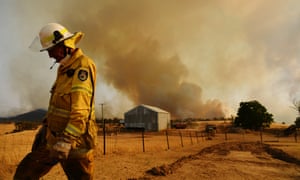
A Rural Fire Service firefighter views a flank of a fire on 11 January in Tumburumba, Australia.
The damage caused by extreme weather events such as
the Australian bushfires is at the top of the WEF’s risks report.
The World Economic Forum’s annual risks report found that, for the first time in its 15-year history, the environment filled the top five places in the list of concerns likely to have a major impact over the next decade.
Børge Brende, the president of the World Economic Forum, said: “The political landscape is polarised, sea levels are rising and climate fires are burning. This is the year when world leaders must work with all sectors of society to repair and reinvigorate our systems of cooperation, not just for short-term benefit but for tackling our deep-rooted risks.”
After a month in which bushfires have raged out of control in Australia, Brende said there was a need for urgent action.

Read the story from The Guardian by Larry Elliott - “Climate crisis fills top five places of World Economic Forum’s risks report.”

14 January, 2020

Some say we’ve seen bushfires worse than this before. But they’re ignoring a few key facts

Every time a weather extreme occurs, some people quickly jump in to say we’ve been through it all before: that worse events have happened in the past, or it’s just part of natural climate variability.
Record-breaking hot and dry conditions preceded this fire season.
The recent bushfire crisis is a case in point. Writing in The Australian recently, columnist Gerard Henderson said:
In Victoria, there were further huge fires in 1983 and 2009. But until now, there was no suggestion that the state’s future would be one of continuing apocalypse. 
Of course, Australia has a long history of bushfires. But several factors make eastern Australia’s recent crisis different to infamous bushfires in the past.
First is the enormous geographic spread of this season’s fires, and second, the absence of El Niño conditions typically associated with previous severe fires.


17 October, 2019

The Truth About Big Oil and Climate Change

In America, the world’s largest economy and its second biggest polluter, climate change is becoming hard to ignore. Extreme weather has grown more frequent. In November wildfires scorched California; last week Chicago was colder than parts of Mars. Scientists are sounding the alarm more urgently and people have noticed — 73% of Americans polled by Yale University late last year said that climate change is real. The left of the Democratic Party wants to put a “Green New Deal” at the heart of the election in 2020. As expectations shift, the private sector is showing signs of adapting. Last year around 20 coal mines shut. Fund managers are prodding firms to become greener. Warren Buffett, no sucker for fads, is staking $30bn on clean energy and Elon Musk plans to fill America’s highways with electric cars.

Even as concerns about global warming grow, energy firms are planning to increase fossil-fuel production. None more than ExxonMobil.

Yet amid the clamour is a single, jarring truth. Demand for oil is rising and the energy industry, in America and globally, is planning multi-trillion-dollar investments to satisfy it. No firm embodies this strategy better than ExxonMobil, the giant that rivals admire and green activists love to hate. As our briefing explains, it plans to pump 25% more oil and gas in 2025 than in 2017. If the rest of the industry pursues even modest growth, the consequence for the climate could be disastrous.

ExxonMobil shows that the market cannot solve climate change by itself. Muscular government action is needed. Contrary to the fears of many Republicans (and hopes of some Democrats), that need not involve a bloated role for the state.

Read the Medium story from The Economist - “The Truth About Big Oil and Climate Change.”

20 March, 2019

Extreme weather, rising seas, feral animals: the state's environmental report card is grim

Climate change is already having a serious effect on Victoria’s environment, a landmark state government report leaked to The Age has warned, generating more extreme weather, less rainfall and snow cover, warmer sea surface temperatures, rising sea levels and the threat of greater bushfires.
Feral cats have proved difficult to control and
 have been devastating to native mammals.
Victoria's biodiversity is rapidly deteriorating in many parts of the state, with feral animals and plants on the march while native species are losing habitat and under increasing threat of extinction.

The latest State of the Environment Report for Victoria reveals that the local environment is being degraded at the hands of humans at a greater rate than it is being conserved elsewhere.

Meanwhile, "unprecedented population growth” is adding further pressure on the natural realm.


29 January, 2019

More than 2,000 flying foxes die from heat stress in eastern Victoria

Heat stress has killed almost a third of an eastern Victorian town's native flying fox population, after extreme weather on Friday.
One of the dead grey-headed flying foxes which
perished in the extreme heat last week.
Victoria's Department of Environment, Land, Water and Planning (DELWP) declared a natural emergency on Friday after officers found dead grey-headed flying foxes near Bairnsdale.

On Friday temperatures soared to almost 46 degrees Celsius in East Gippsland, about 300 kilometres east of Melbourne, accompanied by strong winds.

The department temporarily closed the Mitchell River walking track near nesting areas of the animals at Bairnsdale, to try to protect the flying foxes.

Read the story from The Age by Emma Field and Beth Gibson - “More than 2,000 flying foxes die from heat stress in eastern Victoria.”

02 January, 2019

Kigali Amendment heralds new dawn for climate change action

In 2018, extreme weather conditions were witnessed across the globe, from wildfires in California to floods in India.
Extreme weather conditions were witnessed across the globe.
The Intergovernmental Panel on Climate Change warns that we only have until 2030 to hold the increase in average global temperature at 1.5°C. After several years of stabilization, global carbon dioxide emissions have risen again.

But 2019 is already with us. On this first day of January, a climate deal that many expect will make a real and positive impact to our warming planet comes into force. This deal is the KigaliAmendment to the Montreal Protocol.


Read the story from the Standard Digital - “Kigali Amendment heralds new dawn for climate change action.”

05 November, 2018

Government must help farmers to meet climate challenge, NFU says

The UK government must do more to help farmers invest in their businesses to meet the increasing challenges brought by extreme weather, according to the NFU. 
The challenges faced by farmers grow
increasingly difficult as climate change worsens.
The union’s call for more government assistance to enable farmers to invest in their businesses was made as a new Met Office study showed the UK’s climate is changing, with an increasing trend for warmer and wetter weather.

A report by the forecaster, published on Friday (2 November), revealed further details about the UK’s climate since the 1960s.


Read the Farmers Weekly story by Philip Case - “Government must help farmers to meet climate challenge, NFU says.”

21 October, 2018

Politicians say nothing, but US farmers are increasingly terrified by it – climate change

Research forecasts Iowa corn yields could drop in half within the next half-century thanks to extreme weather – yet it’s not part of the political conversation.
 US and Iowa state flags are seen next to a corn field in Grand Mound, Iowa. 
Farmers around here are itching to go after that amber wave of soya beans, but there was that 5in rain a couple of weeks ago and then a 7in rain, and it drives even the retired guys batty.

Those beans aren’t worth much at the elevator thanks to a Trump trade war with China, but they’re worth even less getting wet feet in a pond that was a field which the glacier made a prairie bog some 14,000 years ago – until we came along and drained it.


21 March, 2018

Turnbull knows better than to deny fire weather link to climate change

Raising the issue of the role of climate change in extreme weather events is always a delicate matter for families battling grief over lost homes and emergency service teams managing the aftermath.
Malcolm Turnbull visit burned out homes in Tathra on Monday.
But that doesn't mean the rest of us can't have a discussion about the issues. If not now, when?

Malcolm Turnbull echoed the comments of his deposed predecessor Tony Abbott when he visited Tathra, the NSW south coastal town hit with huge fires amid record-breaking March heat.

Abbott in 2013 declared in the wake of Blue Mountain bushfires that destroyed 200 homes that "these fires are certainly not a function of climate change, they're a function of life in Australia”.

Unlike Abbott, though, Turnbull is not a denier of climate change, having taken personal efforts to school himself in the issue with scientists from the University of NSW well before becoming Prime Minister.


Read the comment by Peter Hannam from The Age - “Turnbull knows better than to deny fire weather link to climate change.”

16 February, 2018

Just 1 degree changes our risk of severe weather

Current commitments won’t meet the Paris Agreement’s aspirational goals of limiting temperature—and that could make the world a degree warmer and considerably more prone to extreme weather.
Yes, just one degree and the weather
becomes more severe and extreme.
The difference between this UN goal and the actual country commitments is a mere 1 C, which may seem negligible. But a new study in Science Advances finds that even that 1-degree difference could increase the likelihood of extreme weather.

In this study, Noah Diffenbaugh, professor of earth system science at Stanford University’s School of Earth, Energy & Environmental Sciences and colleagues expanded on previous work analyzing historical climate data, which demonstrated how greenhouse gas emissions have increased the probability of recording-breaking hot, wet, and dry events in the present climate.

Now, the group analyzed similar models to estimate the probability of extreme weather events in the future under two scenarios of the Paris Agreement: increases of 1.5 to 2 degrees if countries live up to their aspirations, or 2 to 3 degrees if they meet the commitments that they have made.


Read the story from Stanford University on Futurity - “Just 1 degree changes our risk of severe weather.”

11 September, 2017

Extreme weather makes homelessness even worse. Here’s how we can help

The images of Hurricane Harvey in Texas have shown how extreme weather can rob people of their homes. But what about those who have no home to begin with, or whose living situation is already precarious?

Extreme weather makes homelessness problematic.
Almost one-third of people who have been homeless have suffered extra trauma because of extreme weather, according to our research involving 163 homeless services in Australia and New Zealand.
What’s more, 19% of people in our study cited extreme weather as a factor in their clients becoming homeless in the first place.


Read the piece on The Conversation by a Senior Research Fellow in social vulnerability and disasters from Australia’s CQUniversity, Danielle Every -  ”Extreme weather makes homelessness even worse. Here’s how we can help.”

10 September, 2017

French minister Nicolas Hulot calls out Trump on climate change as Irma wreaks havoc

Paris: French Environment Minister Nicolas Hulot said extreme weather conditions like the powerful hurricane bearing down on Florida risked becoming the norm, and took a dig at US President Donald Trump's stance on climate change.

The links between cause and effect:
French Environment Minister Nicolas
 Hulot's message to Donald Trump. 
In an interview with France 2 TV about Hurricane Irma on Friday evening French time, Mr Hulot implied that Mr Trump - who has called global warming a hoax - was ignoring the reality of man-made climate change, which most mainstream scientists regard as an established fact.

Mr Trump said in May he was pulling the United States out of the landmark 2015 global agreement to fight climate change that was brokered in Paris, saying it would harm the US economy and cost jobs.

Irma - described by Mr Trump as a storm of "absolutely historic destructive potential" - pummelled Cuba and the Bahamas on Friday, and a second powerful hurricane, Jose, was tracking towards the northeastern Caribbean, with a third, Katia, right behind.


04 September, 2017

Climate change increasing the intensity and impact of extreme weather, BOM tells emergency managers

Cyclones are expected to be less likely in the future due to climate change, though the intensity and impact of extreme weather will be greater, according to a senior climatologist with the Bureau of Meteorology (BOM).

Climatologists are warning the intensity
and impact of extreme weather will worsen.
Dr Blair Trewin has told an Australian emergency management conference in Sydney that tropical cyclones are holding more moisture and dumping more rainfall.

He said Hurricane Harvey produced record rainfall because it parked for four days over Texas in the United States.

Dr Trewin said storm surges would also become worse as a result of sea levels that were rising at 3.4 millimetres per year.

He said extreme heat events were already occurring with greater frequency and intensity, which he said were both indicators of a changing climate.


26 August, 2017

Is Hurricane Harvey Related to Climate Change? Scientists Have a Better Answer

As Hurricane Harvey approaches Texas, an old argument has again resurfaced about whether climate change is to blame.
Hurricane Harvey brought some heavy
weather the coast of Texas.
In the past, scientists have had a rather unsatisfying answer for both environmentalists and skeptics, essentially saying that while climate change increases the frequency and severity of extreme weather, no individual event could be attributed to it.

But that may be changing.

Climate scientists now say that they can use models and historical data to evaluate with increased precision how global warming has affected the odds of a given individual weather event.

Known collectively as the World Weather Attribution group, a group of scientists formed in 2014 to conduct studies on the subject, developing a series of steps they have worked to perfect for case studies. The team begins every project with an announcement that it will undertake the project and a promise to publish the results, even if the impact of climate change on a particular event is shown to be negligible.


Read the Time magazine story by Justin Worland - “Is Hurricane Harvey Related to Climate Change? Scientists Have a Better Answer.”

06 August, 2017

Extreme weather deaths in Europe 'could increase 50-fold by next century’

Deaths from weather disasters could increase 50-fold in Europe by the start of the next century if no action is taken to reduce greenhouse gas emissions or protect citizens, researchers have warned.
Wildfires in Portugal killed 64 people in June; the recent study
 explores how often and where similar weather-related
disasters are likely to occur in the coming years. 
A new study estimates a toll of 152,000 deaths a year between 2071 and 2100 as a direct result of hazards relating to extreme weather, with those living in southern Europe likely to be the hardest hit.

“Governments and policies should be focused more on designing suitable adaptation measures,” said Giovanni Forzieri, a co-author of the study from the European Commission Joint Research Centre in Italy. “If no adaptation measures [are] taken, these estimates are really alarming.”

Writing in the journal Lancet Planetary Health, Forzieri and colleagues describe how they used state-of-the art predictions to explore how often and where seven types of weather disasters – including heatwaves, wildfires and floods – are likely to occur across Europe in the coming years if no action on global warming is taken.

The analysis also used large datasets from disasters in recent years to calculate a fixed value of human vulnerability for different weather events, and incorporated projections on how populations were likely to change.


Read The Guardian story bye Nicola Davis - “Extreme weather deaths in Europe 'could increase 50-fold by next century’.”

23 June, 2017

Glastonbury 2070? How the festival might have to cope with 4℃ of global warming

Glastonbury, Britain’s largest and most famous music festival, is a great symbol of the many faces of the global climate change debate. It’s full of people enjoying life and relying on technology, easily available energy and consumer goods, yet it’s also deeply rooted in environmental and social justice concerns. And, of course, it’s also hugely exposed to extreme weather.


If the party is to keep going, can all these be reconciled? And what will it look like in the future – will it need to adapt to survive?

The climate is of course already changing. When Glastonbury’s founder Michael Eavis was born in 1935, the concentration of carbon dioxide in the atmosphere was not far above 300 parts per million (ppm). It’s now above 400ppm and rising, due to the emissions of carbon dioxide from human activities. Around the time of Eavis’s first festival in 1970, early efforts at climate modelling were predicting that the world would warm by 0.6°C by the year 2000. The actual observed warming was around 0.5°C, and again this is still rising.

Read the story on The Conversation by the Chair in Climate Impacts at the University of Exeter,  Richard Betts - “Glastonbury 2070? How the festival might have to cope with 4 of global warming.”

01 April, 2017

Climate change: ‘human fingerprint’ found on global extreme weather

The fingerprint of human-caused climate change has been found on heatwaves, droughts and floods across the world, according to scientists.
Villagers use part of a damaged railway track to cross
 floodwaters in Sultan Kot, Sindh province after
torrential monsoon rains triggered Pakistan’s
worst natural disaster on record in 2010.
The discovery indicates that the impacts of global warming are already being felt by society and adds further urgency to the need to cut carbon emissions. A key factor is the fast-melting Arctic, which is now strongly linked to extreme weather across Europe, Asia and north America.

Rising greenhouse gases in the atmosphere have long been expected to lead to increasing extreme weather events, as they trap extra energy in the atmosphere. But linking global warming to particular events is difficult because the climate is naturally variable.

The new work analysed a type of extreme weather event known to be caused by changes in “planetary waves” – such as California’s ongoing record drought, and recent heatwaves in the US and Russia, as well as severe floods in Pakistan in 2010.


Read Damian Carrington’s story on The Guardian - “Climate change: ‘human fingerprint’ found on global extreme weather.”

30 March, 2017

Fighting tears Peruvian mayor demands action as brutal floods continue

Lima: Extreme weather has battered many parts of the world this year, but few places have suffered more in lives, homes and crops lost than Peru, which has been beset by torrential rains and massive flooding.

People hold onto a rope as they wade through
 flood waters to safety in Lima, Peru, at the
 start of this month's storms. 
The devastation reduced the mayor of a small town to tears, as he interrupted a presidential press conference in Lima earlier this month to confront Peruvian President Pedro Pablo Kuczynski and demand help for the people of Huarmey.

Miguel Sotelo Llacas said he felt helpless witnessing "the executive authorities' indifference towards Huarmey”.

"I demand help," he said. Rejecting explanations about a delay in machinery, Llacas pleaded. "It's been three days. For three days we've been under water. Three days," he said, his voice quivering.


Read Adriana Leon’s story in today’s Melbourne Age - “Fighting tears Peruvian mayor demands action as brutal floods continue.”

22 January, 2017

The threat to species from climate change should provoke shame in our hearts

 ‘Climate change from unprecedented carbon
emissions not only threaten the habitats of
our unique animals and birds, but also
challenges the very ability of them to survive.’ 
While Australia bakes through another hot, angry summer, its precious wildlife is increasingly under threat, not just from the extreme weather of fires and floods but by the growing reality of a changing climate.

It is getting hotter. Day by day, month by month, year by year – 2016 is confirmed as the hottest year on record globally, closely following the leads of 2015 and 2014 – and with summer in full swing in Australia we turn our minds and our national concerns to bushfires, ever more intense, and to extreme weather events, flash flooding, cyclonic winds, unexpected parching and flooding of our wide brown land.

And it is not just the Australian people who are feeling these stresses first hand, but some of the most unique wildlife to be found anywhere in the world.

Read Tim Flannery’s story on The Guardian - “The threat to species from climate change should provoke shame in our hearts.”

15 January, 2017

Extreme weather a regular visitor in 2016


2016 will be remembered as the year of extreme weather events, if the Bureau of Meteorology’s annual climate statement is anything to go by.
Image result for Extreme weather a regular visitor in 2016
2016 will be remembered by farmers
as a year of extreme events.
Australia experienced its fourth-warmest year on record and overall, annual rainfall was 17 per cent above average, according to the bureau’s climate statement.
For Shepparton, the warmest month on average for the year was February with an average temperature of 31.2°C and the hottest daily temperature recorded, 44°C, fell a month earlier on January 13.
The coldest temperature recorded in Shepparton was 8°C on June 26, which was also the coldest month, with an average temperature of 12.7°C.
Read the Country News story - “Extreme weather a regular visitor in 2016.”