Showing posts with label increases. Show all posts

06 May, 2020

Logging likely had significant effect on summer fires: scientists

Logging native forests increases the severity and risk of bushfires and likely had a significant effect on Australia's unprecedented summer fires.
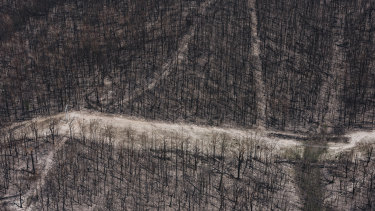
Burnt bushland on the NSW South Coast, which was heavily hit by bushfires.
New research from five scientists published in Nature Ecology & Evolution on Wednesday finds that public debates about the links between climate change and bushfires are warranted and should prompt action, but the contribution of logging to bushfires also needs greater scrutiny.
And, unlike much of the action needed to halt global warming, land management is within the control of Australians, write the scientists from the Australian National University, Macquarie University and the University of Queensland in their review of evidence.
Read the story from The Age by Miki Perkins - “Logging likely had significant effect on summer fires: scientists.”

23 September, 2018

Heatwaves linked to an increase in Australian suicide rates

Heatwaves and high temperatures can have a dramatic impact on people’s physical health. We only have to look at the increases in emergency department admissions during recent heatwaves to know that.
A spike in suicides linked to spikes in heat.
But not many people realise that high variations in temperatures can also impact our mental health.

For my PhD thesis I studied the socio-environmental drivers of suicide rates in Australia from 1986 to 2005. I found that sudden spikes in average temperatures can be attributed as a risk factor for suicide in some cities.


Read the story from The Conversation by a Researcher from the Queensland University of Technology, Xin Qi - “Heatwaves linked to an increase in Australian suicide rates.”

01 July, 2018

GDP is destroying the planet. Here’s an alternative.

GDP is a poor measure of progressit increases as we destroy the natural capital of the planet.
The value of the planet needs to be factored into our financial system.
We need economic growth, but we cannot continue to measure it using GDP. We need a ‘quality adjusted’ GDP linked to transactions which recognise how much social and natural capital they are building.

Although the International Energy Association reported that carbon emissions stabilised for 3 years in the 2014–2016, the best estimates for 2017, which are waiting formal confirmation, are that they increased 2%. This is in the context of Christina Figueres, former chair of the UN Framework Convention on Climate Change, together with leading scientists, saying that we have “three years for carbon emissions to peak and drop rapidly to avoid catastrophic climate change”. That was June 2017. We now have two years.


Read the World Economic Forum story - “GDP is destroying the planet. Here’s an alternative.

29 May, 2018

‘Unfortunate’ the carbon tax coincided with soaring network costs, Rod Sims says

The timing of the carbon tax was “unfortunate” because it coincided with soaring electricity network costs that have underpinned increases to household bills, the head of the Australian Competition and Consumer Commission (ACCC) has told a forum in Brisbane.
 Sydney rally in 2011 against the planned carbon tax.
Rod Sims says it isn’t to blame for power price rises. 
The ACCC is next month due to hand to government its final report on the electricity market. The body’s chairman, Rod Sims, said on Monday he was unable to reveal specific details but gave some hints about the direction the inquiry had taken.

Unlike the interim report, which was released last year and which charted factors that had caused bills to increase over time, the next phase would outline a “tricky” path to ultimately bringing those prices down, Sims said.


27 March, 2018

Climate Change Heightens Risk of Mosquito-Borne Disease Outbreaks

Rising global average temperatures due mainly to greenhouse gas emissions will contribute to increases in the distribution areas of four mosquito-borne viruses: Oropouche (OROV), Mayaro (MAYV), Rocio (ROCV), and St Louis encephalitis (SLEV).
Scientists use mathematical models to predict distribution
 areas by 2100 of four arboviruses: Oropouche, Mayaro, Rocio,
 and St Louis encephalitis. 
This finding is from a study published in the journal PLOS Neglected Tropical Diseases. The research was conducted at Butantan Institute in São Paulo, Brazil, during Camila Lorenz’s PhD with support from FAPESP and supervision by Lincoln Suesdek, a professor in the Parasitology Department at the University of São Paulo’s Biomedical Science Institute (ICBUSP). Flávia Virginio, Thiago Salomão, Breno Aguiar and Francisco Chiaravalloti-Neto, researchers in the same university’s Public Health Department (FSP-USP), also took part.


Read the Science and Technology Research News story - "Climate Change Heightens Risk of Mosquito-Borne Disease Outbreaks.”

18 March, 2018

It’s 50 years since climate change was first seen. Now time is running out

Fifty years ago, the Stanford Research Institute (SRI) delivered a report titled Sources, Abundance, and Fate of Gaseous Atmospheric Polluters to the American Petroleum Institute (API), a trade association for the fossil fuel industry.
 ‘Scientists attribute 15-40% of the epic rain
 of Hurricane Harvey to climate change.’
The report, unearthed by researchers at the Center for International Environmental Law, is one of the earliest attempts by the industry to grapple with the impacts of rising CO2 levels, which Stanford’s researchers warned if left unabated “could bring about climatic changes” like temperature increases, melting of ice caps and sea level rise.

The year was 1968, and the term “global warming” would not appear in a peer-reviewed academic journal until 1975. Famed Nasa scientist James Hansen would not testify before Congress that “global warming has begun” for another 20 years. And the US would not enter into – only to later pull out of – the Paris climate accord for nearly half a century.


Read the climate change opinion piece on The Guardian by Richard Wiles - “It’s 50 years since climate change was first seen. Now time is running out.”

21 January, 2018

Australia’s severe heat is affecting the sperm of the bird population: study

Recent heatwaves and temperature increases are severely impacting bird fertility, according to an Australian-led study.
A pair of Zebra Finches in the Australian heat.
For the avian population, functional and competent sperm is critical for reproduction, and this study led by Macquarie University shows the recent heat is having a devastating impact on the sperm quality of the common zebra finch (Taeniopygia guttata).

The zebra finch is commonly found throughout mainland Australia and is considered a very environmentally adaptable bird, capable of breeding in both hot and cool climates. 

The researchers periodically sampled male zebra finches, exposing them to high temperatures from three to 14 consecutive days.


Read the story by Kamin Gock from today’s Melbourne Age - “Australia’s severe heat is affecting the sperm of the bird population: study.”

26 August, 2017

Is Hurricane Harvey Related to Climate Change? Scientists Have a Better Answer

As Hurricane Harvey approaches Texas, an old argument has again resurfaced about whether climate change is to blame.
Hurricane Harvey brought some heavy
weather the coast of Texas.
In the past, scientists have had a rather unsatisfying answer for both environmentalists and skeptics, essentially saying that while climate change increases the frequency and severity of extreme weather, no individual event could be attributed to it.

But that may be changing.

Climate scientists now say that they can use models and historical data to evaluate with increased precision how global warming has affected the odds of a given individual weather event.

Known collectively as the World Weather Attribution group, a group of scientists formed in 2014 to conduct studies on the subject, developing a series of steps they have worked to perfect for case studies. The team begins every project with an announcement that it will undertake the project and a promise to publish the results, even if the impact of climate change on a particular event is shown to be negligible.


Read the Time magazine story by Justin Worland - “Is Hurricane Harvey Related to Climate Change? Scientists Have a Better Answer.”