Showing posts with label researchers. Show all posts

25 April, 2020

Bugged: Earth's land insects are disappearing

Washington: The world's ants, bees, butterflies, grasshoppers, fireflies and other land-dwelling insects have been suffering population drops of about 9 per cent per decade but freshwater bugs such as dragonflies and mosquitoes have been rallying, researchers say in a new study.

An insect flies next to a flower in Erfurt, Germany.
The findings, based on 166 sets of data covering 1676 sites in 41 countries dating as far back as 1925, provided a nuanced assessment for insects, the most ubiquitous and diverse animals on the planet.
Insects such as mosquitoes - which live in the water as larvae - as well as midges, mayflies, water beetles and caddisflies that spend at least part of their lives in freshwater were found to have experienced a population increase of about 11 per cent per decade.
Freshwater covers only about 2.5 per cent of the Earth's surface, so the vast majority of insects live on land.
Read the story from The Age  by Will Dunham - “Bugged: Earth's land insects are disappearing.”

07 March, 2020

‘Energy superpower' hub hopes dim as Germany, Australia stop funding

The future work of dozens of researchers seeking to develop a low-carbon "energy superpower" vision hangs in the balance after support from both the German and Australian governments was halted.
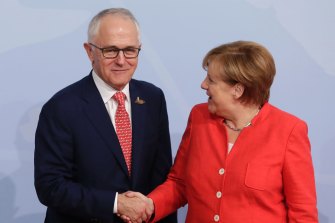
Australian prime minister Malcolm Turnbull and German Chancellor Angela Merkel agreed in 2017 at the G7 leaders' summit to back an energy transition hub that is now facing an uncertain future after both nations ended their support.
Australian prime minister Malcolm Turnbull and German
 Chancellor Angela Merkel agreed in 2017 at the G7 l
eaders' summit to back an energy transition hub that
is now facing an uncertain future after both nations ended their support.
The Energy Transition Hub, a five-year $20 million venture signed in 2017 to foster research by Australian and German universities, stops receiving funds from Germany this quarter, with the Morrison government's support ending in June.

Read the story from The Age by Peter Hannam - “‘Energy superpower' hub hopes dim as Germany, Australia stop funding.”

11 January, 2020

Researchers in Australia take key step toward battery of the future

Researchers in Australia believe they have solved one of the key problems holding back the battery of the future, a breakthrough that would allow them to develop cells that could run a smartphone for four days.
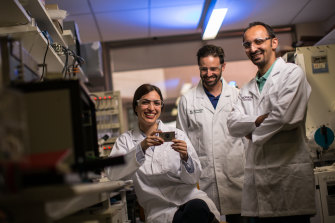
Mahdokht Shaibani, Matthew Hill and Meysam Mirshekarloo at their Monash University battery lab.
Mahdokht Shaibani, Matthew Hill and Meysam
Mirshekarloo at their Monash University battery lab.
Lithium-sulphur batteries can theoretically store six times as much energy as the lithium-ion batteries currently used in phones and electric vehicles, but that extra power can cause them to swell and break.

Read the story from The Age by Liam Mannix - “Researchers in Australia take key step toward battery of the future.”

05 July, 2019

Climate change: Trees 'most effective solution' for warming

Researchers say an area the size of the US is available for planting trees around the world, and this could have a dramatic impact on climate change.
trees
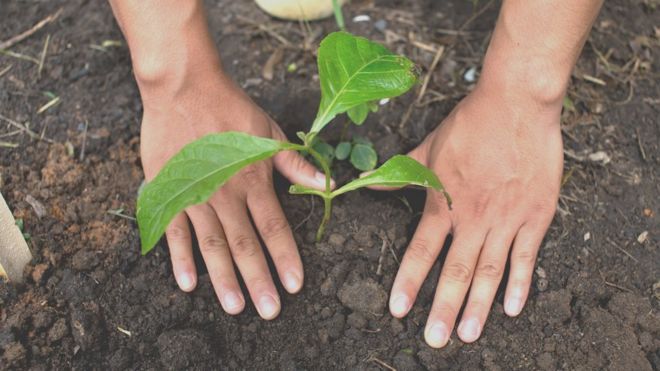
Planting trees could have a huge impact on the mitigation of climate change.
The study shows that the space available for trees is far greater than previously thought, and would reduce CO2 in the atmosphere by 25%.

The authors say that this is the most effective climate change solution available to the world right now.
But other researchers say the new study is "too good to be true”.


Read the story from the BBC News by Matt McGrath - “Climate change: Trees 'most effective solution' for warming.”

06 April, 2019

Climate Change Drove Some Neanderthals to Cannibalism

Six Neanderthals who lived in what is now France were eaten by their fellow Neanderthals some 100,000 years ago, according to gruesome evidence of the cannibalistic event discovered by scientists in a cave in the 1990s.
Global warming and the Neanderthals' world. 

Now, researchers may have figured out why the Neanderthals, including two children, became victims of cannibalism: global warming.

While prior studies have interpreted Neanderthal remains to find proof of cannibalistic behavior, this is the first study to offer clues as to what may have led Neanderthals to become cannibals. Scientists found that rapid shifts in local ecosystems as the planet warmed may have extinguished the animal species that Neanderthals ate, forcing them to look elsewhere to fill their bellies.

Read the story from LiveScience by Monday Weisberger - “Climate Change Drove Some Neanderthals to Cannibalism.”

01 April, 2019

Lord Howe Island coral bleaching 'most severe we've ever seen', scientists say

Researchers have documented what they are describing as the most severe coral bleaching to hit the world’s southern-most reef at Lord Howe Island.
Lord Howe Island: bleaching revealed on world's most southern coral reef.
Scientists from Newcastle University, James Cook University and the National Oceanic and Atmospheric Administration have spent the past two weeks surveying corals around the island in the far south Pacific Ocean after they were alerted to bleaching in isolated areas.

Bill Leggat, a coral biologist at Newcastle University, said the worst of the bleaching was in shallow water closer to the shoreline.


Read the story from The Guardian by Lisa Cox - “Lord Howe Island coral bleaching 'most severe we've ever seen', scientists say.”

29 March, 2019

Keeping a check on the climate with ‘Climate Watch”.

Climate Watch is an online platform designed to empower policymakers, researchers, media and other stakeholders with the open climate data, visualizations and resources they need to gather insights on national and global progress on climate change.
Climate Watch brings together dozens of datasets for the first time to let users analyze and compare the Nationally Determined Contributions (NDCs) under the Paris Agreement, access historical emissions data, discover how countries can leverage their climate goals to achieve their sustainable development objectives, and use models to map new pathways to a lower carbon, prosperous future.

This free platform enables users to create and share custom data visualizations and comparisons of national climate commitments. It contributes to the goals of the Paris Agreement by using open data to increase transparency and accountability, and provide actionable analysis on how countries can enhance their efforts to combat climate change.


Check out the website here.

05 February, 2019

A groundbreaking study outlines what you can do about climate change

Researchers in Sweden examined the possible steps that people can take to help tackle the climate crisis. Although a lot of resulting news coverage focused on the most effective action (having one fewer kid), the real takeaway is that individual actions still matter. A lot.

In fact, the researchers found that behavioral shifts could be faster than waiting for national climate policies and widespread energy transformations. As far as I know, this is the very first comprehensive analysis on the effectiveness of specific individual climate actions.


21 September, 2018

‘Staggering': Full impact of WA heatwave revealed with stark warning on climate

Researchers have warned WA is the “canary in the coalmine for climate change” in the wake of a new study shining light on the impact of a heatwave that swept across the state in 2011.

The study — a collaboration between international academics led by WA researchers — catalogued the devastation from a heatwave that struck most noticeably in March 2011, on the back of a dry 2010 winter.
Murdoch University lecturer and Kings Park
Science research scientist Dr Katinka Ruthrof.
It also coincided with one of the strongest La Niсa weather events on record, which started in the summer of 2010-11 and peaked between February and March 2011.

Researchers put together a database of information on the response of plants and animals to the heatwave across an area about the size of California, spanning from Exmouth down to Cape Leeuwin.

Maximum temperatures in the area studied were 2C higher than the long-term March average while Perth saw weekly maximum temperatures about 5C higher than usual.


27 April, 2018

Climate Change Is Making Deadly Air Pollution Worse in Cities Across the U.S.

Environmentalists worry that climate change could cause problems with rising sea levels and crop failures in the coming decades, but one group of researchers has found it’s already causing health problems now.
Climate change is worsening air pollution in U.S. cities.
Temperature increases linked to climate change are worsening air pollution in communities across the country right now contributing to a range of health problems from asthma to premature death, according to a new report from the American Lung Association.

The total number of Americans exposed to unhealthy air rose to nearly 134 million, according to the group’s 2018 State of the Air report. That represents a spike from 125 million in the previous year.


Read the story by Justin Worland from Time Magazine - “Climate Change Is Making Deadly Air Pollution Worse in Cities Across the U.S..”

23 April, 2018

World’s newest great ape threatened by Chinese dam

Last November scientists made a jaw-dropping announcement: they’d discovered a new great ape hiding in plain sight, only the eighth inhabiting our planet. 
A new species of great ape – the Tapanuli
orangutan – is down to just 800 individuals. 
The Tapanuli orangutan survives in northern Sumatra and it is already the most endangered great ape in the world; researchers estimate less than 800 individuals survive. But the discovery hasn’t stopped a Chinese state-run company, Sinohydro, from moving ahead with clearing forest for a large dam project smack in the middle of the orangutan population. According to several orangutan experts, Sinohyrdo’s dam represents an immediate and existential threat to the Tapanuli orangutan. 

“Building the dam means chopping the orangutan population in half,” Erik Meijaard, the director of Borneo Futures and one of the experts to describe Pongo tapanuliensis, said. “You end up with two smaller populations, and these will have much reduced chances of survival, because a small population is more likely to go extinct than a large one.”


Read the story by Jeremy Hance fromThe Guardian - “World’s newest great ape threatened by Chinese dam.”

01 April, 2018

Sun shield’ could be used to protect Great Barrier Reef from warming, say scientists

A protective film 50,000 times thinner than a human hair could be used to protect coral reefs from rising temperatures.
Areas of the Great Barrier Reef could be protected
 from rises in temperatures using a 'sun shield' 
By applying a layer of protection to the surface of the water researchers think parts of the Great Barrier Reef could be effectively cooled, preventing deadly coral bleaching events.

This ‘sun shield’ is made from the same substance that makes up the coral skeletons themselves – calcium carbonate.

Read the Independent story by its science correspondent, Josh Gabbatiss - “‘Sun shield’ could be used to protect Great Barrier Reef from warming, say scientists.”


(Personally, the idea of any form of geo-engineering is offensive as it is little more than an extension and sustenance of ideas that permit the maintenance of business as usual, a philosophy that has brought us to a point that life as we understand and enjoy it may well collapse, bringing to an end the near-goldilocks-like conditions of the past 10,000 years which have allowed humanity to thrive. However, an Irish friend has suggested that the Beneath the Wisteria blog would be decidedly more balanced if the geo-engineering idea was allowed more exposure - he provided a the link to this story - Robert McLean)

18 March, 2018

It’s 50 years since climate change was first seen. Now time is running out

Fifty years ago, the Stanford Research Institute (SRI) delivered a report titled Sources, Abundance, and Fate of Gaseous Atmospheric Polluters to the American Petroleum Institute (API), a trade association for the fossil fuel industry.
 ‘Scientists attribute 15-40% of the epic rain
 of Hurricane Harvey to climate change.’
The report, unearthed by researchers at the Center for International Environmental Law, is one of the earliest attempts by the industry to grapple with the impacts of rising CO2 levels, which Stanford’s researchers warned if left unabated “could bring about climatic changes” like temperature increases, melting of ice caps and sea level rise.

The year was 1968, and the term “global warming” would not appear in a peer-reviewed academic journal until 1975. Famed Nasa scientist James Hansen would not testify before Congress that “global warming has begun” for another 20 years. And the US would not enter into – only to later pull out of – the Paris climate accord for nearly half a century.


Read the climate change opinion piece on The Guardian by Richard Wiles - “It’s 50 years since climate change was first seen. Now time is running out.”

Warm Arctic? Expect Northeast Blizzards: What 7 Decades of Weather Data Show

The warmer the Arctic, the more likely the Northeast will be clobbered by blizzards, says a team of researchers who analyzed winter weather patterns going back to 1950.
Three extreme winter storms have hit the Northeast this
month, dumping several feet of snow and in some areas
bringing destructive coastal flooding. The Arctic,
meanwhile, has had record warmth.
Citing disruptive storms like Snowzilla (2016), Snowmaggedon (2010) and Snowpocalypse (2009), the climate scientists wrote that "heavy snowfalls are generally more frequent since 1990, and in many cities the most extreme snowfalls have occurred primarily during recent decades.”

Their study, published in the journal Nature Communications, links the increased frequency of extreme winter storms with the rapid and persistent warming of the Arctic since around 1990. When temperatures over the Arctic spike, especially high in the atmosphere, extreme winter weather is two to four times more likely in Boston and New York, while the U.S. West tends to see warmer and drier conditions, they conclude.


Read the Inside Climate News storey by Bob  Berwyn - “Warm Arctic? Expect Northeast Blizzards: What 7 Decades of Weather Data Show.”

12 March, 2018

Scientists call for action in fight against ‘fake news’

Legal scholars, social scientists, and researchers are joining forces in a global call to action in the fight against “fake news.”
Scientists need to join the fight against fake news.
The indictment of 13 Russians in the operation of a “troll farm” that spread false information related to the 2016 US presidential election has renewed the spotlight on the power of “fake news” to influence public opinion.


Read the Futurity story by Kevin Fryling - “Scientists call for action in fight against ‘fake news’.”

11 March, 2018

Researchers Unveil Several Ways To Limit Global Warming To 1.5°C By 2100

A group of researchers led by International Institute for Applied Systems Analysis has used new modelling scenarios to showcase several ways with which to limit global temperature rise to 1.5°C by 2100.
Fresh ideas about limiting global warming to 1.5°C. 
According to their research, “Scenarios towards limiting global mean temperature increase below 1.5 °C“, published in the journal Nature Climate Change, there are in fact several ways to limit global warming to the Paris Agreement’s goal of 1.5°C by 2100, but their modelling shows that the right circumstances are necessary. The research represents one of the first times that scientists investigating limiting global warming to 1.5°C by 2100 have also looked at how socioeconomic conditions such as inequalities, energy demand, and international cooperation would contribute to the feasibility of achieving those goals.

The new research is based on six integrated assessment models and a simple climate model, run under different socio-economic, technological, and resource assumptions that stem from five Shared Socio-economic Pathways (SSPs). The SSPs were previously developed by the International Institute for Applied Systems Analysis (IIASA) along with key partners, and provide a look at different ways in which the world and society might progress. They include a scenario in which the world pursues sustainability, another scenario in which economic and population growth continues along business-as-usual pathways, and another in which the world focuses instead on high economic growth over sustainability.


Read the CleanTechnica story by Joshua S. Hill - “Researchers Unveil Several Ways To Limit Global Warming To 1.5°C By 2100.”

09 March, 2018

Australian uni develops smaller, cheaper battery

Researchers at RMIT University have developed the world’s first working rechargeable proton battery, which they say will be smaller and cheaper to produce than lithium-ion batteries.
The proton battery is world-first development.
“Carbon, which is the primary resource used in our proton battery, is abundant and cheap compared to both metal hydrogen-storage alloys and the lithium needed for rechargeable lithium-ion batteries,” lead researcher Professor John Andrews told Fairfax Media. “It should be reasonably cheap as opposed to lithium-ion, which is scarce.”


Read Cole Latimer’s story in The Age - “Australian uni develops smaller, cheaper battery.”

20 February, 2018

Vatican climate scientist Ramanathan to speak at Creighton University

Veerabhadran “Ram” Ramanathan.
The climate scientist won’t sugarcoat it: The fate of the world is no longer in the hands of the researchers and academics. Now, it’s up to everyone else.

“We’re wasting time talking to people like me,” said Veerabhadran “Ram” Ramanathan. “It’s up to people like you to solve it. This is a human tragedy.”

This week, Ramanathan, climate scientist with the Vatican’s Pontifical Academy of Sciences, will speak at Creighton University about the toll climate change will take on human lives and what we can do to fix it. His talk, “Climate Change: Morphing into an Existential Threat,” will begin at 7 p.m. Wednesday in the university’s Mike & Josie Harper Center. It is free and open to the public.


Read the Omaha World-Herald story by Blake Ursch - “Vatican climate scientist Ramanathan to speak at Creighton University.”

27 January, 2018

NT fracking inquiry's key environmental findings questioned by scientists

One of Australia's top legacy mines researchers has questioned the scientific accuracy of some of the Northern Territory fracking inquiry's key environmental findings.
The inquiry panel thinks fracking chemicals will not
 spill near Katherine or in areas with similar geology.
The practice of hydraulic fracturing — in which a mixture of chemicals, water and sand are injected at high pressure into rock to release gas — has been controversial in the NT over the past decade since applications to frack began pouring in.

It was a key election promise of the Labor Government to respond to community concerns by imposing a moratorium while an inquiry was held.

The March deadline for the inquiry's final report is looming, and it has another round of community consultations to hold following last month's release of its draft report.


(The purveryors of profit invevitbale question anything, including science, that puts their profit at risk and the same dynamicx is being witnessed in the Northern Territory with those in the pro-fracking camp ignoring, and questioning, any advice that suggests these modern attempts to unlock these hitherto inaccessible gases are noit just qestionsable, but simply wrong.
This, again, is an example of profit, at whatever expense, being put ahead of protection of our country - it's short term gain for a handful of people at the long-term cost for the broader community.
The territory's fracking moratorium should not onhy be maintained, but converted into an ouright ban - Robert McLean)

13 January, 2018

Great Barrier Reef tourism spokesman attacks scientist over slump in visitors

A Queensland tourism representative has called one of the Great Barrier Reef’s leading researchers “a dick”, blaming the professor for a downturn in tourism growth at the state’s greatest natural asset.
 A leading scientist has been accused of exaggerating the damage to the Great Barrier
 Reef, which a tourism representative said had hurt the region’s multibillion-dollar tourism industry. 
Col McKenzie, the head of the Association of Marine Park Tourism Operators, a group that represents more than 100 businesses in the Great Barrier Reef, has written to the federal government asking it to stop funding the work of Professor Terry Hughes, claiming his comments were “misleading” and damaging the tourism industry.

But the Australian Conservation Foundation said tourism representatives and operators like McKenzie should stop blaming scientists for reporting what was happening to the reef and start targeting major polluters to ensure change.

Read the story by Amy Remeikis from The Guardian - “Great Barrier Reef tourism spokesman attacks scientist over slump in visitors.”


(Each of us needs to do all we can to support the likes of Professor Terry Hughes and disarm those with vested interests - Robert McLean)