Showing posts with label Northern Territory. Show all posts

07 April, 2020

NT plans big battery in Darwin to cut gas costs and accelerate solar.

The Northern Territory government has announced plans to spend $30 million on a big battery for the Darwin-Katherine grid, a move it says will pay for itself within five years because of reduced gas costs and help expand solar power and meet the 50 per cent renewables by 2030.
NT plans big battery in Darwin to cut gas costs and accelerate ...
An artist's impression of the NT "big battery".
The announcement over the weekend follows an intense debate in NT energy circles over the past year about the need for a big battery in the main Darwin grid, which was supported by the government-appointed task force, and Territory Generation, and frustration over the slow response by the government to those calls.
Instead, the government regulator late last year endorsed a controversial push by network operator and system controller Power and Water Corp to effectively saddle all new large scale solar plants with their own batteries, even though the regulator acknowledged that a centralised battery would be the more efficient option.
Read the story from RenewEconomy by Gile Parkinson - “NT plans big battery in Darwin to cut gas costs and accelerate solar.”

14 July, 2019

‘Just a matter of when': the $20bn plan to power Singapore with Australian solar

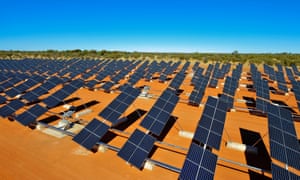
The desert outside Tennant Creek, deep in the Northern Territory, is not the most obvious place to build and transmit Singapore’s future electricity supply. Though few in the southern states are yet to take notice, a group of Australian developers are betting that will change.
Solar NT
There are ambitious solar and wind projects
 planned for both the Northern Territory and
the Pilbara in Western Australia.
If they are right, it could have far-reaching consequences for Australia’s energy industry and what the country sells to the world.

Known as Sun Cable, it is promised to be the world’s largest solar farm. If developed as planned, a 10-gigawatt-capacity array of panels will be spread across 15,000 hectares and be backed by battery storage to ensure it can supply power around the clock.

Overhead transmission lines will send electricity to Darwin and plug into the NT grid. But the bulk would be exported via a high-voltage direct-current submarine cable snaking through the Indonesian archipelago to Singapore. The developers say it will be able to provide one-fifth of the island city-state’s electricity needs, replacing its increasingly expensive gas-fired power.


Read the story from The Guardian by Adam Morton - “‘Just a matter of when': the $20bn plan to power Singapore with Australian solar.” 

22 June, 2019

The 10 Gigawatt Vision: How renewable energy can power jobs and investment in the Northern Territory

The Northern Territory has an exceptional opportunity to prosper in this new era by converting abundant sunshine into renewable energy. By 2030, the NT Government could help drive investment in 10 gigawatts of renewables.

By pursuing the 10 Gigawatt Vision, the Northern Territory can put renewable energy at the centre of a sustainable growth strategy that creates over 8,000 new jobs and over $2 billion in revenue by 2030.


25 November, 2018

NT’s solar sector faces sunny future as Channel Island gas turbines head to retirement

The Northern Territory is four years out from a decision that could see more than half the capacity at its largest power station shut off.
Investment in large solar farms will be required
 for the NT to meet its renewable energy target.
Although it would put the region on track to meet its clean energy targets, it would also force stakeholders to hedge their bets on a renewables sector that sits well behind the rest of the nation.

Only four per cent of the Top End's energy usage came from renewables last year, despite it being Australia's sunniest jurisdiction.

By 2030 it aims to increase that to 50 per cent.


12 September, 2018

Australia Institute labels gas industry input in NT fracking impact research 'totally inappropriate’

The nation's five largest fracking companies are set to help measure the environmental impacts of fracking in the Northern Territory, presenting a "totally inappropriate" conflict of interest in the eyes of one thinktank.
An alliance called GISERA will research and
 give advice on gas development in the Territory.
Last week, the Northern Territory Government awarded a $450,000 grant to the Gas Industry Social and Environmental Research Alliance (GISERA) to deliver "independent and transparent advice on gas development in the Territory”.


23 April, 2018

Morrison denies Northern Territory's extra $260m is for lifting fracking ban

The federal government has given the Northern Territory an extra $260m to compensate for its low GST share, a decision both governments have denied is linked to the territory’s decision to lift a moratorium on fracking.
 NT’s extra funding is not due to the decision to lift
the ban on fracking, Scott Morrison says. 
At a press conference on Monday the treasurer, Scott Morrison, said the Northern Territory would receive the extra funding from the commonwealth’s consolidated revenue, as well as an extra $550m over five years for remote Indigenous housing.

The Northern Territory’s GST share is set to fall from 4.66% of Australia’s total in 2017-18 to 4.26% in 2018-19 as a result of the recommendation of the Commonwealth Grant Commission – the independent body that carves up the GST pie.


Read Paul Karp’s story from The Guardian - “Morrison denies Northern Territory's extra $260m is for lifting fracking ban.”

18 April, 2018

Northern Territory lifts fracking ban, opening up 700,000 sq km to gas exploration

The Northern Territory government has lifted a ban on hydraulic fracturing of onshore gas that will open up more than half of the territory’s land mass to the controversial practice.
 The Northern Territory has lifted a ban on fracking ban
and opened 51% of the territory to gas exploration. 
The first exploration fracking by petroleum companies is expected to occur early next year after the implementation of a regulatory regime and new laws, which the government insists will be strict.

The issue has sharply divided territorians, many of whom believe fracking threatens water supplies, but the chief minister, Michael Gunner, said on Tuesday the industry would create jobs.


29 March, 2018

NT Government told risks can be mitigated if fracking moratorium is lifted

The Northern Territory Government is expected to soon decide if it will lift a fracking moratorium, after an 15-month inquiry concluded the risks associated with the industry could be managed.
The NT fracking inquiry has delivered a final report to government.
The Scientific Inquiry into Hydraulic Fracturing in the Northern Territory chair, Justice Rachel Pepper, handed a final report to the NT Government on Tuesday.

If all 135 recommendations it contained were implemented, the inquiry determined that "the challenges and risks associated with any onshore shake gas industry in the NT can be appropriately managed”.

But Justice Pepper described the recommendations as "a complete package", and said it was critical each one was implemented in full, if government decided to lift the ban.

Read the story from ABC News by Emily JB Smith - “NT Government told risks can be mitigated if fracking moratorium is lifted.”


(The best way to manage to risks associated with fracking is to stop it completely, along with abandoning our search for and use of fossil fuels - Robert McLean)

27 January, 2018

NT fracking inquiry's key environmental findings questioned by scientists

One of Australia's top legacy mines researchers has questioned the scientific accuracy of some of the Northern Territory fracking inquiry's key environmental findings.
The inquiry panel thinks fracking chemicals will not
 spill near Katherine or in areas with similar geology.
The practice of hydraulic fracturing — in which a mixture of chemicals, water and sand are injected at high pressure into rock to release gas — has been controversial in the NT over the past decade since applications to frack began pouring in.

It was a key election promise of the Labor Government to respond to community concerns by imposing a moratorium while an inquiry was held.

The March deadline for the inquiry's final report is looming, and it has another round of community consultations to hold following last month's release of its draft report.


(The purveryors of profit invevitbale question anything, including science, that puts their profit at risk and the same dynamicx is being witnessed in the Northern Territory with those in the pro-fracking camp ignoring, and questioning, any advice that suggests these modern attempts to unlock these hitherto inaccessible gases are noit just qestionsable, but simply wrong.
This, again, is an example of profit, at whatever expense, being put ahead of protection of our country - it's short term gain for a handful of people at the long-term cost for the broader community.
The territory's fracking moratorium should not onhy be maintained, but converted into an ouright ban - Robert McLean)

12 January, 2018

World’s second-most powerful battery after Tesla mooted for Top End

The world's second-most powerful battery could be built in the Top End as part of a plan to produce more renewable energy for the Northern Territory.
Elon Musk.
Territory Generation, the NT Government-owned corporation that runs power plants in the jurisdiction, wants to build a large-scale renewable energy storage system for Darwin and Katherine.

It has released an expression of interest for a 25 to 45 megawatt battery.

By comparison, the new Tesla battery in South Australia — the world's largest — is 100 megawatts, said Dr Ariel Liebman, from Monash University's Energy Materials and Systems Institute.


30 October, 2017

NT fracking inquiry: Economic benefit uncertain, Australia Institute think tank warns

A new economic assessment of the impact hydraulic fracking would have on the Northern Territory shows the financial benefit does not warrant a lifting of the current moratorium, a Canberra-based think tank says.
Jemena is currently constructing the Northern
 Gas Pipeline that will link Tennant Creek with
 Mount Isa in north-west Queensland.
A report released by economic consulting firm ACIL Allen late on Friday evening looked at what effect allowing fracking in the NT would have on employment numbers and revenue — for both the Government and private companies.

Research Director at the Australia Institute think tank, Rod Campbell, said the assessment showed even in the best-case scenario the economic development for the NT was not outstanding.

"It points out... that an unconventional gas industry in the Northern Territory is very uncertain and likely to be quite small," he said.


08 August, 2017

Remote Northern Territory businesses weigh up potential impacts of fracking

Small business owners in a remote part of the Northern Territory are weighing up the potential effects of hydraulic fracturing on their livelihood and the environment.

Jack Harries says his business could benefit
from the development of a shale gas industry in the NT.
A moratorium on the controversial underground gas extraction technique is currently in place in the NT, with a decision to be made on its lifting awaiting the outcome of an independent scientific inquiry into hydraulic fracturing, due late this year.

While the inquiry sits, gas company Origin Energy has its sights on the Beetaloo Basin, about 600 kilometres south-east of Darwin, where it believes a huge amount of gas lies underground.

For the owners of small businesses in the region, the prospect of the development of a shale gas industry could provide a significant boost to their trade, or unknown environmental consequences.


Read the ABC News story by Daniel Fitzgerald - “Remote Northern Territory businesses weigh up potential impacts of fracking.”

01 August, 2017

BOM says global warming behind Northern Territory's hottest July on record

The Northern Territory has sweltered through the hottest July on record, with a mean maximum temperature of 3 degrees Celsius above average, and there's little relief in sight.

Territorians sweltered through hotter
 than average temperatures in July.
The mercury was the highest it had been in July since records began more than 100 years ago, the Bureau of Meteorology said.

Darwinites also sweltered through the nights with only six overnight lows under 20C, while the average for July is 18.5 nights below 20C.

BOM meteorologist Greg Browning said Darwin had a mean maximum temperature of 2C above the average, but the change was more dramatic further south.