Showing posts with label economic. Show all posts

07 April, 2020

Environmental law after a year of catastrophe

The government is undertaking a review of one of our central pieces of environmental law, the Environmental Protection and Biodiversity Protection Act. They have a facility for quick comments of up to 300 words, as well as traditional submission (thanks to the Australian Conservation Foundation for the link). Here’s my 300 words
The catastrophes that have afflicted Australia and the rest of the world over the last year, including coral bleaching, unprecedented wildfires and the coronavirus pandemic point up the need for a radical reconsideration of existing approaches to environmental protection.
Far from achieving a sustainable balance between economic, social and environmental values, recent Australian policy has focused on protecting sectional interests and amplifying second-order issues such as the effect of environmental policy on energy costs.
Read the story by John Quiggin - “Environmental law after a year of catastrophe.”


07 July, 2019

World Needs an Ambitious New Deal for Nature & People

From the fresh air we breathe to the clean water we drink, nature provides the essentials we all rely on for our survival and well-being. The loss of nature threatens these essentials. Loss of biodiversity is therefore not only an environmental issue, but also a developmental, economic, security, social and moral issue. It affects us all and all aspects of our lives.
We need a better deal for narture and people.
Yet, worryingly, a series of recent major intergovernmental scientific reports which will inform policy making all over the world from the IPCC, IPBES and others have issued a siren warning: Our natural world is now under unprecedented pressure. At the current rate of nature loss, we stand to face the extinction of an estimated 1 million species within decades and significant declines of food and water supplies and many other services that nature provides to us everyday, for free.
This is supported by WWF’s Living Planet 2018 report, which has found population sizes of wildlife decreased by 60% on average globally between 1970 and 2014.

Read the story from Medium by the Director General of WWF International, Marco Lambertini -  "World Needs an Ambitious New Deal for Nature & People.”

23 February, 2019

Tackling climate change a 'financial necessity' says top Australian banking regulator

One of Australia's top banking regulators says tackling climate change has become "a financial necessity" and urged companies and governments to take action to avoid an economic and environmental disaster.
APRA executive member Geoff Summerhayes.CREDIT:

The warning comes as Prime Minister Scott Morrison prepares to outline a suite of new climate policies on Monday as the government battles an internal insurgency over its lack of climate action.

A group of Liberal backbenchers believe the government’s weak climate policies are an electoral liability and are agitating for April budget measures to increase funding for renewable energy development and climate change resilience.


16 February, 2018

Intelligence Agencies Warn of Climate Risks in Worldwide Threat Assessment

In their annual summary of global threats, the nation's intelligence agencies warned on Tuesday that climate change and other environmental trends "are likely to fuel economic and social discontent—and possibly upheaval—through 2018.”
Intelligence officials testified before a Senate committee about global threats.
 Left to right: FBI Director Christopher Wray, CIA Director Mike Pompeo, National
Intelligence Director Dan Coats, Defense Intelligence Agency Director Robert
Ashley, National Security Agency Director Michael Rogers and National
  Geospatial Intelligence Agency Director Robert Cardillo.
While there may not be indications of an abrupt and cataclysmic event on the immediate horizon, the trends are already visible, they said in a statement presented to the Senate Intelligence Committee at a hearing where the Trump administration's top intelligence officials testified.

The statement was matter-of-fact and brief, but unambiguous. Normally, conclusions like these might not deserve much notice. But in an administration where top officials, including some with intelligence responsibilities, have repeatedly questioned the basic science of global warming, such a frank confirmation of the mainstream consensus was striking.


17 December, 2017

Energy transition in China and Australia

They expected the industrial era to end with the burning of the last coal.

Image result for ENERGY TRANSITION IN CHINA AND AUSTRALIA
Increasing awareness of the health implications
 of the carbon particles in the air, which can
cause heavy smog, is one of the internal drivers
 for China’s transition away from fossil fuels. 


Modern economic development has been built on intense use of fossil energy. Leading nineteenth and early twentieth century thinkers focusing on the future of human civilisation and the economy, from Jevons to Weber, thought that the benefits of the modern industrial economy depended on the availability of fossil energy to continue.

Australian pioneer of development economics Colin Clark noted in his seminal Conditions of Economic Progress in 1940 that we would need to find other sources of energy to allow modern economic development to continue after we had returned to the air as much fossil carbon as was consistent with stable atmospheric conditions.

Clark suggested that sustainable substitutes would be found for fossil energy, and that we seek them in the fast-growing Australian eucalypt or new technology built on recent developments in silicon physics.


Read the Pursuit story by Professor Ross Garnaut from the University of Melbourne - “Energy transition in China and Australia.”

30 October, 2017

NT fracking inquiry: Economic benefit uncertain, Australia Institute think tank warns

A new economic assessment of the impact hydraulic fracking would have on the Northern Territory shows the financial benefit does not warrant a lifting of the current moratorium, a Canberra-based think tank says.
Jemena is currently constructing the Northern
 Gas Pipeline that will link Tennant Creek with
 Mount Isa in north-west Queensland.
A report released by economic consulting firm ACIL Allen late on Friday evening looked at what effect allowing fracking in the NT would have on employment numbers and revenue — for both the Government and private companies.

Research Director at the Australia Institute think tank, Rod Campbell, said the assessment showed even in the best-case scenario the economic development for the NT was not outstanding.

"It points out... that an unconventional gas industry in the Northern Territory is very uncertain and likely to be quite small," he said.


18 September, 2017

Alan Finkel urges Turnbull to adopt clean energy target before states act

Alan Finkel has urged the Australian government to swiftly commit to the final recommendation of his energy review, warning the longer that commitment takes, the more likely states and territories are to set up conflicting emissions reduction schemes.
 Australia’s chief scientist, Alan Finkel, says he does
not care whether coal remains part of the energy mix,
 as long as emissions keep heading down. 
Speaking at the Melbourne economic forum at Victoria University on Monday, Finkel, Australia’s chief scientist, said that a failure to establish a clean energy target would create more uncertainty for investors, who would have to navigate various state policies.

The Victorian government announced two days after the review had been released that it was prepared to implement its own clean energy target if the federal government didn’t commit.


Read Calla Wahlquist’s story on The Guardian - “Alan Finkel urges Turnbull to adopt clean energy target before states act.”

01 September, 2017

Australia’s energy future on grid edge - can AMEO give it a push?

The Australian Energy Market Operator has again stressed the vital role that demand management solutions – and not more baseload coal – will play in the safe, stable and economic running of Australia’s electricity grid, as it transitions away from centralised fossil fuel generation and towards distributed renewables.

Speaking at an industry event in Melbourne on Thursday night, AEMO CEO Audrey Zibelman said that the key role of the market operator was to drive productivity of the system – “and the best way to drive productivity of the system was being able to get demand to participate.”

This “demand” Zibelman refers to is the multiple gigawatts – 6GW in small-scale renewables, alone – of energy generation capacity that has been installed by homes and businesses around the country, but that is currently “not visible” to the market operator, and therefore of little use in balancing the grid.

Zibelman wants to change that, and firmly believes that by using non-network solutions to help manage this behind-the-meter capacity, Australia’s grid can make an ‘orderly transition’ to renewables and deliver secure, reliable and affordable energy.


“Read Sophje Vorrath’s story on RenewEconomy  - “Australia’s energy future on grid edge - can AMEO give it a push?

13 August, 2017

Fossil fuel subsidies are a staggering $5 tn per year

Fossil fuels have two major problems that paint a dim picture for their future energy dominance. These problems are inter-related but still should be discussed separately. First, they cause climate change. We know that, we’ve known it for decades, and we know that continued use of fossil fuels will cause enormous worldwide economic and social consequences.

The major costs of fossil fuels are hidden.
Second, fossil fuels are expensive. Much of their costs are hidden, however, as subsidies. If people knew how large their subsidies were, there would be a backlash against them from so-called financial conservatives.

A study was just published in the journal World Development that quantifies the amount of subsidies directed toward fossil fuels globally, and the results are shocking. The authors work at the IMF and are well-skilled to quantify the subsidies discussed in the paper.


Read John Abraham’s story on The Guardian - “Fossil fuel subsidies are a staggering $5 tn per year.”

26 June, 2017

Great Barrier Reef valued at $56 billion by Deloitte economists

The Great Barrier Reef is worth $56 billion.

The survey found people value the reef for a range
of reasons – some concrete, such as its importance
 for tourism, and some abstract, such as the belief that
Australia would not be the same without it.
That's the "total asset value" according to a new Deloitte Access Economics report that calculates the World Heritage site's full economic, social and iconic brand value for the first time.

While many Australians would consider the reef priceless, Deloitte believes you can put a number on it.
It arrived at the $56 billion figure after an extensive six-month analysis that drew on research from dozens of economic and scientific sources, as well as a survey of 1500 people from 10 countries.


Read Adam Gartrell’s story in today’s Melbourne Age - “Great Barrier Reef valued at $56 billion by Deloitte economists.”

24 April, 2017

EXIT holds a dramatic mirror to a contemporary global concern

EXIT holds a dramatic mirror to a contemporary global concern: unprecedented numbers of migrants are leaving their home countries for political, economic, and environmental reasons.
EXIT was created to quantify, display, and interpret this escalating trend. Based on an idea of acclaimed French philosopher and urbanist, Paul Virilio, EXIT was created by Diller Scofidio + Renfro, a New York-based studio of artists and architects, in collaboration with architect-artist Laura Kurgan, statistician-artist Mark Hansen, and artist-designer Ben Rubin in collaboration with Robert Gerard Pietrusko, Stewart Smith, and a core team of scientists and geographers. 


Read here about “Exit.

10 April, 2017

Plan to pump cold water on to Barrier Reef to stop bleaching labelled ‘band-aid’


The plan, proposed by the tourism industry and the Reef and Rainforest Research Centre, seeks to protect six reefs with high economic or environmental value near Cairns and Port Douglas.

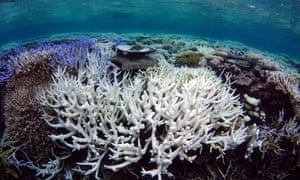
Bleached coral
Mass bleaching is occurring on the reef
 for the second consecutive year,
the marine park authority says. 
A proposal to use $9m to pump cold water on to the Great Barrier Reef’s tourist hotspots to stave off coral bleaching has been described as a “band-aid” solution, which does little to address the fundamental threats to the world’s largest living structure. 

It would involve using low-energy technology to push adjacent cold water from a depth of about 40 metres to the surface. The aim is to use the cooler waters to alleviate bleaching, which is caused by global warming-induced rises in sea surface temperatures.


Read Christopher Knaus’s story in The Guardian - “Plan to pump cold water on to Barrier Reef to stop bleaching labelled ‘band-aid’."

27 July, 2016

Climate change doesn't rate as a threat according to WSJ

Interestingly, this story from The Wall Street Journal, as comprehensive as it might be, makes no reference to the certain economic, social, physical, and emotional threats linked to climate change.

The ravages of climate change will most certainly make all those threats mentioned here seem inconsequential.

“Australia,” the story notes, “is enjoying the longest economic expansion in the developed world—24 years and counting.

“But now the commodity boom that underpinned its growth is ending. Other resource-reliant economies are tumbling into recession. Can Australia defy the odds?" it asks.

Australia was one of the chief beneficiaries of the world's rising demand for raw material and so as deeply implicated manufacturing and consumerist world that drove the worsening of climate change.

14 June, 2016

Heinberg and Fridley write about 'Our Renewable Future'


Richard Heinberg.
Richard Heinberg is an American journalist and educator and has written extensively on energy, economic, and ecological issues, including oil depletion.

He is the author of thirteen books and serves as the senior fellow at the Post Carbon Institute.

Along with David Fridley and Post Carbon Institute staff has written and just published “Our Renewable Future”.
He says”

The process was a pleasure: everyone involved (including the twenty or so experts we interviewed or consulted) was delightful to work with, and I personally learned an enormous amount along the way. But we also encountered a prickly challenge in striking a tone that would inform but not alienate the book’s potential audience.

As just about everyone knows, there are gaping chasms separating the worldviews of fossil fuel promoters, nuclear power advocates, and renewable energy supporters. But crucially, even among those who disdain fossils and nukes, there is a seemingly unbridgeable gulf between those who say that solar and wind power have unstoppable momentum and will eventually bring with them lower energy prices and millions of jobs, and those who say these intermittent energy sources are inherently incapable of sustaining modern industrial societies and can make headway only with massive government subsidies.

We didn’t set out to support or undermine either of the latter two messages. Instead, we wanted to see for ourselves what renewable energy sources are capable of doing, and how the transition toward them is going. We did start with two assumptions of our own (based on prior research and analysis), about which we are perfectly frank: one way or another fossil fuels are on their way out, and nuclear power is not a realistic substitute. That leaves renewable solar and wind, for better or worse, as society’s primary future energy sources.

In our work on this project, we used only the best publicly available data and we explored as much of the relevant peer-reviewed literature as we could identify. But that required sorting and evaluation: Which data are important? And which studies are more credible and useful? Some researchers claim that solar PV electricity has an energy return on the energy invested in producing it (EROEI) of about 20:1, roughly on par with electricity from some fossil sources, while others peg that return figure at less than 3:1. This wide divergence in results of course has enormous implications for the ultimate economic viability of solar technology. Some studies say a full transition to renewable energy will be cheap and easy, while others say it will be extremely difficult or practically impossible. We tried to get at the assumptions that give rise to these competing claims, assertions, and findings, and that lead either to renewables euphoria or gloom. We wanted to judge for ourselves whether those assumptions are realistic.

That’s not the same as simply seeking a middle ground between optimism and pessimism. Renewable energy is a complicated subject, and a fact-based, robust assessment of it should be honest and informative; its aim should be to start new and deeper conversations, not merely to shout down either criticism or boosterism.

‘Unfortunately, the debate is already quite polarized and politicized. As a result, realism and nuance may not have much of a constituency.’

Our Renewable Future -
Richard Heinberg
and David Fridley.
This is especially the case because our ultimate conclusion was that, while renewable energy can indeed power industrial societies, there is probably no credible future scenario in which humanity will maintain current levels of energy use (on either a per capita or total basis). Therefore current levels of resource extraction, industrial production, and consumption are unlikely to be sustained—much less can they perpetually grow. Further, getting to an optimal all-renewable energy future will require hard work, investment, adaptation, and innovation on a nearly unprecedented scale. We will be changing more than our energy sources; we’ll be transforming both the ways we use energy and the amounts we use. Our ultimate success will depend on our ability to dramatically reduce energy demand in industrialized nations, shorten supply chains, electrify as much usage as possible, and adapt to economic stasis at a lower overall level of energy and materials throughput. Absent widespread informed popular support, the political roadblocks to such a project will be overwhelming.

That’s not what most people want to hear. And therefore, frankly, we need some help getting this analysis out to the sorts of people who might benefit from it. Post Carbon Institute’s communications and media outreach capabilities are limited. Meanwhile the need for the energy transition is urgent, and the longer it is delayed, the less desirable the outcome will be. It is no exaggeration to say that the transition from climate-damaging and depleting fossil fuels to renewable energy sources is the central cause of our times. And it will demand action from each and every one of us.

Check out the new website - “Our Renewable Future.”

09 March, 2016

Looking back, looking ahead to China's13th five-year plan

In a few days, China will release its 13th Five-Year Plan, a new economic, social and environmental blueprint for the country’s development through 2020.

After years of astronomical growth, China’s economic expansion has begun to slow. But instead of doubling down on the fossil fuel-intensive strategy that helped produce the country’s runaway growth, China’s leaders have stated that the old growth model has run its course, and that the country will build toward a more environmentally and economically sustainable model of development. Recent signs show that the country is already beginning to shift in this direction, and the new Five-Year Plan provides the opportunity to build on that progress.

19 January, 2015

The sun's power is being put to work


Energy arriving each day on earth from the sun is so great that if we were smart enough to harness it, all human activities could be powered with just a miniscule amount of what is delivered.

And, little by little we are waking up to that,

City editor at The Age, Jason Dowling, tells us industry experts estimate that by 2030 every second detached home in Victoria could have solar panels.

Further, the same people say an increasing number of home-owners will have hybrid systems.

His story: “Solar to power every second home in Victoria” tells of a Croydon couple who home has solar power and batteries.

The home-owner expects to get at least 20 years out of the system and it made sense for both environmental and economic reasons.

03 October, 2014

Abbott's refusal to budge on coal is 'economic suicide'


Hans Joachim Schellnhuber.
Tony Abbott refused to attend the recent UN climate summit in New York and find sounding phases from Foreign Minister Julie Bishop were inadequate to save Australia’s reputation.

And the Australian Government championing of the coal industry has been described as an economic "suicide strategy".

A lead adviser to German Chancellor Angela Merkel on climate policy has attacked Australia's complacency on global warming with his observations being reported in The Age.

The story headed: “Merkel adviser lashes Abbott's 'suicide strategy' on coal” reports that “Hans Joachim Schellnhuber said most countries had given up on Australia setting tougher targets to reduce greenhouse gas emissions and the country was now viewed alongside Canada as not contributing its fair share to global efforts to reduce climate change”.

25 September, 2013

We shouldn't underestimate the risks of global warming - Lord Stern


Lord Stern - 'Don't underestimate the risks'.
A warning not to underestimate the impact of climate change has come from Lord Stern on the eve of crucial scientific report on global warming.

The former World Bank chief economist and author of the key 2006 Stern Review on the economics of climate change warned that scientific and economic predictions were underestimating the risks of global warming.

A story published in The Guardian, headed: “Lord Stern: It would be absurd to under estimate the risks of global warming”, argues that the risks associated with climate change are “immense”.

05 September, 2013

'Voters are being played for mugs' - The Monthly


The Monthly has been keeping us abreast of what is happening in the world of politics in the lead-up to Saturday’s Federal Election.
This latest post brings alarming news – judge it as you will, but if ever the idea of “cheating” could be levelled at a political party for its election campaign behaviour, this is it.

The Liberal Party has always nosily trumpeted it economic strengths, but in this instance it has excelled only at avoiding a confrontation with reality – it’s primary opponents, the Labor Party, has clearly done well at managing Australia’s economy in rather difficult circumstances, but in treating electors like dills, the Liberals have not given us accurate figures, rather we have been taken up the garden path.


This what The Monthly editor, Nick Feik, wrote:


FIGURES IN HIDING


The Coalition has been remarkably adept at avoiding scrutiny of its economic policies and rhetoric throughout the campaign, and this continues today.

It won't release official costings, and has no intention of releasing any before the election. Instead Hockey will present an isolated set of figures purporting to list policies that will marginally improve the budget position, reportedly by $6 billion over the next 4 years.

Nevertheless, voters around the country are today seeing headlines such as 'Coalition savings hit $40 billion,' and articles suggesting the Coalition's costings will all be revealed.

The people voting – and the 2 million who have already voted – are poorly served by ongoing coverage such as this.

The bottom line is that the Coalition is promising to make no major cuts to the budget. Ironically, after years of 'debt and deficit' talk, it is going to the election with a policy platform that entirely sidesteps the 'budget emergency' that it decried.

One final point: the Coalition's excuse for not releasing even these costings until the last days of the campaign was that it couldn't do so until it had announced all of its policies. The Coalition hasn't announced any policies that would have any serious fiscal impact for over a week. Voters are being played
for mugs.