Showing posts with label consequences. Show all posts

13 February, 2020

Climate change challenge

Victorian MP Darren Cheeseman says based on evidence presented at an inquiry yesterday, Shepparton is prepared to tackle climate change.
Mr Cheeseman and his colleagues on the parliamentary Environment and Planning Committee were at the Mooroopna Education and Activity Centre as part of an inquiry into the effect of climate change in Victorian communities.
The panel heard from Greater Shepparton City Council representatives as well as people from Moira, Mitchell and Campaspe shires, plus the North East Regional Sustainability Alliance and Goulburn Valley Community Energy.
Mr Cheeseman said the panel heard a lot of ‘‘really good’’ evidence about initiatives that had been undertaken at the local level to combat climate change.
‘‘It’s principally driven by local government but also some of the community groups within the area,’’ he said.
Mr Cheeseman said Greater Shepparton City Council discussed the challenges it faced as an entity.
‘‘Through the course of the presentation by the local government groups they spoke about energy efficiency,’’ he said.
‘‘They talked about the Australian building code, their planning schemes and how the state government might best set policy directions and legislation that enables local government to ensure that our communities respond to climate change.
‘‘And that includes having appropriate building codes so that our homes are built in a way that will meet the challenges of climate change.
‘‘So that’s making sure things like insulation (are in place), so the energy costs to heat or cool a house are as low as possible.’’
Mr Cheeseman said no apparent climate change sceptics presented to the panel.
‘‘From the evidence, absolutely they’re (Shepparton) prepared to tackle climate change,’’ he said.
‘‘They’re all focused on the consequences of climate change.
Discussions at Mooroopna meeting at which
Victoria MPs heard submissions on climate change.
‘‘I think the broader Shepparton and northeast (Victoria) communities are meeting those challenges.’’
Basin plan not on agenda
During his interview with The News, Mr Cheeseman said because of climate change there would be less water for farmers.
Despite this, however, Mr Cheeseman said the impact of the Murray-Darling Basin Plan was not brought up by local representatives.
He added no farming groups spoke at the inquiry.
‘‘Because of climate change we’re going to see less rain, so less water, more drought and more heat, which means, ultimately, farming practices are going to change,’’ Mr Cheeseman said.
‘‘Communities are already experiencing the consequences of climate change and this community has recognised that.
‘‘It’s developing its own initiatives, and this inquiry really is about hearing what they are.’’
Mr Cheeseman said he understood irrigation was a ‘‘profoundly important economic asset’’ to the area.
‘‘We know because of climate change, in a general sense, there will be less water available for commercial activity,’’ he said.
‘‘So in terms of responding to climate change it’s about making sure that our farms are as drought-resilient as possible; that we use water obviously as efficiently and effectively as possible.
‘‘I know that would be on the mind of many communities throughout the Murray-Darling Basin, but no evidence has been heard today around some of those challenges, and I’m sure they’ll be dealt with in other Commonwealth processes.’’

Story from The Shepparton News by James Bennett - “Climate change challenge.”

03 July, 2019

Australia’s politicians will not be alive when climate impacts accelerate

If a plastics factory dumps toxic sludge into a river, we see, in days, the consequences. If a coal-fired power station in New South Wales dumps carbon emissions into the atmosphere, the impacts diffuse into a stupidly big sheet of roiling fluid film covering our planet, and the consequences manifest among a trillion hyperactive climate variables.
Our present politicians will be dead and gone
when climate change really begins to bite.
As you peer further into the future, the impacts of climate change get worse, and consequently, easier to detect on a personal, lived scale. They get so bad that I feel silly talking literally about them:

“In a six-degree-warmer world, the Earth’s ecosystem will boil with so many natural disasters that we will just start calling them “weather”: a constant swarm of out-of-control typhoons and tornadoes and floods and droughts, the planet assaulted regularly with climate events that not so long ago destroyed whole civilisations”


11 April, 2019

U.S. Climate Report Warns of Damaged Environment and Shrinking Economy

WASHINGTON — A major scientific report issued by 13 federal agencies on Friday presents the starkest warnings to date of the consequences of climate change for the United States, predicting that if significant steps are not taken to rein in global warming, the damage will knock as much as 10 percent off the size of the American economy by century’s end.
Fighting the Camp Fire this month in Magalia, Calif.CreditCredit
The report, which was mandated by Congress and made public by the White House, is notable not only for the precision of its calculations and bluntness of its conclusions, but also because its findings are directly at odds with President Trump’s agenda of environmental deregulation, which he asserts will spur economic growth.

Mr. Trump has taken aggressive steps to allow more planet-warming pollution from vehicle tailpipes and power plant smokestacks, and has vowed to pull the United States out of the Paris Agreement, under which nearly every country in the world pledged to cut carbon emissions. Just this week, he mocked the science of climate change because of a cold snap in the Northeast, tweeting, “Whatever happened to Global Warming?” 


Read the story from The New York Times by Coral Davenport and Kendra Pierre-Louis - “U.S. Climate Report Warns of Damaged Environment and Shrinking Economy.”

29 December, 2018

The Coming Climate Change War

Current global warming is real, it is man-made, and its consequences will be profoundly negative over time. The significant loss of polar ice, damage to the coral reefs, increased flooding along coastlines and other waterways, more frequent heatwaves, and an increased risk of forest fires are among the most likely consequences as the earth continues to warm.

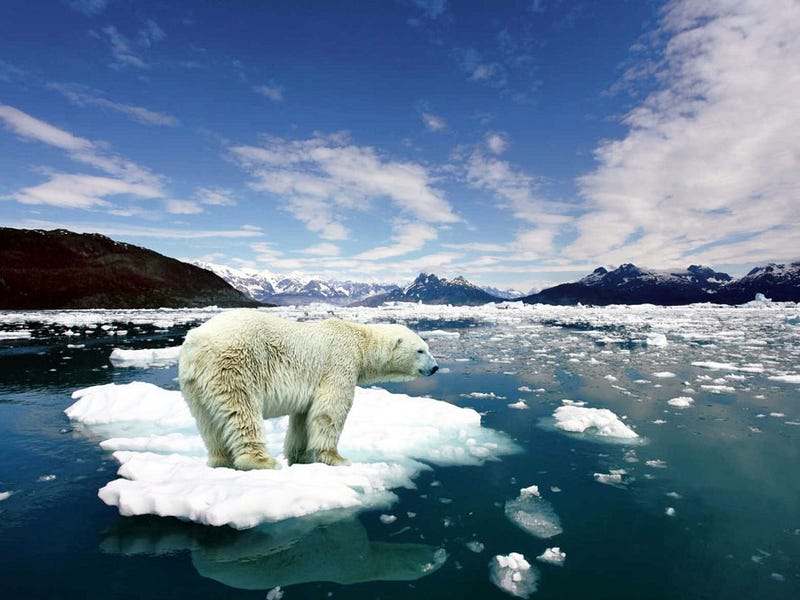
A lone polar bear on a shrinking island
of ice- a symbol of climate change.
Theory and empirical data support these predictions, unequivocally.
That reality, however, is being cynically weaponized by an unqualified chattering class that seeks partisan advantage, even at the risk of war.
Reactions to the latest Intergovernmental Panel on Climate Change (IPCC) report on climate change exemplify this problem…

Read the Medium story by Kent Kroeger - “The Coming Climate Change War.”

19 December, 2018

‘Future-proofing’ is how you say climate change in Texas

There’s a new term for all the work needed to prepare coasts and cities for the consequences of climate change, and it’s blissfully free of the words “climate change.” Introducing “future-proofing.” As in, it’s time to “future-proof” Texas to brace for future disasters like Hurricane Harvey, according to a new comprehensive report.
"Future proofing" is how you say climate change in Texas.
Prepared by Republican Governor Greg Abbott’s reconstruction commission, the report recommends myriad ways for the state to “future-proof”: elevate homes, construct storm-surge barriers, and offer buyouts for homes at high risk of flooding, to name a few.

What’s more interesting is what’s missing. Take the time to read the 168-page report, and you’ll find mention of rising sea levels and more intense storms. You might scratch your head upon finding phrases such as “changing human and environmental conditions” or “changing future weather patterns.” It would be hard to miss “future-proofing,” a phrase that’s employed 44 times. But you won’t find the exact words “climate change” anywhere except for the footnotes, as Dallas News reported on Thursday.


Read the story from Grist by Kate Yoder - “‘Future-proofing’ is how you say climate change in Texas.”

10 September, 2018

Russian Ministry Warns of Coming Environmental Apocalypse Fueled by Climate Change

Russia’s environmental ministry has published a report that paints an apocalyptic future for the country due to climate change, with consequences including epidemics, drought, mass flooding and hunger.

Russian Ministry warns of coming environmental
 apocalypse fuelled by climate change.
While Russia has been slated to reap economic benefits from a modest rise in global temperatures — which are expected to open navigation in the Arctic and allow for more economic activity in the winter — the country has allocated an estimated 1.55 trillion rubles ($22 billion) on a new environmental program to promote air pollution reduction, reforestation and recycling.

At 900 pages, the draft report published by the Natural Resources and Environment Ministry on Monday breaks down the past and future consequences of climate change in the country.

21 January, 2018

As climate risks increase, will geoengineering become a safer alternative?

With fires, storms, record-breaking temperatures and changes in the natural environment, there is growing evidence that our earth’s systems are becoming increasingly unstable. This has potentially catastrophic consequences.
New technologies may one day pull the greenhouse
gases from the atmosphere. But at what cost?
Public debate often places climate risks in the context of "this century" or "by 2100". But scientists are increasingly highlighting the risks of devastating and irreversible impacts in just 20 or 30 years. This is within our lifetimes, and certainly within our children’s.

These risks include:

Loss of nearly all corals, which support 25% of all ocean life (as documented in the recent film Chasing Coral)

Collapsing ice sheets, which will raise sea-levels, devastating coastal cities and low-lying countries

Warming oceans, which energize storms (to category 6 and higher), with damage that includes breaches of coastal nuclear reactors

Warming of the planet, caused by the greenhouse effect, is the primary stressor of many of these environmental challenges. Carbon dioxide and other pollutants present further complications, such as increasing ocean acidification.


12 December, 2017

The ‘utopian’ currency Bitcoin is a potentially catastrophic energy guzzler

The recent upsurge in the price of Bitcoin seems to have finally awakened the world to the massively destructive environmental consequences of this bubble.


These consequences were pointed out as long ago as 2013 by Australian sustainability analyst and entrepreneur Guy Lane, executive director of the Long Future Foundation. In recent months, the Bitcoin bubble has got massively bigger and the associated waste of energy is now much more widely recognised.

In essence, the creation of a new Bitcoin requires the performance of a complex calculation that has no value except to show that it has been done. The crucial feature, as is common in cryptography, is that the calculation in question is very hard to perform but easy to verify once it’s done.


Read the piece on The Conversation by Professor from the School of Economics at The University of Queensland, John Quiggin - "The ‘utopian’ currency Bitcoin is a potentially catastrophic energy guzzler.”

13 August, 2017

Fossil fuel subsidies are a staggering $5 tn per year

Fossil fuels have two major problems that paint a dim picture for their future energy dominance. These problems are inter-related but still should be discussed separately. First, they cause climate change. We know that, we’ve known it for decades, and we know that continued use of fossil fuels will cause enormous worldwide economic and social consequences.

The major costs of fossil fuels are hidden.
Second, fossil fuels are expensive. Much of their costs are hidden, however, as subsidies. If people knew how large their subsidies were, there would be a backlash against them from so-called financial conservatives.

A study was just published in the journal World Development that quantifies the amount of subsidies directed toward fossil fuels globally, and the results are shocking. The authors work at the IMF and are well-skilled to quantify the subsidies discussed in the paper.


Read John Abraham’s story on The Guardian - “Fossil fuel subsidies are a staggering $5 tn per year.”

26 December, 2016

Inertia on the pathway to decarbonisation

One of the biggest challenges in understanding climate change is that the timescales involved are far longer than most people are used to thinking about.
Garvey points out that this makes climate change different from any other ethical question, because both the causes and consequences are smeared out across time and space:


Steve Easterbrook.
“There is a sense in which my actions and the actions of my present fellows join with the past actions of my parents, grandparents and great-grandparents, and the effects resulting from our actions will still be felt hundreds, even thousands of years in the future. It is also true that we are, in a way, stuck with the present we have because of our past. The little actions I undertake which keep me warm and dry and fed are what they are partly because of choices made by people long dead. Even if I didn’t want to burn fossil fuels, I’m embedded in a culture set up to do so.” (Garvey, 2008, p60)

Part of the problem is that the physical climate system is slow to respond to our additional greenhouse gas emissions, and similarly slow to respond to reductions in emissions. The first part of this is core to a basic understanding of climate change, as it’s built into the idea of equilibrium climate sensitivity (roughly speaking, the expected temperature rise for each doubling of CO2 concentrations in the atmosphere). The extra heat that’s trapped by the additional greenhouse gases builds up over time, and the planet warms slowly, but the oceans have such a large thermal mass, it takes decades for this warming process to complete.

Read Steve Easterbrook’s report on Serendipity - “Inertia on the pathway to decarbonisation.”

09 November, 2016

We need social solutions to climate change, not engineered mechanical-like ideas


-      Robert McLean

Even willingly discussing climate engineering is among the worst of human failures.

That, of course, needs to be put in context for people have been “engineering” the climate ever since they appeared and so to modify our behaviour we need to discuss what it is we do.

However, for millennia we were unaware of the consequences of what we were doing, but now we understand the damage we are causing and it appears, sadly, we have no intention of modifying our behaviour to mitigate the cause of the damage, rather we are going to use our “big brains” to engineer our way out of this quickly evolving difficulty.

Instead of looking toward an engineered solution that has potential unintended consequences of which we have little or no understanding, we should study and apply those changes we do understand and whose outcomes are about all forms of life, including humankind.

Climate change will be eventually resolved, or eased, or mitigated, through social solutions, an agreement among the world community that any truly workable solution must be people orientated and not an engineered solution that is detached and remote from what people really need.

Read the “Briefing Paper on Climate Engineering” by Janos Pasztor from Carnegie Council for Ethics in International Affairs, and Simon Nicholson and David  Morrow from the Forum for Climate Engineering Assessment.

09 April, 2016

Paris climate agreement may force geoengioneering move

Geoengineering may have to move from the fringes of the climate debate towards the mainstream if the world is to meet the climate targets included in the Paris Climate Agreement, say some policy analysts and scientists.

At the rate that the world is burning coal, gas and oil, even rapid adoption of low carbon technologies might not keep warming within 1.5C, while the 2C target, also included in the agreement, looks even further out of reach.    

But geoengineering is dangerous stuff – it involves countering climate change by manipulating the planet’s weather without being able to guarantee or calibrate the outcomes. Even leading researchers who spend their lives working on the concept acknowledge that these technologies could have huge unintended, and harmful, consequences.


(Man, it could be argued has been party to geoengineering ever since he/she first began to plod about the planet.

True or not, the human influence on the world’s weather became influential and measurable with the advent of the Industrial Revolution in the 18th Century and in recent decades that change has become noticeable, even for the doubters, with extreme weather events around the world.

It’s human behaviour, primarily our voracious appetite for fossil-fuel created energy, that has worsened the damage inflicted on Earth’s climate system and now the technophiles among us are clamouring for us to innovate our way out of this dilemma using geoengineering.

However, as Olivia Boyd points out in the China Dialogue story “geoengineering is dangerous stuff”; dangerous for it may well bring unintended consequences leaving the Earth or at least humanity, in a situation far worse than that now unfolding – Robert McLean.)

07 February, 2015

'The Conversation' heading tells the tale of climate change


A heading on a story in this weekend’s The Conversation reflects how and why the world fell into the climate change trap.

Author, PhD Candidate in Political Science at Griffith University, Todd Winther, was actually discussing the likely fall of Australia’s Prime Minister, Tony Abbott, next week, but could have just as easily been talking about how the world stumbled into climate change.

His story headed: “Leadership crises turn short-term thinking into long-term failure” seems to go straight to the root cause of climate change.

Humanity has almost without fail looked for short-term gains, all the while ignoring, and not always obvious, the long-term consequences.

Well, all debts must eventually be paid somehow and our frivolous and careless attitude to what our impact on the earth has been, has produced a massive cost and the debt is how due.

23 January, 2015

Profit, in the modern sense, and the sustenance of human life are incompatible


Profit and a regard for sustaining earth’s suitability for humans are incompatibly, particularly if profit is considered in contemporary terms.

Reporting on Davos 2015, The Guardian says: “It’s not possible to listen to petroleum industry executives defending their reckless extraction of oil without feeling that we are living in an age of madness.”

A private conversation under the Chatham House rules, one of the world’s most senior industry leaders, who is considered to be at the more moderate end of the spectrum, insisted that we are going to burn all the world’s hydrocarbons despite the consequences.

Former U.S. vice-president and committed climate change activist, Al Gore, has accused the world’s oil companies of using the atmosphere as an open sewer.

Lord Stern, who wrote the landmark 2006 Stern review of the economics of climate change, says it is no surprise oil executives are seeking to defend their corner, who, like Gore, said basic arithmetic tells us that it is impossible to burn all the world’s hydrocarbons without devastating consequences.

He points out that the earth has not seen a 3C rise for 3m years, he pointed out, and it has been tens of millions of year since there has been a 4C rise.

26 August, 2014

RET talk shuts down Mildura solar power plant


Even the mere suggestion the Australia’s Renewable Energy Target would be reduced, or even scrapped completely, has brought immediate consequences.


The story reports: “The proposed multi-million dollar 100 megawatt Silex Mildura Power Station Project, located in Carwarp, has been abandoned following uncertainty surrounding the revised Renewable Energy Target and low wholesale electricity prices.

“The Mildura solar power station would have provided electricity to 40,000 homes.

“But the company behind the project, Solar Systems, says it could be scaled back to a more feasible operation,” the Weekly Times report notes.