Showing posts with label solution. Show all posts

13 January, 2020

Reading the smoke signals from Morrison on climate change

Australians have heard so many messages about so many climate change policies over so many years that they may shrug off the latest talk from Scott Morrison about his solution to the problem.
Australian Bushfires: Scott Morrison questioned over response
Australian PM Scott Morrison with David Speers on ABC television.
The Prime Minister spoke on Sunday about doing "better and better and better" at reducing greenhouse gas emissions and to "evolve our policy" over time, while also promising to adapt more to a changing climate.

Read the story from The Age by David Crowe - “Reading the smoke signals from Morrison on climate change.”

12 December, 2019

There’s some sunlight beyond the climate doom, and it's coming from business

We live in anxious times. That is understandable. But as all eyes look to Canberra for a solution to the pressing problem of climate change, it's important – and heartening – to remember a lot of work is already being done.
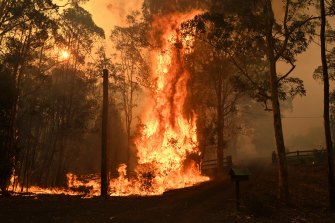
The Green Wattle fire in Orangeville, NSW on December 6.
Indeed, despite lacking a clear carbon price signal from government, corporate Australia has for some time now been factoring a "shadow" carbon price into long-term decision-making.
Why? Not because Canberra is telling it to, but because climate change is the new business reality.
It's a reality that will impose significant costs on business, including the direct costs of extreme weather events, the impact of shifting weather patterns on the agricultural sector, health and productivity impacts for workers and trade disruptions arising from other countries’ attempts to tackle climate change.

Read the opinion piece from The Age by Jessica Irvine - “There’s some sunlight beyond the climate doom, and it's coming from business.”

26 May, 2019

Why environmentalists don't talk much about population

If you ask some people, the solution to our environmental problems is simple – reduce population.
Global population growth is about increased longevity as well as the birth rate.
When I wrote a response to the United Nations report on biodiversity loss two weeks ago, my article attracted 350 online comments, many questioning why I didn't write about population. One person even went to the effort of clipping out the print article, annotating it with comments about population and posting it to me anonymously.

Read the story from The Sydney Morning Herald by Caitlin Fitzsimmons - “Why environmentalists don't talk much about population.”

(Resolving the population issue is not among the “low-hanging fruit” in moving towards easing the world’s climate difficulties, and, generally, slowing population growth is not something friendly to existing market philosophies embedded in the world’s economic systems.

The resolution lynch-pin to population growth is education, particularly that of women, something is fundamentally opposed in some societies - Robert McLean)

06 March, 2019

‘Nothing should be classified as waste': crisis is opportunity for Veena Sahajwalla.

Veena Sahajwalla has a solution for the waste crisis. While for most people the ever-growing mountains of rubbish stockpiled around the world seems like an overwhelming problem, the materials scientist and engineer sees the crisis as an opportunity that could help us to rethink the way we make and dispose of everything in our lives.
 Veena Sahajwalla and her team at UNSW have been
 working on a manufacturing process to create building
 materials from old textiles, paper and glass.
Take textiles. Australians send around 88% of textiles to landfill, with around 6,000kg of clothing dumped every 10 minutes. Earlier this year, there was a nationwide clearing-out flurry, leading to charity shops being inundated with unwanted goods. Most were destined for landfill.

Read the story from The Guardian by Alexandra Spring - “‘Nothing should be classified as waste': crisis is opportunity for Veena Sahajwalla.”


(Veena Sahajwalla was one of a trio of specialists to speak at a Slap Tomorrow forum in Shepparton in 2013 - “Climate Change: A wake-up call” - Robert McLean)

11 April, 2018

Frydenberg takes the low road: It’s a weak NEG or nothing

The Coalition government is ramping up the pressure on the Labor states, seeking to paint the National Energy Guarantee as the middle path and the one and only policy option, despite its desperate attempts to shift the discussion to meet the demands of its own right wing.
Energy minister Josh Frydenberg - "Nice
words, but the cynicism is breathtaking".
Energy minister Josh Frydenberg used a National Press Club appearance on Wednesday to try and force the states to agree on the as yet ill-defined NEG, arguing that economics and engineering should triumph over ideology, and there was a need for a market based solution.

Nice words, but the cynicism is breathtaking.

Ideology? This, from a man who has spent much of the past 18 months demonising renewables, arguing in the face of all evidence to the contrary from the CSIRO and the network owners that high levels of renewables is reckless.


Read the story Giles Parkinson story from RenewEconomy - “Frydenberg takes the low road: It’s a weak NEG or nothing.”

02 April, 2018

Farmers for Climate Action

Australian farmers are on the frontline of climate change, and we can be part of the solution. 


We call for urgent climate action to ensure a prosperous future for rural and regional Australia. Marian MacDonald, Sarah Sulman, Jim McDonald, and Oscar Pearse are the farmers in our ad, representing thousands of us from across Australia.

From the Farmers for Climate Action website:

As individuals over a few decades, many of us have been repeatedly raising our concerns about climate change. Our growing frustration with the inadequate progress on climate action in Australia drove a group of us farmers and producers to meet in the Blue Mountains in 2015, when we decided to form this group.
We got straight to work. That year, more than 100 farmers signed a letter calling on the federal government to set stronger targets to reduce carbon pollution. Another group ran a crowd-funding campaign to send two young farmers, Josh Gilbert and Anika Molesworth, to the UN Climate Talks in Paris. 
In 2016 we set ourselves up as a formalised group and ran a nationwide survey of farmer attitudes towards climate change and renewable energy. More than 1300 farmers around Australia took part, and in November 2016 a delegation of farmers presented the Australian Farmers Climate Survey results to politicians and industry leaders in Canberra.
In 2017 our board was able to employ a CEO thanks to our supporters, and some of our most active members worked together to help set our direction. Our 2017 year in review shows what a busy year it was supporting farmers on the ground.


Learn more about Farmers for Climate Action here.

09 November, 2016

We need social solutions to climate change, not engineered mechanical-like ideas


-      Robert McLean

Even willingly discussing climate engineering is among the worst of human failures.

That, of course, needs to be put in context for people have been “engineering” the climate ever since they appeared and so to modify our behaviour we need to discuss what it is we do.

However, for millennia we were unaware of the consequences of what we were doing, but now we understand the damage we are causing and it appears, sadly, we have no intention of modifying our behaviour to mitigate the cause of the damage, rather we are going to use our “big brains” to engineer our way out of this quickly evolving difficulty.

Instead of looking toward an engineered solution that has potential unintended consequences of which we have little or no understanding, we should study and apply those changes we do understand and whose outcomes are about all forms of life, including humankind.

Climate change will be eventually resolved, or eased, or mitigated, through social solutions, an agreement among the world community that any truly workable solution must be people orientated and not an engineered solution that is detached and remote from what people really need.

Read the “Briefing Paper on Climate Engineering” by Janos Pasztor from Carnegie Council for Ethics in International Affairs, and Simon Nicholson and David  Morrow from the Forum for Climate Engineering Assessment.

01 December, 2014

ARENA tackles the root cause with biomass


The flagrant and irresponsible use of fossil-fuels as an energy source is root cause of climate change.

But now, as author Richard Heinberg said nearly a decade ago, “The Party’s Over”, and subsequently there has since been significant interest in finding another energy source.

Many ideas have been explore and just today the Australian Renewable Energy Agency (ARENA) announced $2 million funding support to develop a solution for collecting renewable biomass from fast growing trees.

The announcement comes in a story headed: “Renewable biomass from fast growing trees”.