Showing posts with label problem. Show all posts

25 March, 2020

Our social identity shapes how we feel about the Adani mine – and it makes the energy wars worse

Australia has the technology to move from fossil fuels to renewable energy, but the social dynamics remain challenging. The Stop Adani protest convoy during the 2019 federal election campaign brought this difficulty to the fore.
A real sticking point for navigating any social change, including the energy transition, is finding a way through entrenched attitudes in which people see themselves as “us” in conflict with “them”. In these situations, people tend to focus on trying to defeat their opponents rather than finding mutually beneficial solutions to the problem.
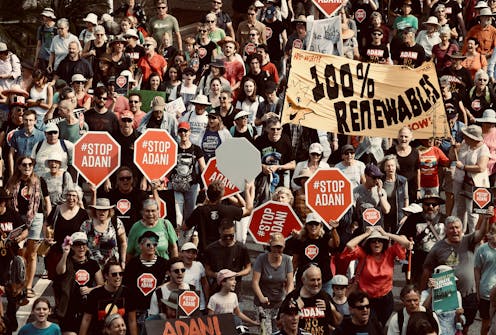
Image result for Our social identity shapes how we feel about the Adani mine – and it makes the energy wars worse
Debate over Australia’s coal industry is fraught and involves entrenched attitudes.
In research just released, I examined media coverage of the Stop Adani protest convoy to better understand these social identity divides. In particular, I analysed the factors shaping who was an “us” and who was a “them” in the conflict.
I found that the media, with the help of politicians, crafted a narrative of division between inner-city “greenies” and Queensland mining communities. These divisions foster a social dynamic that ultimately inhibits co-operation and good policy outcomes.

Read the story from The Conversation by a lecturer from the Crawford School of Public Policy at the Australian National University, Rebecca Colvin  - “Our social identity shapes how we feel about the Adani mine – and it makes the energy wars worse.”

13 January, 2020

Reading the smoke signals from Morrison on climate change

Australians have heard so many messages about so many climate change policies over so many years that they may shrug off the latest talk from Scott Morrison about his solution to the problem.
Australian Bushfires: Scott Morrison questioned over response
Australian PM Scott Morrison with David Speers on ABC television.
The Prime Minister spoke on Sunday about doing "better and better and better" at reducing greenhouse gas emissions and to "evolve our policy" over time, while also promising to adapt more to a changing climate.

Read the story from The Age by David Crowe - “Reading the smoke signals from Morrison on climate change.”

06 April, 2019

Sea levels are rising. Time to build …. floating cities?

WITH SEA LEVELS expected to rise at least 26 inches by the end of the century, due to human-driven climate change, to say that we have a problem is an understatement. By the middle of the next century, many of the world’s major cities will be flooded, and in some cases, entire island nations will be underwater. The people who live there will have to relocate. But to where?
With sea levels rising, is it time to contemplate floating cities?
On Wednesday, the United Nations Human Settlements Program, or UN Habitat, convened its first roundtable to discuss the possibility of floating cities as a solution to this problem. Held at its headquarters in New York City, on the banks of the East River, the location was fitting given that the room itself might be underwater within a century. The specific proposal that dozens of scientists, engineers, artists, and investors came to discuss was Oceanix City, which aspires to create a scalable platform for the seafaring civilizations of tomorrow.


Read the Wired story by Daniel Oberhaus - “Sea levels are rising. Time to build …. floating cities?

19 December, 2018

I was wrong. This is environmentalism’s biggest problem

The problem with environmentalism is that this means nothing for most people. We need to begin equating this to real-world problems, without fear-mongering.

Let’s think for a moment about what 1.5°C of warming will mean for the planet. 48cm of sea level rises. 16% increase in the number of heatwave days. Complete meltdown of the Arctic ice.


(It would also be quite useful to give them credible but simple explanations of climate science, but that’s just wishful thinking.)

So, how exactly does one go about this?


Read the Medium story by Dave Olsen - “I was wrong. This is environmentalism’s biggest problem.”

22 November, 2018

Coal power stations are old and dirty. Here are five ways to end Australia's energy war

Note to politicians: voters will back in your energy plans if they understand them and they meet the scale of the problem.
 Australia could become a legal superpower.
For decades, the major parties have tried and failed to credibly deal with climate change. Various policies became acronyms that people did not really understand. There has been the CPRS, the carbon price, an EIS, CET and most recently the Neg.

Time and again they’ve failed to capture our imagination. Clearly it’s time for a new game plan.
What has worked to progress action on climate in Australia are bold ideas that people can understand, get excited by, that answer the scale of the problem and that affect their lives.


Read the opinion piece by Nicky Ison from The Guardian - “Coal power stations are old and dirty. Here are five ways to end Australia's energy war.”

17 September, 2018

Raimond Gaita and Katerina Gaita: A Climate of Change

How might a philosopher frame the problem of climate change? What can philosophers learn from environmentalists and vice versa?

Riamond and Katerina
Gaita: A Climate of Change.

In this conversation, we bring together a prominent philosopher and a prominent climate-change activist who just happen to be from the same family: Raimond and Katerina Gaita. Raimond is the author of many books including Romulus, My Father and is a professorial fellow at Melbourne University. Katerina is a climate communicator and the founding director of Climate for Change, a non-profit, grassroots organisation that galvanises ordinary Australians to live sustainably and to take climate action.

At the Wheeler Centre, the pair discuss civics, sustainability and legacy, generational differences and the future of the planet.


Watch the discussion at The Wheeler Centre between father and daughter - “Raimond Gaita and Katerina Gaita: A Climate of Change.”

17 June, 2018

Australian teens more worried about climate change than adults

While climate change has always been a problem during Ishan Ahmed's lifetime, he said he's worried about it having the potential to become more extreme.
St Mary MacKillop College year 7 students Justine
Rasheed and Ishan Ahmed discuss what they
 think about global warming and climate change.
"Climate change will get worse in future generations because I do think that humans have caused this by cutting down trees," the year 7 student at St Mary MacKillop College said.

"Climate change it isn't affecting us hugely right now, but it's going to get bigger and get worse and we have to start thinking how we can do the little things to help.”


Read the story from The Age Andrew Brown - “Australian teens more worried about climate change than adults.”

24 March, 2018

Many people feel lonely in the city, but perhaps ‘third places’ can help with that

Loneliness is a hidden but serious problem in cities worldwide. Urban loneliness is connected to population mobility, declining community participation and a growth in single-occupant households. This threatens the viability of our cities because it damages the social networks they rely on.
Third places are most effective when, like Waverley Community Garden
in Sydney, they appeal to people of all ages and backgrounds.
One response to these trends involves “third places”. These are public or commercial spaces that provide informal opportunities for local people to mix socially on neutral ground.

The concept of third place, developed by Ray Oldenburg, is distinct from first and second places. A first place is the private space of home. Second places are where people spend significant time, often formally. These include schools, universities and workplaces.


Read the piece on The Conversation by a PhD Candidate from Griffith University, Joanne Dolley, and a Lecturer in Urban and Environmental Planning, also the Griffith University, Tony Matthews - “Many people feel lonely in the city, but perhaps ‘third places’ can help with that.”

07 February, 2018

Climate action: the Foundation of Sustainable Development

The climate crisis is undoubtedly the single greatest threat to humanity. Despite the fierce debate in the United States surrounding the reality staring us square in the face, much of the rest of the world acknowledges the severity of this problem and the moral imperative to take urgent action. 


In its 2030 Agenda for Sustainable Development the United Nations included climate action as one of the 17 Sustainable Development Goals. Together, these goals outline a path by which the world can work together to strengthen universal peace and prosperity. When the UN pledged to take action on climate as part of the SDGs, it acknowledged an important – though often overlooked – fact: no issue we collectively face as humans exists separate and apart from the others. These challenges – from alleviating poverty to educating women and girls to addressing the climate crisis – intersect and are intimately connected to one another. A planet that is in a state of chaos and disruption offers a poor canvas for advancing development goals. 

Read the Impacter story by the CEO off the Climate Reality Project, Ken Berlin - “Climate action: the Foundation of Sustainable Development.”

24 October, 2017

America’s First Climate Change Refugees

Climate change is often discussed as a problem that’s coming, but in reality it’s already here.

Rising sea levels caused by global warming are, right now, forcing some Americans out of their homes, while others fear for the future of their communities.

This week on Dateline, reporter Jeannette Francis meets Americans, from Alaska to South Beach, who are worried their cities and towns are at risk of going underwater.

Miami is one of the most populous cities in the US and one of its biggest tourist attractions, but its long-term future is uncertain. Hurricanes and flooding are becoming more regular and more damaging, sea level rises are having an effect on property development in the city, and residents are increasingly fearful for their safety. The city has spent hundreds of millions of dollars to address rising sea levels – but some scientists say Miami is unlikely to survive the century.

Professor Harold Wanless has been tracking the tides and sea levels in Miami for decades – he says current trends indicate the issue could be terminal for the city.

“[Miami] won’t be here in 100 years,” Professor Wanless predicts. “It will either be a few stragglers trying to hang on to a city that has no infrastructure, no fresh water, no sewage facility, or it will be abandoned completely.”


Watch the SBS Dateline’s - “America’s First Climate Change Refugees.”

18 October, 2017

The PM's plan will deliver more expensive, dirtier power

The problem with our energy politics is, they have not caught up with energy economics.The price of renewables is plummeting and the investors are rushing. But our discourse remains stuck around clean energy targets being "too expensive”.

Liddell power station in Musewellbrook
did not perform last  February.
The new reality is that the cost of building new renewable energy is far cheaper than the cost of building new coal-fired power plants. If left to the market, no new coal-power station would be built again in Australia. Gas prices, as predicted, have gone through the roof – so that is no longer a cheaper option, either.

Rather than use the falling cost of renewable energy as an opportunity to roll out renewable energy and reduce our energy pollution more rapidly, in the topsy-turvy world of Australian policy debate it is being used as an explanation for why we should prop up uneconomic and unnecessary coal- and gas-fired power stations.

And while renewables are cheaper, energy infrastructure is very-long-term investment. This is where the renewable energy target has worked, by enabling long-term power purchase agreements to underpin investment. And it's how a clean energy target or similar scheme could also work into the future.


Read Ben Quist’s story in The Sydney Morning Herald - “The PM's plan will deliver more expensive, dirtier power.”

04 August, 2017

We only have a 5 percent chance of avoiding ‘dangerous’ global warming, a study finds

In recent years, it has become increasingly common to frame the climate change problem as a kind of countdown — each year we emit more carbon dioxide, narrowing the window for fixing the problem, but not quite closing it yet. After all, something could still change. Emissions could still start to plunge precipitously. Maybe next year.

The sun sets over sea ice floating on the
Victoria Strait along the Northwest Passage
 in the Canadian Arctic Archipelago
 on July 21, 2017.
This outlook has allowed, at least for some, for the preservation of a form of climate optimism in which big changes, someday soon, will still make the difference. Christiana Figureres, the former head of the United Nations’ Framework Convention on Climate Change, recently joined with a group of climate scientists and policy wonks to state there are three years left to get emissions moving sharply downward. If, that is, we’re holding out hope of limiting the warming of the globe to below 2 degrees Celsius (3.6 degrees Fahrenheit) above pre-industrial temperatures, often cited as the threshold where “dangerous” warming begins (although in truth, that’s a matter of interpretation).

Yet a battery of recent studies call into question even that limited optimism. Last week, a group of climate researchers published research suggesting the climate has been warming for longer than we thought due to human influences — in essence, pushing the so-called “preindustrial” baseline for the planet’s warming backwards in time. The logic is clear: If the Earth has already warmed more than we thought due to human activities, then there’s even less remaining carbon dioxide that we can emit and still avoid 2 degrees of warming.


Read Chris Mooney’s story in The Washington Post - “We only have a 5 percent chance of avoiding ‘dangerous’ global warming, a study finds.”

05 June, 2017

Trump’s Stupid and Reckless Climate Decision - Bill McKibben

People say, if all you have is a hammer, then every problem looks like a nail. We should be so lucky. President Trump has a hammer, but all he’ll use it for is to smash things that others have built, as the world looks on in wonder and in fear. The latest, most troubling example is his decision to obliterate the Paris climate accord: After nearly 200 years of scientific inquiry and over 20 years of patient diplomacy that united every nation save Syria and Nicaragua, we had this afternoon’s big game-show Rose Garden reveal: Count us out.
A protester at the March for Science in Philadelphia in April.
It’s a stupid and reckless decision — our nation’s dumbest act since launching the war in Iraq. But it’s not stupid and reckless in the normal way. Instead, it amounts to a thorough repudiation of two of the civilizing forces on our planet: diplomacy and science. It undercuts our civilization’s chances of surviving global warming, but it also undercuts our civilization itself, since that civilization rests in large measure on those two forces.

Science first. Since the early 1800s we’ve been slowly but surely figuring out the mystery of how our climate operates — why our planet is warmer than it should be, given its distance from the sun. From Fourier to Foote and Tyndall, from Arrhenius to Revelle and Suess and Keeling, researchers have worked out the role that carbon dioxide and other greenhouse gases play in regulating temperature. By the 1980s, as supercomputers let us model the climate with ever greater power, we came to understand our possible fate. Those big brains, just in time, gave us the warning we required.


Read the opinion piece by Bill McKiben in The New York Times - “Trump’s Stupid and Reckless Climate Decision.”