Showing posts with label investors. Show all posts

05 May, 2020

Investors urge governments to go green for coronavirus recovery

Major investors, Australian superannuation funds and the International Energy Agency are urging governments to seize the green opportunity to drive economic growth after the coronavirus pandemic and avoid the risks they see in high carbon emitting projects.
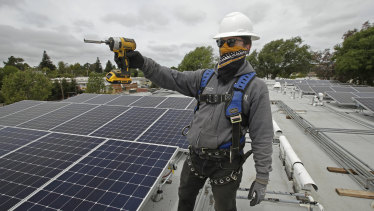
Investors are urging governments to invest in renewable energy and low-emissions industries to drive economic growth after the coronavirus pandemic.
Investors are urging governments to invest in renewable
energy and low-emissions industries to drive economic
growth after the coronavirus pandemic.
"Recovery plans that exacerbate climate change would expose investors and national economies to escalating financial, health and social risks in the coming years," said a statement from the Investor Agenda group - an international coalition of institutional investors and asset managers whose members hold more than US$80 trillion under management.
Large-scale energy generators such as coal and gas fired power plants and their heavy duty transmission networks, as well as gas powered manufacturing facilities, are built to deliver a return on investment over decades.
Investors argue international commitments to tackle climate change and reduce emissions such as the Paris Agreement create an unacceptable risk for long-term investment in emissions intensive projects.
Read the story from The Age by Mike Foley - “Investors urge governments to go green for coronavirus recovery.”

05 December, 2019

Business, unions and farmers urge Australia to cut net greenhouse gas emissions to zero

Groups representing business, unions, farmers, investors, the environment and social policy advocates say Australia should adopt climate change policies that can put it on a stable path to net zero national greenhouse gas emissions if it is to play its part in the Paris agreement.
Emissions from a steelworks
The Australian Climate Roundtable
 warns unconstrained climate change
will have serious consequences unless
 net greenhouse gas emissions are cut to zero.
Launched to coincide with UN climate talks in Madrid, a joint statement by 10 groups under the Australian Climate Roundtable banner warns that unconstrained climate change would have serious economic, environmental and social impacts in Australia, and avoiding it would bring benefits and opportunities.
“Our overarching aim is for Australia to play its fair part in international efforts to achieve this while maintaining and increasing its prosperity,” the statement says.

Read the story from The Guardian by Adam Morton and Katharine Murphy - “Business, unions and farmers urge Australia to cut net greenhouse gas emissions to zero.” 

15 September, 2018

Why incumbents fail - and what that means for sustainability

The core assumption and focus of people who work to drive sustainability through markets – as corporate leaders, investors, NGOs or thought leaders – is that we need to convince existing companies and their shareholders that sustainability is first good for their business, and secondly, they can successfully transition to a sustainable business model.

But what if both of these are wrong? As someone who has spent over 25 years in that world, I’m starting to think they both might be. If so, it calls into question the very basis of the work literally millions of us are engaged in. So, it is at least worth a discussion!

The first point is the foundational question – that sustainability is broadly good for business. Not business as a concept, but business as specific institution.


Read the full article by Paul Gilding - “Why incumbents fail - and what that means for sustainability.”

13 April, 2018

NAB’s Mike Baird calls green energy 'tipping point’

Rapid growth in renewable energy investment has propelled the sector to a "tipping point," former NSW premier Mike Baird says, amid predictions investors will pour trillions of dollars globally into green electricity projects in the coming decades.
Mike Baird, former NSW premier and NAB's chief customer
 officer for corporate and institutional banking, says green
energy is a "huge" opportunity for the bank.
Amid a bitter political fight over energy policy in Australia, Mr Baird, now a senior National Australia Bank executive, said global market forces were already driving long-term changes in the energy mix.

After NAB last year became the first major Australian bank to stop lending for new thermal coal mines, Mr Baird said the lender's balance sheet also reflected the "exponential" growth in renewable energy financing, which he viewed as a "huge opportunity”.

“We’re in a position that there are many moving parts to the energy policy discussion framework, but we’ve reached a critical point where the markets and investors are moving in respect of these challenges,” Mr Baird said in an interview with Fairfax Media.


Read the story Clancy Yates from The Age - “NAB’s Mike Baird calls green energy 'tipping point’.”

01 April, 2018

Judge Rejects Exxon's Attempt to Shut Down Climate Fraud Investigations

With a sharp rebuke, a federal judge on Thursday rejected Exxon's attempt to shut down two state investigations into whether the oil giant misled investors for years about the risks of climate change.
The attorneys general of New York and Massachusetts are
 investigating whether Exxon's questioning of climate change
science and downplaying of its risks constituted fraud against the public and investors. 
U.S. District Court Judge Valerie Caproni dismissed Exxon's complaint with prejudice, meaning the company can't refile it.

In the first line of her ruling, the judge describe Exxon's actions as "running roughshod over the adage that the best defense is a good offense.”

"The relief requested by Exxon in this case is extraordinary: Exxon has asked two federal courts—first in Texas, now in New York—to stop state officials from conducting duly-authorized investigations into potential fraud," she wrote. "It has done so on the basis of extremely thin allegations and speculative inferences.”


29 January, 2018

Banks slash coal loans by 50 per cent as investor pressure mounts

Australia's big banks slashed loans to fossil fuel companies by almost a fifth in 2017, including a 50 per cent drop in their coal mining exposure, new analysis shows, as investors and regulators ramp up pressure over climate change risks.
Banks are cutting their exposure to fossil fuels, especially coal. 
ANZ Bank, National Australia Bank, Westpac and Commonwealth Bank's combined loans to coal miners slumped by about $1.5 billion, or more than 50 per cent per cent, according to analysis of bank disclosures from environmental finance group Market Forces.


Read the story by Clancy Yeates from today’s Melbourne Age - “Banks slash coal loans by 50 per cent as investor pressure mounts.”

18 October, 2017

The PM's plan will deliver more expensive, dirtier power

The problem with our energy politics is, they have not caught up with energy economics.The price of renewables is plummeting and the investors are rushing. But our discourse remains stuck around clean energy targets being "too expensive”.

Liddell power station in Musewellbrook
did not perform last  February.
The new reality is that the cost of building new renewable energy is far cheaper than the cost of building new coal-fired power plants. If left to the market, no new coal-power station would be built again in Australia. Gas prices, as predicted, have gone through the roof – so that is no longer a cheaper option, either.

Rather than use the falling cost of renewable energy as an opportunity to roll out renewable energy and reduce our energy pollution more rapidly, in the topsy-turvy world of Australian policy debate it is being used as an explanation for why we should prop up uneconomic and unnecessary coal- and gas-fired power stations.

And while renewables are cheaper, energy infrastructure is very-long-term investment. This is where the renewable energy target has worked, by enabling long-term power purchase agreements to underpin investment. And it's how a clean energy target or similar scheme could also work into the future.


Read Ben Quist’s story in The Sydney Morning Herald - “The PM's plan will deliver more expensive, dirtier power.”

08 July, 2017

The G20’s new guidelines will help investors tackle climate change

New guidelines being presented to the G20 this weekend will change the way individuals, companies, investors and regulators manage the financial risks of climate change. These risks include physical events, such as changing weather patterns and natural disasters, as well as new technologies and regulations.
Rosemary Sainty - G20 guidelines will help
investors manage climate change risks.
As big investors adopt the guidelines, the companies in their portfolios will be pressured to report on climate change. This will make it easier for investors of all kinds to understand the impacts of climate change on their portfolios, and to assess new opportunities, such as new products and services that will be required and developed.

Companies like BHP have already begun reporting on how climate change will affect their businesses. But, until now, corporate disclosure on climate change has been patchy, shallow and not always financially relevant.


Read the piece on The Conversation by the Scholarly Teaching Fellow at the UTS Business School from Sydney’s University of Technology, Rosemary Sainty -  “The G20’s new guidelines will help investors tackle climate change.”

27 December, 2016

Solar switch for one of Australia's biggest companies funded by community

 
Huon Hoogesteger said the project

would
provide 25 per cent of the

business's power needs.

Mum and dad investors are using their savings to fund a half-a-million-dollar solar energy project at the Wesfarmers-owned Blackwoods distribution depot at Canning Vale in Western Australia.

Blackwood is the country's largest distributor of industrial and safety supplies and its Canning Vale depot will have 630 solar panels installed on its roof in the New Year.

"We have an internal target to reduce our greenhouse gas emissions, so this is something we're very proud of."

The 200-kilowatt system will supply a quarter of the business's electricity needs.

Mr Heagney said it was the biggest single solar installation in the Wesfarmers group, and the first funded by community investors.

17 May, 2013

Fossil fuel divestment campaigns spreading across Australia


Writing on the ABC’s environment section, Simon Copland, said investment in fossil fuel companies was becoming increasingly unpopular.

Simon Copland.
Copland said this reluctance was becoming increasingly obvious among both environment-minded citizens and astute investors.

Writing in the story: “Preventing a carbon bubble crash”, Copland said: “Fossil fuel 'divestment' campaigns are spreading across Australia as activists target what many think is the root cause of the problem: money”.