Showing posts with label pressure. Show all posts

27 August, 2019

Trump’s Trade War Linked To Amazon Rainforest Destruction

As unsold U.S. soybeans are stored in silos across the farm belt, Brazilian farmers and corporations scramble to satisfy the voracious Chinese market. The push to break new ground amid President Donald Trump’s trade war with China is putting increasing pressure on the Amazon rainforest and is likely linked to the region’s devastating fires, according to experts.
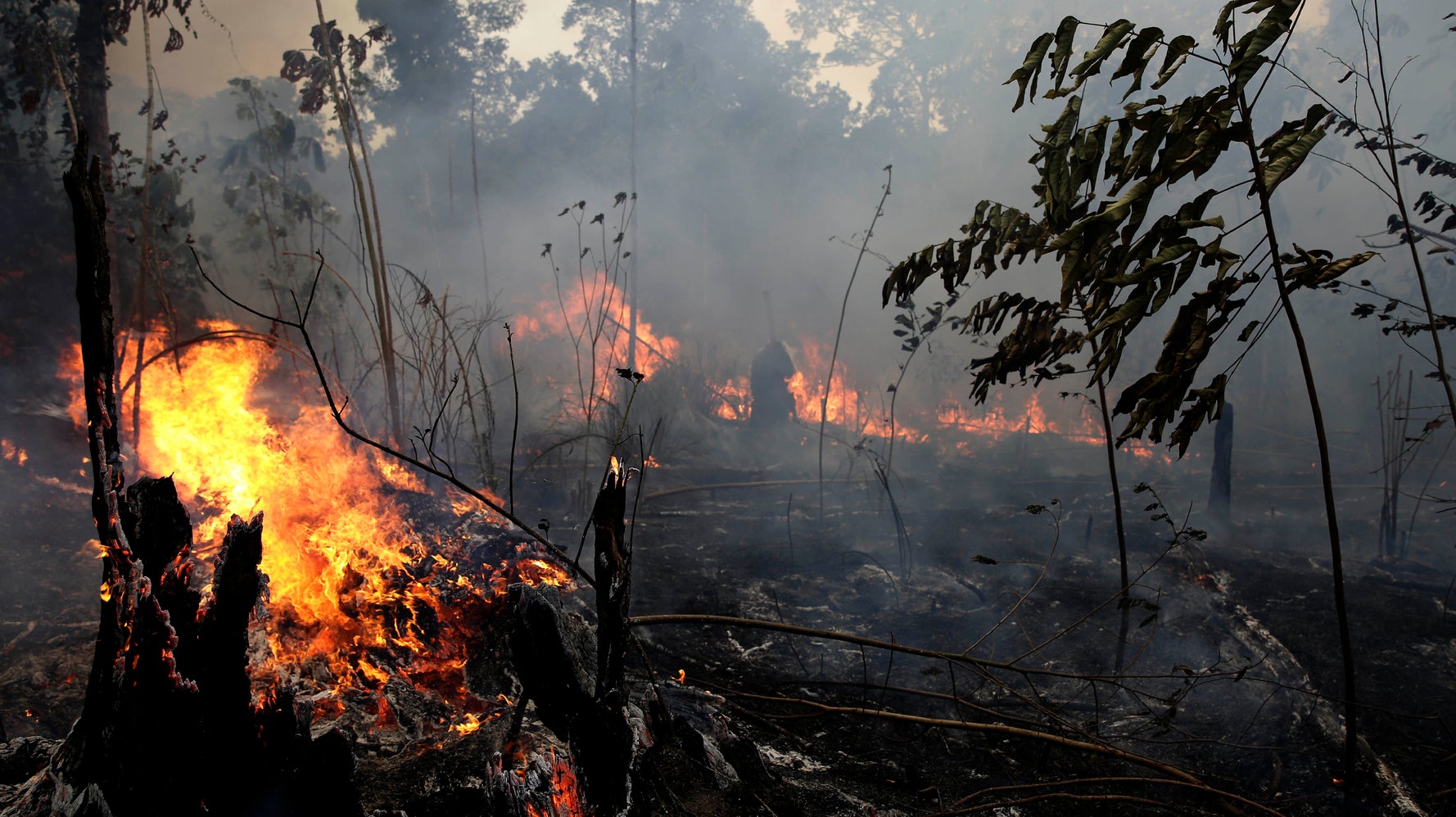
Image result for Trump's Trade War Linked To Amazon Rainforest Destruction

The Amazon burns as the trade wars ramp up.

“There is concern that market pressures related to the disruptions in global trade contributed to the fires in the Amazon,” Paul Murphy-Spooner, the spokesperson for the American Soybean Association, said in an email to HuffPost. 

Brazil is America’s biggest soybean competitor and has stepped up its production now that China has slashed its purchases of U.S. crops in retaliation for Trump’s tariffs on Chinese imports. Soy shipments from Brazil jumped 27% from 2017 to 2018. Chinese imports from Brazil in the 12 months through April amounted to 71 million tons — nearly as much as China imported from the entire world in 2014, according to Bloomberg. 


Read the Huffpost story by Mary Papenfuss - “Trump’s Trade War Linked To Amazon Rainforest Destruction.”

08 April, 2019

Business calls for more detail on Labor's emissions policy

The heads of prominent Australian manufacturing businesses say it is not yet possible to quantify the financial impact of Labor’s proposed emissions plan, but some warn the added pressure could leave them little choice but to shift investment offshore.
Ruffy Geminder from Pact group.

Emissions-intensive manufacturers are set to be among the hardest-hit under the Opposition’s expanded carbon-reduction plan, which sets new emissions limits for businesses that emit more than 25,000 tonnes of carbon a year in a bid to slash national emissions by 45 per cent by 2030.


Read the story from The Age by Nick Toscano and Darren Gray - “Business calls for more detail on Labor's emissions policy.”

21 February, 2019

Australia’s biggest coal miner moves to cap global output

Australia's largest coal miner Glencore will cap its global coal output at current levels in the wake of pressure from activist shareholders as part of a pivot towards minerals used in renewable technologies.
Glencore said it will not cap its global coal production.
The miner announced on Wednesday night that, while it will continue mining thermal coal, which is used in power stations, and coking coal, which is used for making steel, it will limit production to current levels.


Read the story from The Age by Cole Latimer - “Australia’s biggest coal miner moves to cap global output.”

08 August, 2018

Greens to demand 90 per cent emissions cuts from future Labor government

The Greens would pressure a future Shorten government to slash greenhouse gas emissions from the electricity sector by 90 per cent, posing a likely complication for Labor should it win office at the next election without an absolute majority.
The Greens would seek to force Labor to adopt a 90 per
 cent emissions reduction target on he electricity sector.
The Greens’ stance, announced on Tuesday, underscores the importance of negotiations over the final design of the Turnbull government’s national energy guarantee. Labor states want a future federal government to control the setting of emission reductions imposed on the electricity sector, rather than being beholden to forces in Parliament seeking bolder or weaker climate action ambition.


Read the story by Nicole Hasham from The Age - “Greens to demand 90 per cent emissions cuts from future Labor government.”

10 February, 2018

Residents fear over-development in new Anglesea masterplan

Tensions are rising in coastal Anglesea amid a proposal to redevelop sections of unused land for tourist and residential accommodation, in another sign of commercial pressure facing communities on the Great Ocean Road.
Anglesea residents are rallying against development plans for the former Alcoa site. 
The proposed redevelopments were contained in a “concept masterplan” released in late January by Alcoa, which operated a mine and power station in Anglesea until 2015.


Read the story by Benjamin Preiss in The Age - “Residents fear over-development in new Anglesea masterplan.”

01 February, 2018

Big surge in opposition to Adani, new poll reveals.

A growing majority of Australians now oppose the construction of Adani's huge Carmichael coal mine, while environmental groups are ramping up pressure on Bill Shorten and federal Labor to rule out support for the project.
Opponents of the proposed mine dogged candidates
 in last year's Queensland state election.
A poll of 3312 people, conducted by pollsters ReachTEL on January 25 and commissioned by the Stop Adani Alliance, found 65.1 per cent of Australians opposed or strongly opposed Indian mining company Adani building the new coal mine in Queensland.


Read James Massola’s story in today’s  Melbourne Age - “Big surge in opposition to Adani, new poll reveals.”

29 January, 2018

Banks slash coal loans by 50 per cent as investor pressure mounts

Australia's big banks slashed loans to fossil fuel companies by almost a fifth in 2017, including a 50 per cent drop in their coal mining exposure, new analysis shows, as investors and regulators ramp up pressure over climate change risks.
Banks are cutting their exposure to fossil fuels, especially coal. 
ANZ Bank, National Australia Bank, Westpac and Commonwealth Bank's combined loans to coal miners slumped by about $1.5 billion, or more than 50 per cent per cent, according to analysis of bank disclosures from environmental finance group Market Forces.


Read the story by Clancy Yeates from today’s Melbourne Age - “Banks slash coal loans by 50 per cent as investor pressure mounts.”

05 January, 2018

Why the Bomb Cyclone hitting the east coast is so unusual

NOW, THE FIRST thing you should know about a bomb cyclone is it’s just a name—and unlike a sharknado, it’s not a literal one. The very real scientific term describes a storm that suddenly intensifies following a rapid drop in atmospheric pressure. Bombing out, or “bombogenesis,” is when a cyclone’s central pressure drops 24 millibars or more in 24 hours, bringing furious winds that can quickly create blizzard conditions and coastal flooding.
A "bomb cyclone" is stalking America's east coast.
It’s actually not that rare a phenomenon; meteorologists estimate these kinds of storms break out in the Northern Hemisphere about 10 times a year. They can go by other names, like Nor’easter and mid-latitude cyclone, which may explain why you’ve never heard of one before Winter Storm Grayson started dumping snow in Tallahassee on Wednesday morning. But Grayson isn’t your typical bombogenerator.

It’s what happens when everything comes together just right (or just wrong). Grayson is expected to explode up the East Coast between now and Friday, intensifying as it makes its way from Florida to Nova Scotia, blowing record snowfalls around at category 3 hurricane wind speeds. “This storm is a synoptic meteorologist’s dream,” says Paul Huttner, who watches the weather for Minnesota Public Radio. “It’s a perfect alignment of the three things we look for.”


Read the Wired story by Megan Molteni - “Why the Bomb Cyclone hitting the east coast is so unusual."

24 November, 2017

Josh Frydenberg to come under pressure over renewable energy at ministers' meeting

The Turnbull government has come under pressure at Friday's energy ministers' meeting to modify its energy plan to give greater support for renewable energy and extend its effects beyond 2030.
Minister for Environment and Energy Josh Frydenberg
 and Prime Minister Malcolm Turnbull as they unveiled
the National Energy Guarantee in October.
Shane Rattenbury, the ACT energy minister, sought support from other states to have a vote on key policy principles for the National Energy Guarantee during the COAG gathering in Hobart.

Fairfax Media understands two amendments put forward by Mr Rattenbury and his South Australian counterpart, Tom Koutsantonis, fell one vote short of a majority needed.

The mood inside the meeting was described as "fraught".


Read Peter Hannam’s story in today’s Melbourne Age - “Josh Frydenberg to come under pressure over renewable energy at ministers' meeting.”

22 November, 2017

Josh Frydenberg releases new modelling to back energy guarantee savings claims

The Turnbull government will ramp up pressure on the states and the federal opposition to support its national energy guarantee with new modelling confirming it would generate $120 per year in savings for households from 2020.
Prime Minister Malcolm Turnbull (right) and Energy Minister
Josh Frydenberg are trying to ramp up pressure on the states
to support the national energy guarantee. 
A coalition of 15 business, and environmental groups, as well as the Australian Council of Trade Unions have also backed the call for compromise to deliver the national energy guarantee, citing the need for investment certainty for the electricity sector.

Businesses could realise even larger savings than households under the proposed energy guarantee because of the reduction in wholesale energy prices - which could be 23 percent lower compared to business as usual - according to the new modelling by Frontier Economics that was commissioned by the Energy Security Board. 

The household savings figure of $120 is slightly more than the original figure of $115 suggested when the guarantee was unveiled in October.


Read the story by James Massola in today’s Melbourne Age - “Josh Frydenberg releases new modelling to back energy guarantee savings claims.”

19 October, 2017

National energy guarantee would cut 6 per cent off power bills in best scenario

Even the best energy policy will do little to reduce costs for consumers, experts have warned, as the Turnbull government resists pressure to substantiate claims its new policy will save Australians $2 a week on power bills. 
Minister for Environment and Energy Josh Frydenberg, Deputy
 Prime Minister Barnaby Joyce and Prime Minister Malcolm
 Turnbull during Question Time at Parliament House in
 Canberra on Wednesday.
 
 In Parliament on Wednesday, Labor seized on suggestions the reduction could be closer to 50¢ a week but Energy Minister Josh Frydenberg stood by the claim of an average $115-a-year saving between 2020 and 2030.

"The national energy guarantee is a credible, workable, pro-market policy that will deliver lower power prices for Australians and involves no taxes, no subsidies and no emission trading schemes," he said. 

A report this week from the Australian Competition and Consumer Commission found a 63 per cent power price rise since 2007 had put consumers under "unacceptable pressure"
  

Read Eryk Bagshaw’s story in today’s Melbourne Age - “National energy guarantee would cut 6 per cent off power bills in best scenario.”

02 April, 2015

Federal Government rejects Labor's call on renewable energy target


T

he Federal Government has rejected Labor's call to immediately exempt emissions-intensive industries from the renewable energy target (RET), saying it is not possible to do so without legislation.

The conversation continues in Australia
about renewable energy.
The major parties are locked in a stand-off over lowering the target but agree on giving emissions-intensive trade-exposed industries (EITEs) like aluminium an exemption.

The Government has been under pressure from members of its own backbench to legislate the exemption before those industries are liable under the RET for another year.

Read the full ABC story here….

21 November, 2014

Australia's climate change stance alienates many


Many have predicted that Australia will be alienated by its international trading partners if it fails to join the world’s response to climate change.

Greg Barker - 'a lot of
concern about Australia'.
And already that pattern has begun to emerge.

A story in today’s Melbourne Age headed: “UK Tories slam Tony Abbott on climate policy” discusses the disenchantment of influential UK people who, among other things, have described the Australian Prime Minister’s attitude as “baffling”.

The story says: “In a series of wide-ranging, separate interviews on UK climate change policy with The Age, they warn that Australia is taking enormous risks investing in coal and will come under increasing market and political pressure to play its part in the global battle against climate change”.