Showing posts with label predictions. Show all posts

03 July, 2019

Time will tell if this is a record summer for Greenland ice melt, but the pattern over the past 20 years is clear

Greenland has been in the news a bit lately. From Huskies seemingly walking on water, to temperatures soaring to 20 above average for the time of year, to predictions of the vast ice sheet being lost entirely, what is going on?

At its most simple: ice melts when it gets too warm. 

Of course, some ice melts every time summer rolls around, but the amount of Arctic ice that melts each summer is growing, and we’re waiting to see whether this turns out to be a record-breaking year for Greenland ice melt.

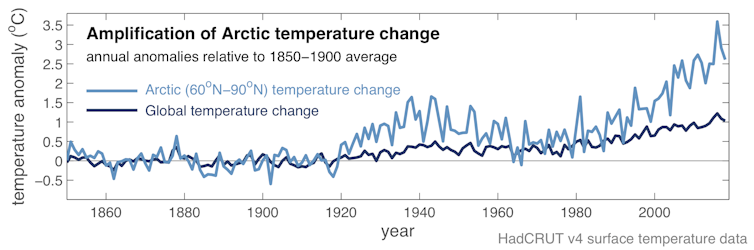
No part of the planet is free from the impacts of human-caused climate change. But Greenland, and the Arctic more generally, is experiencing the impacts particularly severely. Temperatures in the planet’s extreme north are rising twice as fast as the global average


Read the story from The Conversation by an ARC Future Fellow from the Research School of Earth Sciences, who is a chief investigator for the ARC Centre of Excellence for Climate Extremes with the Australian National University, Nerilie Abram  -  “Time will tell if this is a record summer for Greenland ice melt, but the pattern over the past 20 years is clear.”

16 May, 2019

Expect warmer days and less rain this winter

Farmers awaiting winter rains look likely to be disappointed, as the national forecaster releases its predictions for a warm, dry winter for most of the country.
Australia is set for a warm, dry winter, according
 to forecasts from the Bureau of Meteorology.
According to the Bureau of Meteorology’s release on Thursday, drought-ravaged Queensland is not expected to hit historical averages for rainfalls for June to August.

The bureau further tipped a drier-than-average winter for New South Wales, Victoria, south-eastern South Australia, northern Tasmania, the Northern Territory, and parts of Western Australia.


Read The New Daily story - “Expect warmer days and less rain this winter.”

11 June, 2018

Analyzing climate change/hurricane links

Predictions for the 2018 Atlantic hurricane season, now officially under way, amount to a fairy typical forecast and hold no great surprises. Between projections from NOAA and from Colorado State University we’re pretty much looking at more than a dozen named storms, a half-dozen or so hurricanes and a few of those major ones.
Ocean weather research buoy instruments measure sea
 surface temperature, air pressure, wave height, and
storm surge and offer insights on hurricanes and more.
Of course all it takes is one strategically-located, powerful storm to turn an average or even a below-average season prediction into a nightmare. Think hurricane Andrew in the accurately-predicted below-average year of 1992. Last year wasn’t supposed to have been all that terrible a season. Ask the victims of Maria, Harvey, and Irma how that worked out.

Hurricanes at best are difficult to predict at any stage of their development and lifespan. A lot of scientific data and new-age technology have improved our data collection ability and therefore our understandings. But assessing the impacts of climate change – they also difficult to predict – on hurricanes is very much a work in progress.


Read the Yale Climate Connections story by Jan Ellen Spiegel - “Analyzing climate change/hurricane links.”

13 April, 2018

NAB’s Mike Baird calls green energy 'tipping point’

Rapid growth in renewable energy investment has propelled the sector to a "tipping point," former NSW premier Mike Baird says, amid predictions investors will pour trillions of dollars globally into green electricity projects in the coming decades.
Mike Baird, former NSW premier and NAB's chief customer
 officer for corporate and institutional banking, says green
energy is a "huge" opportunity for the bank.
Amid a bitter political fight over energy policy in Australia, Mr Baird, now a senior National Australia Bank executive, said global market forces were already driving long-term changes in the energy mix.

After NAB last year became the first major Australian bank to stop lending for new thermal coal mines, Mr Baird said the lender's balance sheet also reflected the "exponential" growth in renewable energy financing, which he viewed as a "huge opportunity”.

“We’re in a position that there are many moving parts to the energy policy discussion framework, but we’ve reached a critical point where the markets and investors are moving in respect of these challenges,” Mr Baird said in an interview with Fairfax Media.


Read the story Clancy Yates from The Age - “NAB’s Mike Baird calls green energy 'tipping point’.”

11 January, 2016

Ed King avoids making predictions, but give his 'take' on 2016


El Nino ‘on steroids’ will cause drought, flooding; clean energy investments will soar; polluters will face court; Arsenal will win the Premier League.

Ed King from Climate Home says, “Only fools make predictions, so here’s my take on the next 12 months.”

04 February, 2013

Support for fellow Wisteria member


Beneath the Wisteria supporter, Robyn Lipshut, has leapt to the support of fellow member Bill Brown in that she has written to the Shepparton News articulating the failings in a letter by Shepparton’s Keppel Turnour critical of Bill’s views.

Robyn, of Tatura, wrote:

“Thanks to Keppel Turnour “Great times ahead” (letter to The Shepparton News, 2/2/13 for reassuring us that all is well with the world and that some un discovered technological advancement, at some future time, will save us from global warming, overuse of resources, overpopulation, environmental degradation, decreasing bio diversity, poor distribution and use of food etc etc.

It seems that it is easy to hope that we can leave it to chance but maybe we all need to become more informed of how the world has to act, individual countries have to act, communities have to act and individuals have to act. It is not a competition to see who starts first and does more or less. It is lovely to look at the world through rose colored glasses but we have to be circumspect enough to take the predictions and data seriously. The issue is not just climate change as such, but of global warming and the impacts of that. It is all interconnected with human occupation and manipulation of the environment over the last couple of centuries and an Industrial age that has changed the planet forever.”


12 May, 2012

Seeing the light,walking on the moon and the falsities of families

(Reading Dick Smith's "Population Crisis – the dangers of unsustainable growth for Australia”, I was inspired to write the following - Robert McLean).

My grandmother was born before we could casually flick on the electric light; she died long after man walked on the moon.

When “Ma”, as she was colloquially known to all in the family, turned 90 my mother encouraged me to be at her birthday “as it could be her last” – 15 years later I attended what was her “last” birthday.
"Ma" was born before we could
 caually flick on a light switch.
Ma, as you would suspect, was married to “Pa” and about a decade of my life had passed before I discovered, or realised, that “Ma” was actually Ellen and “Pa” was in fact John.

There was nothing intentionally deceptive or wicked about what was a whole-of-family evolving institution, but it has had its legacies and is a small, but integral piece of a sweeping and far more sinister human dilemma.


Becoming a grandfather about four years ago, the question arose as to what I would like to be known? – “Granddad”, “Grandpa”, “Gramps” or maybe “Pa” - the idea of being called “Pa” unearthed memories of childhood confusion and being convinced that life is sufficiently loaded with deceptions without adding the misunderstandings of one’s linage, I suggested  “Robert”.

Beleaguered by emotional responses from family and friends, I am now “Pa” and it feels comfortable, but on hearing it, I immediately feel about 20 years older.

That, however, is incidental, rather what worries me is the fact that the unintentional and imagined friendly emotional intrigue of families shapes us, from a young age, to be unable, or less able, to confront or deal with the intrigues of adulthood.

Beyond having their rapidly expanding minds confused by the identity of the forebears, the natural inquisitiveness of children is exciting, but I suggest confused, when confronted with an array of myths from some mystical gift-bearing soul to super natural beings controlling their fate and that their wellbeing is to be found in the stars to the fact that the good life is simply there for the taking.

Approaching adulthood armed with those myths most people, damagingly, are soundly disconnected from reality and frequently align themselves with one or several of those celebrated falsities.

Childhood is for most a wonderful experience, particularly for those fortunate enough to live in such a peaceful and bountiful place as Australia, and although it is not readily apparent, those are the years in which the foundations are laid down for the superstructure that is become a purposeful adulthood.

However, a life built upon, and maligned, by myths, misinformation and misguided “facts”, can often be tragic, leaving that same person unable to confront life’s brutal realities and consequently unable to accept or deal with them.

Being “Pa” to two grandsons, it is discomforting to be a part of an oblique identity fraud, for as seemingly unimportant as it is, it is one which could have, and will have, I believe, a significant impact on the lives of those two small boys.


From no electricity to walking
 on the moon - "Ma" saw
 it all.

In and of itself, that deception, if I can boldly call it that, is of little significance, but multiplied by the millions of occurrences around the world each day, it becomes an insurmountable difficulty for humanity.

We are born as a blank slate, except for the knowledge and experience of our forebears that is embedded in our DNA and, beyond that, not in isolation from our environment and the cultural norms that surround us to impact on every aspect of our being making us whom and what we are.
We are what we are because of nature, but the person we become is a measurable outcome of by whom and how we are nurtured.
The past 200 years has been particularly kind to humanity, we have learnt much and through the exercise of powerful brains, homo-sapiens have become the pre-eminent species on earth, changing it in a host of ways to make it more applicable and useful to their survival.
Our endeavours have not come, however, without a cost, particularly to many of the earth’s other species; species without which we would not survive.
That same cost, of which many are ignorant or simply unaccepted by others and particularly those who benefit from the maintenance of the status quo, is unfolding in a conflation of difficulties that individually or, even more pressingly, in a combined sense have the capacity to decimate mankind.

Minds polluted by living a life of so called fun and friendly myths underlined by adherence to baseless fantasies are ill-prepared to confront and deal with realities that have never before been imposed upon the human experiment.

Fundamental to the difficulties is the exponential growth of human population rising from just one billion in 1800 to more than seven billion late last year and in my 65 years our numbers have about tripled. Predictions are for those numbers to reach nine billion by 2050.

Other than for the concerns voiced by a few individuals and some groups, the world’s burgeoning population goes pretty much unnoticed, except by those who celebrate it for it brings for them short-term profits.

Our swelling numbers, and the inordinate growth they bring, are eroding the earth’s finite resources; filling up our natural sinks, the oceans and atmosphere, with carbon dioxide; making it near impossible to sate the thirsts of many and ease their hunger; and simply find space for everyone to live.
Dick Smith's 2011 book.
It is pointless to illustrate to many people the difficulties they face for in harking back to fun-like emotional deceptions of youth and the nurture surrounding them as they arrived at adulthood they are unable to understand the reason for gloom about the future.

Even the production of facts, results in a contrariness that sees them react with a certain stubbornness that frequently has them reassert beliefs that careful science supported examination shows, clearly, they are wrong.
Writing in “Population Crisis – the dangers of unsustainable growth for Australia” Australian multimillionaire philanthropist and adventurer, who originally made his fortune retailing electronics and then founded Australian Geographic magazine, Dick Smith, discussed solutions to avoid what he described as “potential disasters”.
“Firstly,” he wrote, “we have to change the way we measure progress; then we must stop the wasteful use of non-renewable resources; and finally, as population growth begins to stabilise, we must completely re-program the global economy to avoid growth altogether”.
So, considering Dick’s advice, rather than concern ourselves about exploring the moon, or anywhere in outer-space, we should be exploring earth and along with that, human nature.