Showing posts with label Greenland. Show all posts

28 April, 2020

Meteorologists say 2020 on course to be hottest year since records began

This year is on course to be the world’s hottest since measurements began, according to meteorologists, who estimate there is a 50% to 75% chance that 2020 will break the record set four years ago.
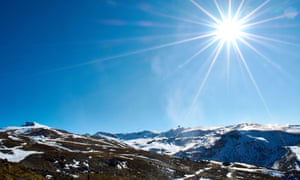
A ski resort in Granada, Spain, which was forced to use artificial snow cannons due to a lack of snow this winter.
A ski resort in Granada, Spain, which was forced to use
artificial snow cannons due to a lack of snow this winter.
Although the coronavirus lockdown has temporarily cleared the skies, it has done nothing to cool the climate, which needs deeper, longer-term measures, the scientists say.
Heat records have been broken from the Antarctic to Greenland since January, which has surprised many scientists because this is not an El NiƱo year, the phenomenon usually associated with high temperatures.
The US National Oceanic and Atmospheric Administration calculates there is a 75% chance that 2020 will be the hottest year since measurements began.
Read the story from The Guardian by Jonathan Watts - “Meteorologists say 2020 on course to be hottest year since records began.”

04 August, 2019

Siberian Wildfires and Heatwaves in Alaska: How the Arctic Is Nearing a Point of No Return

Many of the globe’s far northern regions have been experiencing extreme weather events over the past two months. Plumes of smoke have been picked up by satellites from wildfires across Alaska and Siberia and Greenland has experienced rapid ice loss as usually frigid regions have experienced heatwaves and record temperatures.
Smoke rises from a wildfire on July 3, 2019 south
of Talkeetna, Alaska near the George Parks Highway.
 Alaska is bracing for a dangerous fire season with
record warm temperatures and dry conditions in parts of the state.
 
As the Arctic faces extreme weather events caused by climate change, the events could have ripple effects that accelerate temperature increases across the world, according to scientists and experts.

“The basic chemistry and the basic physics of how the atmosphere absorbs heat — there’s no path where you can imagine that the Arctic is going to start to cool off again,” says Brian Brettschneider, a climatologist and post doctoral fellow at the International Arctic Research Center at the University of Alaska Fairbanks.

“Cold air has to come from somewhere, cold air doesn’t just magically appear, and that somewhere has to be accounted for in the entire energy balance of the Earth. Right now the whole Earth has just warmed up,” Brettschneider tells TIME. “It would take a dramatic reversal of the chemical composition of the atmosphere.”


12 July, 2019

Arctic ice loss is worrying, but the giant stirring in the South could be even worse

A record start to summer ice melt in Greenland this year has drawn attention to the northern ice sheet. We will have to wait to see if 2019 continues to break ice-melt records, but in the rapidly warming Arctic the long-term trends of ice loss are clear. 
Image result for Field camp on the East Antarctic ice sheet. Nerilie Abram Arctic ice loss is worrying, but the giant stirring in the South could be even worse
Field camp on the East Antarctic ice sheet.
But what about at the other icy end of the planet?

Antarctica is an icy giant compared to its northern counterpart. The water frozen in the Greenland ice sheet is equivalent to around 7 metres of potential sea level rise. In the Antarctic ice sheet there are around 58 metres of sea-level rise currently locked away. 

Like Greenland, the Antarctic ice sheet is losing ice and contributing to unabated global sea level rise. But there are worrying signs Antarctica is changing faster than expected and in places previously thought to be protected from rapid change.


03 July, 2019

Time will tell if this is a record summer for Greenland ice melt, but the pattern over the past 20 years is clear

Greenland has been in the news a bit lately. From Huskies seemingly walking on water, to temperatures soaring to 20℃ above average for the time of year, to predictions of the vast ice sheet being lost entirely, what is going on?

At its most simple: ice melts when it gets too warm. 

Of course, some ice melts every time summer rolls around, but the amount of Arctic ice that melts each summer is growing, and we’re waiting to see whether this turns out to be a record-breaking year for Greenland ice melt.

No part of the planet is free from the impacts of human-caused climate change. But Greenland, and the Arctic more generally, is experiencing the impacts particularly severely. Temperatures in the planet’s extreme north are rising twice as fast as the global average. 


Read the story from The Conversation by an ARC Future Fellow from the Research School of Earth Sciences, who is a chief investigator for the ARC Centre of Excellence for Climate Extremes with the Australian National University, Nerilie Abram  -  “Time will tell if this is a record summer for Greenland ice melt, but the pattern over the past 20 years is clear.”

13 February, 2018

Global sea level rise rate speeding up, 25 years of satellite data confirms

The rate of global sea level rise is accelerating as ice sheets in Antarctica and Greenland melt, an analysis of the first 25 years of satellite data confirms.
Satellite data indicates sea levels will rise around 61 cm between now and 2100.
The study, by US scientists, has calculated the rate of global mean sea level rise is not just going up at a steady rate of 3mm a year, but has been increasing by an additional 0.08mm a year, every year since 1993.

If the rate of change continues at this pace, global mean sea levels will rise 61 centimetres between now and 2100, they report today in the journal Proceedings of the National Academy of Sciences.

"That's basically double the amount you would get if you only had 3 mm a year with no acceleration," said the study's lead author Steven Nerem of the University of Colorado.


27 June, 2017

New Ice Core Drilling in Northeast Greenland to Help Us Prepare for Climate Change

“We are the first and only ones in the world to drill through an ice stream. Half of Greenland’s loss of ice sheet mass occurs by way of ice streams, which are are like rivers of fast-flowing ice within the ice sheet that slide towards the sea and eventually calve to become icebergs. The prospects are significant, as we expect research results to provide improved forecasts with regards to rising sea levels in the future – an area now subject to great uncertainty,” according to the Niels Bohr Institute’s Dorthe Dahl-Jensen.


Researchers will study the ice core ice’s fluid-like properties by measuring physical properties and performing deformation studies of the ice core to better understand the material characteristics of the ice. The drill hole’s movement and deformation will also be measured.


Read the Science and Technology Research News story - “New Ice Core Drilling in Northeast Greenland to Help Us Prepare for Climate Change.”

02 April, 2017

Greenland’s Coastal Ice Passed a Climate Tipping Point 20 Years Ago, Study Says

Ice caps and glaciers along the coast of Greenland passed a tipping point in 1997, when a layer of snow that once absorbed summer meltwater became fully saturated. Since then, the coastal ice fields—separate from the main Greenland Ice Sheet—have been melting three times faster than they had been, according to a new study published Friday in the journal Nature Communications.
The coast of Greenland passed
 a tipping point in 1997
"The melting ice caps are an alarm signal for the ice sheet. It means long-term ice mass loss is inevitable. It will increase and accelerate if nothing changes," said lead author Brice NoĆ«l, a scientist at the  University of Utrecht Institute for Marine and Atmospheric Research. "It's very unlikely the ice caps will recover. It's a climate tipping point—the time at which a change or an effect cannot be stopped.”


06 March, 2017

Northern hemisphere sees in early spring due to global warming

Arctic cotton grass grows on Greenland’s
 seashore. Sedge is almost four weeks
ahead of its timetable 10 years ago.
Spring is arriving ever earlier in the northern hemisphere. One sedge species in Greenland is springing to growth 26 days earlier than it did a decade ago. And in the US, spring arrived 22 days early this year in Washington DC.

The evidence comes from those silent witnesses, the natural things that respond to climate signals. The relatively new science of phenology – the calendar record of first bud, first flower, first nesting behaviour and first migrant arrivals – has over the last three decades repeatedly confirmed meteorological fears of global warming as a consequence of the combustion of fossil fuels.

Researchers say the evidence from the plant world is consistent with the instrumental record: 2016 was the hottest year ever recorded, and it was the third record-breaking year in succession. Sixteen of the hottest years ever recorded have happened in the 21st century.


Read Tim Radford’s story on The Guardian - “Northern hemisphere sees in early spring due to global warming.”

13 December, 2016

This stunning Antarctic lake is buried in ice. And that could be bad news

Atop the ice sheet covering the Arctic island of Greenland, you now see dramatic melting in the summer. It forms lakes, rivers and even dangerous "moulins" in the ice where rivers suddenly plunge into the thick ice sheet, carrying water deep below.

East Antarctica is supposed to be different. It is extremely remote and cold. It doesn't see such warm temperatures in the summer - yet - and so its ice tends to remain more pristine.

"Many people refer to East Antarctica as being too cold for significant melt," says Jan Lenaerts, a glaciologist with the Utrecht University in the Netherlands. "I mean there's marginal melt in summer, but there's not a lot."

That's the common wisdom, at least, but it is challenged in a new study in Nature Climate Change, by Lenaerts and his colleagues from universities in the Netherlands, Belgium and Germany. They do so based on research they conducted atop the very large Roi Baudouin ice shelf in East Antarctica, which floats atop the ocean, and where they found a very Greenland-like situation in early 2016.

Read Chris Mooney’s story in The Sydney Morning Herald - “This stunning Antarctic lake is buried in ice. And that could be bad news.”

22 October, 2016

The latest disaster risk from climate change — huge glacial floods.

Glacier and lake near the villages of
Pelechuco and Agua Blanca in the
 Apolobamba region, northern Bolivia. 
We all hear about how the glaciers of Greenland and Antarctica are losing ice, and so threatening to raise our sea levels — perhaps quite dramatically. But mountain ranges across the globe are also strewn with far smaller glaciers that are suffering perhaps an even bigger wallop from rising temperatures — and now, new research suggests their retreat could, quite literally, be deadly in some cases to communities living below.

In a new study in the journal The Cryosphere, Simon Cook of Manchester Metropolitan University in the U.K. and British and Bolivian colleagues examine the mountain glaciers of the Bolivian Andes in particular, which are typically classified as “tropical glaciers.” That’s no oxymoron — the Andes feature such high elevations that even tropical or equatorial countries can have glaciers. The average elevation in the Andes is around 13,000 feet, and according to Cook, Bolivia alone contains about a fifth of the world’s tropical glaciers.

Read the story from The Washington Post - “The latest disaster risk from climate change — huge glacial floods.”

06 August, 2016

Global warming induced ice melt to uncover nuclear waste

Up to 200,000 litres of fuel and
low-level radioactive coolant
from a nuclear generator
were buried at the base in 1967.
Global warming could release radioactive waste stored in an abandoned Cold War-era US military camp deep under Greenland's ice caps if a thaw continues to spread in coming decades, scientists say.

Camp Century was built in north-west Greenland in 1959 as part of US research into the feasibility of nuclear missile launch sites in the Arctic, the University of Zurich said in a statement.

Staff left fuel and an unknown amount of low-level radioactive coolant there when the base shut down in 1967 on the assumption it would be entombed forever, according to the university.

While the waste is currently about 35 metres underneath the ice, the part of the ice sheet covering the camp could start to melt by the end of the century, based on current trends, the scientists said.

"Climate change could remobilise the abandoned hazardous waste believed to be buried forever beneath the Greenland ice sheet," the university said, of findings published this week in the journal Geophysical Research Letters.

02 June, 2016

Unseasonable warm spring melts Iceland ice sheet

Last month in Greenland, more than a tenth of the ice sheet’s surface was
Nicola Jones.
melting in the unseasonably warm spring sun, smashing 2010’s record for a thaw so early in the year. In the Antarctic, warm water licking at the base of the continent’s western ice sheet is, in effect, dissolving the cork that holds back the flow of glaciers into the sea; ice is now seeping like wine from a toppled bottle.

The planet’s polar ice is melting fast, and recent satellite data, models, and fieldwork have left scientists sobered by the speed of the sea level rise we should expect over the coming decades. Although researchers have long projected that the planet’s biggest ice sheets and glaciers will wilt in the face of rising temperatures, estimates of the rate of that change keep going up. When the Intergovernmental Panel on Climate Change (IPCC) put out its last report in 2013, the consensus was for under a meter (3.3 feet) of sea level rise by 2100. In just the last few years, at least one modeling study suggests we might need to double that.

Read the environment360 story by Nicola Jones - “Abrupt Sea Level Rise Looms As Increasingly Realistic Threat.”