Showing posts with label global. Show all posts

20 January, 2019

"I'm Sure Dinosaurs Thought They Had Time, Too': Over 12,000 Students Strike in Brussels Demanding Bold Climate Action

An estimated 12,500 students walked out of their classrooms in Brussels, Belgium on Thursday to join the country's second youth-led climate march in the past week, demanding that government leaders from across Europe take bold action to help stem the global climate crisis.
More than 10,000 Belgian students walked out of their classrooms
on Thursday for the second march for climate justice in the past
week, demanding that their government take bold action to
help stem the climate crisis.
Carrying signs reading "Act now before it's too late," "The planet needs you to give a damn," and "I'm sure the dinosaurs thought they had time, too," young people at the Marche Pour le Climat chanted, "We want change!" as they marched through the city in the rain.


06 October, 2018

'Rise and Resist' - considering high fashion and global carbon emissions

The face of pollution is not limited to dirty fossil fuels or raw sewage in our waterways. 
University of Melbourne’s Sustainable Society Institute,
 deputy director, Dr Sangetha Chandrashekeran (right)
 talks with author and sustainability editor at large for Vogue
 magazine, Clare Press.
The fast fashion we buy each season is creating a negative impact on our planet– The clothing production and selling process is often convoluted; the process entails textile manufactures, various suppliers, raw materials, quality checks, global and domestic shipping, retail, and the inevitable discarding of the item. 

Calculating the overall footprint of this industry is a feat of its own; a comprehensive analysis would take into account not only the clothing production process, but also the farming, harvesting, extraction, and manufacturing needed to create the materials.When examining the lifecycle of clothing there is a shocking amount of emissions and waste from both the production and disposal stage. 

It would be a monumental task to calculate the overall emissions of any single product. However, there are clear steps that industry players can make to reduce this footprint. Items that are made from reused or recyclable material all make a difference in creating a circular economy.

One who has thought a lot about fashion and its contribution to the world’s carbon dioxide problem is the sustainability Editor-at-large for Vogue magazine, Clare Press, who has written about that in her heart book, “Rise and Resist: How to change the world”.


Clare talked with the deputy director of the University of Melbourne’s Sustainable Society Institute, deputy director, Dr Sangetha Chandrashekeran, about her book and then answered questions from the more than 100 people in the audience at the university’s School of Design.

07 April, 2018

World invested more in solar energy than coal, gas and nuclear combined in 2017, UN report reveals

Global investment in renewable energy shot up last year, far outstripping investment in fossil fuels, according to a UN report.
China was largely responsible for the surge in
 solar energy infrastructure in 2017, accounting
 for nearly half the global investment. 
As the price of clean energy technology plummets, it has become an increasingly attractive prospect for world governments.

China was by far the world’s largest investor in renewable energy in 2017, accounting for nearly half of the new infrastructure commissioned.

This was mainly a result of its massive support for solar power, which globally attracted nearly a fifth more investment than in the previous year. Other countries including Australia, Sweden and Mexico more than doubled the amount of money they pumped into clean energy projects.


06 March, 2018

One Plus One: Al Gore

Former US vice president Al Gore reflects on the global climate crisis, his bid to become president and the near-tragedy that almost claimed the life of his son.
Al Gore.

Here he is in discussion with host Jane Hutcheon, so watch “One Plus One: Al Gore”.

25 February, 2018

Sea levels could rise an extra 60cm if emission reductions are delayed until 2035, study finds

Global sea levels will continue to rise until at least 2300 regardless of how much we reduce our greenhouse gas emissions, according to new research published today.
Scientists say sea levels will continue to rise until at least 2300.
But for every five years until 2035 that we delay reaching net-zero carbon emissions, as committed to under the Paris agreement targets, sea levels will rise by about an extra 20 centimetres, the researchers found as part of the study published in Nature Communications.

They estimated average global sea levels would be between 0.7 and 1.2 metres above 2000 levels by 2300, depending on how quickly we can reduce our emissions.

The Paris agreement, to which Australia is a signatory, has a core aim of limiting global temperature rise this century to "well below" 2 degrees C above pre-industrial levels, and to pursue efforts to keep the rise below 1.5 degrees.


13 February, 2018

Global sea level rise rate speeding up, 25 years of satellite data confirms

The rate of global sea level rise is accelerating as ice sheets in Antarctica and Greenland melt, an analysis of the first 25 years of satellite data confirms.
Satellite data indicates sea levels will rise around 61 cm between now and 2100.
The study, by US scientists, has calculated the rate of global mean sea level rise is not just going up at a steady rate of 3mm a year, but has been increasing by an additional 0.08mm a year, every year since 1993.

If the rate of change continues at this pace, global mean sea levels will rise 61 centimetres between now and 2100, they report today in the journal Proceedings of the National Academy of Sciences.

"That's basically double the amount you would get if you only had 3 mm a year with no acceleration," said the study's lead author Steven Nerem of the University of Colorado.


23 January, 2018

Future shocks: 10 emerging risks that threaten our world

It rocked the global economy and threatened to destroy the financial systems that we rely on. Ten years on, some countries are still picking up the pieces.


According to The World Economic Forum’s Global Risks
Report 2018 these are the worlds biggest risks. 
In the wake of the 2008 financial crisis, we asked ourselves one question over and over again: why didn’t we see it coming?

The World Economic Forum’s Global Risks Report 2018 says that, in our increasingly complex and interconnected world, this type of shock may become more likely.


Read Alex Gray’s story from the World Economic Forum -“Future shocks: 10 emerging risks that threaten our world.”

13 January, 2018

Disruption from electric car 'revolution' will rival the introduction of the iPhone: Josh Frydenberg

The global electric car revolution is coming to Australia, Environment and Energy Minister Josh Frydenberg has declared, likening the scale of technological disruption to the introduction of the iPhone.

Australia's Environment and Energy
Minister, Josh Frydenberg, says the
electric car revolution is coming.
In an interview and opinion piece for Fairfax Media, he said three barriers to electric vehicle uptake in Australia - high purchase prices, limited driving range and a lack of charging infrastructure – are on their way to being solved.


(The idea of the electric car is, in itself, not offensive, but what is disturbing is the creation and establishment, of an industry and infrastructure that his enmeshed with the ideology of private profit and public expense. Rather than government endorsement of an electric car industry we need our politicians to support, in every sense, the creation of a publicly owned nation-wide fleet of autonomous vehicles that would respond to smartphone instructions, taking people hither and thither and once a task is completed, return to their base for recharging - Robert McLean)

27 December, 2017

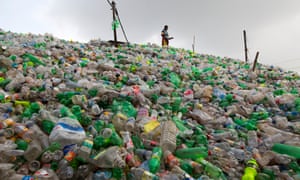
$180bn investment in plastic factories feeds global packaging binge

The global plastic binge which is already causing widespread damage to oceans, habitats and food chains, is set to increase dramatically over the next 10 years after multibillion-dollar investments in a new generation of plastics plants in the US.
One million plastic bottles are bought around the world every minute, with most ending up in landfill or in the sea.
One million plastic bottles are bought around the world every
 minute, with most ending up in landfill or in the sea. Photograph:
Fossil fuel companies are among those who have ploughed more than $180bn since 2010 into new “cracking” facilities that will produce the raw material for everyday plastics from packaging to bottles, trays and cartons.
The new facilities – being built by corporations like Exxon Mobile Chemical and Shell Chemical – will help fuel a 40% rise in plastic production in the next decade, according to experts, exacerbating the plastic pollution crisis that scientist warn already risks “near permanent pollution of the earth.”


Read Matthew Taylor’s story on The Guardian - “$180bn investment in plastic factories feeds global packaging binge.”

14 November, 2017

Climate scientists warn time is running out to prevent global environmental collapse

Time is running out to prevent a global environmental collapse — that's the stark warning 15,364 of the world's leading climate scientists have sent out.

Scientists from 180 countries, many in the developing world, put their names to the journal article published today in Bioscience, which also predicted temperature rises and unpredictable weather patterns that would cause widespread misery.

But the paper also noted it was not too late for governments to do something about it.
The number is believed to be the largest group of scientists to have ever put their names to a research paper focused on climate change.


Fossil fuel emissions hit record high after unexpected growth: Global Carbon Budget 2017

Global greenhouse emissions from fossil fuels and industry are on track to grow by 2% in 2017, reaching a new record high of 37 billion tonnes of carbon dioxide, according to the 2017 Global Carbon Budget, released today.

The rise follows a remarkable three-year period during which global CO₂ emissions barely grew, despite strong global economic growth.

But this year’s figures suggest that the keenly anticipated global peak in emissions – after which greenhouse emissions would ultimately begin to decline – has yet to arrive.

The Global Carbon Budget, now in its 12th year, brings together scientists and climate data from around the world to develop the most complete picture available of global greenhouse gas emissions.


02 November, 2017

If we all stopped eating beef, what would happen to the land?

When the land down the road from Lorraine Lewandrowski’s home in New York State’s Herkimer county was sold, it was bought by developers who turned the land into a subdivision.


“The people who bought the lots from us were nice enough, and they all told me that they wanted to be out in the country,” says Lewandrowski a lawyer and a dairy farmer in Central New York. “But they couldn’t grasp what they were doing. The meadows that were alive with little bird fledglings the developers were plowing under to make these 10 acre lawns.”
It’s hard to argue that that was an ecological improvement over the land’s previous incarnation as a farm.

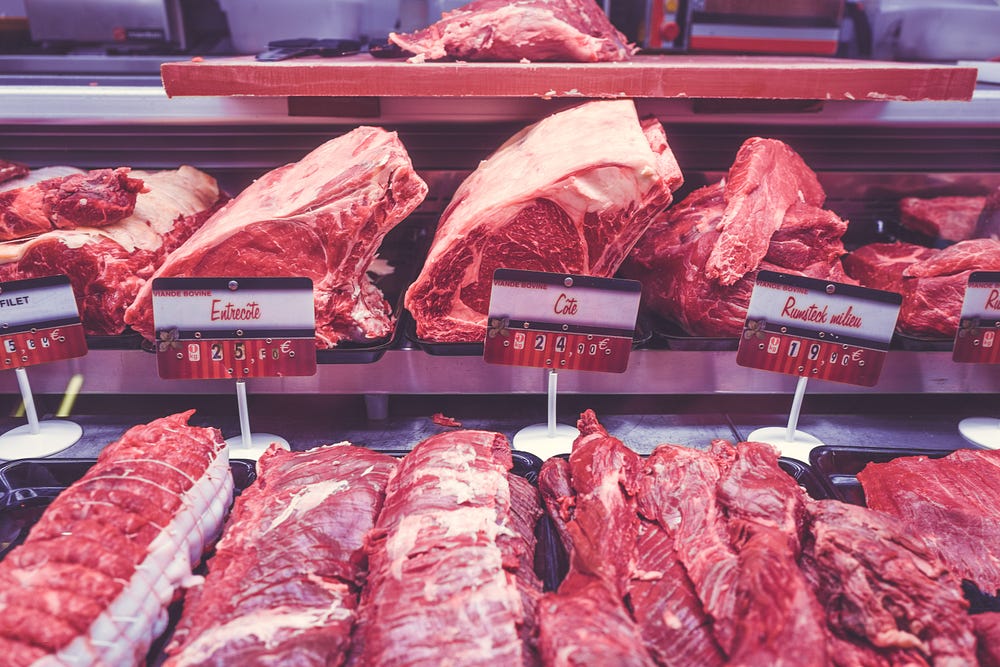
For the past month, many Popular Science staff members have engaged in No Red October in which they eschewed eating beef. The reason was not masochism but environmentalism: livestock accounts for 12-percent of global climate change emissions. And beef — which requires 28 times more land and 11 times more water to produce chicken or pork while emitting five times more climate-changing emissions — seems like a natural place to cut back. 

Especially since Americans annually eat 54 pounds of beef, or a little more than a pound a week.


Read the Popular Science story by Kendra Pierre Louis - "If we all stopped eating beef, what would happen to the land?”

21 October, 2017

South Australia goes all out on renewables despite federal focus on coal

October 13, 2017 — The Australian federal government’s love affair with coal has reached new levels in recent years, with federal ministers bringing chunks of the mineral into parliament and donning high-visibility mining vests as pro-coal publicity stunts. Yet against this backdrop, one Australian state has managed to break global records in the renewable energy space.

Recently, South Australia’s state government has announced not one but two record-breaking renewable energy projects: the world’s largest solar thermal power plant and the world’s largest lithium ion battery installation. Together, these projects will help the state surge well ahead of its already ambitious renewable energy targets while delivering a clear challenge to its coal-obsessed federal counterpart.


Read the ENSIA story by Bianca Nogrady - “South Australia goes all out on renewables despite federal focus on coal.”

16 August, 2017

Adani mining giant faces financial fraud claims as it bids for Australian coal loan

A global mining giant seeking public funds to develop one of the world’s largest coal mines in Australia has been accused of fraudulently siphoning hundreds of millions of dollars of borrowed money into overseas tax havens.

Men wearing masks of Australian prime minister Malcolm
Turnbull and Adani chairman Gautam Adani protest outside
Parliament House in Canberra. 
Indian conglomerate the Adani Group is expecting a legal decision in the “near future” in connection with allegations it inflated invoices for an electricity project in India to shift huge sums of money into offshore bank accounts.

Details of the alleged 15bn rupee (US$235m) fraud are contained in an Indian customs intelligence notice obtained by the Guardian, excerpts of which are published for the first time here.

The directorate of revenue intelligence (DRI) file, compiled in 2014, maps out a complex money trail from India through South Korea and Dubai, and eventually to an offshore company in Mauritius allegedly controlled by Vinod Shantilal Adani, the older brother of the billionaire Adani Group chief executive, Gautam Adani.


06 February, 2017

Factcheck: Mail on Sunday’s ‘astonishing evidence’ about global temperature rise

In an article in today’s Mail on Sunday, David Rose makes the extraordinary claim that “world leaders were duped into investing billions over manipulated global warming data”, accusing the US National Oceanic and Atmospheric Administration (NOAA) of manipulating the data to show more warming in a 2015 study by Tom Karl and coauthors.
What he fails to mention is that the new NOAA results have been validated by independent data from satellites, buoys and Argo floats and that many other independent groups, including Berkeley Earth and the UK’s Met Office Hadley Centre, get effectively the same results.

Read the guest post on CarbonBrief by Zeke Hausfather, a climate scientist and energy systems analyst at Berkeley Earth, an independent temperature analysis project. “Factcheck: Mail on Sunday’s ‘astonishing evidence’ about global temperature rise.”