Showing posts with label Widespread. Show all posts

18 January, 2019

The IPCC’s Climate Change report, and the common mindsets we need to shift

Earlier this week, the Intergovernmental Panel on Climate Change (IPCC) published a critical report on the urgency of addressing the indisputable climate breakdown we’re experiencing, and the global human and environmental consequences of the projected temperature rise. The floods, droughts and poverty that result from extreme heat are already occurring, widespread and indiscriminately. And with the IPCC’s warning that we have just twelve years to limit the climate change catastrophe, the message is loud and clear: we must act now.

Carra Santos.
The major role is that of the politicians and policy-makers. Those in charge of the environment, agriculture, health, industry, infrastructure, international trade and more, have an absolute responsibility to connect the dots and collaborate to achieve sustainability and balance. This is primarily across the reduction of global CO2 emissions, the increase in use of renewable energy to decrease reliance on fossil fuels, and responsibility of land use and management for sustainable agriculture and energy.


Read the Food Culture Forum story by Carra Santos - “The IPCC’s Climate Change report, and the common mindsets we need to shift.”

15 December, 2018

Rare freezing rain and black ice to test UK's Christmas shoppers

Christmas shoppers have been warned to take extra care on Saturday, with widespread heavy freezing rain expected to create hazardous conditions on the UK’s roads.
The Met Office has predicted widespread freezing rain on
 Saturday, one of the busiest shopping days of the year
The Met Office issued an amber weather warning for parts of England and Scotland, highlighting the risk of rapidly forming ice on roads and pavements, while high ground in Scotland could face up to 40cm of snow.

“Tomorrow is going to be treacherous day for many areas. We are going to see widespread freezing rain events, which is fairly unusual,” said the Met Office forecaster Mark Wilson, adding that the north of England and southern Scotland would be worst hit.

“The concern is there will be lot of people on the roads at this time of year, and black ice can produce very dangerous driving conditions, so our strong recommendation is to be mindful of the very difficult situation on the roads,” he said.


Read the story from The Guardian by Alexandra Topping - “Rare freezing rain and black ice to test UK's Christmas shoppers.”

24 November, 2018

Australia failing to meet nature protection targets, UN finds

Australia is failing to meet international targets to protect nature in parts of the country where land clearing and habitat destruction are widespread, according to data in a major new United Nations report.
The UN says Australia is not meeting its obligation for
 a system of parks that protects 17% of all regions
The UN report on protected areas, released at the Convention on Biological Diversity Conference of the Parties in Egypt, examines progress by countries to meet global conservation targets.

Conservation groups said the report showed that Australia was “far from meeting” international targets that require countries to develop well-connected and ecologically representative protected areas for nature.

While 19% of Australia’s total land area has conservation protections in place, this is largely due to an increase in Indigenous protected areas in inland Australia.


Read the story from The Guardian by Lisa Cox - “Australia failing to meet nature protection targets, UN finds.”

10 April, 2018

Shipping’s Heavy Fuel Oil Puts the Arctic at Risk. Could It Be Banned?

Heavy fuel oil—the molasses-like sludge left after the oil refining process—is among the dirtiest fuels on the planet, and yet its use by ships is widespread in the Arctic, a pristine environment where it could do significant harm.
The majority of the Arctic's black carbon, a short-lived climate
pollutant, comes from heavy fuel oil used in ships.
Burning the fuel contributes to climate change, and a spill in Arctic waters would be a nightmare for emergency response coordinators. But it's cheap, and attractive for ships making long hauls, the kind of traffic on the rise as climate change makes Arctic shipping easier.

Concerns about the safety and use of the fuel in a delicate and remote environment led to it being banned in the Antarctic in 2011, but efforts to include the Arctic in that ban fell short.


Read the Inside Climate News story by Sabrina Shankman - “Shipping’s Heavy Fuel Oil Puts the Arctic at Risk. Could It Be Banned?

16 February, 2018

Cyclone Kelvin blue alert issued as apocalyptic clouds bring heavy rainfall to Broome

Broome has had the first taste of the storm system expected to develop into the strongest cyclone of the season, with a blue alert issued for a tropical storm which has already caused widespread flooding.
A low-slung storm front approaches Cable Beach in Broome on Thursday.
The system is forecast to develop into Tropical Cyclone Kelvin, bringing wind gusts of up to 165 kilometres per hour and isolated rainfall of up to 500 millimetres.

The blue alert applies to people between Cape Leveque and De Grey in the Kimberley and Pilbara, including the tourist town of Broome, with a severe tropical cyclone likely to develop later today or tomorrow.

People in the district are being warned to prepare their properties and take shelter.


02 January, 2018

Wild storm wreaks havoc on NSW north coast, with more storms forecast

Severe thunderstorms have caused widespread damage on the New South Wales north coast this afternoon.
The storm ripped roofs off a number of buildings
 in Maclean, including the Clarence Hotel.
The State Emergency Service has reported receiving around 60 calls for help.

SES spokesperson, Jenny North, said most of the damage was in and around the town of Maclean, where severe winds ripped roofs off a number of buildings and brought down powerlines.

A school in Maclean also received some damage, and there were also people camping at the showground, which suffered damage.

"We have had reports of damage to the showground roof, various council buildings and even the Maclean SES has had some damage," Ms North said.


Read the ABC News story by Emma Siossian - “Wild storm wreaks havoc on NSW north coast, with more storms forecast.”

27 December, 2017

$180bn investment in plastic factories feeds global packaging binge

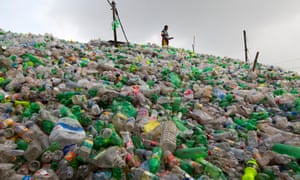
The global plastic binge which is already causing widespread damage to oceans, habitats and food chains, is set to increase dramatically over the next 10 years after multibillion-dollar investments in a new generation of plastics plants in the US.
One million plastic bottles are bought around the world every minute, with most ending up in landfill or in the sea.
One million plastic bottles are bought around the world every
 minute, with most ending up in landfill or in the sea. Photograph:
Fossil fuel companies are among those who have ploughed more than $180bn since 2010 into new “cracking” facilities that will produce the raw material for everyday plastics from packaging to bottles, trays and cartons.
The new facilities – being built by corporations like Exxon Mobile Chemical and Shell Chemical – will help fuel a 40% rise in plastic production in the next decade, according to experts, exacerbating the plastic pollution crisis that scientist warn already risks “near permanent pollution of the earth.”


Read Matthew Taylor’s story on The Guardian - “$180bn investment in plastic factories feeds global packaging binge.”

03 September, 2016

Heavy winter rains devastate NSW crops

Tamworth based ABC
rural reporter,
Joanna Woodburn.
Widespread, heavy rain has devastated crops in central western New South Wales, while other parts of the state have also been inundated.

Few farmers would usually complain about rain, but there is such a thing as getting too much and at the wrong time.

Record rainfalls in the past three months in parts of the state have damaged and killed winter crops such as wheat, barley and chickpeas.

The Department of Primary Industries (DPI) said it had been the third wettest winter on record.

Read Joanna Woodburn’s ABC story - “Rain wipes out NSW crops in third wettest winter on record.”