Showing posts with label damage. Show all posts

22 November, 2019

A Wet Year Causes Farm Woes Far Beyond the Floodplains

The damage from the destructive spring flooding in the Midwest has been followed in parts of the country by a miserable autumn that is making a bad farming year worse, with effects that could be felt into next spring.
Even the widespread flooding in the spring was worse for many farmers than the images of sodden river towns would suggest, said Scott Irwin, an agricultural economist at the University of Illinois. While the images of overwhelmed levees were dramatic, “that’s not the real story.” Across much of the Midwest and Northern Plains soils were saturated throughout the spring, he said, and many farmers couldn’t get crops in the ground or had to delay planting until perilously late in the season. “Farmers told me in Eastern Illinois it felt like they were in a monsoon from April til May.” 
It was the wettest year on record for the lower 48 states, with the kind of extreme rainfall events that are increasingly associated with climate change. And then fall came in with unseasonably heavy rains and snow. That was the case for Aaron Heley Lehman, a farmer in central Iowa and president of the Iowa Farmer’s Union. “This has definitely been a bad year for almost all farmers in Iowa, even if you weren’t on river bottom ground and having your grain bins explode and your land underwater for weeks and weeks at a time,” he said. “It was still a very rough year.” 
Read the story from The New York Times by John Schwartz - “A Wet Year Causes Farm Woes Far Beyond the Floodplains.”

(The wettest year on record in parts of the U.S. and hitherto unseens droughts in Australia. This, surely, must be the chaotic climate - Robert McLean)

29 December, 2018

The Coming Climate Change War

Current global warming is real, it is man-made, and its consequences will be profoundly negative over time. The significant loss of polar ice, damage to the coral reefs, increased flooding along coastlines and other waterways, more frequent heatwaves, and an increased risk of forest fires are among the most likely consequences as the earth continues to warm.

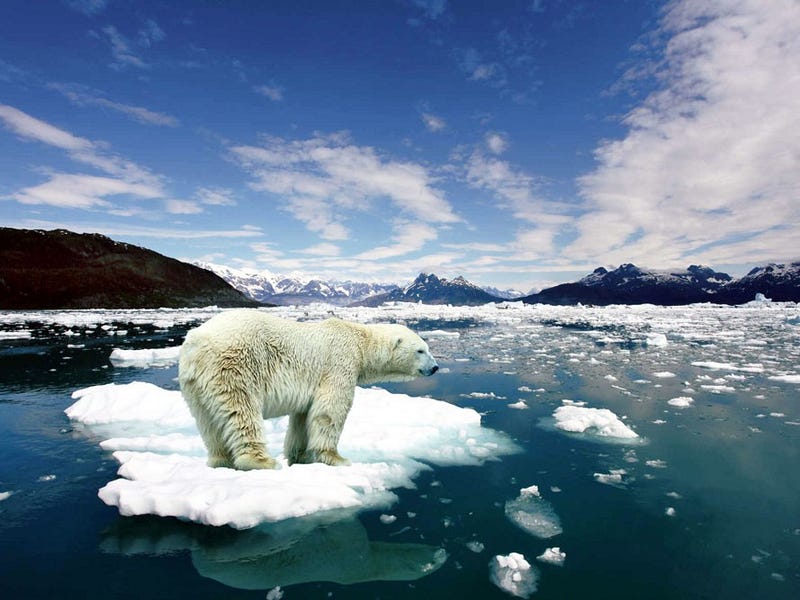
A lone polar bear on a shrinking island
of ice- a symbol of climate change.
Theory and empirical data support these predictions, unequivocally.
That reality, however, is being cynically weaponized by an unqualified chattering class that seeks partisan advantage, even at the risk of war.
Reactions to the latest Intergovernmental Panel on Climate Change (IPCC) report on climate change exemplify this problem…

Read the Medium story by Kent Kroeger - “The Coming Climate Change War.”

08 October, 2018

Major climate report warns of strong risk of crisis as early as 2040

A landmark report from the United Nations’ scientific panel on climate change paints a far more dire picture of the immediate consequences of climate change than previously thought and says that avoiding the damage requires transforming the world economy at a speed and scale that has “no documented historic precedent.”
Harry Tayor, 6, plays with the bones of dead
livestock on his family's drought-hit NSW farm.
The report, issued on Monday by the Intergovernmental Panel on Climate Change, a group of scientists convened by the United Nations to guide world leaders, describes a world of worsening food shortages and wildfires, and a mass die-off of coral reefs as soon as 2040 — a period well within the lifetime of much of the global population.

The report “is quite a shock, and quite concerning,” said Bill Hare, an author of previous IPCC reports and a physicist with Climate Analytics, a nonprofit organisation. “We were not aware of this just a few years ago.”


Read the story by Coral Daveport from The New Daily - “Major climate report warns of strong risk of crisis as early as 2040.”

10 April, 2018

Is climate change really too hard to understand?

It’s a big subject, all right. And a difficult one to address. But too big to understand it isn’t. Quantum physics is too big to understand. Climate change is simple. I’ll put it in one sentence: There are known heat-trapping gasses, and if we add too much of them to the atmosphere, it will cause large, foreseeable damage to humans and natural environments. That is not too big to understand.A lot of people wonder why we are doing so little to prevent the slow-motion catastrophe of climate change. One theory is that it’s too big a subject to understand.


And a majority of people understand it just fine. They are making the assumption that the political process will work normally and that the government will take the steps necessary to deal with it. Like government did with smog, and with polluted water, and with acid rain, and with ozone depletion. The thing that is hard to understand is how people in positions to do something about it do nothing. Or rather, do everything in their power to stop action.


Read the opinion piece from The Washington Post by Tom Toles - “Is climate change really too hard to understand?

01 April, 2018

Greece’s second-largest city without water.

Thessaloniki:  Large sections of the northern Greek city of Thessaloniki have been without water for a fifth day because of damage to an old pipeline.
A broken pipe has disrupted water supplies in
 Thessaloniki, Greece's second largest city.
The centre and north-western parts of Greece's second-largest city have been without water since Tuesday, when a 40-year-old pipeline that brings water to the city from 50 kilometres away burst. Hundreds of thousands of people in the metropolitan area of 1.2 million, which includes the city's suburbs, have been affected.

Read the story from The Age - “Greece’s second-largest city without water.


(Surely, this must be something of a preview of what is to come as climate change brings droughts of hitherto unseen dimensions and the water supplies of cities all around the world begin to dry up - Robert McLean)

28 January, 2018

Curbs on fuel pollution ruled out in favour of cheaper options

Moves to introduce stringent regulations for Australian fuels have been excluded from the government’s most recent consultation paper in favour of cheaper options that would result in more damage to the environment and public health.
Environment department says it will no longer
 consider changes that would provide greatest health benefit.
The Ministerial Forum on Vehicle Emissions is considering changes that would reduce emissions from motor vehicles, including regulations that would improve the fuel-efficiency of new cars and limits on pollution levels in fuel.

The motoring lobby and the petroleum industry have been fighting the introduction of the strongest regulations on both fronts. This week the department of environment revealed it did not plan to continue examining the strongest options.


Read Michael Slezak’s story in The Guardian - “Curbs on fuel pollution ruled out in favour of cheaper options.”

02 January, 2018

Wild storm wreaks havoc on NSW north coast, with more storms forecast

Severe thunderstorms have caused widespread damage on the New South Wales north coast this afternoon.
The storm ripped roofs off a number of buildings
 in Maclean, including the Clarence Hotel.
The State Emergency Service has reported receiving around 60 calls for help.

SES spokesperson, Jenny North, said most of the damage was in and around the town of Maclean, where severe winds ripped roofs off a number of buildings and brought down powerlines.

A school in Maclean also received some damage, and there were also people camping at the showground, which suffered damage.

"We have had reports of damage to the showground roof, various council buildings and even the Maclean SES has had some damage," Ms North said.


Read the ABC News story by Emma Siossian - “Wild storm wreaks havoc on NSW north coast, with more storms forecast.”

27 December, 2017

$180bn investment in plastic factories feeds global packaging binge

The global plastic binge which is already causing widespread damage to oceans, habitats and food chains, is set to increase dramatically over the next 10 years after multibillion-dollar investments in a new generation of plastics plants in the US.
One million plastic bottles are bought around the world every minute, with most ending up in landfill or in the sea.
One million plastic bottles are bought around the world every
 minute, with most ending up in landfill or in the sea. Photograph:
Fossil fuel companies are among those who have ploughed more than $180bn since 2010 into new “cracking” facilities that will produce the raw material for everyday plastics from packaging to bottles, trays and cartons.
The new facilities – being built by corporations like Exxon Mobile Chemical and Shell Chemical – will help fuel a 40% rise in plastic production in the next decade, according to experts, exacerbating the plastic pollution crisis that scientist warn already risks “near permanent pollution of the earth.”


Read Matthew Taylor’s story on The Guardian - “$180bn investment in plastic factories feeds global packaging binge.”

01 December, 2017

Wild weather: Monster storm threatens 20 per cent of Australia's wheat crop

Heavy rains in eastern Australia could wipe out or damage up to 4 million tonnes of wheat due to be harvested shortly, forecasters said on Friday.
Farmers have been working round the clock to harvest
their crops before the wild weather strikes.
 
The "major weather event" being faced by most of Victoria and parts of South Australia and NSW this weekend poses a major threat to the countries grain harvest.

"The main concern is that these are the areas where crops are still being harvested," said James Maxwell of Australian Crop Forecasters, which expects to downgrade its national wheat forecast of 21.7 million tonnes once the damage is assessed.

"At the moment, we estimate that around 4 million tonnes will be affected," Mr Maxwell said.
It was not yet possible to determine how much of the crop would be wiped out and how much is downgraded due to the onset of re-sprouting, or premature germination, resulting in lower yields.


25 September, 2017

Irrigation plans for Kimberley's Gogo Station facing green wall of opposition

Environmental groups have launched a campaign against a proposed irrigation development on Gogo Station in the Kimberley, claiming the project could do irreversible damage to the Fitzroy River.

Gogo Station wants to expand its irrigated
fodder operation in the Kimberley.
Gogo is planning to use floodwater from a tributary known as Blue Bush Creek, to grow around 5,000 hectares of fodder crops for its cattle, and is currently seeking the necessary approvals from the State Government.

The campaign against the proposal, led by the Broome-based Environs Kimberley, says Gogo's plan to draw water into large storage dams makes no sense and contradicts government plans to create the Fitzroy River National Park.

Environs Kimberley's Jason Fowler said it was a big project that posed a major risk to the environment.


20 September, 2017

Neil deGrasse Tyson says it might be 'too late' to recover from climate change.

Scientist and astrophysicist Neil deGrasse Tyson said Sunday that, in the wake of devastating floods and damage caused by Hurricanes Harvey and Irma, climate change had become so severe that the country "might not be able to recover.”

Neil deGrasse Tyson.
In an interview on CNN's "GPS," Tyson got emotional when Fareed Zakaria asked what he made of Homeland Security Adviser Tom Bossert's refusal to say whether climate change had been a factor in Hurricanes Harvey or Irma's strength -- despite scientific evidence pointing to the fact that it had made the storms more destructive.

"Fifty inches of rain in Houston!" Tyson exclaimed, adding, "This is a shot across our bow, a hurricane the width of Florida going up the center of Florida!"


06 January, 2017

Tasmanian floods: BOM and SES lashed by farmers over weather warnings amid June deluge

The Latrobe and Kentish areas were
among those inundated last June.
Forecasting by the Bureau of Meteorology (BOM) and SES phone alerts during flooding in Tasmania last June have been criticised as inadequate.

The Government has released 55 submissions to its review into the disaster, which is due to report in June this year.

The flooding claimed three lives and caused at least $180 million in damage.

Railton dairy farmer Paul Lambert lost 20 cattle and is still repairing extensive flood damage around his property.

He said SMS warnings came too late.

"It was nine o'clock the next morning that the warning from the SES came through, which it was only a few hours before the peak, so it was a bit late then to really do anything," he said.

11 July, 2016

'Unheard of' conditions leads to massive dieback of mangroves

Mangrove dieback across northern Australia's
coastline comes after a long, hot summer,
lower than usual rainfalls, and the absence of
a wet season. "Unheard of" says fisherman.
The widespread dieback of mangroves across northern Australia's coastline has the commercial fishing industry worried about its future.

It is estimated around 10,000 hectares of mangroves have died along the Gulf of Carpentaria coastline, in an event being described by experts as severe and unprecedented.

Barramundi fisherman Jeff Newman has been working in the Gulf for years and has seen the mangrove dieback first hand.

"The extent of damage is a shock to me and of real concern to the [fishing] industry," he said.

"To see it on this massive scale is unheard of.

"I've never seen or heard of anything like this before in the past."

Mr Newman said the death of so many mangroves could have a disastrous impact on the local fishery.

15 July, 2015

Many enthused about dams, but it is a false belief


M
any in Australia see man-made dams as the solution to the nation’s water scarcity problems.

The simplistic view wants us to trap and store the massive downpours that are becoming more common because of global warming and then use that water as we go about enduring the inevitable droughts.

Such views take no account of the damage such dams cause to the local environment. the flora and fauna, and not to mention people who live in the area, the significant and devastating overall changes they make to the river systems on which they are inevitably built and, of course, the accompanying silting or the dams that can, and does lead to their ultimate ineffectiveness and failure.

Responding to Climate Change (RTCC) reports that the Belo Monte hydroelectric plant in Brazil is flouting agreements to protect indigenous communities as its builder seeks approval to start generating power, environmental lawyers have warned.

The US$11 billion dam on an Amazonian tributary – set to be the third-largest producer of hydropower globally – has met just 30% of the social and environmental conditions set by government, said AIDA Americas.

04 April, 2015

Typhon Maysak to unsettle the Philippines


R

ecently is was Vanuatu being levelled by Cyclone Pam and now the Philippines are be stalked by Typhoon Maysak.

Some argue that what we are seeing it simply “natural variability” and others attribute these rather trying weather events directly to the damage humans have caused to the atmosphere and consequently the world’s climate.

Scientific evidence illustrates that humans, that’s you and I, have indisputably changed the world’s climate resulting in notably different, and significantly severe, weather events.

Cyclone Pam was one of those major weather events and Typhoon Maysak is similar, although it is likely to be less intense.

An ABC story - “Typhoon Maysak: Philippines braces for possible landslides and storm surges across Easter weekend” – says: “Maysak, initially a top-rated category five typhoon, has weakened to category four as it lost strength over the water.”

03 April, 2015

David Roberts puts his view on 'the climate thing'


W

riting in Grist about a literary fiction author - “Jonathan Franzen is confused about climate change, but then, lots of people are” – David Roberts makes this observation.

His thoughts resonate and would be understood by most who care about the damage we are casing to the world’s climate system.
 
“Shouldn’t our responsibility to other people, both living and not yet born, compel us to take radical action on climate change? The problem here is that it makes no difference to the climate whether any individual, myself included, drives to work or rides a bike. The scale of greenhouse-gas emissions is so vast, the mechanisms by which these emissions affect the climate so nonlinear, and the effects so widely dispersed in time and space that no specific instance of harm could ever be traced back to my 0.0000001-per-cent contribution to emissions. I may abstractly fault myself for emitting way more than the global per-capita average. But if I calculate the average annual quota required to limit global warming to two degrees this century I find that simply maintaining a typical American single-family home exceeds it in two weeks. Absent any indication of direct harm, what makes intuitive moral sense is to live the life I was given, be a good citizen, be kind to the people near me, and conserve as well as I reasonably can.”
-      David Roberts.

16 March, 2015

Cuts will hamper community groups in their helping role


Community groups will play a lead role when extreme weather events resulting from climate change unfold to trouble societies.

However, today’s Melbourne Age reports that the community sector in Victoria will not be equipped to handle natural disasters and emergencies, leaving vulnerable people at risk if disaster strikes.

The story: “Community sector struggles to cope after state and federal funding cuts” tells readers, “It is estimated that in the event of an emergency, about half of all community sector organisations would be out of operation for a week if they sustained serious damage – and many might never provide services again, according to a recent Victorian Council of Social Services report.”

03 November, 2014

Warnings continue to cram our news headlines, yet we procrastinate


Warnings about catastrophic climate change continue to cram the headlines, but still we procrastinate.

An ABC story today tells us that greenhouse gas levels are higher than they have been for nearly a million years.

The United Nations’ Intergovernmental Panel on Climate Change (IPCC) has released its synthesis report, a summary of its last three reports to alert humanity to the damage it is causing to the world.

Today’s story, headed: “IPCC report warns greenhouse gas levels at highest point in 800,000 years, identifies fossil fuels as cause of recent increases” outlines a definitive truth, but still we react and continue to behave as if there is nought but clear sailing ahead.

17 March, 2014

Food security suffers as climate change bites


Food security will become increasingly fragile as climate change further disrupts earth’s weather patterns.

An ABC story headed; “Climate affect on crops worse than thought” explains that a warming of two degrees could seriously impact on crop yields by 2030.

A study published in the Nature Climate Change journal, of which the CSIRO’s Dr Mark Howden was one of the authors, says the climate extremes are happening faster than scientists had anticipated.

29 July, 2013

This might be America, but Australia stands in the same queue


Just some of the damage of 'Superstorm
Sandy' as week after the event.
This is America and not Australia it might be argued, but like the flow of money around the world which appears unrestricted, climate change knows no boundaries.

A story in Mother Jones headed: “Flood, Rebuild, Repeat: Are We Ready For Another Superstorm Sandy Every Other Year?” helps us understand the numbers, or the economics, of climate change.

The economics of climate change induced damage appear at first glance as contrived and cherry-picked to simply support arguments for climate change, but they are not.

Rather, they are real, they are numbers that refer to infrastructure, they are numerical additions that equate with the lives of millions; they are the cost, the real cost, of ignoring the realities that humanity has changed the world’s climate.