Showing posts with label CSIRO. Show all posts

26 February, 2020

Climate change science: now and what’s the future

Benalla Sustainable Future Group, invite you to attend a public presentation at BPACC on Thursday 19th March, 6.45pm for a 7pm start, on the subject of Climate Science – what the current data is telling us, and what the trends are predicting for the future.

Image result for benalla sustainable future group logo

Our guest speakers are Dr Leanne Webb from the CSIRO Climate Research Institute in Aspendale, and Dr Lynette Bettio from the Bureau of Meteorology in Melbourne.


Read the report from the Benalla Sustainable Future Group - “Climate change science: now and what’s the future.”


24 February, 2020

Engineers Australia to host climate change roundtable

Engineers Australia will host the Engineering Responses to Climate Change Roundtable in Sydney this Wednesday, February 26.

The roundtable will bring together leaders from industry, the scientific community, governance and academia, including Arup, AECOM, Baker McKenzie, WSP, CSIRO, Standards Australia, ANSTO, Planning Institute of Australia, ClimateWorks, Australian Academy of Technology and Engineering, Australian Building Codes Board, Climate Science Centre, Business Council for Sustainable Development, Green Building Council, Infrastructure Sustainability Council and the Clean Energy Finance Corporation,Image result for engineers australia

Engineers Australia CEO, Dr Bronwyn Evans, said delegates would explore practical ways in which engineers can accelerate the low carbon transition and reduce the impacts of climate change on our communities.


“Engineers have multiple important roles: as practical implementers, as innovators developing novel solutions to address constraints, as motivators for change and as technical advisors to decision-makers. 

Indeed, we are in the privileged position of being trusted because of our evidence-based approach,” said Dr Evans.

The Engineering Responses to Climate Change Roundtable arose from the recognition that engineers have a vital role to play in concert with a wide range of contributors.

“Dealing with climate change requires urgent action on two critical areas that engineers, society, industry and governments must address together: reducing net emissions and adapting to the effects of climate change,” said Dr Evans.

“No single organisation, government or technology will solve the myriad issues related to climate change. Action on climate change is a team effort, and Engineers Australia is asking: what is the most effective role for us?

“By asking the right questions, exploring the answers, and by working together we can resolve the issues associated with climate change.”


15 January, 2020

Climate Change in Australia

Image result for climate change in australia logoEager to know more about the technical aspects of climate change then visit the “Climate Change in Australia” website,


The site is the work of the CSIRIO and the Bureau of Meteorology.

21 September, 2019

How the climate crisis will affect you – interactive map

The CSIRO and Bureau of Meteorology have compiled different models for predicting the outcome of climate change in Australia to produce a guide to how different regions are likely to be affected.

According to this work, every part of Australia will continue to experience increases in average temperature and will have a higher frequency of hot days. The projections on rainfall and drought are more variable, as is the change in fire weather and intensity.

We have reproduced the summaries for each region so you can see how the climate crisis might impact your area. We’ve also added a postcode and suburb search – either type in your area or click on the region you’re interested in.


Check out the story from The Guardian by Nick Evershed and Andy Ball - “How the climate crisis will affect you – interactive map.”

02 July, 2019

State of the Climate 2018

The Bureau of Meteorology and CSIRO play an important role in monitoring, analysing and communicating observed changes in Australia's climate.
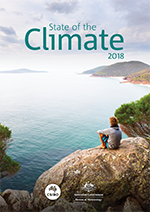
State of the Climate 2018 report cover
This fifth, biennial State of the Climate report draws on the latest monitoring, science and projection information to describe variability and changes in Australia’s climate. Observations and climate modelling paint a consistent picture of ongoing, long term climate change interacting with underlying natural variability.
These changes affect many Australians, particularly the changes associated with increases in the frequency or intensity of heat events, fire weather and drought. Australia will need to plan for and adapt to some level of climate change. This report is a synthesis of the science informing our understanding of climate in Australia and includes new information about Australia’s climate of the past, present and future. The science underpinning this report will help inform a range of economic, environmental and social decision-making and local vulnerability assessments, by government, industry and communities.

Read and download the full report - “State of the Climate 2018.”

11 November, 2017

CSIRO appoints new Senior Climate Scientist to lead national Earth Systems and Climate Change Hub

CSIRO is pleased to announce the appointment of Dr David Karoly as Senior Climate Scientist leading the National Environmental Science Programme Earth System and Climate Change (ESCC) Hub.
Dr David Karoly who will lead the CSIRO's new
National Environmental Science Programme Earth
System and Climate Change (ESCC) Hub
Dr Karoly, an eminent Australian climate scientist, will lead the multidisciplinary ESCC Hub, a partnership of Australia’s leading Earth systems and climate change research institutions, hosted by CSIRO.

“I am delighted to be joining CSIRO as the Leader of the National Environmental Science Programme Earth Systems and Climate Change Hub,” Dr Karoly said.


09 November, 2017

CSIRO launch program to make Australia hydrogen fuel leader

The CSIRO has launched new Future Science Platforms to make Australia a renewable energy exporter and hydrogen fuel hotspot.

Australia is seeking to become a world
leader in hydrogen fuel technology.
It is investing $13.5 million into hydrogen fuel research and tailored health solutions.

Hydrogen fuel has been touted as a major future energy source. The development of a Hydrogen FSP will support the creation of technologies that will enable Australia to export its solar energy and a low-emissions energy source.

"Under our strategy 2020, we're committed to increasing funding for science that underpins innovation and will reinvent and create new industries and jobs for Australia's future," CSRIO chief executive Larry Marshall said.


Read Cole Latimer’s story in today’s Melbourne Age - “CSIRO launch program to make Australia hydrogen fuel leader.”

16 August, 2017

Nerds and Billionaires: Let scientists out of their boxes

When I came home to Australia to head up the CSIRO, I was on a panel and the moderator told me I was “just a scientist”. The implication was: what would you know about business?

                                                             Artwork: Tom Jellett.
Reviewing some of the television interviews given by my predecessor, Megan Clark, I was shocked to hear her called a “head of the nerds”. She laughed it off, but I don’t think I could have.

After 26 years in the US I’d forgotten what Australian culture thinks of scientists. Sure, they’re smart, they’re achievers, and they’re important — but don’t ask them about anything other than science.

Science becomes very specialised very quickly, and so do markets, so you need to be an endlessly curious person who isn’t afraid to ask questions. That’s definitely at the heart of science training and, I think, at the heart of the best business training. But just because you study science doesn’t mean you can’t do business. 

In fact, it may prepare you to run companies far better than management courses do, especially in the innovation revolution.


Read the piece by the CSIRO’s chief executive officer, Larry Marshall -  “Nerds and Billionaires: Let scientists out of their boxes.”

05 June, 2017

Australia can’t lose in the global race for cheaper, cleaner energy

Despite our sometimes heated national debate about our energy future, Australia is well positioned to benefit from innovative low emission technologies. No matter which avenue we take to cleaner energy, our energy-rich resources means there are opportunities for Australian businesses – and cheaper energy for Australian consumers.
Australia is awash with options for low-emissions energy. 
That’s the conclusion reached by CSIRO in our Low Emissions Technology Roadmap, which outlines potential pathways for the energy sector to contribute to Australia’s emissions reduction target.

Our target under the Paris climate agreement calls for a 26-28% reduction of emissions by 2030 from 2005 levels. Our analysis also considers how the energy sector could meet the more ambitious aspiration of avoiding 1.5-2℃ global warming.


Read the piece on The Conversation by the Chief economist with CSIRO energy, Paul Graham -  “Australia can’t lose in the global race for cheaper, cleaner energy.”

22 May, 2017

China to partly fund new CSIRO climate research centre

CSIRO's re-embracing of climate change research will be stressed on Monday when the national science agency announces a new centre partly funded by Chinese interests.

CSIRO research ship Investigator.
Based in Hobart, the $20 million centre will examine the role oceans will play in future climate change, including their influence on floods and drought. It will be half funded by China's Qingdao National Laboratory for Marine Science and Technology.

The Centre for Southern Hemisphere Oceans Research will also look at the capacity of seas to keep absorbing carbon dioxide – more than 90 per cent of heat has been taken up by oceans in recent decades – and the expected impact of melting Antarctic ice shelves.

The announcement comes a year after CSIRO came under fire for a proposed restructure that involved a shift away from "science for science sake" and towards corporate partnerships and work that could be sold.


Read Adam Morton’s story in today’s Melbourne Age - “China to partly fund new CSIRO climate research centre.”

20 May, 2017

Seaweed-fed cows could solve livestock industry's methane problems

Cattle on a CSIRO research station are being fed a mix of grain and seaweed to see if eating algae drastically reduces methane emissions in cows.
A CSIRO trial is underway to if feeding seaweed to
 cows drastically reduces their methane emissions
If successful, the trial could pave the way for a commercial Australian seaweed farming industry to help the overall livestock industry cut its methane emissions.

Agriculture contributes more than 15 per cent to Australia's overall greenhouse gas emissions, and almost 70 per cent of that is from sheep and cattle.

Research last year showed that in a laboratory setting, adding dried seaweed to a cow's diet could reduce the amount of methane it produced by up to 99 per cent.

Those results are now being put to the test in live cattle at the CSIRO's Lansdown Research Station, west of Townsville, in north Queensland.


02 May, 2017

The solar panel and battery revolution: how will your state measure up?

A new roadmap for Australia’s electricity networks outlines a national plan to keep the lights on, make sure bills are affordable, and decarbonise our electricity industry by mid-century.
Some states are poised for a 500% growth
in rooftop solar panels by 2030. 
The plan, by CSIRO and Energy Networks Australia, sets out measures that could save households A$414 a year on average, by generating their own electricity through “distributed” technologies such as solar panels and batteries. It envisages that Australia could save a total of A$101 billion by 2050, while also bringing net greenhouse emissions to zero.

As described in an earlier draft report last December, Australia’s electricity networks can be transformed to give millions of customers more choice and control over their energy, while also meeting Australia’s international climate change commitments.

The roadmap calls for a coordinated approach, but how will that play out in practice?


Read the piece on The Conversation by the Chief economist with CSIRO energy, Paul Graham - ”The solar panel and battery revolution: how will your state measure up?”

22 February, 2017

CSIRO says Australia can get 100 per cent renewable energy

No technical impediment to Australia
reaching 100 per cent renewables.
The Australian government’s chief scientific body says there is no apparent technical impediment to reaching 100 per cent renewables for the national electricity grid, and levels of up to 30 per cent renewable energy should be considered as just “trivial” in current energy systems.

The CSIRO estimate was made in the Senate select committee into the “Resilience of electricity infrastructure in a warming world,” which is providing some fascinating insight that we will be reporting on (because mainstream media won’t).

Of course, the whole proposition of the committee was considered absurd by One Nation Senator and climate conspiracy theorist Malcolm Roberts, who repeatedly insisted that global warming was not happening and constantly badgered the energy experts on this point.

But what did emerge was a general consensus that the electricity grid was in the midst of a rapid and massive transformation, and a change of rules and regulations could likely accelerate that transformation and make it cheaper.

And amid the toxic political debate about the level of renewable energy, specifically wind and solar, that can be accommodated into the system, CSIRO energy division’s principal research scientist Paul Graham said there were no barriers to 100 per cent renewable energy, and lower levels could be easily absorbed.


Read the RenewEconomy by Giles Parkinson - “CSIRO says Australia can get 100 per cent renewable energy.”

06 February, 2017

Horrible time': CSIRO climate science proves its worth one year after deep cuts

Climate science at the CSIRO is bouncing back one year after executives modelled its demise, securing new revenue streams in the Pacific and China, and looking to hire new staff.

On February 4 last year, chief executive Larry Marshall shocked staff in the country's premier research body by stating that because the question of whether the climate was changing "has been answered", it was time to deploy resources elsewhere.

Read Peter Hannam’s story in the Melbourne Age - "’Horrible time': CSIRO climate science proves its worth one year after deep cuts.”

16 December, 2016

Coal seam gas mining costs farmers millions, CSIRO study finds

There are more than 5,000 active
CSG wells in Queensland.
A CSIRO study has for the first time put a dollar figure on the losses to farmers due to coal seam gas (CSG) mining on their land.

According to the model used by the CSIRO, a sample area averaged a loss of $2.17 million over 20 years when CSG mining activity was present.

The study, to be published in Land Use Policy at the end of December, measured the losses to productive land under 24 different scenarios.

It found the biggest cause of losses to agricultural production was from gas industry access tracks and lease areas.

07 November, 2016

Malcolm Roberts Denies Climate Science, Rod Culleton Compares Self To Muhammad Ali

Senator Malcolm Roberts presented
 his report to media on Monday.
One Nation certainly had their Weetbix this morning, coming strong out of the blocks on a Monday with Malcolm Roberts issuing a report slamming the CSIRO's climate science and Rod Culleton likening himself to Muhammad Ali.

Roberts had been spruiking his Monday morning press conference all weekend, promising a "major" announcement at 9am. The press conference was to launch his report -- 'On Climate, CSIRO Lacks Empirical Proof' -- taking aim at the climate change science of the CSIRO.

Roberts said he had a meeting in September with "CSIRO senior scientists", which led him to find that the science agency "does not have empirical evidence proving that carbon dioxide from human activity effects climate", that their findings "contradicts the empirical climate evidence", and that their climate computer models are neither appropriate nor recommended to be used to inform government policy".

27 October, 2016

Karl (BOM) and Steve (CSIRO) writing on The Conversation


‘The Australian Bureau of Meteorology and CSIRO have released their fourth biennial State of the Climate Report’

 State of the Climate 2016 provides an update on the changes and long-term trends in Australia’s climate.


The report’s observations are based on the extensive climate monitoring capability and programs of CSIRO and the Bureau, which provide a detailed picture of variability and trends in Australia’s marine and terrestrial climates. The science underpinning State of the Climate informs impact assessment and planning across all sectors of the economy and the environment.

Read the piece on The Conversation  by the Manager of the Climate Monitoring Section from the Australian Bureau of Meteorology, Karl Braganza, and the Research Team Leader of the Marine & Atmospheric Research from the CSIRO, Steve Rintoul - “State of the Climate 2016: Bureau of Meteorology and CSIRO.”

State of the Climate 2016 - from BOM and the CSIRO

The Bureau of Meteorology and CSIRO play an important role in monitoring, analysing and communicating observed changes in Australia's climate.

This fourth, biennial State of the Climate report draws on the latest monitoring, science and projection information to describe variability and changes in Australia's climate, and how it is likely to change in the future. Observations and climate modelling paint a consistent picture of ongoing, long-term climate change interacting with underlying natural variability.

These changes affect many Australians, particularly changes associated with increases in the frequency or intensity of heat events, fire weather and drought. Australia will need to plan for and adapt to some level of climate change. This report is a synthesis of the science informing our understanding of climate in Australia, and includes new information about Australia's climate of the past, present and future. The science underpinning this report will help inform a range of economic, environmental and social decision-making and local vulnerability assessments, by government, industry and communities.

Read the Bureau of Meteorology  report - “State of the Climate 2016.”

Australia experiencing more extreme fire weather, hotter days as climate changes

More frequent, more prolonged and more
 intensive heatwaves are already being
recorded across Australia as the
climate warms.
Australia is already experiencing an increase in extreme conditions from climate change and more sophisticated modelling is allowing scientists to pinpoint humans' contribution to the wilder weather, the Bureau of Meteorology and CSIRO said.

The fourth State of the Climate report found Australia's mean surface temperature has risen by about 1 degree since 1910, rainfall patterns are shifting away from the nation's south, and there is a marked increase in heatwaves and extreme fire weather days.

"Climate change is happening now and it's having a tangible impact on Australia," Karl Braganza, manager of the bureau's climate monitoring, said.

The fire season is now extending "by a matter of weeks on average", as warmer conditions arrive sooner and last longer over much of the country, he said.

Read Peter Hannam’s story in today’s Melbourne Age - “Australia experiencing more extreme fire weather, hotter days as climate changes.”

16 September, 2016

Malcolm Roberts to talk with the CSIRO about climate change 'evidence'

One Nation senator Malcolm Roberts used question
time on Thursday to ask the Coalition for the
  'specific location of data that proves
claims that humans affect global climate change’.
The CSIRO will meet Malcolm Roberts to discuss global warming after the innovation and science minister, Greg Hunt, intervened to help the One Nation senator obtain a briefing.

Roberts told Guardian Australia he would listen to the evidence, despite having described climate data that contradicted his view as “corrupted”.

In Senate question time on Thursday Roberts asked the minister for resources and Northern Australia, Matt Canavan, for “the specific location of data that proves claims that humans affect global climate change”.

Read Paul Garp’s story on The Guardian - “Malcolm Roberts to discuss climate science with CSIRO.”