Showing posts with label science. Show all posts

04 February, 2020

Morrison’s refusal to move on climate, and the “prosperity doctrine”

It’s become, quite literally, the burning question of the Australian summer. How do you explain a prime minister who says he accepts the science of climate change, acknowledges the link between climate change and the devastating bushfires, who bears witness to the suffering and losses, and then chooses to do nothing about it?
Image result for Morrison’s refusal to move on climate, and the “prosperity doctrine”"
Prime Minister Scott Morrison at church.
Prime minister Scott Morrison likes to say he is a “do-er”. In fact, says so ad infinitum. But when it comes to climate policies, the appeals to Do Something beyond Australia’s glaringly inadequate current policies, and to show some leadership, have been ignored.
Morrison insists that Australia is doing more than most, which is patently not true; that emissions are falling, which are the result only of accounting tricks; and says he will not increase Australia’s emissions targets, or urge other countries to do so, even when it is clear that current policies will take average global warming to more than 3°C, and more devastation for Australia and Australians.

Read the story from RenewEconomy by Giles Parkinson and Michael Mazengarb - “Morrison’s refusal to move on climate, and the “prosperity doctrine”.”

03 January, 2020

Michael Pascoe: How Murdoch’s myrmidons murdered climate policy

“The Murdoch media, determined to remove the Labor government at any cost, mounted a savage war on the science of climate change and the structural reforms that needed to be undertaken,” wrote former Labor Treasurer Wayne Swan in a 2017 article and reprised this week on Twitter.
Murdoch climate change denial
Rupert Murdoch's far-reaching press power has consistently
silenced climate change news, keeping the Coalition in a comfortable position, Michael Pascoe writes.
It’s an important insight as it suggests an answer to the mystery of the Murdoch media’s rabid climate denialism in Australia – a campaign by our biggest newspaper company that has both enabled and goaded the troglodyte end of the Coalition to make Australia a world leader in fighting carbon reduction, in worsening our changed climate.
Without the on-going Murdoch campaign promoting climate disinformation and sheer lunacy, it’s hard to imagine any government being able to persist with its cynical twisting of emissions policy, never mind outright lies.

21 June, 2019

William Happer: Trump aide pushing climate denial inside the White House

By the early 1990s, the man now dubbed the “chief climate change skeptic” in Donald Trump’s White House had already decided he was uneasy with the science that showed humans were heating the planet.

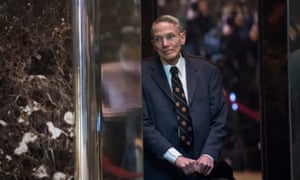
William Happer in Trump Tower in 2017. Happer has pushed to challenge the government’s findings that the climate crisis is a national security threat.
William Happer in Trump Tower in 2017.
Happer has pushed to challenge the
 government’s findings that the climate
crisis is a national security threat.
William Happer, the former Princeton physicist now on Trump’s National Security Council, was then in charge of energy research under George HW Bush.
He asked experts at the Department of Energy to discuss their work with him and was displeased with the attitude he sensed from a climate researcher, according to a story recalled by two of his colleagues.
“They were not just defensive; they just weren’t going to entertain questions,” said Richard Lindzen, an atmospheric physicist from the Massachusetts Institute of Technology and a critic of the scientific consensus on the climate crisis.
Two years later, when Bill Clinton entered office, Happer got into a public disagreement with Al Gore, then the vice-president, over evidence that refrigerant chemicals were eating a hole in the ozone layer. Happer was soon relieved of his government job.

Read the story from The Guardian by Emily Holden - “William Happer: Trump aide pushing climate denial inside the White House."

18 May, 2019

Scientists want to build trust in science and technology. The alternative is too risky to contemplate

New research shows that despite differences in their funding commitments, major political parties in Australia – the Coalition, Labor and the Greens – see science and technology as important aspects of our economy and future prosperity.
Not everyone trusts that science will bring benefits to society.
But that’s not enough.

It’s also crucial that the Australian public is able to have a say on priorities for scientific research and its applications. The social license of science depends on being able to engage with the public. Without this, scientists and other experts risk losing public trust.

This could have real implications for achieving the public good when it comes to emerging disruptive technologies (like robotics and AI), the environment (including climate change) and more.


07 May, 2019

A Postmortem for Survival: on science, failure and action on climate change

Failing to learn from past mistakes is the only truly unforgivable mistake in science. And on climate change, the scientific community (by and large) has been criminally negligent when it comes to observing and especially learning from its own track record. This blog post is a postmortem in 4 acts: an anatomy of failure, so that we can hopefully learn, act and change. Fast.
Dubious anatomical science: Zodiac Man from Fasciculo
di medicina by Johannes de Ketham, 1495 CE (via Moxham
 & Plaisant, 2014).
Act 1: Science as success
Let’s get one thing out of the way, shall we? The physical science of climate change has been a resounding, phenomenal, triumphant success. As a colleague from the University of Leeds recently put it, “We’ve been right for decades.” This makes the Intergovernmental Panel on Climate Change first Working Group (on the physical science) assessment reports an absolute dawdle to write up: “Still right!” [That’s a joke, by the way. There are always absolute stacks of new science to report on: just the large lines of it have not budged at all.] So there is not much to learn from there in terms of failure. Well done, physical scientists, you’ve observed & modeled external reality. You aced the case.


Read the story from Medium by Julia Steinberger - “A Postmortem for Survival: on science, failure and action on climate change.”

27 March, 2019

Are more Aussie trees dying of drought? Scientists need your help spotting dead trees

Most citizen science initiatives ask people to record living things, like frogs, wombats, or feral animals. But dead things can also be hugely informative for science. We have just launched a new citizen science project, The Dead Tree Detective, which aims to record where and when trees have died in Australia.
As climate change threatens Australian trees,
it’s important to identify which are at risk. 
The current drought across southeastern Australia has been so severe that native trees have begun to perish, and we need people to send in photographs tracking what has died. These records will be valuable for scientists trying to understand and predict how native forests and woodlands are vulnerable to climate extremes.


19 August, 2018

With Nature against climate change

Science has shown, beyond doubt that humans have brought climate change upon themselves, but in an act illustrating insanity continue to use the technologies fundamental to the trouble, all along largely ignoring the help nature offers.

Invest just 30 minutes of you time to Anthony Fennel on the Future Tense podcast discuss the wonderful help nature affords and it is something we simply need to cooperate with rather than compete with.

Listen to the “With Nature against climate change” podcast from Future Tense.


19 May, 2018

Sarah Myhre: Scientist/feminist/activist, all in one

At the American Geophysical Union fall meeting in New Orleans last December, Sarah Myhre, PhD, joined with other scientists on a panel presenting and fielding questions on the science, economics, and politics of climate solutions.
Sarah Myhre, a veritable force of nature in addressing
 climate and other issues she is passionate about.
Myhre (pronounced my-ree) delivered a message that may have been startling to some in the audience – that climate change cannot fully be addressed without also grappling with the misogyny and social injustice that have perpetuated the problem for decades. Myhre characteristically delivered her talk with a sense of urgency, confidence, and polish.

After the presentations, an audience member directed a comment to panelist Stefan Rahmstorf, PhD, of the Potsdam Institute. Rahmstorf had illustrated just how quickly the world will need to stop burning fossil fuels if warming is to be kept to no more than 2 degrees C, about 3.6 degrees F.


Read the Yale Climate Connections story Karin Kirk - “Sarah Myhre: Scientist/feminist/activist, all in one.”

13 March, 2018

9 questions about climate change you were too embarrassed to ask

There is a decisive and growing fissure in America right now as climate change science and federal climate change policy move steadily in opposite directions.

In his first year in office, President Donald Trump has shirked all responsibility on the issue, rejecting or beginning to dismantle President Obama’s signature climate policies: the Paris climate agreement and the Clean Power Plan, the main domestic policy for limiting greenhouse gas emissions.

Trump has appointed to key positions more than 20 climate change skeptics, including Scott Pruitt and Rick Perry to lead the Environmental Protection Agency and the Department of Energy. And officials at these and other science agencies have been removing the words “climate change” from government websites and press releases.


28 February, 2018

How Six Americans Changed Their Minds About Global Warming

The Rev. Richard Cizik used to believe climate change was a myth. The science had to be rigged, he thought; those who believed in it were just tree-huggers. But in 2002, a friend convinced Mr. Cizik to go to a conference about climate change, and there, he said, “the scales came off my eyes.”

Nearly 70 percent of Americans now say that climate change is caused mainly by human activity, the highest percentage since Gallup began tracking it two decades ago. The number of Americans who say they worry “a great deal” about climate change has risen by about 20 percentage points.

But people don’t change their minds easily about controversial issues. So what is behind this trend?


Read The New York Times story - “How Six Americans Changed Their Minds About Global Warming.”

14 January, 2018

The global warming experiment we conduct at our peril

When the Australian Research Council awarded its funding plans in mid-2017, one recipient of the highly competitive seven-year grants was the Centre of Excellence for Climate Extremes.
The heat is on, and it is time to understand and
confront what extremes are going to look like. 
While building on the work of the previous Climate System Science centre, the new hub represents more than a name change.

The centre – grouping leading scientists from the Australian National University, Monash, Melbourne, and Tasmania universities, and based at the University of NSW – is the first in the world "with an unambiguous focus on the science behind climate extremes", according to its director, Professor Andy Pitman.

The Turnbull government and particularly Simon Birmingham, as the responsible minister, deserve credit for increasing the centre's capacity 10 percent over its predecessor – presumably against the views of a rump within the Coalition that denies climate change is a serious threat.


Read the Editorial from the Sydney Morning Herald - “The global warming experiment we conduct at our peril.”

01 September, 2017

Hurricane Harvey: Connecting the dots between climate change and more extreme events

The science of attributing extreme weather to climate change is complicated and developing every day. 

Here’s a guide of what we know about the links between climate change and Harvey to help unpack the elements that contributed to this historic and unfolding storm. 


28 August, 2017

Why the IPA's claim global warming is natural is 'junk science’

People who work for climate science denial thinktanks tend not to spend all that much time worrying about getting stuff into scientific journals.

Participants at a 2015 UN climate conference look
at a world map of rising global temperatures. 
Perhaps because it’s easier, people who are paid to tell the public and policy makers that human-caused climate change is overblown bunk would rather pump out newspaper columns, do softball interviews or push out their own self-published reports. There’s a lot less scrutiny in that kind of public relations.

So when two staffers at Australia’s Institute of Public Affairs managed to get some “science” into a journal earlier this month, there was much delight in conservative media outlets, together with a distinct lack of any genuine scepticism.

Global Warming Is Almost Entirely Natural, Study Confirms,” wrote Breitbart. “Advanced Computer Models Suggest Most Global Warming Is From Natural Forces,” said the Daily Caller.


Read Graham Readfearn’s story on The Guardian - “Why the IPA's claim global warming is natural is 'junk science’.”

16 August, 2017

Nerds and Billionaires: Let scientists out of their boxes

When I came home to Australia to head up the CSIRO, I was on a panel and the moderator told me I was “just a scientist”. The implication was: what would you know about business?

                                                             Artwork: Tom Jellett.
Reviewing some of the television interviews given by my predecessor, Megan Clark, I was shocked to hear her called a “head of the nerds”. She laughed it off, but I don’t think I could have.

After 26 years in the US I’d forgotten what Australian culture thinks of scientists. Sure, they’re smart, they’re achievers, and they’re important — but don’t ask them about anything other than science.

Science becomes very specialised very quickly, and so do markets, so you need to be an endlessly curious person who isn’t afraid to ask questions. That’s definitely at the heart of science training and, I think, at the heart of the best business training. But just because you study science doesn’t mean you can’t do business. 

In fact, it may prepare you to run companies far better than management courses do, especially in the innovation revolution.


Read the piece by the CSIRO’s chief executive officer, Larry Marshall -  “Nerds and Billionaires: Let scientists out of their boxes.”

12 August, 2017

Humanity needs science to survive and thrive.

“Bad times have a scientific value. These are occasions a good learner would not miss.” -Ralph Waldo Emerson

Hi there, world. It’s been a long time since you’ve had a heart-to-heart with science, but there’s no better opportunity than right now. There are a whole slew of problems facing our nation and the world today, and I’m afraid you’re going to need it for all of them if you want to get through them successfully. The world is a large, complex system, with many different competing interests all vying for your attention as to which one is most important. No one is here to decide that for you, contrary to what you might’ve heard. Instead, science is here to contribute something that every perspective should agree on: the best suite of facts, laws, models, theories, conclusions and inferences that the whole of humanity has been able to collect and construct. That’s what science is. It’s what science was made to do. And it’s why humanity is the success that it is today.

Read the story by Ethan Siegel - “Humanity needs science to survive and thrive.

26 June, 2017

Has ‘denying’ won? - Radio National

The science is 150 years old and growing each day, yet it is still being rejected by politicians and some academics. 

The "pale blue dot".
We shall talk to a few of those who remain unconvinced by climate research and its conclusions: a former vice-chancellor, a renowned Princeton mathematician, a space scientist from WA who worked on the Apollo program, a fellow of the Australian Academy of Science and a climate researcher in America. 

Have they ever changed their minds on the topic? Do they perceive any risk at all? What do they think of President Trump’s policies? How can critics remain unmoved as the evidence mounts? Sharon Carleton reports.


Listen to the Science Show on Radio National - “Has ‘denying’ won?”

28 April, 2017

Neil deGrasse Tyson Says This Is His Most Important Message Ever

Famed astrophysicist Neil deGrasse Tyson released an emotional new video in which he passionately implores Americans to reconsider how they are increasingly relating to science.
Neil deGrasse Tyson.
In the post accompanying the video on his Facebook Page, Tyson wrote that this video contains “what may be the most important words I have ever spoken”.

He explains that innovation through science is how America, a “backwoods country,” became “one the greatest nations the world has ever known”.

Read the Big Think story and watch the video - “Neil deGrasse Tyson Says This Is His Most Important Message Ever.”

09 April, 2017

‘Completely unlivable': Climate change pushing humans, other species to the brink

Human societies and a multitude of species are going to be tested by climate change in ways that are barely understood, a wide-ranging study involving researchers from 44 institutions around the world has found.
Malaria and other mosquito-borne diseases
are spreading as temperatures warm. 
Species in every ecosystem are being affected by rising temperatures and shifting rainfall patterns, with marine animals moving poleward at the average pace of 72 kilometres and land-based ones 17 kilometres a decade, according to the paper published on Friday in the journal Science.

Read Peter Hannam’s story in the Melbourne Age - “‘Completely unlivable': Climate change pushing humans, other species to the brink.”

12 February, 2017

Climate warming unabated, despite media spin

David Spratt - he's behind
Climate Code Red.
As a result of human activities, primarily the burning of fossil fuels, the planet is warming. Those who deny this fact have pointed to a supposed “pause” in warming to justify opposition to climate action.

In 2015, a study led by NOAA’s Tom Karl was published in Science that flatly refuted the idea of a “pause.” It is one of many. But its high profile made it a target for attack.

On Saturday 4 February, a feature in the UK’s Mail on Sunday by David Rose makes outrageous claims that were already disproven as the paper version hit stands, and that he has already had to in part correct

Rose, who has a history of inaccurate reporting, spins a scandal out of a letter by a former NOAA employee published on a climate change denial blog. The letter makes accusations of wrongdoing in the methodology and data archiving procedures used in the study. 

These accusations have already been shown to be faulty. Even if they were true, the implications have been blown out of proportion by Rose.

Read the Climate Code Red story - “Climate warming unabated, despite media spin.”

27 December, 2016

Solar energy and rethinking geothermal: Arena's hits and misses

ARENA boss,
Ivor Frischknecht.
 
As any punter will know, backing winners isn’t easy. There’s a little bit of science, a little bit of art and a whole lot of luck.

Australia’s independent renewable energy agency came into being in 2012 though an act of parliament, with a $2.5bn, 10-year mission to improve the affordability of renewable energy and increase its supply in Australia. It hasn’t been smooth sailing; this year Arena was facing a $1.3bn budget cut but this was commuted to a smaller but still significant $500m.

Six years on it has spent nearly $100m wholly or partly funding more than 60 projects across the renewable energy portfolio, from solar to geothermal to wind to hybrid.

Read Bianca Nogrady’s story on The Guardian - “Solar energy and rethinking geothermal: Arena's hits and misses.”