Showing posts with label NSW. Show all posts

21 April, 2020

Five big solar farms set to increase energy output after tests

Grid constraints that have forced the electricity regulator to deliberately halve the output of five big solar farms in Victoria and NSW could soon be lifted if tests on the utilities succeed this week.
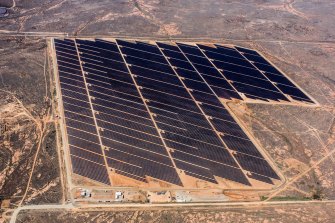
The Broken Hill solar farm has been affected by transmission constraints. Testing this week will determine whether the plant - and four others in Victoria - can resume full output to the grid.
The Broken Hill solar farm has been affected by transmission
constraints. Testing this week will determine whether the plant - and
four others in Victoria - can resume full output to the grid.
The Australian Energy Market Operator (AEMO) intervened last September to slash the amount of power entering the grid from the plants - which have a rated capacity of 350 megawatts - because "unprecedented technical issues" threatened its stability.
Regulators have tested the performance of individual plants - four of which are in Victoria and the other in Broken Hill - after engineers used a technical fix to smooth the energy output from the plants and make them more compatible with the grid.
Tests involving all five plants began on Monday and will continue this week to ensure grid stability can handle the resumption of their full output, according to AEMO and company officials.
Read the story from The Age by Peter Hannam - “Five big solar farms set to increase energy output after tests.”

31 January, 2020

Morrison delivers big fossil fuel win for major donor Santos.

Scott Morrison’s energy deal with NSW, announced this morning, is a huge win for fossil fuel company Santos, a major political donor with extensive ties to the Coalition.
green tape Scott Morrison
Scott Morrison hands a win to fossil fuel companies.
Morrison’s deal with Gladys Berejiklian’s Coalition government will provide $960 million in funding, mostly through loans, for renewable energy projects and grid infrastructure in exchange for “commitments from the NSW Government to facilitate investment opportunities to inject an additional 70 petajoules of gas per year into the east coast market” and “an undertaking from the NSW Government to remove barriers to coal supply to the Mount Piper Power Station”.
At the National Press Club on Wednesday, Morrison argued expanding natural gas supply for power generation represented “climate action now”, that “we need to get the gas from under our feet” and that “there is no credible energy transition plan for an economy like Australia in particular, that does not involve the greater use of gas as an important transition fuel”.
That statement is clearly, and easily shown to be, false. 

Read the story from Crikey by Bernard Keane - “Morrison delivers big fossil fuel win for major donor Santos.

06 May, 2018

The top solar postcodes in Victoria and NSW

Rooftop solar has been growing rapidly in Australia and while Melbourne's commuter belt is experiencing strong take-up, in NSW the greatest growth is occurring outside Sydney.
The level of rooftop solar in Australia is rising rapidly.
Australian aerial imagery company Nearmap has utilised the latest Clean Energy Regulator data to show the top five postcodes for rooftop solar energy growth in NSW and Victoria as of March.

"From the ground, it can be difficult to see the progress our country is making to reduce energy costs and our carbon footprint, but when you look at it from the air, you can observe in incredible detail the renewable energy uptake occurring across our country," Nearmap executive Shane Preston said.

"We’ve been capturing aerial images of Australia for the last 10 years, and have recently seen a dramatic change in the rooftop landscape, with many more solar panels on Aussie homes.”


Read Cole Latimer’s story from The Age - “The top solar postcodes in Victoria and NSW.”

24 March, 2018

NSW government's power plan reveals huge renewable energy resources

The Berejiklian government has identified three priority renewable energy zones in NSW that potentially have seven times the capacity of the state's coal-fired power plants.
A wind turbine at Crookwell in NSW: there's
 huge untapped potential in the state.
In a submission to the Australian Energy Markets Operation, the government said the zones, in New England, the central-west and the south-west of NSW "could unlock 77,000 megawatts of new generation capacity”.


Read Peter Hannam’s story from The Sydney Morning Herald - “NSW government's power plan reveals huge renewable energy resources.”

10 March, 2018

Laws that make land clearing easier ruled invalid by NSW court

Laws that make land clearing in New South Wales easier have been ruled invalid by the NSW land and environment court after a challenge filed by the Nature Conservation Council.
 In November 2016, NSW replaced three Acts
with its new Biodiversity Conservation Act.
In November 2016, the NSW Coalition government scrapped the state’s Native Vegetation Act, the Threatened Species Conservation Act and the Nature Conservation Trust Act, and replaced them with its new Biodiversity Conservation Act.

The government also introduced a suite of codes that exempted clearing in a range of circumstances from normal development assessment requirements.

The council, represented by the environmental defenders office NSW, argued in court in Sydney on Friday that the codes were invalid because the environment minister had not approved them before they were implemented.


Read Michael Slezak’s story from The Guardian - “Laws that make land clearing easier ruled invalid by NSW court.”

09 February, 2018

Solar 'tsunami' coming in Australia as NSW accelerates approvals

The Berejiklian government has approved 11 large-scale solar energy plants in the past 12 months, clearing the way for NSW to join a "tsunami" of new renewable energy capacity across the nation.
Solar farms are about to see a huge increase
as states such as NSW accelerate approvals.
The 170-megawatt Finley Solar Project in the Riverina, which will include half a million solar panels, is the first to get approval in 2018.

The 10 to get the go-ahead in 2017 doubled the number in the previous year, and alone supported 1800 construction jobs, Planning Minister Anthony Roberts said.

Those 10 "collectively reduce carbon emissions by over 2.5 million tonnes, which is equivalent to taking around 800,000 cars off the road", he said.


Read the story from The Age by Peter Hannam and Cole Latimer - “Solar 'tsunami' coming in Australia as NSW accelerates approvals.”

14 January, 2018

The global warming experiment we conduct at our peril

When the Australian Research Council awarded its funding plans in mid-2017, one recipient of the highly competitive seven-year grants was the Centre of Excellence for Climate Extremes.
The heat is on, and it is time to understand and
confront what extremes are going to look like. 
While building on the work of the previous Climate System Science centre, the new hub represents more than a name change.

The centre – grouping leading scientists from the Australian National University, Monash, Melbourne, and Tasmania universities, and based at the University of NSW – is the first in the world "with an unambiguous focus on the science behind climate extremes", according to its director, Professor Andy Pitman.

The Turnbull government and particularly Simon Birmingham, as the responsible minister, deserve credit for increasing the centre's capacity 10 percent over its predecessor – presumably against the views of a rump within the Coalition that denies climate change is a serious threat.


Read the Editorial from the Sydney Morning Herald - “The global warming experiment we conduct at our peril.”

10 January, 2018

Record warmth in the east made 2017 Australia's third-hottest year on record

Australia's posted its third-warmest year on record in 2017, with the eastern half including NSW and Queensland notching their hottest annual readings.
Another relatively hot year across the nation, with
 conditions on the dry side in eastern Australia.

The Bureau of Meteorology's annual report showed the nation's area-averaged mean temperatures – taking in daily highs and lows – were 0.95 degrees above its 1961-90 baseline at 22.75 degrees.
Read Peter Hannam’s story from today’s Melbourne Age - “Record warmth in the east made 2017 Australia's third-hottest year on record.”

04 January, 2018

Charge of the batteries: Pressure on NSW as Victoria joins line for large-scale battery

Victoria has joined South Australia in lining up a new large-scale battery to support the electricity grid, adding pressure on NSW to follow suit.
A Tesla car charging station is at South Australia's wind
and solar battery plant outside of Jamestown. 
The reliability of the National Electricity Market, a major political and economic issue in 2017, may be tested in coming days as a large heatwave sweeps across southern Australia. The electricity market operator has issued an alert.


Read Peter Hannam’s story in today’s Melbourne Age - “Charge of the batteries: Pressure on NSW as Victoria joins line for large-scale battery.”

21 November, 2017

Severe dry to cut grain harvest in half

The severe dry that has smashed crops in NSW and southern Queensland is expected to slash total grain production this season and affect business conditions in farming communities where grain is a key industry, the nation's largest agribusiness has warned.

GrainCorp's underlying net profit surged in fiscal 2017 to $142 million.
Discussing GrainCorp's bumper full-year results for fiscal 2017, including an underlying net profit that nearly tripled to $142 million, managing director Mark Palmquist said this year's harvest would be "tremendously smaller", and in response the company would run a leaner harvest operation, with some sites to stay closed because of the lower volumes.

GrainCorp, an integrated grains handler, exporter and processor, said while the crop would be substantially smaller than last year, production would be skewed towards Victoria and southern NSW.

Rabobank senior grains and oilseeds analyst Cheryl Kalisch Gordon said Rabobank had forecast a "national drop of 41 percent from last year's record grain harvest. This is also down 19 percent on the five-year average prior to last year, which really puts the drop in context.


Read Darren Gray’s story in the Melbourne Age - “Severe dry to cut grain harvest in half.”

01 November, 2017

Driest September on record through Murray-Darling Basin

The severity of drought in NSW has been backed up by Bureau of Meteorology data that shows that last month was the driest September in the Murray Darling Basin on record.
 Drought impacted crops are a common sight
 through the Murray-Darling Basin this year.
Many centres in the region recorded no rainfall for September at a time when falls are critical for crop development.

The data is compiled using an aggregation of rainfall data across the BOM’s network of weather stations and can be averaged out to a regional basis.

Worryingly, the record dry comes without a major climate driver pushing the weather towards drier conditions.


Read the farmonline story by Gregor Heard -  “Driest September on record through Murray-Darling Basin.”

13 September, 2017

Liddell power station: What do AGL and the Prime Minister want, and how much will it cost?

An ageing power station is in the spotlight as the Prime Minister tries to stop it closing in 2022.

Liddell was commissioned in 1971 and is due to close in 2022.
Liddell power station in NSW is seen by its owner as ready to close, yet regarded by the Prime Minister as the key to energy supply for five years beyond that.

The short answer is that it is unreliable and expensive to run.

Liddell is the oldest coal-fired power station still running in Australia. It was commissioned in 1971 and is due to close in 2022.

Its owner AGL notes it is likely to be more unreliable as it nears the end of its life.


11 January, 2015

Simple question seems impossible to answer


Economics editor, Peter Martin, asks in The Age today a simple question that apparently has a complex and elusive answer.

He wants to know why some of us refuse to believe the world is getting hotter, even though the evidence is right there in black and white.

The opinion piece in today’s Age: “Climate change: Why some of us won't believe it's getting hotter” reflects Martin’s puzzlement even though the year just ended was one of the hottest on record. In NSW it was the absolute hottest, in Victoria the second-hottest, and in Australia the third hottest.

30 September, 2014

'Hottest on record' not natural variation


David Karoly.
David Karoly told Radio National listeners today that it was almost impossible the Australia’s hottest year on record was caused by natural variation.

The University of Melbourne’s Professor from the School of Earth Sciences, who is also a member of the ARC Centre of Excellence for Climate System Science, said the results were single clearest marker that humans are influencing the weather we have had to date.

Five separate research papers released today by the ARC Centre of Excellence for Climate System Science indicate that human-caused global warming was almost certainly cause for 2013 being Australia's hottest year on record.

The centre is the largest Australian university research group working on climate, with representation from ANU, Monash and the universities of NSW, Melbourne and Tasmania.

22 October, 2013

NSW bushfires a product of climate change - no doubt!


Executive Secretary of the UN
Framework Convention on Climate
 Change, Christina Figueres.
Bushfires in New South Wales are the product of climate change.

They are the product of the “doom and gloom” the world may be facing without vigorous action on climate change.

The executive secretary of the UN Framework Convention on Climate Change, Christina Figueres, says the fires prove the world is “already paying the price of carbon”

"The World Meteorological Organisation has not established the direct link between this wildfire and climate change yet, but what is absolutely clear is that the science is telling us there are increasing heatwaves in Asia, Europe and Australia," she told CNN.

However, some climate scientist claim there is a direct link between the fires and climate change has been established and it is time for action.

A story headed: “UN climate chief Christiana Figueres calls for global action amid NSW bushfires”, notes that the circumstances that resulted in the NSW fires will worsen and become more frequent.