Showing posts with label carbon. Show all posts

26 August, 2019

The Amazon is on fire – here are 5 things you need to know

Record fires are raging in Brazil’s Amazon rainforest, with more than 2,500 fires currently burning. They are collectively emitting huge amounts of carbon, with smoke plumes visible thousands of kilometres away.
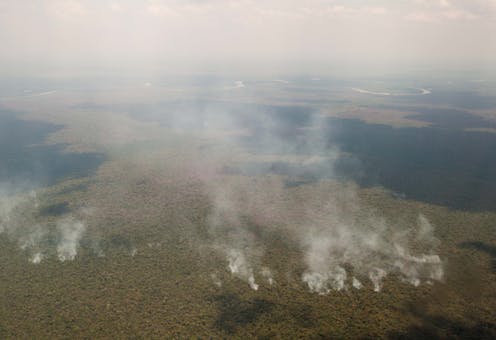
Image result for The Amazon is on fire – here are 5 things you need to know
Huge fires are raging across multiple regions of the Amazon Basin.
Fires in Brazil increased by 85% in 2019, with more than half in the Amazon region, according to Brazil’s space agency.

This sudden increase is likely down to land degradation: land clearing and farming reduces the availability of water, warms the soil and intensifies drought, combining to make fires more frequent and more fierce.


Read the story from, The Conversation by a PhD candidate from The University of Sydney,  Danilo Ignacio Urzedo - “The Amazon is on fire – here are 5 things you need to know.”

03 May, 2018

Green superheroes of the sea: how wetland plants are tackling climate change

Did you know that a single hectare of wetland vegetation – like seagrass, mangroves and marshes – can store twice the amount of carbon that a hectare of tropical forest can store? These grasses and trees of the sea may look a bit weedy, but they certainly pack a punch as they could hold the key to a low carbon future by absorbing and storing carbon from the water and the atmosphere.
Long-term self-storage: Coastal wetland vegetation,
 like the seagrass shown here, can absorb and
 store carbon for hundreds of years.
In fact, a marine heatwave in Shark Bay, WA in 2010-11 caused seagrass loss that resulted in as much carbon dioxide being released into the atmosphere as the yearly exhaust of 1.6 million cars!

Mangroves are salt-tolerant trees or shrubs that grow between the tides, while seagrasses are flowering plants that live underwater and grow in sediment on the seafloor. Like plants that live on land, mangroves and seagrasses have roots, stems and leaves. They provide homes for marine life and a supply of nutrients; seagrasses are especially sought after by dugongs and green turtles as a part of their diet.


Read Natalie Kikken’s story from CSIROscope - “Green superheroes of the sea: how wetland plants are tackling climate change.”

18 April, 2018

BP to cap emissions in first step towards fighting climate change

BP’s Chief Executive, Bob Dudley, has told an audience in London that the petroleum giant will place a cap on carbon emissions out to 2025.
Petroleum giant will place a cap on carbon emissions out to 2025.
The plan, outlined in a new report, will see the company take baby steps towards a low-carbon future.

Mr Dudley stated that even as BP grows total carbon emissions each year from now until 2025 will remain no bigger than in 2015 when the Paris climate accord was signed.


30 March, 2018

‘Harder and riskier': Carbon removal needed if Paris goals don't rise

Greenhouse gas emission cuts must be at least 20 per cent deeper than pledged under the Paris climate accord or the world will have to begin the costly direct removal of atmospheric carbon to avoid dangerous climate change, a new study argues.
Emissions impossible? Delays in cutting emissions make it
 more likely that carbon will have to be directly captured
if dangerous climate change is to be avoided.
The Germany-based researchers examined the action needed if nations failed to deliver greater carbon curbs by 2030 but still kept global warming to under 2 degrees, compared with pre-industrial levels.

"Each tonne of CO2 we don't emit, we don't have to remove from the atmosphere afterwards in an expensive and strenuous way," said Jessica Strefler from the Potsdam Institute for Climate Impact Research and the lead author of the paper published on Thursday in Environmental Research Letters.

24 March, 2018

Global carbon emissions grow to highest-ever rate

Carbon emissions emitted into the Earth’s atmosphere grew by 1.4 percent in 2017, reaching a historic high of 32.5 gigatonnes.
The world's carbon emissions continue to climb.
This is the headline figure from a new report from the International Energy Agency (IEA), which also found that global energy demand grew by 2.1 percent over the past year. Energy usage has been bolstered by renewed consumption in China and India, which made up 40 percent of the overall increase.

72 percent of this new demand was met by fossil fuels while renewables managed to meet one quarter.


Read the ClimateAction story - “Global carbon emissions grow to highest-ever rate.”

04 March, 2018

Ancient carbon discovered coming from Arctic soil

Scientists have published new evidence that old or even ancient carbon, pulled out of the atmosphere and stored in the bodies of plants hundreds or thousands of years ago, is being set loose again from soils in the Arctic region.
The discovery is a potentially worrying indicator that "permafrost"
soils may already be worsening the problem of climate change.
It's a potentially worrying indicator that these "permafrost" soils may already be worsening the problem of climate change. However, scientists are still debating just how much old carbon Arctic soils should release normally even without climate change, leaving the ultimate significance of the findings unclear.


Read Chris Mooney’s story in The Age - “Ancient carbon discovered coming from Arctic soil.”

22 February, 2018

How Crushed Volcanic Rock in Farm Soil Could Help Slow Global Warming — and Boost Crops

Pulverizing volcanic rock and spreading the dust like fertilizer on farm soils could suck billions of tons of carbon from the atmosphere and boost crop yields on a warming planet with a growing population.
Volcanic plains tend to be fertile farmland. A new study
explores how spreading crushed volcanic rock on
 farms can increase carbon storage and crop yields.
In a paper published this week in the scientific journal Nature Plants, an international team of researchers lays out the prospects for "enhanced rock weathering"—a process that uses pulverized silicate rocks, like basalt, to speed the ability of minerals to store carbon in soil.

The team, led by the University of Sheffield in the UK and including U.S. climate scientist James Hansen, says the technique of enhanced weathering on swaths of the world's cropland could potentially offset a meaningful chunk of global carbon emissions.


Read the Inside Climate News story by Georgina Gustin - “How Crushed Volcanic Rock in Farm Soil Could Help Slow Global Warming — and Boost Crops.”

10 December, 2016

Federal politicans are left gun-shy in the climate war

Carbon is like kryptonite for our
politicians - they go weak at the knees
and start talking utter bollocks.
There is something about carbon that acts like kryptonite for politicians. Their knees go all wobbly and they start talking utter bollocks.

And this week it’s produced the very sort of vacuous, dumb politics that Malcolm Turnbull had promised to end when he offered a different style of leadership; one that explained the challenges and seized the opportunities.

“A style of leadership that respects the people’s intelligence, that explains these complex issues and then sets out the course of action we believe we should take and makes a case for it. We need advocacy, not slogans,” Turnbull said just hours before becoming Prime Minister last September.

And yet there we were on Wednesday, just five months after the last Federal election, hearing Turnbull rehearse old sloganeering attack lines for the next election in two years time.

Read Andrew Probyn’s opinion in The Western Australian - “Federal politicans are left gun-shy in the climate war.”

13 November, 2016

Study: Carbon-Hungry Plants Impede Growth Rate of Atmospheric CO2

New findings suggest the rate at which CO2 is accumulating in the atmosphere has plateaued in recent years because Earth’s vegetation is grabbing more carbon from the air than in previous decades.

That’s the conclusion of a multi-institutional study led by a scientist from the Department of Energy’s Lawrence Berkeley National Laboratory (Berkeley Lab). It’s based on extensive ground and atmospheric observations of CO2, satellite measurements of vegetation, and computer modeling. The research is published online Nov. 8 in the journal Nature Communications.

To be clear, human activity continues to emit increasing amounts of carbon, and the atmospheric concentration of CO2, now at 400 parts per million (ppm), continues to rise. But the scientists found that between 2002 and 2014, the rate at which CO2 increased in the atmosphere held steady at about 1.9 ppm/year. In addition, the proportion of the CO2 emitted annually by human activity that remains in the atmosphere declined by about 20 percent. This slowdown can’t keep pace with emissions, so the overall amount of human-caused CO2 in the atmosphere increased, just not as quickly. And for that, new research suggests, we can thank plants.

Read Dan Krotz from the Berkeley Lab - “Study: Carbon-Hungry Plants Impede Growth Rate of Atmospheric CO2.”

19 June, 2016

Sucking CO2 out of the air using synthetic leaves

Klaus Lackner - director of Arizona
State  University's Center for
Negative Carbon Emissions.
What about all the carbon we've already poured into the atmosphere? If only there were a device that could take some of it back out.

Researchers at Arizona State University’s Center for Negative Carbon Emissions are working on one. They discovered a commercially available resin that can grab carbon dioxide at low concentrations when the material is dry and release it when the material is moist. The CO2 it collects could be stored underground, used in greenhouses, or fed to algae for biofuel production.

"Right now, we are taking carbon out of the ground. We then convert the energy into something useful. Then there’s a third step that we ignore—namely, to clean up after ourselves," said Klaus Lackner, the center’s director.

Read the Bloomberg story - “Watch These Synthetic Leaves Suck CO2 Out of the Sky.”

19 March, 2015

Trees are our saviour, but they are dying


M

uch faith in mitigating climate change is put in trees.

The amazing Amazon Forest.
However, the very thing trees help avoid is their undoing.

A warming atmosphere is causing a die-off among trees, particularly among those in the amazing Amazon carbon sink.

A story in The Conversation - “Amazon carbon sink is in decline as trees die off faster” – reports that the Amazon forest covers an area 25 times that of the UK, and spans large parts of nine countries.

“The region contains a fifth of all species on earth, including more than 15,000 types of tree. Its 300 billion trees store 20% of all the carbon in the Earth’s biomass, and each year they actively cycle 18 billion tonnes of carbon, twice as much as is emitted by all the fossil fuels burnt in the world,” it reports.

Professor of Tropical Ecology at University of Leeds, Oliver Phillips, and NERC Research Fellow at University of Leeds, Roel Brienen, has explained the difficulties facing this huge forest, and by implication, the earth.

18 October, 2014

Delaying the inevitable


What is inevitable is naturally unavoidable.

The impacts and complications of climate change are unavoidable, but the governments of both Australia and Canada have delayed that inevitability.

That is, however, not quite right for they haven’t delayed the inevitabilities of climate change rather, they have procrastinated about and frustrated a reasoned response.
Further evidence of the necessary, but critical time-wasting intrigue, is illustrated in a story headed: “Nick Xenophon’s ploy to price carbon” published in The Saturday Paper.

26 August, 2014

Cutting carbon pollution saves money, makes people healthier


Pursuing climate mitigation policies might appear costly, but they are not and they actually make the world a better place to be.

Climate Progress considers this from a health point of view and writes about in a story headed: “Cutting Carbon Pollution Saves More Money Than It Costs By Making People Healthier”.

Beyond making people healthier, cutting carbon pollution also makes people happier and those in a better frame of mind are also more productive, better citizens and simply better people to be about.

The spin-off from cutting carbon pollution is manifest and answers most every aim of those who prefer” business-as-usual”, a paradigm that will ensure catastrophic climate change, along with a serious decline in individual and societal health.

22 October, 2013

NSW bushfires a product of climate change - no doubt!


Executive Secretary of the UN
Framework Convention on Climate
 Change, Christina Figueres.
Bushfires in New South Wales are the product of climate change.

They are the product of the “doom and gloom” the world may be facing without vigorous action on climate change.

The executive secretary of the UN Framework Convention on Climate Change, Christina Figueres, says the fires prove the world is “already paying the price of carbon”

"The World Meteorological Organisation has not established the direct link between this wildfire and climate change yet, but what is absolutely clear is that the science is telling us there are increasing heatwaves in Asia, Europe and Australia," she told CNN.

However, some climate scientist claim there is a direct link between the fires and climate change has been established and it is time for action.

A story headed: “UN climate chief Christiana Figueres calls for global action amid NSW bushfires”, notes that the circumstances that resulted in the NSW fires will worsen and become more frequent.