Showing posts with label politicians. Show all posts

11 January, 2020

Watching our politicians fumble through the bushfire crisis, I’m overwhelmed by déjà vu

As someone who has studied Australian climate policy and politics closely, this summer’s bushfire crisis have been both heartbreaking and bewildering. The grave warnings politicians ignored for so long have now come to pass.
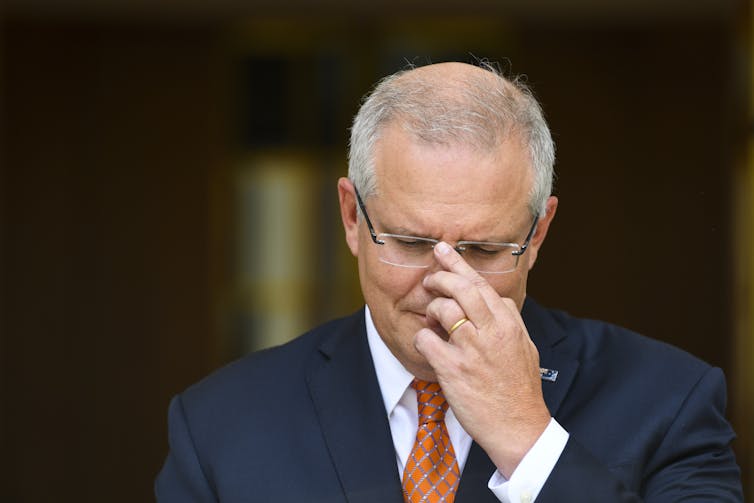
Prime Minister Scott Morrison was savaged by
critics for refusing to meet former fire chiefs.
The fires may be without precedent, but these dark weeks have also brought an overwhelming sense of déjà vu. It’s hard to believe, but the Morrison government’s fumbling response to the fires and the broader climate crisis is in many ways history repeating.
From the disastrous optics of Prime Minister Scott Morrison’s trip to Hawaii to blaming conservationists for the fires, our politicians keep making the same blunders and rolling out the same failed strategies.

Read the story from The Conversation by a researcher on sociomaterial transformations and social movements from Keele University, Marc Hudson - “Watching our politicians fumble through the bushfire crisis, I’m overwhelmed by déjà vu.”

17 November, 2019

If you can’t talk about climate when the country is burning, when can you?

In weeks like this one it becomes quite clear just how much of federal politics is performative. Politicians do things for no discernible reason other than to be seen to be doing something, or to put on a show that will elevate their profile or position.
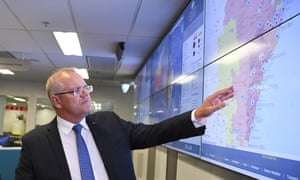
Scott Morrison looks at a screen
The PM is expected to be there, touring around, being seen listening to briefings by the local emergency services chief, with a bit of looking at maps and so forth, and showing emotion.
Once the New South Wales and Queensland fires reached a critical level, politicians were always going to do all they could to be seen to be involved.
The problem is that during such a crisis there is very little for a prime minister to do. He actually has no role – the fire services are state based, and anything that will require federal coordination, whether it be Australian federal police or Australian Defence Force, does not really need the prime minister at all.

Read the story from The Guardian by Greg Jericho - “If you can’t talk about climate when the country is burning, when can you?

15 October, 2019

The only thing as certain as drought in Australia is the stupid call to build new dams

In Australia, the only thing as certain as drought is the subsequent calls by politicians to build new dams.
A dam near Booligal NSW
‘If new dams can solve Australia’s water problems,
why didn’t the government build more dams last
time? Or the time before that?’
Right on cue, the prime minister announced a $1bn commitment for new dams on Sunday.
But if new dams can solve Australia’s water problems, why didn’t the government build more dams last time? Or the time before that?
It may seem obvious, but building new dams doesn’t make it rain. Even if it does rain, we already have plenty of empty dams where the water can go.
But with even more empty dams, Australia could hold even more water to last through the next drought, right?
Not necessarily. More important than how many dams Australia has is how we allocate water. Even if a new dam had been built for public use and it had water in it last year, most likely it would have been used for irrigation. Towns like Dubbo and Tamworth would be in exactly the same situation that they are in now.

Read the story from The Guardian by Maryanne Slattery - “The only thing as certain as drought in Australia is the stupid call to build new dams.”

12 October, 2019

Climate protestors deserve a pat - Ern Meharry

Conservative commentators and politicians across the country are once again engaging in breathtaking acts of hypocrisy, this time in their reaction to the Extinction Rebellion protests happening around the world.
In a nutshell, they claim that protesters shouldn’t be disrupting traffic flow and people going about their everyday lives.
More extreme suggestions are that the government names and shames them, jails them and stops their welfare payments (making the incorrect assumption the protesters are all ‘dole bludgers’).
Where was the outcry from these reactionary right-wingers when logging contractors, protesting over an alleged monopoly on forest operations by sawmill owners, shut down Spring St in February, 2003?
What about the disruption to traffic and business when hundreds of dairy farmers protesting about the price of milk blocked city streets in May, 2016?
And who remembers the gridlock in Melbourne caused by the massive taxi protest against the deregulation of the industry in response to Uber in February, 2017?
That’s funny, I don’t remember the outcry from these commentators on any of those occasions either.
Perhaps the ultimate hypocrisy was shown by Liberal Party MP and former Institute of Public Affairs member Tim Wilson when he attended a pro-democracy march in Hong Kong on Sunday.
Is this the same Tim Wilson who tweeted that the Occupy Melbourne protesters in 2011 should be water cannoned?
My take on this is that it is okay to protest for conservative causes but anything that goes against the establishment’s agenda should be met with the full force of the state.
So what is Extinction Rebellion?
It is a worldwide movement using non-violent civil disobedience to try to make governments and the population aware of the environmental crisis we find ourselves heading towards.
Protesters feel climate change is such an important issue that they are justified in disrupting our normal way of life.
Their tactics are annoying and risk putting people offside but I ask you, what is the purpose of a protest unless it is uncomfortable and disruptive?
Extinction Rebellion has planned a ‘‘spring rebellion’’ from Monday to Sunday, including marches aimed at blocking traffic.
Which brings me to the School Strike for Climate held in recently.
A gathering of a few hundred people peacefully and non-disruptively came to the Maude St Mall to listen to great speeches from students and adults alike.
Notable in their absence were (as far as I could tell) all Shepparton city councillors, and our local LNP politicians Damian Drum and Wendy Lovell.
Suzanna Sheed was the only politician I could see who bothered to attend.
In the most recent election, apathetic, greedy voters voted for the retention of franking credits, more coal mining and a continuation of the rort that is negative gearing over a comprehensive (if inadequate) environmental policy put forward by the ALP.
The lack of interest by our elected representatives in dealing with this existential issue is the reason Extinction Rebellion and Greta Thunberg’s School Strike for Climate movements exist.
I commend the guts and determination of everyone involved in these movements. After all, there are no jobs on a dead planet.
What do you think?

● Ern Meharry writes a regular blog at www.sheppnews.com.au/ @ernestos-manifesto 

12 August, 2019

Extinction Rebellion: hitting a nerve at Australia's climate flashpoint

The Extinction Rebellion protesters think you should be angry. They want politicians and opinion columnists to be angry. The more people they upset stopping traffic in the Brisbane city centre – the louder the car horns, the more vicious the insults – the more certain it is they’ll be back.
Image result for Extinction Rebellion: hitting a nerve at Australia's climate flashpoint
Extinction Rebellion protesters block
the corner of Margaret and William
streets during a climate change
 protest in Brisbane.
“It’s not an enjoyable experience, we don’t take pleasure in doing it,” says Emma Dorge, an activist arrested in Brisbane on Tuesday, during a day of mass civil disobedience that shut down Australia’s third-largest city.
Extinction Rebellion, the decentralised global movement calling for aggressive action on the climate crisis, has engaged in similar disruption tactics in major cities on every continent. Those protests have been most effective when they are most polarising, like in Queensland, where talking and writing and screaming and marching about the climate emergency has not shifted public sentiment; a state home to the threatened Great Barrier Reef, and also the world’s most controversial coal project.

Read the story from The Guardian by Ben Smee - “Extinction Rebellion: hitting a nerve at Australia's climate flashpoint .”

25 November, 2018

Why aren't they doing anything?: Students strike to give climate lesson

This Friday, November 30, thousands of Australian students will go on strike, demanding their politicians start taking serious action on climate change.
Lucie Atkin-Bolton, an 11-year-old student and school
captain at Forest Lodge Public School, wants an end
 to 'coal-sourced energy', and is willing to go on strike for it.
CREDIT:
The movement, School Strike 4 Climate Action, has been inspired by a 15-year-old Swedish student, Greta Thunberg, who started boycotting classes before parliamentary elections in her nation on September 9, and continues to skip school every Friday. She also has a particular message for Australia.

Students in each state capital and across 20 regional Australian centres will walk out of their classrooms this week to tell politicians that more of the same climate inaction is not good enough.

Here are some of the lessons they hope to teach.


Read The Sydney Morning Herald story by Peter Hannam - “Why aren't they doing anything?: Students strike to give climate lesson.”

22 November, 2018

On climate policy, Bill Shorten has learnt from the political disasters that swamped Gillard and Rudd

A decade of political pain on climate change has told Australians not to expect too much from their politicians on energy policy.
Bill Shorten has learnt from Julia Gillard
and Kevin Rudd's political disasters.
CREDIT:
Bill Shorten is making sure he does not repeat the pain of the last Labor government if he is fortunate enough to lead the next one.

Julia Gillard negotiated with the Greens to put a price on carbon emissions with what became known as a carbon tax. She broke an election promise and never recovered.

Kevin Rudd tried to negotiate with the Coalition to put a price on carbon with an emissions trading scheme. The Coalition split, the Greens voted against the plan and Rudd was forced to retreat.


06 June, 2018

How we could revive faith in democracy

How much is our disillusionment with politicians, governments and even democracy the result of our pollies’ 30-year love affair with that newly recognised mega-evil “neoliberalism”?
Illustration: Dionne Gain
To a considerable extent, according to Dr Richard Denniss, of the Australia Institute, in the latest Quarterly Essay, Dead Right.

I’m not sure I’m fully convinced by his argument, but it’s a thought-provoking thesis that’s worth exploring.

Like “globalisation” in the 1990s, neoliberalism has become the all-purpose political swearword of the 2010s. Anything economic that you don’t approve of can be condemned as neoliberalism.

But Denniss provides some more specific attributes. “The intellectual core of neoliberalism is the idea that the profit motive of companies, combined with consumers’ ability to choose the product that suits them best, will result in the best possible social and economic outcomes,” he says.


Read the comment by Ross Gittins from today’s Age - “How we could revive faith in democracy.”

21 May, 2018

Stopping Adani mine would pose no 'sovereign risk' to Australia, says economist Saul Eslake

Stopping the Adani coal mine would pose no "sovereign risk" to Australia, and politicians on both sides have willingly misled people into thinking otherwise, says respected economist Saul Eslake.
"Sovereign risk is not the risk a government might change
 its mind or make a decision I don't like": economist Saul Eslake.
The former chief economist of ANZ told Fairfax Media the major parties were "abusing the term" for political gain when in fact there had been no impact on Australia's sovereign rating as a result of decisions taken on environmental grounds.

In a paper commissioned by the Australian Conservation Foundation, Mr Eslake found there was "absolutely no reason" the country's sovereign risk would be affected if a future government stopped the Adani mine proceeding for environmental reasons.


04 April, 2018

It’s time to think seriously about cutting off the supply of fossil fuels

There is a bias in climate policy shared by analysts, politicians, and pundits across the political spectrum so common it is rarely remarked upon. To put it bluntly: Nobody, at least nobody in power, wants to restrict the supply of fossil fuels.
Time to shut down the supply of fossil fuels.
Policies that choke off fossil fuels at their origin — shutting down mines and wells; banning new ones; opting against new pipelines, refineries, and export terminals — have been embraced by climate activists, picking up steam with the Keystone pipeline protests and the recent direct action of the Valve Turners.

But they are looked upon with some disdain by the climate intelligentsia, who are united in their belief that such strategies are economically suboptimal and politically counterproductive.


Read the story by David Robert from VOX - “It’s time to think seriously about cutting off the supply of fossil fuels.”

05 March, 2018

Michael Brissenden and Four Corners look at climate change in Australia

How Australia's warming climate is changing the way we live and work. 


Rather than waiting for politicians, our farmers, small businesses, government planners and corporations are adapting to weather challenges and acting now.


Watch tonight’s Four Corners on ABC TV.

24 February, 2018

Standing Up for Rural Australia Means Standing Up on Climate Change

The farmers in this ad represent thousands from across Australia who are demanding rural and regional politicians do more to stop damage to our climate harming our livelihoods. 

We must act, to prevent a situation where our kids won’t have the choice to farm like we do.


10 February, 2018

Adani coal mine: Matt Canavan's symbolic war that went wrong

Politicians love symbols, whether it's standing in front of a wall of flags, wearing a ribbon on their lapel or being photographed with workers in hard hats.
Protestors gather at Federal Parliament this week to oppose the Adani coal mine. 
Voters love symbols, too. Political travel expenses are, for many voters, a symbol of all that's wrong with politics. Traffic jams are a symbol of all that's wrong with immigration policy and the number of women in cabinet is a symbol of a party's concern about gender equity. Of course, different issues have different importance for different voters.


Read the comment by Richard Denniss in The Canberra Times - “Adani coal mine: Matt Canavan's symbolic war that went wrong."

24 November, 2017

How do we tackle climate change?

Common Ground Podcast logoIn the final episode our participants come to agreements on climate change and renewable energy much faster than our politicians seem to be able to. 

However, what would they be willing to pay to see a transition to a much higher proportion of renewables used in Australia’s energy generation?

Listen to the Common Ground podcast - “How do we tackle climate change?

17 November, 2017

The Big Australian under pressure to quit Minerals Council over coal lobbying

The world's biggest mining company has told lobby groups and politicians to "back off" and let the market resolve Australia's energy impasse, at its annual general meeting in Melbourne.
The Big Australian has told lobby groups and
politicians to "back-off" and let the market  resolve
Australia's energy and climate change troubles.

BHP Billiton chief Andrew Mackenzie made the comments as the company comes under pressure to cut its ties with the mining lobby, the Minerals Council of Australia.

The Minerals Council campaigned against Alan Finkel's Clean Energy Target and has lobbied for a new Government-funded coal-fired power station.

The Australasian Centre for Corporate Responsibility says this undermines BHP's stated positions on climate change.


Listen to the Radio National interview why Fran Kelly - “The Big Australian under pressure to quit Minerals Council over coal lobbying.”

(Leave it to the market! It was a laissez-fair approach to the market that has brought the world untold troubles and most certainly worsened climate change and has long frustrated any attempts to mitigate what is happening and the damage it is doing Earth's atmosphere - Robert McLean)

14 October, 2017

In China, the war on coal just got serious

Beijing: In Australia, politicians continue to debate the existence of climate change. Donald Trump's Environment Protection Agency declared this week that the "war on coal is over”.

A woman wears a mask as she walks on a street in Beijing.
In China, the outlook could not be more different.

The war on coal reached fever pitch here this month. As a deadline looms to achieve clean air targets by the end of 2017, October has seen unprecedented measures come into force to curb air pollution and reduce emissions.

Steel production has been halved in major steel cities, coal banned in China's coal capital, factories closed down for failing pollution inspections, and hundreds of officials sacked for failing to meet environmental targets.


Read Kirsty Needham’s story in today’s  Melbourne Age - “In China, the war on coal just got serious.”

21 August, 2017

It’s time to start talking about ‘negative’ carbon dioxide emissions.

The world’s nations have agreed, almost unanimously, to try to limit the rise of global average temperature to 2 degrees Celsius or less over preindustrial levels.


Is that still possible? Climate campaigners, scientists, and politicians frequently insist it is. All we need, they say, is political will.

But that’s not all we need. There’s something else, something we talk about much less.

You see, in order to have a reasonable chance of hitting the 2C target, modeling shows that humanity must go carbon negative in the mid-to late 21st century. Here are two scenarios developed by Oil Change International, one that offers a 66 percent chance of hitting 2 degrees, one that shows a 50 percent chance of hitting 1.5 degrees.


08 July, 2017

Malcolm Turnbull must take on Tony Abbott over renewables

In a world of short-term, opportunistic, populist politics, politicians easily ignore the so-called "vision thing". Responding to issues day by day, they easily put aside longer-term strategic considerations - indeed, often compounding the magnitude and severity of the policy challenge.

Tony Abbott believes he won his election on carbon
pricing, rather than simply because the voters had
had enough of Rudd/Gillard/Rudd.
Not working to a strategic end game, essentially just patching up rather than solving, results in the policy task becoming so big that any change soon becomes a large and politically difficult one.

Climate change is a glaring example of this; politicians have played short-term politics to the point at which they have made it politically very difficult to move substantially forward when, in terms of the science, the world may already be past a tipping point.

What's more, it is now personal, Abbott v Turnbull, and the stakes are very high; the next election outcome is at risk, as households and industries get eaten by rapidly rising power prices and face the mounting probability of blackouts.


Read John Hewson’s story in the Melbourne Age - “Malcolm Turnbull must take on Tony Abbott over renewables.”

16 June, 2017

Scrambled politics - Anna Krein

Blueprints and Scramble – that modelled the world until 2050. For decades the company had been strategising – and as early as 1982, climate change was being factored in.
Scramble is a scenario that has come about from poor regulation, politicians too fearful to take any popularity hits, and countries unwilling to curb harmful traditional means of economic growth. Global cooperation begins to break down as rich nations compete to secure and drain remaining deposits of fossil fuels. Protests and activism give rise to increased security measures. Agricultural groups begin producing biofuels, which compete with food production, and this sees increases in food prices and deforestation. 

Global tensions are high, climate change is kicking in, blame is being laid, the poor haven’t become rich. By 2050, whatever cards the climate deals, responding is bound to be expensive.


Read the piece by Anna Krein in The Monthly's Quarterly Essay - “Scrambled politics.”