Showing posts with label climate policy. Show all posts

01 March, 2020

Morrison a ‘predatory’ centrist on climate policy with no plans for meaningful emissions reduction, says Swan

Labor’s federal president Wayne Swan will accuse Scott Morrison of engaging in “predatory centrism” on climate policy by styling himself as the pragmatist between the extremes of climate emergencies and denialism, when the government has no intention of driving meaningful emissions reduction.
Wayne Swan
Wayne Swan.
In a speech to be delivered on Sunday, Swan will argue Labor will only win the decade-long climate wars if it approaches the challenge with “pragmatic policy and ruthless organisation”.
According to speech notes, Swan will say Labor needs to articulate a roadmap for the domestic coal powered industry “which manages its decline”.

24 February, 2020

Angus Taylor rejects claims government is driven by toxic ideology on climate policy

Divisions over climate policy have deepened with the Liberal Government in New South Wales leading a state revolt over greenhouse gas emissions. 
Image result for angus taylor
Angus Taylor rejects claims of a toxic ideology.
State Energy Minister Don Harwin was left fuming after his federal counterpart Angus Taylor blocked his bid at yesterday's COAG meeting to discuss a national roadmap to reaching zero carbon output by 2050. 
Don Harwin says the Federal Government was on the right track when Malcolm Turnbull was still Prime Minister and energy policy included an obligation to reduce emissions.
Harwin accused the Morrison Government of being out of touch on climate policy and warned its refusal to adopt a zero-emissions reduction plan will keep power prices high. 

17 January, 2020

If the bushfires won't force climate policy change, we need to circumvent Scott Morrison

It’s time to face a dreadful truth. If this bushfire crisis, this nation-wide trauma, can’t loosen the denialists’ grip on Coalition climate policy, then maybe nothing will.
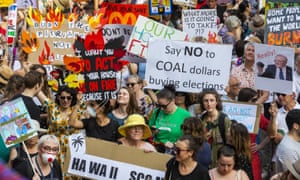
Protesters rally in Sydney for climate action
‘Despite the wave of grief and anger, it’s still not clear that
 the bushfires and Australian public opinion will force this
government to change.’
That would mean everyone sifting through Scott Morrison’s verbiage for signs that he might really be intending to change direction is searching in vain, because he’s just trying to talk himself out of political trouble.
It would mean everyone patiently pointing out that the prime minister could quite easily “evolve” his current policies into something that actually reduced Australia’s greenhouse emissions could save their breath, because that isn’t the kind of evolution he is considering.
And it would mean there’s no point reprising the facts, that Australia’s emissions are flatlining, not falling, that we could seize an economic advantage in a low-carbon world and at the same time help the globe avoid the all too obvious costs of inaction. The Coalition cabal who apparently still call the shots thinks climate science is “voodoo”. They’re impervious to facts. They are already threatening, via anonymous quotes to the Australian, to “blow the place up”. Again. Just like they’ve been blowing up national climate action for more than a decade.

Read the story from The Guardian by Lenore Taylor - “If the bushfires won't force climate policy change, we need to circumvent Scott Morrison.” 

12 January, 2020

These Climate Science Deniers are Spreading Misinformation about the Australian Bushfires

Australian Prime Minister Scott Morrison has doubled down on his refusal to strengthen his administration’s approach to climate policy as his country burns. While Morrison acknowledges that climate change is one factor driving the fires, he is unwilling to consider reversing his government’s poor record on climate action to help prevent similar disasters happening again.
Alex Jones InfoWars
Spreading misinformation about Australia's bushfires.
In recent days, Morrison’s position has been bolstered by a group of fringe climate science deniers pushing conspiracy theories and misinformation about the relationship between the fires and climate change.
An article on the alt-right website NewsWars makes the false claim that “authorities in Australia are working on the premise that arsonists and lightning strikes are to blame for bushfires that have devastated numerous areas of the country, not ‘climate change’ as many global warming alarmists have claimed.” Independent factcheckers from Climate Feedback judged the article to be “misleading”, saying the claim's “flawed reasoning misunderstands that fires are exacerbated by hot and dry conditions and Australia is currently facing a severe drought amidst increasing temperatures.” 

20 May, 2019

Frydenberg backs government's climate policy despite Warringah walloping

Treasurer Josh Frydenberg says the Morrison government will not toughen the climate policy it took to the election despite Tony Abbott's thrashing in Warringah and demands from key crossbenchers that Australia tackle planetary warming.
Treasurer Josh Frydenberg voting at Balwyn North
Primary School surrounded by protesters carrying
 'Stop Adani' placards.
The Morrison government's unexpected win will also force Labor to rethink its strategy in Queensland where voters resoundingly endorsed the Coalition's support for the controversial Adani coal mine.

The Coalition's victory on Saturday defied expectation in what had been touted as the climate change election. It returned to office by promising to make electricity more affordable and reliable, and framing action on climate change as an economic rather than a moral issue.

Prime Minister Scott Morrison had repeatedly emphasised the potential cost to the economy of Labor's pledge to lower greenhouse gas emissions by 45 percent between 2005 and 2030.


Read the story from The Age by Nicole Hasham - “Frydenberg backs government's climate policy despite Warringah walloping.”

06 May, 2019

Modelling that shows Labor’s climate policy could cost billions is ridiculous

The national debate about climate policy is off the rails again.
We should be talking about positioning Australia for
a low-carbon future, instead, it’s carbon wars again.
We should be talking about positioning Australia economically for the low-carbon future, making use of our huge opportunities to produce low-cost clean energy, and mobilising investment. We should be having a serious conversation about what are the best policies needed for that. And we should understand the implications of Australia’s climate policy for our long-term competitiveness and international standing.

Instead, it’s the carbon wars once more. A confected furore over the presumed cumulative economic cost dominates the headlines, provoked by a single short report with some scary-looking numbers. The paper by Brian Fisher is a private black-box modelling exercise of no particular standing that uses outdated assumptions.

But we still have news reports citing its supposed findings that “the Labor emissions target would subtract at least $264bn from gross national product by 2030”, and numbers as high as $542bn have also been used.


Read the story from The Guardian by Frank Jotzo - “Modelling that shows Labor’s climate policy could cost billions is ridiculous.”

05 April, 2019

Labor climate policy requires scrutiny

The ALP’s announcement of key details of its climate policy on Monday was quickly overshadowed by the federal budget, but it could prove to be a more important document in the long-term if there is a change of government at the federal election.


The policy is complex and, unfortunately, the political debate on the details has been poor. Prime Minister Scott Morrison chose to respond to a question about climate policy in Parliament on Wednesday with a dad-joke impersonation of the slapstick character Borat from a 2006 movie.

The government’s failure to engage intellectually is giving the ALP too easy a ride. There are serious questions to be answered.

The ALP must show it has a practical plan that will achieve its promise to cut emissions by 2030 to 45 per cent below 2005 levels while at the same time keeping costs to a minimum.


Read the Editorial from The Age - “Labor climate policy requires scrutiny.”

25 February, 2019

Morrison puts lipstick on Tony Abbott’s pig of a climate policy

Prime minister Scott Morrison has finally unveiled his climate policy and it is clearly designed to do two things: Placate the core rump of climate deniers and ideologues within his own party and the conservative media, and try to fool enough others that the Coalition is doing something to address a problem it barely admits exists, or worth doing anything about.
Scott  Morrison - puts lipstick on Tony Abbott's pig of a climate policy.
The $2 billion funding over 10 years for emissions reduction projects shows that the Coalition’s climate policy and commitment has barely moved in a decade. Tony Abbott’s Direct Action funnelled more money in less than half the time – even if the emissions benefits of many of the projects funded are questionable and being questioned.

But Morrison, even as Australia lags ever further behind its modest commitments to Paris, and as the warning signs over climate change grow every stark, is putting on lipstick on a pig of a policy.


Read the story from RenewEconomy by Giles Parkinson - “Morrison puts lipstick on Tony Abbott’s pig of a climate policy.”

10 September, 2018

Lack of climate policy threatens to trip up Australian diplomacy this summit season

Australia has navigated a somewhat stormy passage through the Pacific Islands Forum in Nauru. Scott Morrison’s new-look government faced renewed accusations at the summit about the strength of Australia’s resolve on climate policy.
Australia’s climate stance risks its standing on the world stage.
Australia is neither a small nation nor one of the most powerful, but for many years it has been a trusted nation. Historically, Australia has been seen as a good international citizen, a country that stands by its international commitments and works with others to improve the international system, not undermine it.

But in recent years climate change has threatened this reputation. This is especially so among our allies and neighbours in the Pacific region, who attended this week’s Nauru summit.


Read the piece from The Conversation by Australian Research Council DECRA Fellow from the Australian National University, Christian Downie - “Lack of climate policy threatens to trip up Australian diplomacy this summit season.”

25 July, 2018

Victoria urged to reject Canberra's energy blueprint as deadline looms

States are being urged by the Energy Security Board to sign onto its National Energy Guarantee and end 15 years of costly instability on climate policy.
Waubra wind farm, central Victoria.
The Victorian government is being put under intense pressure to reject the Turnbull government’s energy blueprint by lobby and environmental groups as the August 10 deadline looms for states to sign on.


Read the story by Benjamin Preiss and Adam Carey from The Age - “Victoria urged to reject Canberra's energy blueprint as deadline looms.”

13 June, 2018

Why methane should be treated differently compared to long-lived greenhouse gases

New research provides a way out of a longstanding quandary in climate policy: how best to account for the warming effects of greenhouse gases that have different atmospheric lifetimes.
Livestock is a significant source of methane,
a potent but short-lived greenhouse gas
.
Carbon dioxide is a long-lived greenhouse gas, whereas methane is comparatively short-lived. Long-lived “stock pollutants” remain in the atmosphere for centuries, increasing in concentration as long as their emissions continue and causing more and more warming. Short-lived “flow pollutants” disappear much more rapidly. As long as their emissions remain constant, their concentration and warming effect remain roughly constant as well.

Our research demonstrates a better way to reflect how different greenhouse gases affect global temperatures over time.


30 May, 2018

Land-clearing wipes out $1bn taxpayer-funded emissions gains

More than $1bn of public money being spent on cutting greenhouse gas emissions by planting trees and restoring habitat under the Coalition’s Direct Action climate policy will have effectively been wiped out by little more than two years of forest-clearing elsewhere in the country, official government data suggests.
Emissions projections data estimates more than 60.3m tonnes
 will be emitted this year – equivalent to more than 10%
 of national emissions.
The $2.55bn emissions reduction fund pays landowners and companies to avoid emissions or store carbon dioxide using a reverse auction – the cheapest credible bids win. The government says it has signed contracts to prevent 124m tonnes of emissions through vegetation projects – mostly repairing degraded habitat, planting trees and ensuring existing forest on private land is not cleared.


Read the story by Adam Morton from The Guardian - “Land-clearing wipes out $1bn taxpayer-funded emissions gains.”

05 April, 2018

Tensions rise inside the Coalition over energy policy

Senior cabinet ministers have offered sharply different public positions over the future of new coal in Australia, as tensions inside the Coalition deepen over energy and climate policy.
Treasurer Scott Morrison rejected calls for the government
to build a new coal-fired power station.
As the Turnbull government applied new pressure on energy giant AGL to keep its ageing Liddell coal-fired power station open beyond its planned closure date, a “ginger group” of Coalition MPs ramped up demands for direct federal investment in a new coal-fired power station, claiming the intervention would lower power bills and plug a potential supply shortfall.

The so-called Monash Forum has caused friction inside the government, with ministers arguing privately the real aim of disgruntled MPs like Tony Abbott, Barnaby Joyce and Eric Abetz was to undermine Prime Minister Malcolm Turnbull’s authority as he seeks the agreement of the states and territories for his National Energy Guarantee.


Read Mark Kenny’s story from The Age - “Tensions rise inside the Coalition over energy policy.”

04 April, 2018

It’s time to think seriously about cutting off the supply of fossil fuels

There is a bias in climate policy shared by analysts, politicians, and pundits across the political spectrum so common it is rarely remarked upon. To put it bluntly: Nobody, at least nobody in power, wants to restrict the supply of fossil fuels.
Time to shut down the supply of fossil fuels.
Policies that choke off fossil fuels at their origin — shutting down mines and wells; banning new ones; opting against new pipelines, refineries, and export terminals — have been embraced by climate activists, picking up steam with the Keystone pipeline protests and the recent direct action of the Valve Turners.

But they are looked upon with some disdain by the climate intelligentsia, who are united in their belief that such strategies are economically suboptimal and politically counterproductive.


Read the story by David Robert from VOX - “It’s time to think seriously about cutting off the supply of fossil fuels.”

20 March, 2018

The Future of Energy Transformation

This week, many conversations at CERAWeek in Houston— one of the world’s leading energy events— revolved around the massive transformation that is reshaping the global energy landscape. Topics ranged from energy and climate policy to innovation and investment in an energy market that is going through unprecedented change. The growing role of renewables and the impact of distributed energy technologies were two frequently discussed examples. 
At GE, we believe that the energy transformation is playing out as an evolution: from a centralized, one-directional grid, into a decentralized, decarbonized, digitized network that’s smarter and more productive.  

This evolution brings together seemingly competitive energy offerings—solar, coal, wind and gas—that combine traditional and emerging energy to deliver more efficient and effective results.


Read the story from LinkedIn by GE Chairman and CEO, John Flannery - “The Future of Energy Transformation.”

26 February, 2018

Emissions Reduction Fund is almost empty. It shouldn’t be refilled

Australia’s flagship climate policy, the Emissions Reduction Fund (ERF), has come in for fresh questions over whether the emissions allowances offered to big businesses will wipe out much of the progress made elsewhere.
The Emissions Reduction Fund is not capturing
enough emissions from the most polluting industries.
This voluntary scheme – the central plank of Australia’s efforts to reduce greenhouse gas emissions by 26-28% below 2005 levels by 2030 – allows interested parties to reduce pollution in exchange for a proportion of the A$2.55 billion fund.

So far, through successive rounds of “reverse auctions”, the scheme has secured 191.7 million tonnes of emission reductions, at a price tag of A$2.28 billion.


Read the piece on The Conversation by a Senior Lecturer in Economics from The University of Queensland, Ian A. MacKenzie -  “Emissions Reduction Fund is almost empty. It shouldn’t be refilled.”

16 February, 2018

Australia criticised for lack of long-term climate policy

A global energy body has criticised Australia’s lack of a long-term climate policy and urged a swift embrace of electricity market reform.

The International Energy Agency’s four-yearly review of the country’s energy policies, released yesterday, focuses on the transition to a low-carbon economy and the role of gas — areas the Federal Government chose for special scrutiny.

Executive Director Fatih Birol. 
It says the resilience of Australia’s electricity system is being tested with the transition happening at a faster pace and scope than expected.

However, the IEA says despite pledging to cut emissions under the Paris climate agreement, the Federal Government ‘‘has not yet come forward with durable climate change policies after 2020’’ nor named a long-term goal.

It notes that while Australia has cut the emissions intensity of its electricity sector by 15 percent since 2005, it is still the highest of any IEA member country and double the average.

‘‘The country is not subject to any effective carbon constraint or rate under the Emissions Reduction Fund and its safeguard mechanism,’’ the report states.

‘‘Current energy efficiency measures and climate mitigation policies are not sufficient. To meet its 2030 target, domestic efforts need to increase.’’

While the agency sees the national electricity market, covering the east coast states, as a world-leader, the IEA warns greater collaboration on energy security is needed.

‘‘The energy policy governance in Australia is very complex and fragmented,’’ it states.

‘‘It suffers from frequent changes of policy direction and institutions at commonwealth level.’’

A stable and longer-term framework of climate and energy policies is critical for investors and consumers.

The Turnbull government has proposed a national energy guarantee to ensure a reliable and lower emissions electricity sector.

The IEA says this could be an effective market-based mechanism provided the government can ensure more competition, better connection between the states and stronger rules for the integration of renewables.

‘‘We don’t know the details (of the NEG) yet, but looking at the concept and the highlights, I would say that this is a golden opportunity for Australia to study and to bring the energy and climate targets together,’’ executive director Fatih Birol said.

However, the report warns the policy could not become a silver bullet solution.

Energy Minister Josh Frydenberg says the IEA’s 52 recommendations align with what the government is already doing.

‘‘In particular, the national energy guarantee goes towards the review’s overarching recommendation for a stable, enduring policy response so that Australia can manage the energy transition already taking place,’’ he said.

Dr Birol briefed a group of about 100 stakeholders including Liberal, Labor and Greens MPs on the IEA report yesterday morning.

Greens energy spokesman Adam Bandt said the IEA made it clear the overwhelming majority of pollution cuts for Australia would come from renewables and energy efficiency and that was where the government should be spending its money.

From today’s Shepparton News - “Climate policy void warning.”

18 January, 2018

Avoiding summer blackouts doesn’t mean energy crisis over

Australians deserve – and need – far better energy and climate policy in 2018 than they got in 2017.


Last year, the mess that is Australian energy and climate policy became clear to all: governments, businesses and households. There were threats to electricity supply, the shutdown of major power plants without adequate replacement, further rises in electricity and gas prices, concerns about excessive profits for retailers, and never-ending rancorous political debate over key reform proposals.

It took too long, but industry finally got the message that when it comes to energy, it can no longer assume an untrammelled right to just get on with business. And unfortunately, governments discovered that direct, reactive intervention is far easier and more popular in the short term than development of credible, stable policies.

Reviews and reports were a feature of the second half of the year. And taken together, they give hope: they may just provide the framework for focused action in 2018.


Read the report by Tony Wood from the Grattan Institute - “Avoiding summer blackouts doesn’t mean energy crisis over.”

12 January, 2018

Josh Frydenberg concedes Australia's carbon emissions rose in 2017

Environment and Energy Minister Josh Frydenberg concedes Australia's greenhouse gas pollution continued to soar last year, confirming that more than a decade of climate policy bickering has failed to curb harmful emissions.
Environment and Energy Minister Josh Frydenberg said the government's national energy guarantee, announced in October, ...
Environment and Energy Minister Josh Frydenberg said the
government's national energy guarantee, announced in October,
 was "the most effective way" to cut emissions. 
Official data shows Australia's annual emissions have risen for the fourth year running. They were up by 0.7 per cent in the year to June 2017, to 550 million tonnes of carbon dioxide.


Read Nicole Hasham’s story in today’s Melbourne Age - “Josh Frydenberg concedes Australia's carbon emissions rose in 2017.”

16 November, 2017

Australia fails again climate rankings, but states get honourable mention

Australia has once again found itself languishing at the bottom of the global rankings on climate policy and action, not budging from its 2016 position of fifth-last, in the latest Climate Change Performance Index, published overnight by the Climate Action Network Europe and German NGO Germanwatch.

As you can see in the table below, Australia comes in at number 57 – sandwiched in-between two developing nations, the Islamic Republic of Iran and Korea, in the “very poor” performance section – out of a group of 61 countries responsible for more than 90 per cent of global energy-related CO2 emissions.


Read Sarah Vorrath’s RenewEconomy story - “Australia fails again climate rankings, but states get honourable mention.”