Showing posts with label innovation. Show all posts

24 June, 2019

Understanding climate emergency and Local Government

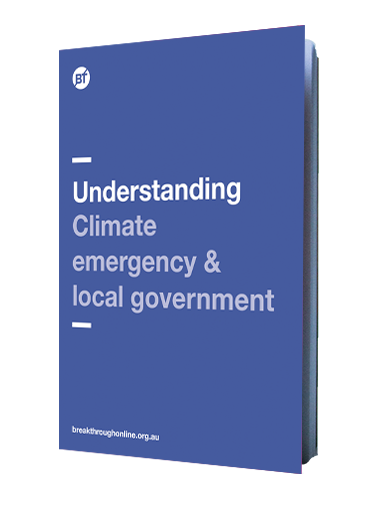
lgceguide.pngThe National Centre for Climate Restoration (Breakthrough) is an independent think tank that develops critical thought leadership to influence the climate debate and policy making.

Breakthrough’s mission is to develop and promote strategy innovation and analysis that is essential to deliver safe climate restoration.
Safe climate restoration is defined as actions to reinstate natural climate processes that generate global average temperatures and ocean acidity that are safe for all species and for civilisation.  (ie. preindustrial temperatures & acidity)
Time has run out for half measures and it is now imperative that work begins to restore safe climate conditions as fast as humanly possible - this will require action at emergency scale and speed.
Contributors and writers draw upon peer-reviewed science to provide commentary and analysis on high-end risk management issues and response pathways.
Breakthrough uses an overarching framework to guide its work across ethics, science, economics, politics and culture.

Breakthrough is a leading body in safe climate restoration and draws on local and international expertise. Breakthrough publishes innovative thinkers, produces original communications, and hosts thought-provoking events for a variety of audiences.
Breakthrough has been formed on a non-political party platform and is based in Australia, Breakthrough is funded by philanthropic donations from private individuals. and grants were available.

Read Breakthrough’s latest publication in its Short guide series  - “Understanding climate emergency and Local Government.”

15 April, 2018

This Solar-Powered RV Runs Without Fuel Or Charging Stations

The cross-country road trip is as American as apple pie. Which is why it’s so ironic that the latest motorhome innovation comes from overseas in Germany, where a new, electric motorhome has been unveiled by RV company Dethleffs. This motorhome is built for the open road, with a sleek design and head-to-toe solar panels so you never have to worry about finding the next charging station.
Ready to roll with head-to-toe solar panels.
The transportation industry is being flipped on its head by taking two of the most basic essentials—the driving experience and fuel—out of the equation entirely.

Self-driving vehicles and rechargeable technology is changing the landscape of driving. That market has been expanding beyond everyday vehicles with advances in things like electric-powered semi trucks. And we’ve seen the rise (and possible peak) of the tiny home market, where solar panels and other green technology is often utilized.


Read the story by Nicole Caldwell from Greenmatters - “This Solar-Powered RV Runs Without Fuel Or Charging Stations.”

20 March, 2018

The Future of Energy Transformation

This week, many conversations at CERAWeek in Houston— one of the world’s leading energy events— revolved around the massive transformation that is reshaping the global energy landscape. Topics ranged from energy and climate policy to innovation and investment in an energy market that is going through unprecedented change. The growing role of renewables and the impact of distributed energy technologies were two frequently discussed examples. 
At GE, we believe that the energy transformation is playing out as an evolution: from a centralized, one-directional grid, into a decentralized, decarbonized, digitized network that’s smarter and more productive.  

This evolution brings together seemingly competitive energy offerings—solar, coal, wind and gas—that combine traditional and emerging energy to deliver more efficient and effective results.


Read the story from LinkedIn by GE Chairman and CEO, John Flannery - “The Future of Energy Transformation.”

03 February, 2018

Are You a Wizard or a Prophet?

The term “GMO” can be a Rorschach test. It makes some people see potential for plants that can grow in any ecosystem, resist drought and disease, and yield massive amounts of food and prosperity for all. Human innovation, this camp says, can get us out of any jam.

But many environmentalists see a racket that will give mega-corporations control over the world’s food supply and encourage thoughtless consumption. We are part of the Earth’s global ecosystem, the second group contends, we can’t “bio-hack” our way out of every problem.

In his latest book, The Wizard and the Prophet: Two Remarkable Scientists and Their Dueling Visions to Shape Tomorrow’s World, journalist Charles C. Mann traces current incarnations of these world views to two 20th-century figures — agronomist Norman Borlaug and ecologist/activist William Vogt. Both men were unlikely scientists, and both have left their fingerprints all over environmental thought.


Read the story by Diana Crow form Neo.Life - “Are You a Wizard or a Prophet?”

20 January, 2018

Adidas moves forward sustainability in fashion

Adidas, one of the global leaders in the sporting industry, has partnered with Fashion For Good – a global platform acting as a convener for change, to scale up sustainable innovation in the apparel industry.

The partnership intends to illustrate the benefits of cross-industry collaboration to integrate disruptive innovations in the fashion supply chain.

Katrin Ley, Managing Director at Fashion for Good, said: “Together with Adidas and our other partners, we are accelerating the transition to a circular apparel industry and reimagining the way fashion is designed, made, worn and reused”.


Read the Climate Action story - “Adidas moves forward sustainability in fashion.”

10 August, 2017

Drone Tech Offers New Ways to Manage Climate Change

An innovation providing key clues to how humans might manage forests and cities to cool the planet is taking flight. Cornell researchers are using drone technology to more accurately measure surface reflectivity on the landscape, a technological advance that could offer a new way to manage climate change.

Charlotte Levy examines a drone that
will examine albedo before flight. 
“When making predictions about climate change, it’s critical that scientists understand how much energy the earth is absorbing and retaining,” said Charlotte Levy, a doctoral candidate who presented a talk on her research at the annual Ecological Society of America meeting, in Portland, Oregon, August 8.

When a surface reflects solar energy rather than absorbing it as heat, the result is major cooling, locally and globally. The scientific term for the measurement of surface reflectivity is albedo. “Albedo is important to understand because it’s one of the main controls for the Earth’s overall energy budget,” said Levy, whose research project is directed by Timothy Fahey, professor of natural resources. She is advised by Christine Goodale, professor of ecology and evolutionary biology.


Read the Science and Technology Research News story - “Drone Tech Offers New Ways to Manage Climate Change.”

23 February, 2017

A-Lab Energy System Innovation

A-Lab is ARENA’s grid integration innovation lab. 


It draws on a network of people with a wide range of expertise and passion to drive systemic change in the electricity sector. A-Lab provides a space for these people to explore and define solutions to the most complex challenges of integrating renewables and grids, combining their respective strengths and building momentum for change.


Learn more about the new ARENA initiative here - “A-Lab Energy System Innovation.”

06 March, 2016

Commission seeks sustainable, competitive, energy-efficient and low carbon ideas

The European Commission today launched a public consultation on the development of an Integrated Research, Innovation and Competitiveness Strategy aimed at facilitating the EU’s transition to a sustainable, competitive, energy-efficient and low-carbon economy.

The strategy is linked to the implementation of the Energy Union Communication, which called for more research and innovation to ensure that the energy transition happens via modern, user-friendly, safe, sustainable and secure solutions to the benefit of EU citizens and businesses. Commitments taken at the COP21 international climate conference in Paris in December 2015 reinforce the need to step up efforts for reaching agreed climate targets.

07 February, 2016

CSIRO cuts blunt PM's 'innovation' motto - Age editorial

Of all the words Malcolm Turnbull has favoured since winning the mantle of Prime Minister, "innovation" has become his motto. But judged on deeds, Mr Turnbull is failing to match his promise.

The deep cuts to climate science research at the CSIRO announced last week are nothing short of regressive. Worse, the loss to scientific endeavour could result in Australia missing out on the very future opportunities Mr Turnbull claims to be so keen to embrace.

Read The Age Editorial - “Science cuts cruel the climate.”

13 January, 2016

Low cost of intellectual property helps cut costs of renewable energy


Plummeting costs for renewable energy have finally made solar and wind a viable alternative to fossil fuels. But what’s responsible for the drop in price? Technological innovation and expanded manufacturing share some of the blame, but less examined is the low cost of intellectual property.

According to a report from the International Center of Trade and Sustainable Development (ICTSD), “the basic approaches to solving the specific [clean energy] technological problems have long been off-patent. What are usually patented are specific improvements or features.” Competition between sellers brings the price of these components “down to a point at which royalties and the price increases available with a monopoly are reduced.”

Read the ClimateProgress story - “The Little-Known Reason Renewable Prices Are Dropping.”

15 October, 2015

Humanity needs to replicate tenacity, innovation, determination, inventiveness, commitment adaptation and damn sheer hard work to escape this dilemma


H

uman tenacity, innovation, determination, inventiveness, commitment adaptation and damn sheer hard work have allowed us to build an earthly superstructure that we now discover rests on massively inadequate foundations.

Responding from innate human needs we built from the ground up, but lacking vision at the time we were unable to comprehend that this human experiment would become so grand that its demands would outstrip earth’s natural recovery abilities and seriously disturb its equilibrium.

Humanity was for millennia simply another life form that plodded about the planet competing with others for space and resources upon which they depended until its inherent desire to know, understand and exploit whatever it found, led to the unlocking of fossil fuel energy, bringing on the Industrial Revolution and, in the last 200 years or so, the drip-feed of disaster that has measurably unsettled earth’s atmosphere.

Aided by the abundant amounts of apparently free energy in fossil fuels, our wants quickly overtook our needs and grandiose dreams replaced more utilitarian goals of simply answering our necessities.

The unsettling of earth’s atmosphere, measured in tiny numbers, but illustrated through large, complex and difficult outcomes, can only be addressed if we are able to re-apply those qualities that got us to where we are, but with a different intent.

The commitment it took to get us to where we are today was unquestionably impressive, but will we be able to replicate that commitment to extricate ourselves from this present dilemma.

An event in Melbourne earlier this week illustrates that our commitment will probably fall well short of what is needed.

The event, “Climate Change: What happens after the Paris conference?” at the 200-seat Village Roadshow theatrette at the State Library was booked out within two days of being announced.

Organizers, Melbourne’s Grattan Institute and the Melbourne Energy Institute quickly organized a waiting list, which equally quickly blew out to 300 names, but it was at this point the commitment of people died.

The event went ahead as scheduled, but the official count of the audience was 160, illustrating that 40 of those who had pre-booked had decided something more important needed attending to, and the 300 on the waiting list simply missed out on what was an illuminating and educative session.

The speakers were the Energy and Program Director at the Grattan Institute, Tony Wood; the lead secretary, Strategy and Planning at the Department of Economic Development, Anthea Harris; and the Professor of Atmospheric Science at the University of Melbourne’s School of Earth Sciences, David Karoly, while the moderator was the Environment Editor from the Melbourne Age, Tom Arup.

21 September, 2015

Nuclear pundits overlook critical issues on 'carbon-free' energy


N

uclear energy pundits overlook a few critical issues when advocating the importance of this “carbon-free” energy source.

Josh Frydenburg - nuclear energy fan.
The world’s carbon dioxide levels are already well beyond what is considered safe and so we have no more time for talk or procrastination of any sort.

We are presently in what has been described, and accepted as by the world’s climate scientists, as the “critical decade”, that ever so brief window when we must stop, and if possible reverse the world’s carbon emissions.

The nuclear energy boosters never talk about the fact that it would take another decade to design and build a nuclear energy plant and along with that never avoid any talk of embedded energy.

Nuclear power and its claimed zero emissions, an easily disputed argument, despite these apparent and obvious drawbacks still has many supporters even in the face of staunch facts that Australia could easily be powered by renewable, decentralized energy.

However, little has changed in Canberra’s corridors of power with Australia’s new Prime Minister, Malcolm Turnbull, appointing a strong advocate of nuclear energy in the key resources and energy portfolio as part of sweeping changes to his cabinet and ministry.

Josh Frydenberg, an ally of Tony Abbott who was previously assistant Treasurer, has been named as minister for resources, energy and northern Australia, as part of a reshuffle that sees the portfolio split from industry, innovation and science, which goes to former education minister Chris Pyne.

Greg Hunt retains his spot as environment minister, to continue his bluster around Direct Action as a result of Turnbull’s pact with the Liberal Party’s far right wing, and Turnbull has also appointed Jamie Briggs to be Minister for Cities and the Built Environment, in an appointment welcomed by the Green Building Council and others.

Read Giles Parkinson’s story on Reneweconomy - “Turnbull appoints a nuclear fan to head energy policy”.

31 July, 2015

Innovation needed to tackle climate change, but don't look to Australia for answers


W

hen I say ‘science’ you say ‘beaker’. When I say ‘science’ you say ‘white lab coats’. When I say ‘science’ you say ‘microscopes’. Why is it so few people say ‘technology’ and ‘innovation’ and ‘collaboration’?

Science is the essential building block for a smart society and it’s got much, much more to offer than the high-school science stereotype that plagues us.

We’ve been doing a lot of thinking about where we’re headed, about our science masterplan for the next five years, and for us, science and innovation are inextricably linked.

But there are some challenges around Australia’s ability to be innovative. Currently Australia ranks 81st in world rankings for innovation efficiency. This is the bang for our buck we get when we transform innovation investment into results. If Australia ranked 81st in the world in a sport, ANY sport, we’d be outraged. Even New Zealand is ahead of us in this game.

Gates will invest $1 billion to find clean energy techology


by Bill Gates

L

ast month, during a trip to Europe, I mentioned that I plan to invest $1 billion in clean energy technology over the next five years.

Bill Gates - he will invest a billion
dollars to spur innovation.
This will be a fairly big increase over the investments I am already making, and I am doing it because I believe that the next half-decade will bring many breakthroughs that will help solve climate change. As I argued in this 2010 TED talk, we need to be able to power all sectors of the economy with sources that do not emit any carbon dioxide.

But when it comes to preventing the worst effects of climate change, the investments I make will matter much less than the choices that governments make. In Europe I got to talk about these choices with several political leaders, and in this post I want to share the steps that I encouraged them to take.

Read what Bill Gates has to say about innovation - “We Need Clean-Energy Innovation, and Lots of It”.

09 July, 2015

New bicycle is evidence of climate change driven innovation


E

fforts to combat climate change will drive innovation, particularly in human movement.

Transport is one of the major contributors to global carbon dioxide emissions and so cars, public transit and bicycles have been, and are the subject of massive intellectual effort aimed at still allowing movement, although at a lower emissions rate.

The "YIKEBIKE” is one example of innovative thinking to allow ease and convenience of movement within our towns and cities.