Showing posts with label essential. Show all posts

24 June, 2019

Understanding climate emergency and Local Government

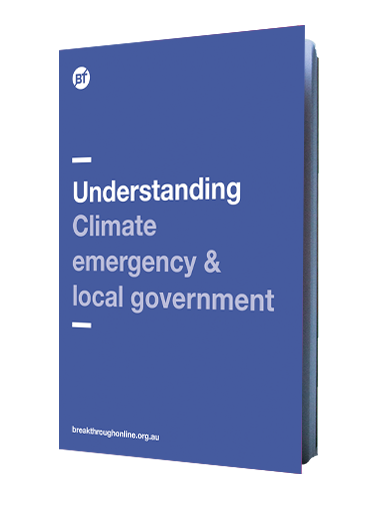
lgceguide.pngThe National Centre for Climate Restoration (Breakthrough) is an independent think tank that develops critical thought leadership to influence the climate debate and policy making.

Breakthrough’s mission is to develop and promote strategy innovation and analysis that is essential to deliver safe climate restoration.
Safe climate restoration is defined as actions to reinstate natural climate processes that generate global average temperatures and ocean acidity that are safe for all species and for civilisation.  (ie. preindustrial temperatures & acidity)
Time has run out for half measures and it is now imperative that work begins to restore safe climate conditions as fast as humanly possible - this will require action at emergency scale and speed.
Contributors and writers draw upon peer-reviewed science to provide commentary and analysis on high-end risk management issues and response pathways.
Breakthrough uses an overarching framework to guide its work across ethics, science, economics, politics and culture.

Breakthrough is a leading body in safe climate restoration and draws on local and international expertise. Breakthrough publishes innovative thinkers, produces original communications, and hosts thought-provoking events for a variety of audiences.
Breakthrough has been formed on a non-political party platform and is based in Australia, Breakthrough is funded by philanthropic donations from private individuals. and grants were available.

Read Breakthrough’s latest publication in its Short guide series  - “Understanding climate emergency and Local Government.”

04 April, 2018

Starting the Dialogue on Climate Engineering Governance: A World Commission

Climate engineering can, if appropriately governed within a coherent overall climate change strategy, reduce risks beyond what mitigation and adaptation can achieve alone, and is probably essential to achieve the Paris Agreement temperature targets. Climate engineering also poses significant new risks, and needs expanded research and scrutiny in climate assessments.

Starting the conversation on
climate engineering governance.
Both types of climate engineering — carbon removal and solar geoengineering — also pose significant challenges to governance. The governance challenges of solar methods are particularly novel and severe, and urgently need international examination and consultation, both to learn how (and whether) climate engineering can deliver societal and ecosystem benefits, and to prepare for the likelihood that some states, facing mounting climate change impacts, will pursue climate engineering, and the international system will have to respond.

The needed international dialogue on geoengineering governance will have broad international participation; engage high-level expertise in international policy and institutions; draw closely on parallel advances in scientific knowledge and technical capability, while keeping governance the central focus; and facilitate open, exploratory investigations of governance needs and potential responses, rather than pursue specific decisions, at least in initial stages. Present institutions are not well equipped to support these needs.


Read the Centre for International Governance Innovation by Edward A. Parson - “Starting the Dialogue on Climate Engineering Governance: A World Commission.”

(Read the "Conclusion" closely and you will see that such an idea is not without its challenges - Robert McLean)

22 December, 2017

How to Restore Our Relationship to Earth

According to the Ecological Footprint Network,
 humans currently consume at a rate 1.7 times
what Earth’s generative capacity can sustain—and
the gap is growing.
To have a viable human future on this overstressed planet, it is essential that we build a solidarity economy that seeks material sufficiency and spiritual abundance for all in balance with a living Earth. We must join in common cause to build local relationships of caring and equitable sharing across the lines of race, religion, and class. Strong and healthy local relationships, however, are only one element of the larger economic transformation required to rebalance our relationship to Earth and achieve a radical redistribution of access to and control of the essentials of living.


Read the Yes! Magazine story by David Korten - “How to Restore Our Relationship to Earth.”

06 February, 2015

Tony Abbott takes the 'Knightmare' title


Tony Abbott wanted to be known as Australia’s “infrastructure Prime Minister”.

And now it seems like he has that title, but for all the wrong reasons.

Australia had built a world-leading climate change mitigation infrastructure and then upon being elected in 2013, Mr Abbott and his coalition cohorts tore that piece of essential infrastructure apart.

His handy-work had not gone unnoticed around the world and he is seen by many to be among the world’s worst climate villains,

The American magazine, Mother Jones has written a story headed: “One of the World's Worst Climate Villains Could Soon Be Booted From Office”.

The kicker to the main headline says: “Australia: Your long national Knightmare may soon be over.”

“Knightmare” is in recognition of the fact that Mr Abbott dragged his country back into the past when he reinstated Knights and Dames, to reinforce Australia’s forelock tugging approach to Great Britain. And then to worsen and already troubling national trajectory he had taken the country on, Mr Abbott made a “captain’s call” and handed out a Knighthood to England’s Prince Phillip.