Showing posts with label targets. Show all posts

29 February, 2020

Smelters 'stick out' in Rio Tinto's $1.5b push to cut carbon emissions

Rio Tinto will need to source cleaner energy for its highly carbon-intensive Australian aluminium smelters in order to achieve its tougher new emissions-reduction targets, unless it opts to divest plants instead.
Rio's jointly owned Tomago aluminium smelter is Australia's largest.
This week the Anglo-Australian miner pledged to invest $1.5 billion over five years in initiatives to neutralise its greenhouse gas emissions by becoming a net zero emitter by 2050 and to reduce its direct emissions by 15 per cent within the next decade.

Read the story from The Age by Nick Toscano - “Smelters 'stick out' in Rio Tinto's $1.5b push to cut carbon emissions.”

10 January, 2020

Victoria set to lead the way as Andrews eyes deepest carbon cuts yet

Victoria’s state Labor government will sign off on deep new emission cut targets by the end of Australia’s horror bushfire summer, with potential reductions of up to 40 per cent likely to put pressure on the state’s ageing coal-fired power plants.

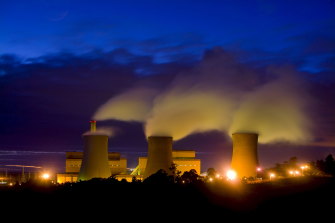
Tougher emissions reduction targets will put pressure on Victoria's brown coal -fired electricity generators.
Tougher emissions reduction targets will put pressure
on Victoria's brown coal-fired electricity generators. 
In a move that will expand the gap between Victorian and federal climate policy aims, the state government has confirmed it will comply with its obligations under its own Climate Change Act and impose emissions cuts targets of no less than 20 per cent by March 31.

The state’s main advisor on its interim emissions targets, former federal Labor politician Greg Combet, says the severity and the extent of the bushfires has sharpened the national focus on climate change and called on some politicians to “stop denying the science”.

Mr Combet’s expert panel’s longer term advice is even more ambitious, calling for cuts of up to 60 per cent by 2030, more than twice the target being pursued by the federal government.

Read the story from The Age why Noel Towell - “Victoria set to lead the way as Andrews eyes deepest carbon cuts yet.”

04 April, 2018

Starting the Dialogue on Climate Engineering Governance: A World Commission

Climate engineering can, if appropriately governed within a coherent overall climate change strategy, reduce risks beyond what mitigation and adaptation can achieve alone, and is probably essential to achieve the Paris Agreement temperature targets. Climate engineering also poses significant new risks, and needs expanded research and scrutiny in climate assessments.

Starting the conversation on
climate engineering governance.
Both types of climate engineering — carbon removal and solar geoengineering — also pose significant challenges to governance. The governance challenges of solar methods are particularly novel and severe, and urgently need international examination and consultation, both to learn how (and whether) climate engineering can deliver societal and ecosystem benefits, and to prepare for the likelihood that some states, facing mounting climate change impacts, will pursue climate engineering, and the international system will have to respond.

The needed international dialogue on geoengineering governance will have broad international participation; engage high-level expertise in international policy and institutions; draw closely on parallel advances in scientific knowledge and technical capability, while keeping governance the central focus; and facilitate open, exploratory investigations of governance needs and potential responses, rather than pursue specific decisions, at least in initial stages. Present institutions are not well equipped to support these needs.


Read the Centre for International Governance Innovation by Edward A. Parson - “Starting the Dialogue on Climate Engineering Governance: A World Commission.”

(Read the "Conclusion" closely and you will see that such an idea is not without its challenges - Robert McLean)


30 March, 2018

Climate Change Act must set 'net zero' emissions target by 2020, experts say

Britain's climate change targets must be strengthened by 2020 in order to meet stringent international targets, a new report  has warned.
A new report states the UK must set new targets to ensure
 greenhouse gas emissions are balanced by the removal
of greenhouse gases from the atmosphere.
The nation must strive to cut its emissions to “net zero”, the point at which annual greenhouse gas emissions are balanced by the removal of greenhouse gases from the atmosphere, the experts at the London School of Economics (LSE), stated. 

Achieving such a target could require anything from planting more trees to developing new technologies that suck carbon dioxide from.”

Read the story from the Independent by  Science Correspondent, Joe Gabaritiss -  "Climate Change Act must set "net zero" emissions target by 2020, experts say."


15 February, 2018

German cities to trial free public transport to cut pollution

“Car nation” Germany has surprised neighbours with a radical proposal to reduce road traffic by making public transport free, as Berlin scrambles to meet EU air pollution targets and avoid big fines.
Public transport is hugely popular in Germany, with 10.3
  billion journeys being made in 2017. A plan to trial free
public transport is part of an effort to reduce road traffic.
The move comes just over two years after Volkswagen’s devastating “dieselgate” emissions cheating scandal unleashed a wave of anger at the auto industry, a keystone of German prosperity.

“We are considering public transport free of charge in order to reduce the number of private cars,” three ministers including the environment minister, Barbara Hendricks, wrote to EU environment commissioner Karmenu Vella in the letter seen by AFP Tuesday.


Read the story by Philip Oltermann, and agencies, on The Guardian - “German cities to trial free public transport to cut pollution.”

20 October, 2017

Turnbull to rely on state schemes he once rubbished as reckless

State government anger over the federal government’s new energy plan is reaching boiling point, both because of the Coalition’s co-opting of what is supposed to be an independent board, and its decision to essentially rely on state-based renewable targets that it once derided as reckless.

Turnbull government relies on schemes it once called "reckless".
The seething anger from the states is completely overshadowing the proposal for the National Energy Guarantee, not least because it cannot be implemented without their approval.

But they have been astonished by the federal government’s decision to go behind their backs, obtain a policy proposal from the newly constituted Energy Security Board – which is supposed to report to the states through the COAG energy council – and then use the ESB directors to sell the idea to media, politicians and business.

Read the RenewEconomy story by Giles Parkinson - “Turnbull to rely on state schemes he once rubbished as reckless.”

25 September, 2017

Climate crunch: Australia to fail on Paris commitments without massive renewable switch

Australia will fall short of its Paris carbon reduction targets signed under Tony Abbott unless it lifts its renewable energy production to levels higher even than Labor's plan for 50 per cent green energy reliance by 2030.
Chief Scientist Alan Finkel proposed a clean energy
target which would lock in a 28 per cent reduction
 in energy-related emissions by 2030. 
The first assessment by the Australia Institute's new Climate and Energy Program, to be released on Monday, has found that unless a higher burden is placed on the more expensive process of carbon reductions in other sectors – agriculture, transport and manufacturing – then the electricity generation sector will need to aim for a renewable energy target of at least 66 per cent by 2030, and possibly as high as 75 per cent.

That is, a power generation sector where the fossil fuel component is reduced to perhaps a quarter of the size it is now.

Power generation currently accounts for 35 per cent of total emissions, which is twice as much as the next biggest contributor, fuel combustion and transport, at 18 per cent. 


Read the story by Mark Kenny in today’a Melbourne Age - “Climate crunch: Australia to fail on Paris commitments without massive renewable switch.”

14 September, 2017

Claims Australia won't meet Paris climate commitment if it keeps coal in the Clean Energy Target

Australia will not meet its Paris emissions reduction targets if the Turnbull government includes coal-fired power in any watered down climate and energy policy, environment groups and the Greens are warning.

The government is yet to make a decision on
 whether to adopt a Clean Energy Target. 
Power companies have also restated their concerns about policy uncertainty after Fairfax Media revealed the government was working on a major redesign of the Clean Energy Target proposed by Chief Scientist Alan Finkel, arguing further change would cause additional uncertainty and delay new investment.

A revised scheme would allow high-efficiency, low-emission coal-fired power plants to receive partial certificates, or credits, under a clean energy scheme.

Deputy Prime Minister Barnaby Joyce would not say on Wednesday what level the government would set for the emissions baseline in the revised target but confirmed "it will keep base load coal-fired power going”.


Read the story by James Massola and Cole Latimer in today’s Melbourne Age - “Claims Australia won't meet Paris climate commitment if it keeps coal in the Clean Energy Target.”

01 June, 2015

AMA ramps up pressure for government to act on climate change


T

he powerful doctors lobby group is set to ramp up pressure on the federal government to take action on climate change.

Australian Medical Association vice president Stephen Parnis says a working group has been established to revamp the group's climate policy before the UN climate change conference in Paris this year.

"We would like Australia's targets and priorities to be informed by AMA policy and influenced by AMA advocacy," he told doctors at the AMA's national conference in Brisbane on Sunday.

Dr Parnis called for doctors to take a more active role in mitigating climate change, with the negative health effects already becoming apparent and putting additional strain on the health system.

He said heatwaves in Victoria last summer produced a dramatic increase in visits to emergency departments.

30 May, 2015

'Don't leave the heaviest burden to later generations' - Garnaut


F

ormer climate adviser to two Labor governments Professor Ross Garnaut says Australia should ensure the heaviest burden of cutting greenhouse gases is not pushed onto future generations and new emissions targets should be set accordingly.

Ross Garnaut - don't leave
it up to those who follow.
In a paper that has been sent to the Abbott government's review of what targets to reduce emissions Australia should adopt for after 2020, Professor Garnaut proposes cuts of at least 27.5 per cent by 2025 and 40 per cent by 2030, both from 2000 levels.

He says these targets would be consistent with a gradual and steady reduction in Australia's emissions and broadly in line with the targets of other comparable countries

20 April, 2015

Perverse posturing wins local favour, but falls flat overseas


T

ony Abbott’s perverse posturing saw him elected as Australia’s Prime Minister, but has done little for the fulfilling our world community responsibilities.

Major developed nations around the world are now “calling out” Australia for its absolutely (the PM’s favourite word) inadequate response to climate change.

Today’s Melbourne Age - “China and other big emitters challenge Australia over its climate changepolicies”  - reports that “The world's biggest greenhouse gas emitters, including China and the US, have questioned the credibility of Australia's climate change targets and "direct action" policy in a list of queries to the Abbott government.”

13 December, 2014

Nature cares little for what it is we procrastinate about


Those at the Lima climate talks seem oblivious that nature cares little for what it is they procrastinate about.

It simple knows that the constituents of earth’s atmosphere are out of balance and only an immediate and world community-wide response will set about restoring the necessary equilibrium.

If we (the nations of the world) fail to make significant decisions at Lima in the lead up to Paris next year, untold trouble awaits.

The mindset that brought on the 2008 Global Financial Crisis, took the Western powers into a decade long conflict in the Middle East, and has allowed privately corporations to become among the richest and most powerful entities in the world is alive among those at Lima.

Until we are prepared to relinquish and abandon the greed driven individualism that proliferates in the developed world, conversations such as those at Lima will always stall and simply produce nothing more than aspirational and so unenforceable targets.

Considering that, it was interesting to note The Guardian story that pointed to “scant progress”.

The story headed: “Scant Progress As UN Climate Talks Enter Final Stretch” said U.N. global warming talks seemed set to spill over into the weekend.

27 September, 2013

Beneath the Wisteria supporter questions 'commitments'


Professor Dave Griggs.
Current commitments to cut greenhouse gases are inadequate according to Beneath the Wisteria supporter, Dave Griggs.

Professor Griggs, the director of Monash University’s Sustainability Institute, said today (September 27) in the Melbourne Age that current commitments to limit greenhouse gases would not stabilize global emissions at relatively safe levels.

Australia, it was reported, has committed to an unconditional emissions cut of 5 per cent below 2000 levels by 2020, and would adopt a target of 15 or 25 per cent depending on the level of global action.

Prof Griggs has not joined us Beneath the Wisteria, but has long been among the recipients of posts to our blog.
His comments can be read in a story headed: "Emissions targets too low: experts".