Showing posts with label State Government. Show all posts

08 April, 2020

‘Months of haze': Doctors demand smoke pollution check as pandemic raises burn-off fear

Doctors have pleaded with the state government to install air quality monitors in the Yarra Valley to alert vulnerable residents to dangerous smoke pollution during the autumn burn-off season.
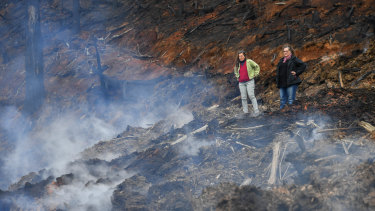
Yarra Ranges residents Nicole Fox, left, and Jennifer Conway are concerned about the impact of burn-offs on respiratory health.
Yarra Ranges residents Nicole Fox, left, and Jennifer Conway are
concerned about the impact of burn-offs on respiratory health. 
Supported by Yarra Ranges Council, which voted unanimously to back the push for better monitoring, the doctors say smoke pollution during the coronavirus pandemic is a dangerous health risk for their patients.
The Healesville-Yarra Glen region's death rate relating to respiratory system diseases is already nearly double the state average, according to local council data.
"There is growing fear and anxiety in the Yarra Valley about what the COVID-19 pandemic will mean ... and we are now facing months of smoke haze when already there are shortages of medications including asthma inhalers," the doctors write in a letter to Minister for Environment and Climate Lily D'Ambrosio and the Environment Protection Agency.

31 January, 2020

NSW Government poised to begin independent inquiry into bushfires

As parts of New South Wales brace for yet more severe fire conditions in the coming days, the State Government is poised to begin an independent inquiry into the recent disaster.
Image result for john barilaro"
NSW deputy premier, John Barilaro.
The six-month inquiry will examine the causes of the fires, as well as how state authorities prepared for and responded to them.
It will also consider the role of climate change, human activity and other factors.

Listen to the Radio National interview with NSW deputy premier, John Barilaro and host, Hamish Macdonald - “NSW Government poised to begin independent inquiry into bushfires.”

14 March, 2019

WA watchdog abandons carbon-neutral push after oil and gas industry criticism

Western Australia’s environmental watchdog has abandoned a recommendation to the state government that new emissions-intensive projects should be carbon neutral following widespread criticism.
 Western Australia’s EPA has abandoned a recommendation
that new emissions-intensive projects should be carbon
neutral after criticism from the oil and gas industry.
The Environmental Protection Authority last week released updated guidelines on mitigating emissions from new or expanding projects, suggesting proposals with emissions higher than 100,000 tonnes a year should be fully offset.


Read the story from The Guardian by Australian Associated Press - “WA watchdog abandons carbon-neutral push after oil and gas industry criticism.”

24 February, 2019

‘Everyone loves solar': Climate action heats up as NSW election issue

NSW voters, including conservative ones, want the state government to step up action on climate change, including boosting renewable energy, two separate polling sets show.
Solar farms are rolling out at a record rate and voters
would support much larger levels of renewable energy,
surveys have found.
A statewide Essential survey conducted February 6-11 for the Nature Conservation Council of 544 respondents found 51 per cent were more likely to back a party boosting clean energy and 18 per cent less likely. Among those identifying as Liberal or National supporters, the ratio was 43 per cent in favour and a quarter against.


Read the story from The Age by Peter Hannam - “‘Everyone loves solar': Climate action heats up as NSW election issue.”

27 November, 2018

Protest movement swells as Premier green-lights fracking

The state government announced on Tuesday it would lift a moratorium on gas fracking in the Kimberley, Pilbara and Mid West of Western Australia on the grounds that the risks to people and environment were manageable and that it could not turn its back on industry.
A protest in Broome on Monday.
The Premier said the moratorium would only be lifted on existing petroleum titles, that landowners and traditional owners would get veto rights, and royalties would go into a fund for renewable energy.


Read the story by Emma Young and Nathan Hondros  from WAToday - “Protest movement swells as Premier green-lights fracking.”

01 October, 2018

Renewable energy abattoir project approved for central Queensland

A $308 million abattoir with its own renewable energy facility in central Queensland has been given the green light by the State Government.
Artist's impression of the solar-powered abattoir, due to be operational by 2021.
The project, to be built by the Asia Pacific Agri-corp near Gladstone, will feature a meat processing plant powered by its own on-site renewable energy facility and will be the first of its kind in Australia.

The solar farm will be on a 340-hectare site adjacent to the abattoir.

Once up and running, the facility will have the capacity to process up to 2,400 head of cattle per day.

Asia Pacific Agri-Corp managing director Daniel Daly said the addition of a renewable energy facility would make the beef processing plant viable.

Read the ABC Rural story by Rachel McGhee - “Renewable energy abattoir project approved for central Queensland.”


(The artist’s image of the proposed abattoir provides a view of a wonderfully “green” facility, but it is surrounded by and depends upon, it appears, and energy-rich infrastructure; an infrastructure that is wholly sustained by fossil fuels. As wonderful as the actual abattoirs maybe, it appears to be operating in isolation and so until it is supported by and linked to a low-energy infrastructure, it alone is of limited value. I guess, however, it is a start - Robert McLean).

26 February, 2018

Victoria should consider burning rubbish to generate energy, reduce landfill, report finds

Burning rubbish is being touted as a viable alternative to landfill for Victoria, under a waste-to-energy proposal put before the State Government.
Waste-to-energy technology could reduce landfill
by about 90 per cent, the report said.
The Andrews Government commissioned a series of public consultations on waste-to-energy technology after local councils took legal action against the expansion of Victoria's largest tip, at Ravenhall, last year.

The public consultation report urged the Government to support the creation of a $220 million waste-to-energy plant in Melbourne's western suburbs.

The technology involves burning rubbish to produce electricity, which could reduce the amount of waste going to landfill by around 90 per cent.


20 October, 2017

Turnbull to rely on state schemes he once rubbished as reckless

State government anger over the federal government’s new energy plan is reaching boiling point, both because of the Coalition’s co-opting of what is supposed to be an independent board, and its decision to essentially rely on state-based renewable targets that it once derided as reckless.

Turnbull government relies on schemes it once called "reckless".
The seething anger from the states is completely overshadowing the proposal for the National Energy Guarantee, not least because it cannot be implemented without their approval.

But they have been astonished by the federal government’s decision to go behind their backs, obtain a policy proposal from the newly constituted Energy Security Board – which is supposed to report to the states through the COAG energy council – and then use the ESB directors to sell the idea to media, politicians and business.

Read the RenewEconomy story by Giles Parkinson - “Turnbull to rely on state schemes he once rubbished as reckless.”

27 June, 2017

Queensland Investment Corporation denies planning to fund Galilee coal mines

A Queensland Government investment vehicle has held talks about investing in the Galilee Basin coal mining region, raising speculation it may help bankroll infrastructure for the controversial Adani mine.
Documents show QIC has at least discussed
the prospect of investing in the Galilee Basin.
The Queensland Investment Corporation (QIC), established by the state government, held discussions with the Queensland Treasury in February about the prospect of QIC investing in projects that would mine, transport or export coal from the Galilee Basin region, documents released under the state's Right to Information laws show.

The documents were almost entirely redacted, with the Queensland Treasury determining that releasing details would prejudice QIC's business interests as the information "could be used by a competitor to cause commercial harm to the QIC and/or disadvantage QIC in the pursuit of the investment in potential projects”.


03 June, 2017

$8b plan would see Australia's first offshore wind farm built in Bass Strait

The waters off Gippsland would be home to Australia's first offshore wind farm under a radical proposal for as many as 250 turbines generating enough renewable energy to power 1.2 million homes.

This offshore wind farm is in the North Sea
near Hartlepool in the north-east of England. 
The "Star of the South" project, would supply about 18 per cent of Victoria's power usage and be connected to existing power infrastructure in the Latrobe Valley via undersea and underground cables, according to the local company behind the project, Offshore Energy.

News of the proposal comes as pressure grows on the State Government to release its long-awaited coal policy.

Latrobe City Council has called for the policy's immediate release and confirmed that it considers the Latrobe Valley's vast brown coal reserves "vital to the economy of Gippsland”.


Read Darren Gray’s story in today’s Melbourne Age - “$8b plan would see Australia's first offshore wind farm built in Bass Strait.”

06 October, 2016

Our 'solar city' taking shape - $50 000 study grant

Member for Northern Victoria,
Jaclyn Symes announces
clean energy grants.
Shepparton, in the Goulburn Valley, has long been known, in some circles as the “Solar City” and a State Government announcement today could see that bolstered in a truly practical way.

The Murchison based GV Community Energy (GVCE) has been handed a $50 000 grant to advance the Tatura Energy Future project and determine the viability of a large-scale (up to 30 MW) PV installation at one of three potential sites.

GV Community Energy CEO, Geoff Lodge, said that should they be able to demonstrate the viability of the project and see it go ahead, then it would easily be Victoria’s largest PV installation.

The grant to GVCE was announced today by the Member for Northern Victoria, Jaclyn Symes, who said the Andrews Labor Government has confirmed the first group of successful recipients of its $20 million New Energy Jobs Fund grants with Northern Victoria to receive nearly $300,000 in funding.

Other projects to be funded include $80 000 to Wodonga City Council for a community solar project; $50 000 to the Euroa Environment Group to prepare a business case for the Strathbogie/Seymour Energy Alliance Pumped Hydroelectric Storage project; and $100 000 to the Wangaratta Government Centre to fund a study into a clean energy project.

Mr Lodge said the GVCE study would be completed largely by existing staff with just minor input from others in specialist areas.

He said that the study would be completed with an end user in mind, who would be a part of the conversation.

He said today the work starts “now” and would be completed just as quickly as possible.

Ms Symes said the GVCE, Wodonga, Euroa, Wangaratta projects are four of 24 grants announced state-wide and it is exciting that the Northern Victoria grant recipients provided innovative ideas for projects that support a clean energy future and help position Victoria as a leader in new energy technologies.

“I look forward to working with these groups, we are determined to grow clean energy jobs and business opportunities that benefit our local communities in country Victoria,” Ms Symes said.

“We’re proud to be rebuilding much needed confidence in the renewable energy industry following the neglect of the former Liberal National Government at both state and federal levels over recent years.”

Ms Symes said the fund is a key component of the Labor Government’s $200 million Future Industries Fund to support high growth, high value industries, such as the new energy technologies sector that are critical to securing Victoria’s future as a competitive, innovative and outward looking economy.

31 August, 2016

'Wide, long, and loud applause' for state-wide fracking ban

Victorian Premier. Daniel Andrews, had, for
various reasons, been out of favour with many
people, but his historic state-wide ban on
fracking had won him, and his government
wide, long, and loud applause.
A permanent ban on fracking and all exploration and development of unconventional onshore gas will be introduced across Victoria, in a move the state government described as historic and a first for Australia.

Premier Daniel Andrews said the government would introduce the ban later this year, to protect the state's valuable farming sector, which earned billions of dollars in exports each year and employed nearly 200,000 people.

"We've listened to the community and we're making a decision that puts farmers and our clean green brand first," he said.

South Gippsland resident Deborah O'Connor said she was "thrilled" with the government's decision.

20 April, 2016

Apprehension about climate change at community forum was unfounded

Apprehension was the prevailing sense walking into the lecture room this week at the Tatura offices of the Department of Economic Development, Jobs, Transport and Resources (DEDJTR).

Tuesday night’s forum at the Tatura centre, commonly known as the Tatura Agricultural Research Centre, has been set up to allow the community to comment on what is being proposed as strategic directions for ‘Water for Victoria”.

The Tatura forum was one of 16 organized through the state to allow public input into the “Water for Victoria” discussion paper.

Fewer than 30 people were at the Tatura forum, and of those several were directly connected with organizers or from local or State Government organizations intimately involved with the maintenance and supply of water.

A few were farmers or had a direct connection with the commercial use of water.

An interest in climate change and its direct impact on water made it impossible to not attend.

Having been involved in previous conversations at which the attendees had similar characteristics, it seemed likely that climate change would quickly be dispensed to the “of little consequence” category, but surprisingly, that was not the case.

Many aspects of water were discussed during the two-hour workshop, but as had often been the case in previous similar discussions, climate change was discussed seriously and several people appeared to believe that the crisis that is climate change needed to be either at the top or close to the top of hierarchy of matters warranting attention when considering “Water for Victoria.”

Although, it is near too late, the serious of climate change and the need for it to be attended to appears to be gaining traction.

-       Robert McLean.