Showing posts with label burning. Show all posts

29 August, 2019

Taming fire let humans thrive. Now man-made flames in the Amazon threaten us all

The Amazon is burning, because of human actions. And once it's gone, we can never get it back.
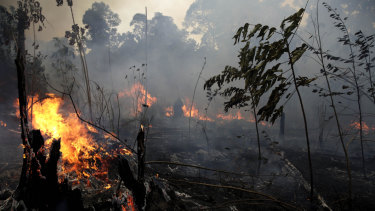
A fire burns trees and brush along the road to Jacunda National Forest in Brazil.
And yet, we still seem so indifferent. The fires in the Amazon, cumulatively, have received less media coverage than the fire at Notre Dame in France this spring, for instance: Media Matters reported that the fire at Paris' historic church got 15 times the coverage that the burning rainforest has.
On Monday morning, the Group of 7 leaders agreed to fund firefighting measures with a budget of $20 million. Notre Dame raised 1 billion euros in a matter of days. Perhaps Notre Dame is an easier place to grieve: It's a human-made place of worship, a marker of a time in history, a work of art. It's an easy place to understand. The Amazon, though, is a dense, lush, sprawling landscape that spent millions of years evolving, home to indigenous people and a diverse ecosystem and, most important, one that many people never get to see in their lifetime. That's much harder to relate to. But maybe our ability to look away from disasters like this is a symbol of our own ambivalence about doing anything to fight the climate crisis in general.

Read the opinion piece from The Age by Shannon Stirone - “Taming fire let humans thrive. Now man-made flames in the Amazon threaten us all."

27 April, 2018

‘We're doomed': Mayer Hillman on the climate reality no one else will dare mention

"We’re doomed,” says Mayer Hillman with such a beaming smile that it takes a moment for the words to sink in. “The outcome is death, and it’s the end of most life on the planet because we’re so dependent on the burning of fossil fuels. There are no means of reversing the process which is melting the polar ice caps. And very few appear to be prepared to say so.”
Dr Mayer Hillman with his bike outside his home in London.
Hillman, an 86-year-old social scientist and senior fellow emeritus of the Policy Studies Institute, does say so. His bleak forecast of the consequence of runaway climate change, he says without fanfare, is his “last will and testament”. His last intervention in public life. “I’m not going to write anymore because there’s nothing more that can be said,” he says when I first hear him speak to a stunned audience at the University of East Anglia late last year.


Read the Patrick Barkham story from The Guardian - “‘We're doomed': Mayer Hillman on the climate reality no one else will dare mention.”

23 April, 2018

Will rising carbon dioxide levels really boost plant growth?

Plants have become an unlikely subject of political debate. Many projections suggest that burning fossil fuels and the resulting climate change will make it harder to grow enough food for everyone in the coming decades. But some groups opposed to limiting our emissions claim that higher levels of carbon dioxide (CO₂) will boost plants’ photosynthesis and so increase food production.
New research published in Science suggests that predicting the effects of increasing CO₂ levels on plant growth may actually be more complicated than anyone had expected.
To understand what the researchers have found out requires a bit of background information about photosynthesis. This is the process that uses light energy to power the conversion of CO₂ into the sugars that fuel plant growth and ultimately provide the food we depend on. Unfortunately, photosynthesis is flawed.


Read the piece on The Conversation by a Senior Lecturer in Plant Biochemistry from the University of Westminster, Stuart Thompson - “Will rising carbon dioxide levels really boost plant growth?”

20 April, 2018

Push for controversial waste-to-energy centre at Fishermans Bend

Melbourne could be burning its waste for energy within a decade, as a booming population and China’s ban on accepting recycling combine to force more drastic steps to tackle the city’s mounting rubbish problem.
Lord mayoral candidate Jennifer Yang is backing a push
for a waste-to-energy facility in Fishermans Bend.
And Jennifer Yang, a candidate in the byelection to elect a new lord mayor of Melbourne, has put forward what she says is an “urgent, comprehensive feasibility study” into a new waste management, recycling and water treatment centre in Melbourne’s Fishermans Bend area.


Read the story from The Age by by Ben Miller and Clay Lucas - “Push for controversial waste-to-energy centre at Fishermans Bend.”

06 March, 2018

Sorry, burning our recyclables isn't the solution

Burning recyclable material to produce energy is about as smart as burning your antique furniture to keep warm. Both practices ignore the potential value of what is being burned, instead seeing only a waste product that can be used as fuel. Even so, there have been calls recently for building waste-to-energy plants now that China will no longer receive our waste or recyclables.
A steel recycling plant.
The distinction between waste and recyclable material is not obvious as much of the ''waste'' that currently goes to landfill could be easily recycled here in Victoria.
Let’s start with the low hanging fruit of food waste. Roughly half of what is sent to landfill is food waste, and half of this is generated by households. Already, some councils in Victoria are collecting food ''waste'' from households for composting. The resulting compost is bought by growers who, as a result, enjoy improved soil and more abundant crops. These crops need less water, less synthetic fertiliser, and less herbicide. Another benefit is that carbon is returned to the soil, where it is badly needed, rather than to the atmosphere as a greenhouse gas.


Read the story by Vivienne Waller from The Age - "Sorry, burning our recyclables isn't the solution.”

26 February, 2018

Victoria should consider burning rubbish to generate energy, reduce landfill, report finds

Burning rubbish is being touted as a viable alternative to landfill for Victoria, under a waste-to-energy proposal put before the State Government.
Waste-to-energy technology could reduce landfill
by about 90 per cent, the report said.
The Andrews Government commissioned a series of public consultations on waste-to-energy technology after local councils took legal action against the expansion of Victoria's largest tip, at Ravenhall, last year.

The public consultation report urged the Government to support the creation of a $220 million waste-to-energy plant in Melbourne's western suburbs.

The technology involves burning rubbish to produce electricity, which could reduce the amount of waste going to landfill by around 90 per cent.


19 February, 2018

Electrify Everything & Save The Planet!

Have you ever wondered why so many of the items we use on a daily basis are switching away from fossil fuel power to electricity? About 80% of the world’s GHG emissions are a direct or indirect result of extraction and burning of fossil fuels. Electricity offers a more efficient, lower-cost, and sustainable energy alternative to fossil fuel power.
Yes, we need to electrify everything.
Consumer energy technologies fall into two basic types: those that run on electricity (anything that plugs in or has a battery) and those that directly combust fuels like oil, gasoline, natural gas, or biomass. Let’s zoom in specifically on vehicles to understand the importance of electrification.

The gas-powered internal combustion engine is intrinsically inefficient. Less than a quarter of the energy consumed is used to drive the vehicle — the balance is rejected as waste heat. The preferable scenario is to choose electricity to drive our vehicles of all sizes and capacities. If that were the case, more than 90% of the energy devoted to our personal transportation would be deployed usefully. Let’s translate that in a different way. We could provide the driving potential of a gallon of gasoline by substituting as few as 8 kilowatt-hours (kWh) of electricity.


Read the story by Carolyn Fortuna on CleanTechnica - “Electrify Everything & Save The Planet!”

07 December, 2017

Out of control' wildfires explode in California and tens of thousands flee

Ventura, California: Ferocious fires tore through Southern California on Tuesday, local time, burning massive stretches of land in a matter of hours and forcing tens of thousands of people from their homes.
A firefighter pulls a water hose as a wildfires continue to burn in Santa Paula, California.
As firefighters in Ventura County grappled with an explosive blaze northwest of downtown Los Angeles, others across the region confronted additional fires that burned during the day and forced more evacuations. Authorities issued ominous warnings of more dangers to come during a "multiday event" across the area, as weather forecasters said the region faces "extreme fire danger" until at least Thursday, due to intense Santa Ana winds and low humidity.


Read the story in today’s Melbourne Age - “‘Out of control' wildfires explode in California and tens of thousands flee.”

05 January, 2017

Record-breaking extreme weather in Australia in 2016 devastates ecosystems

 Australia’s extreme weather in 2016 was driven
 by humankind’s burning of fossil fuels as
well as a strong El Niño. 
Australia’s weather was extreme in 2016, driven by humankind’s burning of fossil fuels as well as a strong El Niño, according to the Bureau of Meteorology’s annual climate statement.

That extreme weather led to devastated ecosystems both on land and in the sea, with unprecedented bushfires in regions that don’t usually burn, the worst coral bleaching on record, and has been attributed as the cause of damage to vast tracts of crucial kelp forests, oyster farms and salmon stocks across southern Australia.

The statement, released on Thursday, said the country as a whole had its fourth-warmest year on record, but locally, Sydney and Darwin broke records for both their hottest maximum temperatures and hottest minimum temperatures.

Hobart had its warmest night on record in 2016 and both Hobart and Brisbane had records for their hottest annual mean temperature fall as well. The hot and dry start to the year sparked bushfires in Victoria, Tasmania and Western Australia.

Read Michael Slezak’s story in The Guardian - “Record-breaking extreme weather in Australia in 2016 devastates ecosystems.”