Showing posts with label future generations. Show all posts

15 June, 2019

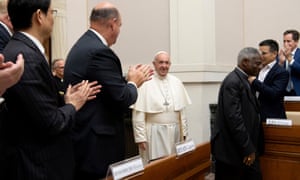
Pope Francis declares 'climate emergency' and urges action

Pope Francis has declared a global “climate emergency”, warning of the dangers of global heating and that a failure to act urgently to reduce greenhouse gases would be “a brutal act of injustice toward the poor and future generations”.
Pope Francis addresses energy representatives
‘Future generations stand to inherit a greatly
spoiled world,’ the pope said at a meeting at the Vatican.
He also endorsed the 1.5C limit on temperature rises that some countries are now aiming for, referring to warnings from the Intergovernmental Panel on Climate Change of “catastrophic” effects if we crossed such a threshold. He said a “radical energy transition” would be needed to stay within that limit, and urged young people and businesses to take a leading role.“Future generations stand to inherit a greatly spoiled world. Our children and grandchildren should not have to pay the cost of our generation’s irresponsibility,” he said, in his strongest and most direct intervention yet on the climate crisis. “Indeed, as is becoming increasingly clear, young people are calling for a change.”

Read the story from The Guardian by Fiona Harvey and Jilllian Ambrose - “Pope Francis declares 'climate emergency' and urges action.” 

25 April, 2019

‘You did not act in time': Greta Thunberg's full speech to MPs

My name is Greta Thunberg. I am 16 years old. I come from Sweden. And I speak on behalf of future generations.
Greta Thunberg.
I know many of you don’t want to listen to us – you say we are just children. But we’re only repeating the message of the united climate science.

Many of you appear concerned that we are wasting valuable lesson time, but I assure you we will go back to school the moment you start listening to science and give us a future. Is that really too much to ask?


Story from The Guardian by Greta Thunberg - “‘You did not act in time': Greta Thunberg's full speech to MPs.”

30 November, 2018

The climate apocalypse is now, and it is happening to you

WHAT PEOPLE SAY they know about climate change is a roller coaster of human ignorance—wait, everyone knows that but no one knows that? It’s striking to learn (according to Yale’s climate survey program) that 74 percent of women and 70 percent of men believe climate change will harm future generations of humans, but just 48 and 42 percent, respectively, think it’s harming them personally.
Climate change - the roller coaster of human ignorance.
It is, of course, in lots of ways. Yet fewer than half of Americans think climate change is a right-here, right-now problem. So it’s critical that a new report on the impact of climate change is about the present as much as the future. The topline results: 157 million more people experienced a heat wave in 2016 than in 2000—12.3 million Americans. That heat and the injuries that can come from it cost the world 153 billion hours of labor—1.1 billion in the US. The geographic range of the mosquitoes that carry dengue fever, Zika, malaria, and chikungunya is spreading. So is the range of the bacterium that causes cholera. Global crop yield is going down.


Read the Wired story by David Paul Morris - “The climate apocalypse is now, and it is happening to you.”

07 October, 2017

The Meat of the Matter by George Monbiot

What will future generations, looking back on our age, see as its monstrosities? We think of slavery, the subjugation of women, judicial torture, the murder of heretics, imperial conquest and genocide, the First World War and the rise of fascism, and ask ourselves how people could have failed to see the horror of what they did. What madness of our times will revolt our descendants?

George Monbiot - what madness will revolt our descendants?
There are plenty to choose from. But one of them, I believe, will be the mass incarceration of animals, to enable us to eat their flesh or eggs or drink their milk. While we call ourselves animal lovers, and lavish kindness on our dogs and cats, we inflict brutal deprivations on billions of animals, that are just as capable of suffering. The hypocrisy is so rank that future generations will marvel at how we could have failed to see it.

The shift will occur with the advent of cheap artificial meat. Technological change has often helped to catalyse ethical change. The $300m deal China signed last month, to buy lab-grown meat, marks the beginning of the end of livestock farming. But it won’t happen quickly: the great suffering is likely to continue for many years.


Read the piece by Guardian columnist, George Monbiot - “The Meat of the Matter.”

23 July, 2016

Much debate today in Melbourne Age about power systems


Letters in today’s Melbourne Age.

We need to redesign our electricity systems

South Australia, which has substantial wind power, recently experienced a crisis in electricity supply, requiring a gas-fired power station to be reopened. Thomas Hogg (Letters, 22/7) uses this example to suggest that rhetoric about renewable energy does not match reality. The reality is that we must stop using fossil fuels urgently. We have no choice – unless we want to bequeath future generations a much hotter world.

Certainly this transformation is difficult. Our electricity systems are designed around large, centralised, coal and gas-fired power stations sending electricity radially to consumers. Renewable energy is diffuse and site-dependent and typically the electricity output is variable.

We could embrace nuclear power and bequeath nuclear waste and the risk of devastating accidents to future generations. Or we can embrace renewables and redesign our electricity systems accordingly. This means a stronger grid, including more interconnections between states, distributed storage facilities, and more use of solar thermal (which can better match demand). It also means managing electricity demand to better match the output of renewable power stations. Rather than dismissing renewables, let us redesign our electricity systems to make them work with renewables.

Andrea Bunting, Brunswick.

The flexibility of pumped hydro-electricity

Thomas Hogg correctly argues that power grids have supply and demand problems. This balancing act is as old as the grid itself and as individual as the market in which it operates. All generating assets need to be shut down for routine maintenance, suffer breakdowns and are strained by unusual high demand or supply limits (eg coal mine fires, drought, low wind or sun). The most flexible solution is pumped hydro-electricity as was incorporated into the Snowy Hydro Scheme in 1949. Pumped hydro responds within minutes to consume excess electricity to pump water from a low to a high dam. When there is a supply shortfall, the stored power can be quickly recovered.

Pumped hydro has fast and controlled two-way response at much lower cost and pollution than batteries. It needs very small water volumes as they fill and empty daily or weekly (rather than annually like combined irrigation/power dams), and requires established technology often easily applied to existing grid systems. Our lives will depend on a renewable future, including solar and wind. The new multi-sourced grids need to expand pumped hydro to manage the ever-changing community demand and means of supply.

Robbert Veerman, Wandin North.

The gradual transition to renewable energy

In South Australia, when the wind didn't blow and Victoria's electricity link was down, they did use gas (a fossil fuel) to produce electricity. But when the wind was blowing, fewer tonnes of carbon dioxide were put into the atmosphere. Also, because South Australia bought electricity sourced from gas, less carbon dioxide was emitted than if it had bought it from coal. Maybe this is an acceptable outcome whilst we are in transition to renewable energy sources. In terms of emissions saved, it is already certainly better than coal-based electricity. Let's look at the bigger picture, please.

Jill Dumsday, Ashburton.

Environment cost of building turbines

When wind farms are under discussion, a significant factor is conveniently overlooked – the hundreds of thousands of tonnes of greenhouse gases which are produced in manufacturing and installing the wind turbines.

Roy Barclay, Frankston South.

05 September, 2015

Christina Figueres - 'We are passing on a huge moral injustice'


T

he verdict on global warming is in, insists UN climate change chief Christiana Figueres, who warns that if we don't act now, we are passing on a huge moral injustice to future generations.

Today’s Age and The Sydney Morning Herald both carry the “Good Weekend” and in the magazine is Deborah Snow’s report - “Ray of hope: Christiana Figueres”.

13 August, 2015

Australian Government's weak targets will 'gut women'


T

he Australian Government’s science-denying approach to carbon pollution reduction targets will emotionally gut women who are looking for stronger climate action and a compelling clean energy path for future generations.

We know women want more in the fight against global warming because market research and opinion polling continually tell us so. Most recently this week, via the Climate Institute's annual survey on the Australian public's attitudes to climate change, which once again highlighted how women on average are more likely to support climate action and clean energy than men.

Read the 1Million Women story - “Weak climate targets drag Australia down: Women speak out.”

30 May, 2015

'Don't leave the heaviest burden to later generations' - Garnaut


F

ormer climate adviser to two Labor governments Professor Ross Garnaut says Australia should ensure the heaviest burden of cutting greenhouse gases is not pushed onto future generations and new emissions targets should be set accordingly.

Ross Garnaut - don't leave
it up to those who follow.
In a paper that has been sent to the Abbott government's review of what targets to reduce emissions Australia should adopt for after 2020, Professor Garnaut proposes cuts of at least 27.5 per cent by 2025 and 40 per cent by 2030, both from 2000 levels.

He says these targets would be consistent with a gradual and steady reduction in Australia's emissions and broadly in line with the targets of other comparable countries

03 April, 2015

Looking back makes looking forward rather daunting


E

arly last year the Huffington Post looked back over the past two decades considering public inaction on global warming, while noting the worsening of the world’s climate.

Texas A&M University Climate
Scientist, Andrew Dessler, who
laments the missed opportunity.
Rather than depend on rhetoric, it relied in numbers to make its case - Carbon dioxide emissions: up 60 percent. Global temperature: up six-tenths of a degree. Population: up 1.7 billion people. Sea level: up 3 inches. U.S. extreme weather: up 30 percent. Ice sheets in Greenland and Antarctica: down 4.9 trillion tons of ice.

Climate scientist at the Texas A&M University Andrew Dessler said, "Overall, what really strikes me is the missed opportunity."

"We knew by the early 1990s that global warming was coming, yet we have done essentially nothing to head off the risk. I think that future generations may be justifiably angry about this."

The Huffington Post story - “In Decades Since Leaders First Got Together On Climate, World Has Gotten Hotter, Weirder” – quoted the Professor of geosciences and international affairs at Princeton University, Michael Oppenheimer, who said:  "Simply put, we are rapidly remaking the planet and beginning to suffer the consequences.”