Showing posts with label failure. Show all posts

06 December, 2019

The great dividing rage of Australian politics.

The failure of Labor policy on climate change a decade ago this week has led to a bitter but predictable argument over the blame for an upheaval that shapes Australian politics to this day. The rise and fall of Australian leaders, the success and failure of political parties, the progress and setbacks on climate change policy – all can be traced to the decisions in the Senate to veto the Carbon Pollution Reduction Scheme in December 2009.

Illustration: Michael Mucci
The vote followed the fall of Malcolm Turnbull as leader of the Liberals, the rise of Tony Abbott on a mission to kill a price on carbon, the struggle by Kevin Rudd as prime minister to secure a deal and the crucial decision of the Greens to reject a workable scheme in the confidence – fatally misguided – they would gain a better solution over time.
Parliament staged a flashback when Penny Wong, the Labor leader in the Senate, moved a motion to praise the CPRS and condemn those who blocked the bill. When the vote came, it was eerily similar to the one a decade earlier. Labor sat on one side of the chamber. The Liberals, Nationals and Greens sat on the other.
The result was a reminder of the unchanging dynamics in Australian politics – and especially the permanent competition between Labor and the Greens.

Read the opinion piece from The Age by David Crowe - “The great dividing rage of Australian politics.

15 June, 2019

Pope Francis declares 'climate emergency' and urges action

Pope Francis has declared a global “climate emergency”, warning of the dangers of global heating and that a failure to act urgently to reduce greenhouse gases would be “a brutal act of injustice toward the poor and future generations”.
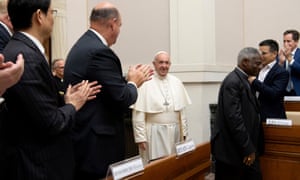
Pope Francis addresses energy representatives
‘Future generations stand to inherit a greatly
spoiled world,’ the pope said at a meeting at the Vatican.
He also endorsed the 1.5C limit on temperature rises that some countries are now aiming for, referring to warnings from the Intergovernmental Panel on Climate Change of “catastrophic” effects if we crossed such a threshold. He said a “radical energy transition” would be needed to stay within that limit, and urged young people and businesses to take a leading role.“Future generations stand to inherit a greatly spoiled world. Our children and grandchildren should not have to pay the cost of our generation’s irresponsibility,” he said, in his strongest and most direct intervention yet on the climate crisis. “Indeed, as is becoming increasingly clear, young people are calling for a change.”

Read the story from The Guardian by Fiona Harvey and Jilllian Ambrose - “Pope Francis declares 'climate emergency' and urges action.” 

21 May, 2019

Civilisational collapse has a bright past – but a dark future

Is the collapse of a civilisation necessarily calamitous? The failure of the Egyptian Old Kingdom towards the end of the 2nd millennium BCE was accompanied by riots, tomb-raids and even cannibalism. ‘The whole of Upper Egypt died of hunger and each individual had reached such a state of hunger that he ate his own children,’ runs an account from 2120 BCE about the life of Ankhtifi, a southern provincial governor of Ancient Egypt. 
Mayan society experienced a gradual decline over three centuries. 
Many of us are familiar with this historical narrative of how cultures can rapidly – and violently – decline and fall. Recent history appears to bear it out, too. Post-invasion Iraq witnessed 100,000 deaths in the first year and a half, followed by the emergence of ISIS. And the overthrow of the Libyan government in 2011 produced a power vacuum, leading to the re-emergence of the slave trade.


Read the Aeon story by Luke Kemp - “Civilisational collapse has a bright past – but a dark future.”

28 December, 2018

The Nobel Prize for Climate Catastrophe

Many people were thrilled when they heard that the Nobel Memorial Prize in Economics this year went to William Nordhaus of Yale University, a man known for his work on climate change. Finally, the economics profession is giving climate the attention it deserves, just as the world is waking up to the severity of our ecological emergency. Media outlets have taken this positive narrative and run with it.
William Nordhaus - the Nobel Prize for climate catastrophe.
But while Nordhaus may be revered among economists, climate scientists and ecologists have a very different opinion of his legacy. In fact, many believe that the failure of the world’s governments to pursue aggressive climate action over the past few decades is in large part due to arguments that Nordhaus has advanced.

It’s a blazing controversy that hinges on the single most consequential issue in climate economics: the question of growth. The stakes couldn’t be higher. After all, this isn’t just a matter of abstract academic debate; the future of human civilization hangs in the balance.


Read the Medium story by Jason Hickel - “The Nobel Prize for Climate Catastrophe.”

20 November, 2018

IAG says climate change could make world ‘uninsurable’: Financial Review

The insurance industry will be unable to operate effectively if the current trajectory of climate change proves accurate, Insurance Australia Group (IAG) Executive Jacki Johnson told the Financial Review.
Climate change will make the world uninsurable.
Johnson’s comments come after the UN Environment’s Finance Initiative (UNEP FI) announced a partnership with a group of 16 large, global insurers and reinsurers (of which IAG is included), to develop a new generation of risk assessment tools that enable the risk transfer industry to better understand the impacts of climate change on their business.

She adds that a failure to reduce greenhouse emissions could result in a world that is “pretty much uninsurable”, an outcome that would hit poorer regions hardest.

In Australia, Johnson says a temperature rise of over three degrees would inflict higher levels of extreme weather events such as cyclones and flooding to Queensland, while a rise of more than four degrees would render insurers unable to provide protection in certain areas of the world.


15 August, 2018

Capitalism killed out climate momentum, not human nature

This Sunday, the entire New York Times Magazine will be composed of just one article on a single subject: the failure to confront the global climate crisis in the 1980s, a time when the science was settled and the politics seemed to align. Written by Nathaniel Rich, this work of history is filled with insider revelations about roads not taken that, on several occasions, made me swear out loud. And lest there be any doubt that the implications of these decisions will be etched in geologic time, Rich’s words are punctuated with full-page aerial photographs by George Steinmetz that wrenchingly document the rapid unraveling of planetary systems, from the rushing water where Greenland ice used to be to massive algae blooms in China’s third largest lake.
The skyline of Manhattan at sunset in New York, May 23, 2018.
The novella-length piece represents the kind of media commitment that the climate crisis has long deserved but almost never received. We have all heard the various excuses for why the small matter of despoiling our only home just doesn’t cut it as an urgent news story: “Climate change is too far off in the future”; “It’s inappropriate to talk about politics when people are losing their lives to hurricanes and fires”; “Journalists follow the news, they don’t make it — and politicians aren’t talking about climate change”; and of course: “Every time we try, it’s a ratings killer.”


Read the Intercept article by Naomi Klein - “Capitalism killed out climate momentum, not human nature.”

13 September, 2017

Carbon price the key to ending Australia’s energy woes

The primary reason for the doubling of electricity prices in the past decade is the failure by successive federal governments to listen to the market.


We have reached an absurd impasse.

he industry itself is saying there is no rational future for coal-fired power generation in Australia.

And yet an avowedly pro-market Coalition government – having intervened some months ago in the gas market with threats to block exports and more recently in the retail electricity market by jawboning sellers into writing to customers about cheaper offerings – is now trying to force one of the biggest operators, AGL, to extend the life of Australia's oldest coal-fired station, NSW's Liddell.

This policy, if continued, will merely enrich AGL with taxpayers' funds and cause further costly delays in the transition to low-emission, low-cost power.


Read the Editorial in today’s Melbourne Age - “Carbon price the key to ending Australia’s energy woes.”

20 July, 2017

GE global renewables head Jerome Pecresse warns on clean energy target

Failure by the Turnbull government to settle on a clean energy target risks it losing recently restored momentum in the clean energy industry and undermining the credibility of Australia's global climate commitments, the head of General Electric's renewables division says.

Jerome Pecresse, GE's global head of renewable energy, in Sydney for the Clean Energy Summit.
Jerome Pecresse, GE's global head of renewable
energy, in Sydney for the Clean Energy Summit. 
The US energy giant has $1.6 billion in new wind farm projects under way in Australia that will add 800 megawatts of capacity to the grid as the industry rebounds from policy uncertainty during the Abbott government.

Read Peter Hannam’s story in today’s Melbourne Age - “GE global renewables head Jerome Pecresse warns on clean energy target.”

16 June, 2017

Our energy policy: stupidity, economic illiteracy, or sponsored obfuscation?

As we dissect the Finkel review’s failure to give serious credence to Australia’s commitment to the Paris agreement, what is yet again missing from the debate is a discussion of the economic and technological transition that is rapidly unfolding.

 Lessons from around the world are clear: successful
clean energy industries need domestic policy support. 
President Donald Trump attempts to revive failed rust belt industries in the states with hollow and economically ludicrous promises – promises which helped put him into the White House. New industries are growing that have already created many millions of jobs around the world and which will provide clean energy to power the 21st century.

This is not an “alternative fact”; it is the only game in town.

For the second straight year in a row the demand for coal has dropped. Renewable energy technologies are increasingly competitive with thermal electricity generation – without subsidies and without factoring in all the hidden costs of thermal power plants and their associated extractive industry requirements (think water pollution, emissions, coal ash, mercury).


Read Tim Buckley’s story on The Guardian - “Our energy policy: stupidity, economic illiteracy, or sponsored obfuscation?

15 May, 2015

Climate change and the global coffee business clash


I

n the past, companies that dominate the global coffee business have managed their supply risk by diversifying their suppliers.

Now a quarter of production in Brazil, the largest producer of high-quality Arabica coffee, is under direct threat from climate change, and rising temperatures are expected to undermine the commercial viability of Arabica coffee in many of the world’s coffee-growing regions.

In the next two decades, this systemic failure across many regions will require companies to radically change their production models and sourcing relationships.

Yes, the price of your favourite coffee will increase due to climate change, but there is hope that the risks involved will change the entire industry for the better.