Showing posts with label economists. Show all posts

24 February, 2020

I’ve seriously tried to believe capitalism and the planet can coexist, but I’ve lost faith

As the Productivity Commission confirmed this week, Australia’s economy has enjoyed uninterrupted growth for 28 years straight. Specifically, our output of goods and services last financial year grew by 2%. Economists obviously see the growth of a national economy as good news – but what is it doing to the Earth?
Image result for I’ve seriously tried to believe capitalism and the planet can coexist, but I’ve lost faith
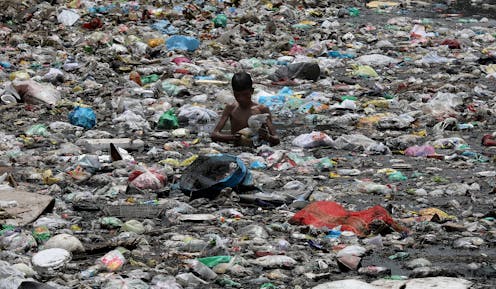
The product of capitalism.
Capitalism demands limitless economic growth, yet research shows that trajectory is incompatible with a finite planet.
If capitalism is still the dominant economic system in 2050, current trends suggest our planetary ecosystems will be, at best, on the brink of collapse. Bushfires will become more monstrous and wildlife will continue to be annihilated.

Read the story from The Conversation by Samuel Alexander - “I’ve seriously tried to believe capitalism and the planet can coexist, but I’ve lost faith.”

28 December, 2018

The Nobel Prize for Climate Catastrophe

Many people were thrilled when they heard that the Nobel Memorial Prize in Economics this year went to William Nordhaus of Yale University, a man known for his work on climate change. Finally, the economics profession is giving climate the attention it deserves, just as the world is waking up to the severity of our ecological emergency. Media outlets have taken this positive narrative and run with it.
William Nordhaus - the Nobel Prize for climate catastrophe.
But while Nordhaus may be revered among economists, climate scientists and ecologists have a very different opinion of his legacy. In fact, many believe that the failure of the world’s governments to pursue aggressive climate action over the past few decades is in large part due to arguments that Nordhaus has advanced.

It’s a blazing controversy that hinges on the single most consequential issue in climate economics: the question of growth. The stakes couldn’t be higher. After all, this isn’t just a matter of abstract academic debate; the future of human civilization hangs in the balance.


Read the Medium story by Jason Hickel - “The Nobel Prize for Climate Catastrophe.”

10 November, 2018

Demand for Australia's thermal coal exports to be dire in future, IEEFA report warns

Economists are predicting Australia's thermal coal exports to plummet faster than expected due to falling demand across Asia that appears permanent and irreversible.
Industry figures predict a rosy future for coal, but a new report says otherwise.
A study by the Institute for Energy Economics and Financial Analysis (IEEFA) found Australia's top four export markets — China, Japan, Taiwan and South Korea — were shifting rapidly to renewables.

The study found New South Wales, the source of nearly 70 per cent of thermal coal exports, should brace for disruption in energy markets.


03 January, 2018

On its 100th birthday in 1959, Edward Teller warned the oil industry about global warming

It was a typical November day in New York City. The year: 1959. Robert Dunlop, 50 years old and photographed later as clean-shaven, hair carefully parted, his earnest face donning horn-rimmed glasses, passed under the Ionian columns of Columbia University’s iconic Low Library. He was a guest of honor for a grand occasion: the centennial of the American oil industry. 
Physicist Edward Teller pointing at a formula on a blackboard on 22 May 1968.
Over 300 government officials, economists, historians, scientists, and industry executives were present for the Energy and Man symposium – organized by the American Petroleum Institute and the Columbia Graduate School of Business – and Dunlop was to address the entire congregation on the “prime mover” of the last century – energy – and its major source: oil. As President of the Sun Oil Company, he knew the business well, and as a director of the American Petroleum Institute – the industry’s largest and oldest trade association in the land of Uncle Sam – he was responsible for representing the interests of all those many oilmen gathered around him.


Read the The Guardian US story by Benjamin Franta - “On its 100th birthday in 1959, Edward Teller warned the oil industry about global warming.”

25 February, 2017

Our Most Pressing Problem

Economic growth– we hear about it all the time, so often that most of us probably don’t notice it any more than we’d notice someone saying that things are going well, or that everything is on track. 


In the world of economic reporting–the sort you might hear every hour or so throughout the day on NPR, or as highlighted in press-releases from the Federal Reserve–economic growth is the measure against which everything else in its orbit is judged; and it has a large orbit.  It has become a synonym for “good,” for “well-functioning ”or“ basic progress.”  And, in the reverse, an economy that is not growing is described as facing some sort of temporary “headwinds,” and we can be sure that economists, industry leaders, and the government are fast at work on the “recovery” that will bring things back to “normal.”

But if you listen to the words of politicians and policy-makers a bit more closely, you might notice that all this talk indicates something more like a preoccupation or obsession, and hear the urgency and anxiety surrounding it.  This is not surprising, as elections are usually won or lost over the issue or economic growth, or who has the best-sounding plan to keep the economy growing.  If you are anything like I was before I started looking into these issues, you probably take this preoccupation with economic growth and the sense that it is a necessary part of our national well-being in unquestioning stride.  After all, there is rarely anyone out there suggesting that something other than economic growth should be our number one priority.  Democrats and Republicans are in equal agreement over its importance, arguing only about how we might achieve the best, fastest, and most sustainable kind of economic growth.  And during times when the economy is not growing as fast as all the economists say it should be, people do lose jobs, houses go into foreclosure, and our political system starts appearing a little rougher around the edges.  Maybe economic growth is a justifiable synonym for the common good.


Read the resilience.org story - “Our Most Pressing Problem.”

05 February, 2017

Scope 2017 survey: Economists say action on carbon is vital, or say nothing at all

Ai Group's Julie Toth said market mechanisms
 should be used to meet national commitments
to substantially cut emissions. 
There is no consensus. Economists either believe it is vital that Australia becomes a low-carbon intensity economy, or that the issue is so unimportant – or perhaps that it is so politically divisive – that they choose not to volunteer an opinion.

Asked about the importance of reducing the country's carbon footprint and how best to do it, more than half of 27 economists from industry, consultancy, academia and finance questioned for the annual BusinessDay Scope survey agreed it was a must.

Another 10 left the question blank. Whether this indicates a lack of interest or the contentious nature of climate change policy is unclear.

But none of those who did answer made the case that cleaning up the economy did not matter. They overwhelmingly said action should be swift and include a market-based carbon pricing scheme.

Read Adam Morton’s story in today’s Melbourne Age - “Scope 2017 survey: Economists say action on carbon is vital, or say nothing at all.”

02 January, 2016

Capitalism will experience the most exquisite of deaths: Jeremy Rifkin


At the very moment of its ultimate triumph, capitalism will experience the most exquisite of deaths.

This is the belief of political adviser and author Jeremy Rifkin, who argues the current economic system has become so successful at lowering the costs of production that it has created the very conditions for the destruction of the traditional vertically integrated corporation.

Rifkin, who has advised the European Commission, the European Parliament and heads of state, including German chancellor Angela Merkel, says:

“No one in their wildest imagination, including economists and business people, ever imagined the possibility of a technology revolution so extreme in its productivity that it could actually reduce marginal costs to near zero, making products nearly free, abundant and absolutely no longer subject to market forces.”

With many manufacturing companies surviving only on razor thin margins, they will buckle under competition from small operators with virtually no fixed costs.

19 August, 2015

'Jobs, jobs, jobs' is hollow argument - Ross Gittins


Jobs, jobs, jobs” is the cry of the Australian Coalition Government and it has been the Prime Minister, Tony Abbott, who has said he will never put the environment ahead of the economy.

Ross Gittins - questioning the
pleas of the Abbott Government.
And with the environment running in a distant last place, the government is doing all it can to ensure massive industrial projects become a fixed part of our landscape, and along with that, the jobs they promise.

This endless bleating about jobs is a fallacy as explained by Ross Gittins in his article in today’s Age - “Economists' concerns with emissions reduction target not what you'd expect.”

04 November, 2013

This is too important to quibble


Peter Martin.
Peter Martin discussed the Abbott-led Coalition Government’s Direct Action plan in today Business Day section in the Melbourne Age.

In a comment piece headed: “Is direct action on carbon no action?”, the economics correspondent did what economists love to do, discuss numbers.

He considered different ideas of how to approach the control of carbon emissions, but then, in the final analysis, Martin said, “Some goals are too important to quibble over the means of achieving them”.