Showing posts with label Ross Garnaut. Show all posts

06 May, 2020

Garnaut: Australia will lose competitive advantage if no clean energy transition

A strong future Australian economy can be created by embracing a low emissions economy, and risks sacrificing much of its economic advantages if its doesn’t, according to one of Australia’s leading economists.
Garnaut: Australia will lose competitive advantage if no clean ...
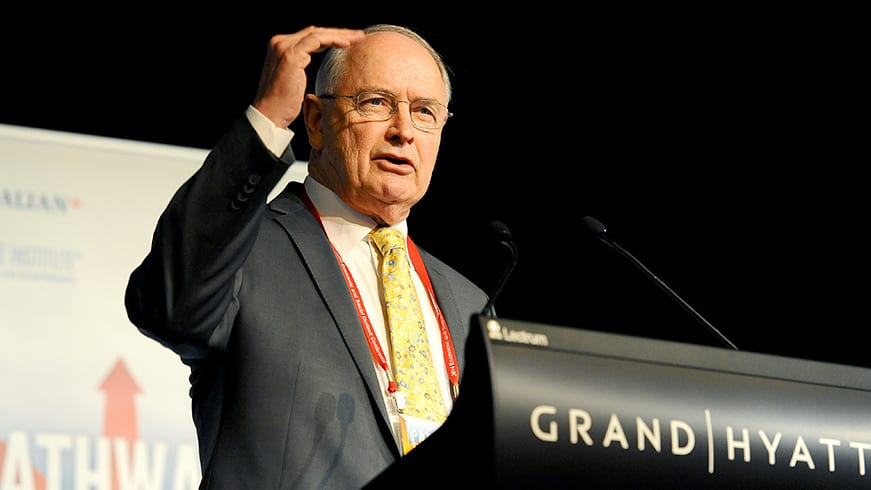
Ross Garnaut - we need to accelerate our transition to renewable energy.
Addressing the Stimulus Summit co-hosted by the Smart Energy Council and RenewEconomy, leading economist Professor Ross Garnaut said that there is an increasing appreciation of the benefits of acting on climate change, and the opportunities that exist in accelerating the transition to a clean energy economy.
Expressing optimism about the opportunities that exist in a transition to zero net emissions, Garnaut said that the transition provides a way for Australia to invest in future industries, while also supporting the economy to recover after the impacts of Covid-19.
Read the story from RenewEconomy by Michael Mazengarb - “Garnaut: Australia will lose competitive advantage if no clean energy transition.”

13 January, 2020

The path to a zero-carbon economy: Ross Garnaut

Prime Minister Scott Morrison says the Government's climate policy will "continue to evolve" to "meet and beat" its global commitments. He has, however, stopped short of pledging new emissions reduction targets.
The bushfire crisis now unfolding was effectively predicted 12 years ago by the final report of the Garnaut Climate Change Review for the then Rudd Labor government.
Its lead author, economist Ross Garnaut, says Kyoto carry-over credits "do us no good at all" and warns that the less Australia does now, the more it will have to do mid-century.

Listen to a discussion between Ross Garnaut and Tom Tilley on Radio National’s Breakfast show - “The path to a zero-carbon economy: Ross Garnaut.”

16 May, 2019

Australia can be 'superpower of post carbon world', says Ross Garnaut

Australia has the opportunity to surpass other rich countries to become more prosperous than ever before in a post-carbon world, according to the eminent economist Ross Garnaut.
Opportunities for Australia: Professor Ross Garnaut. 
Australia could become "the superpower of the post-carbon world economy", said the former economic adviser to prime minister Bob Hawke and author of the Hawke government's strategy for economic engagement with Asia.

The Australian political debate has been preoccupied with the cost of moving to a lower-carbon economy, but new work by Professor Garnaut finds that the economic costs would be far outweighed by economic gains.

"Embrace the post-carbon economy, and Australia will greatly expand new minerals processing and chemical manufactures, way beyond the limits of coal, gas and the industries they supported in the past," he said in a Melbourne University lecture on Wednesday night.


Read the story from The Age by Peter Hartcher -  “Australia can be 'superpower of post carbon world', says Ross Garnaut.”

13 March, 2016

Four years gone, four years to go - what are our chances?

-       Robert McLean

The 2012 book.
Just four years ago the Melbourne Sustainable Society Institute assembled the thoughts of more than 30 people and subsequently published “2020: Vision for a Sustainable Society”.

The resultant book was not on the best seller list, I suspect, despite being timely, educative, informative and alive with information that would have made the achievement of a sustainable society in eight years possible, or at least not impossible.

Writing about “Public Wisdom” Tim van Gelder said public opinion falls a long way short of public wisdom.

van Gelder quoted democracy theorist, James Fishkin, who said “Respondents are generally ill-informed; they are usually “rationally ignorant” on the topic.

Individualsattitudes are subject to manipulation by powerful forces pursuing their own agendas: eg, major corporations resisting tax system changes.

“The opinions elicited in standard polls may be artificially manufactured by the polling process itself: ie, may not reflect any real view held by the respondents but rather views shaped by that process,” Fishkin said.

The forward for the book which declares on an opening page, “For our grandchildren”, written by a Distinguished Professor of Economics at the Australian National University and both a Vice-Chancellor's Fellow and Professorial Fellow of Economics at The University of Melbourne, Ross Garnaut AO, ends in saying:

Professor Ross Garnaut.
“What Australians do over the next few years will have a significant influence on humanity’s prospects for handing on the benefits of modern civilisation to future generations. This book will help Australians understand their part in the global effort for sustainability.”

Nobel Prize Laureate, Peter Doherty, was awarded and shared the prize in 1996 for his work in discovering how the immune system recognises virus-infected cells.

The University of Melbourne Professor wrote about disease and his concluding “Actions for 2020” were:

A sustainable society must be a fairer world that promises health and global wellbeing. Medical, agricultural and other professionals can provide expertise, but what is really needed are innovative economic models and courageous political leadership.

Hopefully, we can mobilise the necessary will before we are forced to act in “fire engine” mode to counter some major, and perhaps irreversible, global disaster. Though agreed international regulatory frameworks and collective action clearly have important roles to play, any effective action can only work via mechanisms that also emphasise individual enterprise, insight and inventiveness. Perhaps what we need most is innovative and business entrepreneurs who function as global gamekeepers, not poachers, and focus as much on human as on financial capital. A dedication to greed makes people fundamentally callous and less than human. Giving back enhances lives, not least the life of the giver.

The book, “2020: Vision for a sustainable society” was published in 2012, allowing humanity just eight years for concrete action – that has been halved and we now have just four of those critical years left.

Claims of success are many, but the simple and measurable reality is that our carbon dioxide emissions continue to climb worsening the risk of irreversible climate change and so with just four years left until this arbitrary date arrives, we have in fact done little to change our behaviours and so seriously mitigate our carbon dioxide emissions or understand how and when we should adapt to what is unfolding.

Many point to the Paris climate conversations and with considerable glee claim that global agreement to tackle climate change was significant and important.

Maybe it was a global agreement and while that acknowledgement is critical, the Earth’s climate has been disrupted to such an extent that the world needs more than words, it needs a style of action replicating what happened among allied countries in the lead-up to the Second World War, anything less will not do.  

What do we need to reach a sustainable society?

Narratives: a sustainable future will be attractive.

Actions: specifics to achieve sustainability. Largely, behaviour and policy changes, not technology.

Evidence: research to identify what is needed and its impact when it occurs. Publicise success.

Commitment: join the movement.

Partners: civil society, government, business and media working in concert.

11 August, 2015

Government's proposed carbon cuts inadequate in the extreme


S

uggestions by the Federal Government that Australia will reduce its carbon dioxide emissions by 26 per cent, based on 2005 figures, is inadequate in the extreme.

Ross Garnaut - considering emissions
in a global context.
Australia is clearly among the world’s worst polluters of the atmosphere and so it should be declaring a cut of at least 80 per cent and taking evidence of how that will happen to the Paris climate conference later this year.

Consider these numbers from the Garnaut Review - “Australia’s emissions in a global context”.

Ross Garnaut was commissioned by the Australian Government to provide an independent update to his 2008 Climate Change Review. He is also an independent expert adviser to the Multi-Party Climate Change Committee.

The Garnaut Climate Change Review—Update 2011 released a series of papers in February and March 2011 addressing developments across a range of areas including:

-      climate change science and impacts,

-      international mitigation progress,

-      carbon pricing, land,

-      innovation, and

-      the electricity sector.

Professor Garnaut delivered his final report to the Prime Minister on 31 May 2011.

15 June, 2015

Ross Garnaut will encourage cooperation, collaboration among GV people


R

oss Garnaut will speak in Shepparton in November this year at what is colloquially known as “GV21”, an event that will encourage cooperation and collaboration among Goulburn Valley people, organizations and institutions.

Ross Garnaut - coming to Shepparton,
Today, the professorial research fellow in economics at Melbourne University has written in the Melbourne Age in a story headed: “Climate change: the challenge for Australia”.

Professor Garnaut has advised prime ministers and ministers on trade policy and relations with Asia and the Pacific since the late 1970s.

30 May, 2015

'Don't leave the heaviest burden to later generations' - Garnaut


F

ormer climate adviser to two Labor governments Professor Ross Garnaut says Australia should ensure the heaviest burden of cutting greenhouse gases is not pushed onto future generations and new emissions targets should be set accordingly.

Ross Garnaut - don't leave
it up to those who follow.
In a paper that has been sent to the Abbott government's review of what targets to reduce emissions Australia should adopt for after 2020, Professor Garnaut proposes cuts of at least 27.5 per cent by 2025 and 40 per cent by 2030, both from 2000 levels.

He says these targets would be consistent with a gradual and steady reduction in Australia's emissions and broadly in line with the targets of other comparable countries

26 August, 2014

Discuss climate at G20 forum - Ross Garnaut


Ross Garnaut at last night's
 University of Melbourne lecture.
Climate change needs to be among discussions at his year’s G20 forum according to economist and expert climate policy analyst, Professor Ross Garnaut.

The Melbourne based economist, who was an adviser to the former Labor Government, argued for the G20 discussions when answering a question from the floor after a public lecture at the Carillo Gantner Theatre at the University of Melbourne last night.

Age environment editor, Tom Arup, reported on the lecture in a story headed: “Climate hope in China coal turnaround: Ross Garnaut”.

Arup wrote: “The international goal of halting global warming at 2 degrees is now within reach because China has slowed the growth of its coal use, despite continuing to economically develop, climate policy expert Ross Garnaut says”.

Professor Garnaut said, according to Arup’s story, that the fall in the emissions intensity of Chinese economic growth was the result of new development policies pursued by Beijing over the past six years, which could serve as a model for other developing nations.

20 June, 2014

Garnaut critical of Federal Government's intentions


Ross Garnaut has been critical of the Federal Government’s plan to scrap the existing carbon tax in Australia.

Ross Garnaut criticizes
 Federal Government.
The Melbourne Herald-Sun reporting in a story headed: “Carbon policy pits Aus against US: Garnaut”, said the former government adviser and a prominent economist has questioned government intentions.

Mr Garnaut says China, Europe and U.S, are moving toward big efforts to combat climate change and Australia, through the scrapping of its detailed and sophisticated carbon laws, is fundamentally opposing that action.

He said that with existing policies, Australia would be still in the game and doing its fair share, but pursuing what’s proposed we would be out of the game and not doing our fair share.

25 November, 2012

Call for volunteers


There is much to be done.

Tim Flannery
for Shepparton?
Beneath the Wisteria supporters are called on to consider volunteering their skills and time to join a working group to help create a major public event in Shepparton at which climate change and its implications would be discussed.

The idea for the event arose from an idea brought to the November Beneath the Wisteria gathering by Terry Court.

Terry suggested that someone such as Tim Flannery should be invited to speak and although that idea was seemed to be universally accepted, fellow supporter, John Lawry, warned that the former Australian of the Year can be divisive and that he should share the podium with another speaker who is somewhat less polarizing.

Terry suggested, in an email subsequent to Saturday’s discussions, “That we form a working group- for the sake of a name- to organise the event. GVEG/ GV Community Energy will provide support and I reckon the Goulburn Broken Catchment Management Authority will also support.  Need to think about format and other speakers- Malcolm Turnbull/ Ross Garnaut /Tim Costello”.

The event would not be until 2013, but as such speakers can be difficult to secure and sometimes need spoken with months in advance, Terry has suggested that working group should meet within two or three weeks.

Anyone who feels they would like to be involved with such a group should just send their name to Robert McLean at robed@sheppnews.com.au.


16 September, 2012

Jo's beliefs lead us to the 'Homer Simpson paradigm'


Leaving “A conversation on the climate crisis” my thoughts were alive with hope until I felt the full force of a city alive with “business as usual”.

Returning home, I sat down and wrote about the event and the sentiments that arose from it.

-       Robert McLean.


Jo Chandler doesn’t believe in climate change, but she does believe in science.

Humanity is in the grip of
the "Homer Simpson
 paradigm".
The implication of that observation for the former science writer at the Melbourne Age is that the science of climatology illustrates conclusively that humans have changed the world’s weather patterns.

Ms Chandler, who only took voluntary redundancy at The Age earlier this month, was one of two speakers at the University of Melbourne’s “A conversation on the climate crisis”.

Her fellow speaker at the seminar was the author of the Garnaut Climate Change Review, Professor Ross Garnaut. His 2008 report was then presented to the Australian Government and updated last year.

Ms Chandler told the more than 100 people who joined the conversation that family and friends often asked her why she believed in climate change.

She said she doesn’t, rather she believes in the clear, unambiguous and evidence-based findings of science that illustrate the reality of the changes we have made to our atmosphere.


Professor Ross Garnaut.
Professor Ross Garnaut, who presented his review to the then Australian Prime Minister, Mr Kevin Rudd, came to the recent conversation with an unparalleled understanding of the economic impact of climate change on Australia.

Prof Garnaut appears a naturally conservative fellow and even when exploring the most damning scenarios of our changing climate, talks in a kindly way and seems to avoid observations the might “scare the horses”.

Despite that, Prof Garnaut was unable to avoid the facts; facts that point to a certain two degree rise in earth’s temperature (we are at less than one degree at the moment) and explore realities suggesting even the two degree number is conservative.

Jo Chandler.
Leaving the seminar feeling somewhat euphoric about having been a part of reasoned and respectful conversation about a crisis not yet understood, I walked straight into a Melbourne that is what it is because of business as usual, a paradigm that underpins our changing climate.

The dichotomy was evident; some understand, recognise and want action on the crisis, but even within that mindset there appears to be a reluctance to let go of the good life.

That made me think of Homer Simpson, who in trying to pilfer a soft drink from a dispenser, became trapped and after significant effort it was realized that if he loosened his grip on the can, his hand could slide free.

Humanity is locked in the “Homer Simpson paradigm” and until we are prepared to let go of our lavish life-style, scale it back and accept a simpler life we, like that cartoon hero, will remain trapped, and doomed to difficult times.

I stand with Jo Chandler and, like her, embrace science and align myself with the likes of Ross Garnaut enjoying his respectfulness and kindly behaviour.