Showing posts with label Germany. Show all posts

17 January, 2020

How Hard Is It to Quit Coal? For Germany, 18 Years and $44 Billion

Germany announced on Thursday that it would spend $44.5 billion to quit coal — but not for another 18 years, by 2038.
The move shows how expensive it is to stop burning the world’s dirtiest fossil fuel, despite a broad consensus that keeping coal in the ground is vital to averting a climate crisis, and how politically complicated it is.
Coal, when burned, produces huge amounts of the greenhouse gas emissions that are responsible for global warming.
Germany doesn’t have shale gas, as the United States does, which has led to the rapid decline of coal use in America, despite President Trump’s support for coal. Germany also faces intense opposition to nuclear power. After the Fukushima disaster in 2011, that opposition prompted the government to start shutting down the country’s nuclear plants, a transition that should be complete by 2022.

Read the story from The New York Times by Somini Sengupta and Melissa Eddy - “How Hard Is It to Quit Coal? For Germany, 18 Years and $44 Billion.”

12 January, 2020

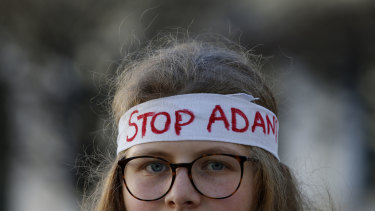
57,000 Germans want Siemens to quit Adani mine over climate

Munich: Climate activists have protested outside Siemens offices across Germany demanding that the conglomerate end its participation in the controversial Adani mining project in Australia, where raging bushfires have been met with calls to tackle climate change.
An activist wears takes the message to Siemens in Munich, Germany, on Friday.
The demonstrations, organised by the German branch of the Fridays for Future environmental youth movement, took place in several German cities, including Munich, where the firm is headquartered.
Protesters said they handed over a petition signed by 57,000 people during the hundreds-strong Munich demonstration on Friday, German time.

Read the story from The Age by Christof Ruehrmair - “57,000 Germans want Siemens to quit Adani mine over climate.”

27 July, 2019

A Heat Wave Bakes Europe, Where Air-Conditioning Is Scarce

LONDON — Never in recorded history has Paris been hotter than it was on Thursday, when the temperature neared 110 degrees. The same was true of Belgium, Germany and the Netherlands, as a dangerous heat wave scorched Western Europe.
Air conditoning is scarce in Europe.
Parisians could be seen plunging fully clothed into the fountains of the Trocadéro, Viennese cooled themselves in municipal misters, and Amsterdamers dangled their feet in a repurposed kiddie pool at a cafe. But here is what is far less likely to be seen: air-conditioners.
That’s because the technology that transformed American homes and offices over the last century still gets a chilly reception in much of Europe.

Read the story from The New York Times by Iliana Magra, Elian Peltier and Constant Méheut  - “A Heat Wave Bakes Europe, Where Air-Conditioning Is Scarce.”

25 July, 2019

Climate crisis blamed as temperature records broken in three nations

Belgium, Germany and the Netherlands have recorded their highest ever temperatures as the second extreme heatwave in as many months to be linked by scientists to the climate emergency grips the continent.
 Water is sprayed on a taxiway at Schiphol
airport in Amsterdam during extreme heat.
The Dutch meteorological service, KNMI, said the temperature reached 39.2C (102.5F) at the Gilze-Rijen airbase near Breda on Wednesday afternoon, exceeding the previous high of 38.6C set in August 1944.

In Belgium, the temperature in Kleine-Brogel hit 38.9C, fractionally higher than the previous record of 38.8C set in June 1947. Forecasters said temperatures could climb further on Thursday.

Germany’s national weather service, DWD, said it believed a new all-time national high of 40.5C – 0.2C higher than the record – had been set in the town of Geilenkirchen near the Dutch and Belgian borders, but had still to confirm it.


Read the story from The Guardian by John Henley - “Climate crisis blamed as temperature records broken in three nations.”

12 July, 2019

Heat Wave Compromises Europe’s Climate Goals

As temperatures last month soared to nearly 100 degrees in parts of Germany and 113 in France – the hottest since reliable record-keeping began in 1880 – Europeans are rethinking their once-cool view toward air conditioning. And that's forcing policymakers and grid-planners to reassess the continent's climate and energy ambitions. 


Europeans have long looked askance at America's love-affair with air conditioning. While roughly 90% of U.S. households have air conditioning devices, fewer than 5% of homes have them in Europe – and those that do tend to use the devices less frequently and to set the temperatures higher. 

Some of that is due to geography: The United Kingdom, for example, is farther north than the U.S. border with Canada, as are parts of other Western European countries such as France and Germany. That area once experienced as few as five days a year above 90 degrees. More recently, however, temperatures in those countries are climbing into the 90s during the summer as often as two weeks per month, forcing homeowners, offices and health centers to reconsider investing in air conditioning. Last month marked the planet's hottest June on record, driven in part by Europe's heat records.


Read the story from U.S. and Worldwide News by Alan Neuhauser - “Heat Wave Compromises Europe’s Climate Goals.” 


30 June, 2019

A strange, wavy jet stream is blasting Europe with heat. Scientists say this could be the 'new normal.’

An oppressive heat wave baked Western Europe this week, setting record high temperatures in France, Germany, Poland and the Czech Republic. In India, a severe drought has choked water supplies in the city of Chennai, exposing its 9 million residents to a major shortage. And after the United States’ wettest 12-month stretch on record, towns across the Midwest and the Great Plains are reeling from devastating floods.
Image: FRANCE-WEATHER-CLIMATE-HEAT-TEMPERATURE-RECORD
People bathe in the Trocadero Fountain in Paris
during a severe heat wave on June 28, 2019.
The reasons behind these extreme weather events are complex, but scientists believe they have a common trigger: profound recent changes to the jet stream, a ribbon of fast-moving air that flows from west to east over the Northern Hemisphere and controls weather systems.

The jet stream is powered by temperature differences between the cooler polar region to the north and warmer air masses to the south. As it circles the planet, this river of air can become rippled in places. The resulting troughs and ridges can create unusual weather patterns, amplifying cold snaps in one region and intensifying blasts of heat in another, said Jeff Masters, co-founder and director of meteorology for Weather Underground, a commercial weather service headquartered in San Francisco.

16 April, 2019

Germany to close all 84 of its coal-fired power plants, will rely primarily on renewable energy

Germany, one of the world’s biggest consumers of coal, will shut down all 84 of its coal-fired power plants over the next 19 years to meet its international commitments in the fight against climate change, a government commission said Saturday.
In this Jan.6, 2019, file photo water vapor rises from the
cooling towers of the Joenschwalde lignite-fired power
plant of Lausitz Energie Bergbau AG in Brandenburg, Germany.
The announcement marked a significant shift for Europe’s largest country — a nation that had long been a leader on cutting CO2 emissions before turning into a laggard in recent years and badly missing its reduction targets. Coal plants account for 40% of Germany’s electricity, itself a reduction from recent years when coal-dominated power production.

“This is an historic accomplishment,” said Ronald Pofalla, chairman of the 28-member government commission, at a news conference in Berlin following a marathon 21-hour negotiating session that concluded at 6 a.m. Saturday. The breakthrough ended seven months of wrangling. “It was anything but a sure thing. But we did it,” Pofalla said. “There won’t be any more coal-burning plants in Germany by 2038.”


Read the story from The Los Angeles Times by Erik Kirschbaum - “Germany to close all 84 of its coal-fired power plants, will rely primarily on renewable energy.”

28 January, 2019

German plan to phase out coal would cost a cool $64 billion.

Berlin: Germany will spend tens of billions of dollars to end its use of coal power within two decades, if a plan agreed to by representatives of the power industry, environmental movement, miners and local interest groups becomes official policy.
Protesters hold a poster before the meeting of a panel
of experts on the exit of the use of coal in Germany on Friday.
The deal, hammered out on Saturday after more than 20 hours of intense, often fractious negotiating among a 28-member commission appointed last year by Chancellor Angela Merkel, would be one of the most significant energy transformations a nation has yet attempted in the face of climate change.


Read the story from The Age by Melissa Eddy - “German plan to phase out coal would cost a cool $64 billion.”

30 November, 2018

Heatwaves threaten Australians’ health, and our politicians aren’t doing enough about it

Extreme heat affects the mental health of Australians to the same degree as unemployment, yet Australia’s policy action on climate change lags behind other high-income countries such as Germany and the United Kingdom.
In most states where temperatures are increasing,
 Australians are at a higher risk of suicide.
As Australia approaches another summer, we face the inevitability of deadly heatwaves. Our report published today in the Medical Journal of Australia concludes that policy inaction, particularly at the federal level, is putting Australian lives at risk.

The report, The MJA–Lancet Countdown on health and climate change: Australian policy inaction threatens lives, builds on an earlier publication in The Lancet medical journal, which concluded climate change is the biggest global health threat of the 21st century.


30 October, 2018

German Government Faces Lawsuit Over Its Failure Meet Climate Goals

Three families in Germany are suing their government hoping to compel it to cut carbon emissions as it has promised, joining a growing trend of citizens worldwide taking legal action against national governments over insufficient climate policies.
Germany's government, and Chancellor Angela
Merkel (center) face a lawsuit by three farming
families over the country's climate policy. 
Greenpeace Germany filed the lawsuit last week on the families’ behalf. The complaint alleges that the government’s failure to meet its 2020 climate target violates the families’ rights to life and health. In 2007, the German government pledged to cut its emissions by 40 percent below 1990 levels by 2020, but now says it will not meet that target.

The three families—the Backsens, the Blohms, and the Lütke Schwienhorsts—are organic farmers whose livelihoods are threatened by climate change.

The German government now says the country’s emissions will fall only 32 percent by 2020 and said instead of working toward meeting that goal it will instead focus on meeting its 2030 goal of a 55 percent reduction.   


Read the story by Dona Drugmand from Climate Liability News - “German Government Faces Lawsuit Over Its Failure Meet Climate Goals.”

29 October, 2018

Germany Is Planning Free Public Transit to Fight Air Pollution

Germany is a global leader in wind and solar power, but air pollution throughout the country has gotten so bad that the European Union just threatened the country with massive fines if the life-threatening situation wasn’t rapidly addressed, according to the Independent.
Germany wants to help clean up the atmosphere through free public transport.
Rather than fight the decree, the German government announced earlier this week a bold new plan to clean up the atmosphere: free public transit.

In a letter to the European Commission, government ministers laid out their plan.


Read the story from Global Citizen by Joe McCarthy - “Germany Is Planning Free Public Transit to Fight Air Pollution.”

15 April, 2018

This Solar-Powered RV Runs Without Fuel Or Charging Stations

The cross-country road trip is as American as apple pie. Which is why it’s so ironic that the latest motorhome innovation comes from overseas in Germany, where a new, electric motorhome has been unveiled by RV company Dethleffs. This motorhome is built for the open road, with a sleek design and head-to-toe solar panels so you never have to worry about finding the next charging station.
Ready to roll with head-to-toe solar panels.
The transportation industry is being flipped on its head by taking two of the most basic essentials—the driving experience and fuel—out of the equation entirely.

Self-driving vehicles and rechargeable technology is changing the landscape of driving. That market has been expanding beyond everyday vehicles with advances in things like electric-powered semi trucks. And we’ve seen the rise (and possible peak) of the tiny home market, where solar panels and other green technology is often utilized.


Read the story by Nicole Caldwell from Greenmatters - “This Solar-Powered RV Runs Without Fuel Or Charging Stations.”

06 April, 2018

How to ensure resilience in the grid of the future

Recently it was reported that a political dispute between Serbia and Kosovo is sapping a small amount of energy from the local grid, causing a domino effect across the 25-nation network spanning the continent from Portugal to Poland and Greece to Germany.

Collapsed electricity pylon
after a tornado in Australia.
“The deviation from Europe’s standard 50 Hz frequency has been enough to cause electric clocks that keep time by the power system’s frequency, rather than built-in quartz crystals, to fall behind by about six minutes since mid- January.”

This is a good example for a phenomenon known as the fragility of complex systems: the tendency for multilayered and interconnected systems like electricity grids, transport networks (think gridlock) and the world health system (think pandemics and antibiotic resistance) to become increasingly prone to failure as layers of organisation and connectivity are added.


Read the piece from energypost by Mark Bryne - “How to ensure resilience in the grid of the future.”

15 February, 2018

German cities to trial free public transport to cut pollution

“Car nation” Germany has surprised neighbours with a radical proposal to reduce road traffic by making public transport free, as Berlin scrambles to meet EU air pollution targets and avoid big fines.
Public transport is hugely popular in Germany, with 10.3
  billion journeys being made in 2017. A plan to trial free
public transport is part of an effort to reduce road traffic.
The move comes just over two years after Volkswagen’s devastating “dieselgate” emissions cheating scandal unleashed a wave of anger at the auto industry, a keystone of German prosperity.

“We are considering public transport free of charge in order to reduce the number of private cars,” three ministers including the environment minister, Barbara Hendricks, wrote to EU environment commissioner Karmenu Vella in the letter seen by AFP Tuesday.


Read the story by Philip Oltermann, and agencies, on The Guardian - “German cities to trial free public transport to cut pollution.”

30 November, 2017

The Cost of Saving the World


This week, diplomats are gathered in Bonn, Germany to hammer out the latest details of the 2015 Paris Climate Agreement. While the minutiae of the negotiations are important, the real action isn’t at the UN. The climate pact is bottom up, which means it’s up to each country to meet the goals set forth in Paris.

One of the simplest tools for making progress would be a tax on carbon. Few people like taxes in the abstract, but they help address a real, pressing problem. A carbon tax would bring the price of fossil fuels closer to its true cost to the climate and to public health.

Earlier this year, Nobel prize-winning economist Joseph Stiglitz and former World Bank chief economist Nicholas Stern said that in order to rein in destructive carbon pollution, countries should implement a tax on carbon of $40 per ton by 2020 that would rise to as much as $100 per ton over the following decade.


Read the NexusMedia story - “The Cost of Saving the World.”

20 November, 2017

At Bonn, the stakes got higher in our gamble on the planet's future

Bonn: Perhaps the most revealing moment at this year's United Nations climate talks came on Wednesday, when Chancellor Angela Merkel of Germany addressed the nearly 200 nations gathered here.
German Chancellor Angela Merkel, right, talks to
 Fiji prime minister and COP president Frank Bainimarama,
second right, and Timoci Naulusala, a child from Fiji, with
 Patricia Espinosa, executive secretary of the United Nations
 Framework Convention on Climate Change, left, and
 French President Emmanuel Macron
After declaring that "climate change is an issue determining our destiny as mankind," Merkel acknowledged that Germany was likely to miss the goals it had set itself for cutting greenhouse gas emissions by 2020 because of its continued reliance on coal power. While vowing to grapple with the issue, she said that phasing out coal use would require "tough discussions" with German policymakers in the weeks ahead.

On one level, it was a stark reminder that the real action on global warming does not unfold in international venues. The problem will largely be addressed by governments back home trying to adopt policies to shift away from fossil fuels, by businesses perfecting and deploying clean energy technologies, by city planners reworking their local transportation systems.

But Merkel's speech was an example of what diplomats are trying to achieve. As the two-week Bonn talks concluded on Saturday, negotiators said they had made headway on creating a formal process under the 2015 Paris agreement in which world leaders would regularly and publicly detail the efforts they are making to address climate change, pinpoint areas where they are falling short, and push each other to do more.


Read the story in today’s Melbourne Age by Brad Plumer - “At Bonn, the stakes got higher in our gamble on the planet's future.”

08 November, 2017

UN says 2017 set to be among top three hottest years, as Bonn climate talks seek action despite US stance

This year will be among the three hottest on record, the United Nations says, as almost 200 countries begin talks in Germany to bolster a global climate accord that the United States plans to quit.
A polar bear greets delegates at a UN
climate change conference in Bonn.
Temperatures this year will be slightly less than during a record-breaking 2016 and roughly level with 2015, the United Nations' World Meteorological Organisation (WMO) said, part of a long-term warming trend driven by greenhouse gases from burning fossil fuels.

"We have witnessed extraordinary weather," WMO head Petteri Talaas said, pointing to extreme events including a spate of hurricanes in the Atlantic and Caribbean, monsoon floods in Asia and drought in East Africa.

The WMO attributed the small dip from last year to the fading effects of a natural El Nino event that released extra heat from the Pacific Ocean in 2016.


01 September, 2017

The future of driving looks awfully tiny

YOU MIGHT EXPECT cars at the world’s largest auto show, hosted in Frankfurt, Germany, to reflect European tastes for smaller, more economical cars. And, indeed, previewing what’s coming to the show in September, confirms those proclivities: Car makers are taking the miniaturization idea global. And in some cases, giving it a retro twist that will please the older, more-moneyed city dwellers who are all too happy to open their wallets to buy a little bit of nostalgia.

Mercedes Benz steps up to "tiny motoring".
Volkswagen finally announced it’s definitely making a much-teased electric microbus, a 21st century resurrection of the beloved van from the 1960s, for sale in 2022. Based on the same platform as the I.D. electric car, it should pack eight passengers and their luggage into a vehicle the size of a small SUV and bedecked in a 60s-look packaging.

Mini, introduced in 1959 and now a part of BMW, evokes different memories—mostly of misspent youths spent aimlessly trawling the streets. While the newer Mini models aren’t as small as they were in the 60s, they still take up less road space than an SUV or crossover. And renderings of the Mini Electric concept, debuting in Frankfurt and set to go on sale, come complete with custom wheels and headlights, and flashes of yellow on that pay tribute to the much-loved Mini E, an early, but limited experiment in electric cars.


Read Jack Stewart’s story on Wired - “The future of driving looks awfully tiny.”

09 July, 2017

G20 leaders reaffirm support for climate change action and stand against United States.

World powers have lined up against US President Donald Trump on climate change, reaffirming their support for international efforts to fight global warming.

US President Donald Trump is
on the the outer G20 summit.
The final statement of the Group of 20 summit in Hamburg, Germany, underlined that the other countries and the European Union supported the Paris climate agreement rejected by Mr Trump.

They called the deal to reduce greenhouse gases "irreversible" and vowed to implement it quickly and without exception.

The other countries, from European powers such as Germany to emerging ones such as China and energy producers such as Saudi Arabia, merely "took note" of the US position, which was boxed off in a separate paragraph.


06 May, 2017

Over 9.4 million people employed in the renewable energy sector

More than 9.4 million people across the world are now employed in the renewable energy sector, according to a recent whitepaper published by Allen & York, a leading technical recruitment consultancy. 
Millions are employed in the renewable energy sector.
The report, “Recruitment and career opportunities within the UK, European and global renewable and clean energy markets”, details that over 9.4 million people now work in renewable energy, including 2.8 million in solar photovoltaics (PV) and 1 million in the wind sector.

According to the data, China, Brazil, the U.S., India, Japan and Germany ranked highest for the number of renewable energy jobs.

China continues to lead the world in renewable employment, with more than with 3.5 million people employed in the sector. 

Last year, China contributed to more than a third of the global renewable energy capacity.