Showing posts with label Gathered. Show all posts

24 December, 2019

Is Nuclear Power Worth the Risk?

On a blustery Sunday in Okuma last spring, a crowd was seated under red-and-white tents awaiting the arrival of Prime Minister Shinzo Abe. They had gathered to celebrate the opening of a new town hall, and the reopening, just a few days earlier, of the town of Okuma itself. In March, 2011—after a magnitude-nine earthquake, one of the most powerful in recorded history, triggered a twelve-story tsunami—the nearby Fukushima Daiichi nuclear-power plant flooded and lost power, prompting three of the plant’s six reactors to partially melt down. Radioactive water flowed into the sea, and plumes of radioactive particles spewed into the sky. The fallout contaminated Okuma and the surrounding towns. More than a hundred thousand people were ordered to leave their homes, with little sense of when, if ever, they would be able to return. Many more people across Fukushima Prefecture—which is slightly larger than Connecticut—self-evacuated, afraid and uncertain about the danger the fallout posed.

Prime Minister Shinzo Abe came to Okuma to celebrate
 the opening of a new town hall, and the reopening of
the town of Okuma itself.
“It’s been 2,956 days since 3/11,” Jin Ishida, Okuma’s vice-mayor, told me, referring to the date of the disaster. We were standing near the entrance to the new town hall, a glass-and-cedar building next to a stubbly field that had once been rice paddies. Ishida, who is sixty-five, had returned to live in Okuma alone, without his family. He had given the day’s opening speech, followed by a parade of officials, including Fukushima’s governor, a member of the national assembly, representatives from Japan’s Ministries of Environment and Economics, and the Okuma mayor. Abe, who was late, was coming from a nearby sports complex known as J-Village, which had, until recently, served as a logistics base for disaster-response workers. In 2020, the Japan leg of the Tokyo Olympic-torch relay will begin on its grounds, to celebrate the region’s recovery—at least, that is the hope.

Read the story from The New Yorker by Carolyn Korman - “Is Nuclear Power Worth the Risk?

14 November, 2019

‘How good is this carbon tax!' Psst, PM's speech falls off the back of a truck

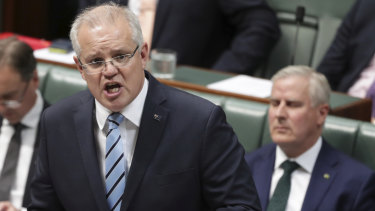
A leaked copy of a speech to Parliament to be delivered by Prime Minister Scott Morrison on the occasion of the December 2019 mid-year budget update ...*
Thank you, Mr Speaker, and thank you to my many colleagues gathered in this chamber to hear me speak today. But it is my fellow Australians – wherever you are watching this, from an inner-city living room or from our great outback – to whom I now address my remarks.
Prime Minister Scott Morrison ... telling it like it is.
We know that we are a great and vibrant nation. Despite our laid-back image, we know that we are a deeply passionate people. This passion often leads us to disagree, and when we do, we hold our debates out in the open – the way a free and passionate democratic nation should.
On no other issue have we been so politically divided in recent times as on climate change. Fifteen years ago, after a particularly long and hot summer, one of our greatest prime ministers convened a special taskforce to investigate the proper design of a scheme to put a price on carbon emissions.

Read the story from The Age by Jessica Irvine - “‘How good is this carbon tax!' Psst, PM's speech falls off the back of a truck.”

20 September, 2019

Global climate strike sees 'hundreds of thousands' of Australians rally across the country

Organisers estimate 300,000 Australians have gathered at climate change rallies around the country in one of the largest protest events in the nation's history.
In a large crowd of protester, someone holds a sign that reads "Not happy Jan".
Thousands gathered in Sydney's Domain.
The global day of action, led by Swedish teenage climate activist Greta Thunberg, is happening three days before the United Nations Climate Change Summit in New York.
Organisers say they expect millions of people to turn out worldwide in 150 countries.
In Australia, demonstrators took place in all eight capital cities as well as 104 other centres.

20 August, 2019

Athlete vs. heat - from The Washington Post

LOVELL CANYON, Nev. — It was 73 degrees and the early-morning sun was still rising over the Mojave Desert as nearly six dozen long-distance runners gathered at the start line and anxiously watched numbers tick down on the digital clock overhead.
Julie Bertoia, a 50-kilometer runner, descends into
 the lower part of the valley during the Running with
the Devil race in the Mojave Desert. 
“Make sure that you’re staying on top of your internal hydration and your external cooling,” the race organizer said into a microphone.
The runners shook their limbs loose and bobbed in place, eager for the start. The annual race is called Running with the Devil, and it takes place less than 30 miles from the glitzy air-conditioned casinos on the Strip in Las Vegas. The forecast called for an unseasonably cool day in the desert, but the racers — running a marathon, 50 kilometers, 50 miles or 100 kilometers — had assembled specifically for a physiological test in the heat.


Read the story from The Washington Post by Rick Maese - “Athlete vs. heat.”

13 March, 2019

Grown-Ups Get a Scolding on Climate

The girl in long braids and lavender pants was in striking contrast to the rich and powerful adults gathered in Davos in January for the World Economic Forum, and her brief address lacked the usual niceties. 
CreditCredit
Christine Rösch
“Adults keep saying, ‘We owe it to the young people to give them hope,’” she said. “But I don’t want your hope. I don’t want you to be hopeful. I want you to panic. I want you to feel the fear I feel every day. And then I want you to act.” 

The applause was tepid.

Hers was not a tone grown-ups welcome from a 16-year-old. But Greta Thunberg is someone they should listen to. In fact, must listen to.

Read the story from The New York Times by the Editorial Board - “Grown-Ups Get a Scolding on Climate.”

10 January, 2019

Don’t look away now, the climate crisis needs you.

A voice came over the intercom: would the passengers of Flight 3935, scheduled to depart Washington DC, for Charleston, South Carolina, kindly collect their carry-on luggage and get off the plane. They went down the stairs and gathered on the hot tarmac. There they saw something unusual: the wheels of the US Airways jet had sunk into the black pavement as if it were wet cement. The wheels were lodged so deep, in fact, that the truck that came to tow the plane away couldn’t pry it loose. The airline had hoped that without the added weight of the flight’s 35 passengers, the aircraft would be light enough to pull. It wasn’t. Someone posted a picture: “Why is my flight cancelled? Because DC is so damn hot that our plane sank four inches into the pavement.”
Naomi Klein published this book nearly five years
ago, but it is still remarkably relevant today.
Eventually, a larger, more powerful vehicle was brought in to tow the plane and this time it worked; the plane finally took off, three hours behind schedule. A spokesperson for the airline blamed the incident on “very unusual temperatures”.


Read the story from The Guardian by Naomi Klein - “Don’t look away now, the climate crisis needs you.

13 April, 2018

Victorian coal to keep lights on in Japan, says Turnbull

On one of Victoria’s hottest mid-April days on record, Australian and Japanese leaders gathered at the base of Loy Yang, the state’s biggest power plant, to launch a project to secure the long-term future of its vast brown coal reserves.
Malcolm Turnbull says brown coal might
one day keep the lights on in Japan.
If this $496 million pilot project to convert the Latrobe Valley’s brown coal into liquid hydrogen pays off, there is hope that a new export industry will be created that will fuel the valley’s coal-dependent economy for many decades to come.

Speaking at the launch of the project between Australia and Japan in the Latrobe Valley, Prime Minister Turnbull highlighted the government's agnostic position on energy, one of the main tenets of the National Energy Guarantee, which has been used to increase the role of coal in Australia's energy mix.


Read the story from The Age by Adam Carey and Cole Latimer - “Victorian coal to keep lights on in Japan, says Turnbull.”

25 March, 2018

Considering the totality of Australia's climate history

Australia’s climate history has been gathered by Dr Joëlle Gergis.
The outcome of the assembly, a book entitled “Sunburnt Country”, will be launched at the University of Melbourne on Thursday, April 5.
The book is result of the work of an award-winning climate scientist and writer from the University of Melbourne, Dr Gergis. 
Sunburnt Country is the story of the quest to piece together Australia’s climate history for the first time. It starts in the summer of 1787 and journeys through previously unknown floods, bushfires, droughts and cyclones that shaped our nation, taking us beyond the well-known 20th century weather events that define our ‘on record’ understanding of Australian climate. By using a range of historical and scientific records spanning back hundreds of years before official weather records began, we gain an unparalleled perspective on Australia’s natural climate cycles.

This ground-breaking story journeys deep into our natural and cultural history exploring how past generations of Australians responded to climate extremes. We’ll ask: What’s the difference between natural variability and climate change? How did Aboriginal people and the first European explorers deal with our extreme climate? How do scientists get information about past climate from ancient corals, tree-rings and ice core records? Do human activities really have the power to alter natural cycles that have been with us for millions of years? If so, what does climate change in our own backyard actually look like?

Using evidence that has never been brought together before, we can clearly see how our warming planet is sending Australia’s natural climate variability into overdrive. Sunburnt Country provides powerful insight into what’s at stake for Australian lifestyles and ecosystems as the planet continues to warm. We are now witnessing a pivotal moment in human history that represents the end of an era for polluting fossil fuels and the dawn of the clean energy revolution. If we choose to face reality and restore care for the planet that sustains us, we can protect humanity from an apocalyptic future. We are now living in the age of consequences where the actions of every single person on the planet have the power to shape future life on Earth.


Dr Joëlle Gergis .
Biography: Dr Joëlle Gergis is an award-winning climate scientist and writer from the University of Melbourne. She has held two Australian Research Council fellowships as an internationally recognised expert in Australian and Southern Hemisphere climate variability and change. Over the past 20 years Joëlle has worked as a researcher, teacher and communication professional to bring the wonders of the natural world alive for others. Her goal is to help people connect the head with the heart when thinking about climate change. Sunburnt Country is her first book and is based on the research project she led that won the 2014 Eureka Prize for Excellence in Interdisciplinary Research.

30 November, 2017

The Cost of Saving the World


This week, diplomats are gathered in Bonn, Germany to hammer out the latest details of the 2015 Paris Climate Agreement. While the minutiae of the negotiations are important, the real action isn’t at the UN. The climate pact is bottom up, which means it’s up to each country to meet the goals set forth in Paris.

One of the simplest tools for making progress would be a tax on carbon. Few people like taxes in the abstract, but they help address a real, pressing problem. A carbon tax would bring the price of fossil fuels closer to its true cost to the climate and to public health.

Earlier this year, Nobel prize-winning economist Joseph Stiglitz and former World Bank chief economist Nicholas Stern said that in order to rein in destructive carbon pollution, countries should implement a tax on carbon of $40 per ton by 2020 that would rise to as much as $100 per ton over the following decade.


Read the NexusMedia story - “The Cost of Saving the World.”

17 November, 2013

Many gather in Shepparton for National Day of Climate Action.


The crown that gathered at Shepparton's
 Victoria Park Lake for the 'National Day of
 Climate Action' organized by GetUp!
More than 100 people gathered at Shepparton’s Victoria Park Lake today (April 17) to be a part of the “National Day of Climate Action”.

A petition from the event signed by nearly 120 people will be delivered to the office of the Federal Member for Murray, Sharman Stone tomorrow at 11:00am.

Using John Pettigrew’s utility as a podium, speakers stood at a lectern made from a workshop vice stand bringing a sense of formality to what was Shepparton’s role in GetUps! national event.

John introduced the principal organizer of Sunday’s Shepparton gathering, Nickee Freeman, who expressed delight at the number who turned up express their demand for more action on climate change.

Nickee was eager that the enthusiasm present at the lake should not dissipate and urged all those who attended to talk with others there about the reasons for joining the rally and what they could do to ensure enthusiasm illustrated at the lake maintained its vibrancy.

Others speakers included Victoria’s Sustainability Commissioner, Professor Kate Auty, who was also the master of ceremonies and who talked about leadership saying that all who attended had displayed leadership simply by turning up.

Indigenous people and the Yorta Yorta nation were represented by Aunty Rochelle Patten and Lee Joachim; Caitlin Bigbnold, of Kyabram, brought the views of a 15-year-old; local activist, environmentalist and long-standing member of the Goulburn Valley Environment Group and former board member with Goulburn Broken Catchment Management Authority, Nick Roberts, discussed solar opportunities in the area; Undera farmer and foundation board member of GV Community Energy, Ian Christoe, discussed the difficulties climate change was creating for farmers; and former Shepparton News editor, Robert McLean, about the threat climate change would bring for his grandsons.

All at the rally walked around the lake, carrying their banners declaring the need to action on climate change and at the encouragement of Nickee, occasionally chanting about the urgent need for action from our Federal Government.

Brigette Meneghetti brought an especially beautiful and light touch to the rally with her singing and guitar playing.

Nathalia artist, Bill Kelly, had been invited to speak at the rally, but being unable to attend he condensed the essence what he would have said into one sentence –

 
“If we truly love others and if we truly love our children and grandchildren we will work to give them a world which is beautiful, healthy and in which their voices and laughter are part of the poetry of the earth”.