Showing posts with label Japan. Show all posts

06 July, 2019

Japan’s clean energy quest could fuel Australia's hydrogen export industry

The world energy authority says Australian hydrogen imports into Japan could be cheaper than domestic production by 2030, in a positive signal of the lucrative export potential offered by the clean fuel source.
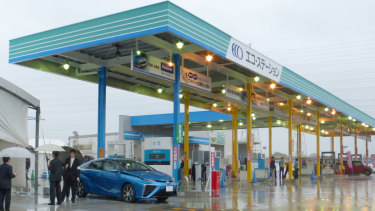
A hydrogen station for fuel-cell vehicles in Japan. The country is prioritising the development of a hydrogen-based economy.
A hydrogen station for fuel-cell vehicles in Japan. The country
is prioritising the development of a hydrogen-based economy.
The Council of Australian Governments this week released a consultation paper on the national hydrogen strategy being developed by Chief Scientist Alan Finkel, in another step towards developing a long-mooted multi-billion dollar hydrogen export industry.

Read the story from The Age by Nicole Hasham - “Japan’s clean energy quest could fuel Australia's hydrogen export industry.”

26 February, 2019

Paris? We’ll always have Kyoto.

When the Kyoto Protocol on climate change was being negotiated in Japan in December 1997, I was living in Tokyo. It was probably the most important international summit Japan had hosted, and the local media was giving it saturation coverage, right down to Australia’s discordant contributions.
Carrying on carrying over: Kyoto-era prime minister
John Howard with PM Scott Morrison at 
the opening
 of the UNSW Howard Library at Old Parliament House

in December.
Five years earlier, the signing of the UN Framework Convention on Climate Change had recognised the growing scientific consensus that anthropogenic global warming was occurring, that it would pose an increasing threat, and that coordinated action was needed to reduce greenhouse gas emissions. The aim of the Kyoto meeting was to move from a shared aims to a means of achieving it, to agree on binding commitments to reduce emissions.

The delegates gathered in Kyoto acknowledged that different countries were at different stages of economic development. Because Western countries had a 200-year head start in the industrialisation stakes, they would need to take the lead in reducing emissions, with developing countries, including China and India, joining at a future date.


Read the InsideStory by Rodney Tiffen - “Paris? We’ll always have Kyoto.

31 July, 2018

Droughts, Heat Waves and Floods: How to Tell When Climate Change Is to Blame

The Northern Hemisphere is sweating through another unusually hot summer. Japan has declared its record temperatures a natural disaster. Europe is baking under prolonged heat, with destructive wildfires in Greece and, unusually, the Arctic. And drought-fuelled wildfires are spreading in the western United States.
The dried up bed of Yarrow Reservoir near Bolton, England,
 on July 23, 2018, during a weeks-long heatwave across the U.K.
For Friederike Otto, a climate modeller at the University of Oxford, UK, the past week has been a frenzy, as journalists clamoured for her views on climate change’s role in the summer heat. “It’s been mad,” she says. The usual scientific response is that severe heatwaves will become more frequent because of global warming. But Otto and her colleagues wanted to answer a more particular question: how had climate change influenced this specific heatwave? After three days’ work with computer models, they announced on 27 July that their preliminary analysis for northern Europe suggests that climate change made the heatwave more than twice as likely to occur in many places.


Read the Scientific American story by Quirin Schiermeier -  “Droughts, Heat Waves and Floods: How to Tell When Climate Change Is to Blame.”

06 May, 2017

Over 9.4 million people employed in the renewable energy sector

More than 9.4 million people across the world are now employed in the renewable energy sector, according to a recent whitepaper published by Allen & York, a leading technical recruitment consultancy. 
Millions are employed in the renewable energy sector.
The report, “Recruitment and career opportunities within the UK, European and global renewable and clean energy markets”, details that over 9.4 million people now work in renewable energy, including 2.8 million in solar photovoltaics (PV) and 1 million in the wind sector.

According to the data, China, Brazil, the U.S., India, Japan and Germany ranked highest for the number of renewable energy jobs.

China continues to lead the world in renewable employment, with more than with 3.5 million people employed in the sector. 

Last year, China contributed to more than a third of the global renewable energy capacity.


17 March, 2017

The great gas robbery is happening before our eyes. But what can we do about it?

Cheap gas for domestic consumers
has disappeared.
It's the great gas robbery. And it's right before us in our utility bills.

When you next look in horror at your gas bill, think this: you are the unwitting victim of a gigantic game of risk shifting by the multinationals.

These companies have played the domestic customer on a break, because they saw something we didn't see two years ago.

And it's resulted in gas that was once destined for our heaters, cookers and manufacturing plants being sucked north to Gladstone where it is liquefied and sent to Japan, South Korea and China.


26 June, 2016

Record rains force evacuation of 700,000 in Japan and brings flash floods to West Virginia

An image showing the huge
storm over Kyushu.
In Kyushu, Japan on Friday, government officials urged 700,000 residents to evacuate as record heavy rains and severe flooding inundated the city for the fifth day in a row. Half a world away in West Virginia, another unpredicted record deluge dumped 8.2 inches of rain, washed out roads, cut off shopping malls, flushed burning homes down raging rivers, and left more than 14 people dead and hundreds more stranded.

Individually, these events would be odd. But taken together with what are now scores of other extreme flooding events happening around the world in the space of just a few months and the context begins to look a lot like what scientists expected to happen due to human-forced climate change.

In Kyushu, the skies opened up on Monday. An extension of a seasonal front draped across China and feeding on moisture bleeding off of record hot ocean surfaces edged out over Japan. Mountainous cloud banks unloaded. Record rains in the range of five inches an hour then began to inundate the southern Japanese island. This mass dumping of water eventually accumulated to half a meter (or 1.6 feet) over some sections of the island over the course of just one 24 hour period.

12 April, 2016

Gas industry leaders persist in promoting a fallacy

The gas industry is arguing that its product
is "critical and central
 to the decarbonisation of the world.
leaders have declared the fuel is essential to meeting emissions reductions targets and improving security of supply as they seek to turn around slowing demand growth that is contributing to some of the weakest prices for years in the LNG export market.

Origin Energy chief executive Grant King said gas was "absolutely critical and central to the decarbonisation of the world in the next 50 years", and said those turning their back entirely on fossil fuels were putting supply security at risk.

Gas stepped into the breach after the Fukushima nuclear disaster in Japan and is now saving Tasmania from energy shortages after the breakdown of the Basslink power cable, Mr King said ahead of the LNG18 conference in Perth.

Read the story in today’s Melbourne Age - “Gas industry leaders go into battle for LNG.”

(Of course, the gas industry leaders would be claiming their product was "absolutely critical and central to the decarbonisation of the world in the next 50 years", but gas is still a fossil fuel, like coal and all the other energy sources arising from fossil fuels, it emits carbon dioxide, and allows for the maintenance of a life-style which is contrary to a way of living that we will have to arrive at if we are to avoid catastrophic climate change.

By law, the first and largely only responsibility those gas industry leaders have is to the financial wellbeing (profit) of their company and the idea that they might actively pursue the health and welfare of the planet ahead of those perverse, confusing commercial realities is nigh on impossible – Robert McLean.)

21 September, 2015

Heat records tumble as days pass - 2015 the hottest yet?


A

nother day, another smashed temperature record.

Earlier this week, a trio of independent analyses by scientists in the UK, Japan, and the US found that global temperatures over the summer were among the highest on record.

Wednesday, US scientists announced that sea ice extent in the Arctic shrunk to its fourth-lowest minimum ever this summer.

And Thursday, the National Oceanic and Atmospheric Administration, scientists joined the chorus with a report that found that last month was the hottest August ever recorded, and that 2015 is on pace to be the hottest year on record.

Read the MotherJones story - “2015 Will Probably Be the Hottest Year on Record”.

04 July, 2015

Solar Impulse 2 flies around-the-world powered by the sun and makes history


T

he Solar Impulse 2 aircraft has completed a historic flight in its quest to circle the globe without consuming a drop of fuel, touching down gracefully in Hawaii after the most arduous leg of its journey.

Solar Impulse 2 -
around-the-world
powered by just the sun.
The sun-powered plane, piloted by veteran Swiss aviator Andre Borschberg, took 118 hours — about five days — to make the voyage from Japan to Hawaii and landed shortly after dawn at Kalaeloa Airport on the main Hawaiian island of Oahu.

"Just landed in #Hawaii with @solarimpulse! For @bertrandpiccard and I, it's a dream coming true," Mr Borschberg tweeted triumphantly after completing the most perilous part of the around-the-world odyssey.

Mr Borschberg and Bertrand Piccard have been alternating the long solo flights and Japan to Hawaii — where it was Borschberg in sole control — was the eighth of 13 legs

24 May, 2015

Some, it seems, give and some, it appears, take away


A

ustralia’s politicians it seems have dedicated themselves to spending less on overseas aid, while Japan appears to have taken a quite different approach.

Japan's Shinzo Abe - his country has
 responded with nearly $600 million
 to help Pacific island
nations combat climate change.
The ABC reports: “Japanese Prime Minister Shinzo Abe has pledged $578 million in aid to Pacific island nations to help them combat climate change and natural disasters.

“Mr Abe made the pledge as leaders of 14 Pacific island nations gathered for a two-day meeting, which began on Friday in Iwaki, Fukushima prefecture, to discuss their development needs.

"As a pledge of the Japanese government, we will provide no less than 55 billion yen ($578 million) to you in the upcoming three years ... in order to foster resilient capabilities that will not be defeated by climate change or disasters," he told the meeting.”

Further the ABC reports that, “The seventh round of Pacific Islands Leaders Meeting (PALM) came as host Japan attempts to boost its profile in the Pacific, at a time of growing Chinese economic and political influence in the region.

“The meeting, held every three years, was also attended by senior officials from Australia, New Zealand and the United States,” is says in a story.

16 March, 2015

Vanuatu 'monster' was climate change - president


A “monster” that hit Vanuatu has been attributed to climate change.

Vanuatu's President Baldwin Lonsdale -
it's climate change.
The island nation’s President Baldwin Lonsdale, has described the category five cyclone Pam as ‘a monster that has hit Vanuatu’, wiping out development.

Speaking after Cyclone Pam ripped through his nation, President Lonsdale said climate change was contributing to more extreme weather conditions and cyclone seasons.

President Lonsdale told a United Nations world conference in Sendai, Japan, on Monday, that the storm was a major setback for the people, virtually wiping out Vanuatu’s development.

A story in The Guardian headed: “Cyclone Pam: Vanuatu's president blames climate change for extreme weather” told of the storm.

09 January, 2015

Our embrace of everything economic explains climate change


Society’s fascination with and consuming embrace of everything economic explains much about why the world is wrestling with the persecutions of climate change.

A story in The Guardian headed: “Civil society urges politicians to transform the finance system” explains how a manifesto backed by 11 organisations has called on the government to create a finance system that serves society, the environment and the wider economy.

Among other things, the manifesto demands more sustainability through the expansion of the Green Investment Bank into a broader state investor akin to those in other developed countries such as Germany, France and Japan.

“Changing the financial system isn’t just about avoiding another crash. We need to fundamentally rethink the purpose of our financial system to ensure that it delivers what we need for society, the environment and the wider economy. Civil society is leading the way,” the story says.

23 November, 2014

Rhetorical comfort, but distinct lack of action by Australia


Australia continues to find comfort in rhetoric about climate change, while many countries have stepped forward and are acting.

China and the U.S. have promised action to mitigate difficulties the world is facing because of climate change, Japan has announced it will contribute $US1.5 billion to an international climate green fund, Canadian Prime Minister Stephen Harper has also back-pedalled to say Canada would provide a donation and UK Prime Minister David Cameron said money has already been set aside, and now France is acting to assist Pacific Nations troubled by difficulties arising from climate change.

The ABC reported today on the decision by France in a story headed: “French president Francois Hollande launches funding for Pacific nations hit by climate change”.

21 November, 2013

Australia and Japan taking us off track in climate struggle


Australia and Japan have been credited with playing a significant role in taking global efforts to combat climate change off track.


The Reuters story argued that negatives behaviour in both Australia and Japan offset the positive outcomes in both the U.S. and China.

Climate Action Tracker had found, the story said, that the world was headed for a temperature rise this century of nearly four degrees compared to an earlier prediction of just over three degrees, if governments stuck to promised greenhouse gas emissions.